
BuddhistCatholicContemplativeEvangelicalGeneral ChristianHinduJewishLatter-day SaintMuslimNew VisionsProgressive Christian
Beliefs
- Buddhist
- Catholic
- Contemplative
- Evangelical
- General Christian
- Hindu
- Jewish
- Latter-day Saint
- More Voices
- Muslim
- New Visions
- Pagan
- Progressive Christian
Topics
- Religion News
- Food and Religion
- Sports and Religion
- Religious Art
- Religious Music and Entertainment
- Religious Events
- History and Religion
- Style and Religion
- Politics and Religion
- Women in Religion
- Recreation Outdoors and Religion
- Business Finance and Religion
- Careers Workplace and Religion
- Education and Religion
- Family Parenting and Religion
- Health Fitness and Religion
- Home and Religion
- Relationships and Religion
- Technology and Religion
- Travel and Religion
Columnists
- Buddhist Columnists
- Business Finance and Religion Columnists
- Careers Workplace and Religion Columnists
- Catholic Columnists
- Contemplative Columnists
- Education and Religion Columnists
- Evangelists Columnists
- Family Parenting and Religion Columnists
- General Christian Columnists
- Health Fitness and Religion Columnists
- Hindu Columnists
- History and Religion Columnists
- Home and Religion Columnists
- Jewish Columnists
- More Voices Columnists
- Latter Day Columnists
- Muslim Columnists
- New Visions Columnists
- Nonreligious Columnists
- Pagan Columnists
- Politics and Religion Columnists
- Progressive Columnists
- Recreation Outdoors and Religion Columnists
- Relationships and Religion Columnists
- Religion News Columnists
- Religious Art Columnists
- Religious Events Columnists
- Religious Music and Entertainment Columnists
- Sports and Religion Columnists
- Style and Religion Columnists
- Technology and Religion Columnists
- Travel and Religion Columnists
- Women in Religion Columnists
Resource Library
- 2026 Calendar
- Library of World Religions
- The 100 Most Holy Places on Earth
- Patheos Answers
- Podcasts
- Videos
- Faith Leaders Database
- Anglican Episcopalian
- Bahai
- Baptist
- Buddhism
- Christianity
- Confucianism
- Eastern Orthodoxy
- Hinduism
- Holiness and Pentecostal
- ISKCON
- Islam
- Judaism
- Lutheran
- Methodist
- The Church of Jesus Christ of Latter-day Saints
- New Age
- Paganism
- Presbytarian and Reformed
- Protestantism
- Religion Behind the Scenes
- Roman Catholic
- Scientology
- Shia Islam
- Sikhism
- Sufism
- Sunni Islam
- Taoism
- Zen
- See all religions
Research Tools
 Ad-Free & Subscriber Log-In Subscription Support
Ad-Free & Subscriber Log-In Subscription Support
Follow Patheos 

- Trending:
- Forgiveness
- |
- Marriage
- |
- Consciousness
- |
- Death Penalty
- |
- Election
- |
- Halloween

- Home
- Evangelical
- On the Third Day After Christmas, Make Room in Your Hearts for Jesus—and Animals.
On the Third Day After Christmas, Make Room in Your Hearts for Jesus—and Animals.
Last updated on: December 28, 2018 at 6:21 pm by Paul Louis Metzger
On the Third Day After Christmas, Make Room in Your Hearts for Jesus—and Animals. 2018-12-28T18:21:44-08:00 Paul Louis Metzger
Patheos Explore the world's faith through different perspectives on religion and spirituality! Patheos has the views of the prevalent religions and spiritualities of the world.
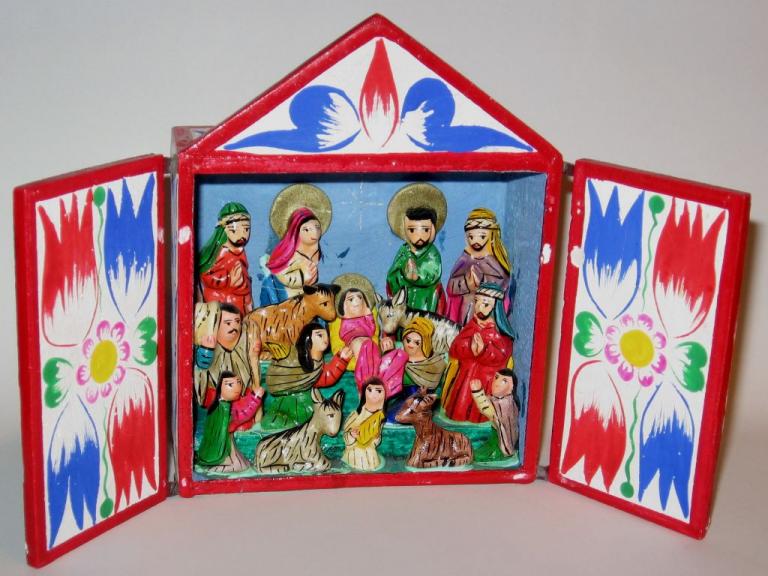
Mexican Nativity Scene; H. Raab (User: Vesta) Creative Commons

What did Jesus’ mother do with Jesus three days after he was born? That would have been December 28th, if Jesus had been born on December 25th. According to one ancient source, Jesus’ mother took Jesus out of the cave where he was born and placed him in a stable where animals like oxen and donkeys resided. Maybe it was an ancient version of a petting zoo.
Now, let’s pause for a moment. Is that account of farm animals being present biblical or apocryphal? For some of us, our first response might be to look not in the Bible, but under the Christmas tree.
Many of us grew up with nativity sets on display under the Christmas tree at home. In addition to Mary, Joseph and Jesus who’s lying in a manger, there were shepherds and sheep, and quite possibly oxen and donkeys. And yet, apart from mention of shepherds watching over their flock at night out in the field when an angel appears to them to announce Jesus’ birth (Luke 2:8-9), there is no explicit mention of animals in the birth narratives of the canonical gospels. In fact, there is no indication that the shepherds took sheep with them when they traveled to Bethlehem to see the Christ child (Luke 2:15-16). Given that they set out in a speedy manner, it is quite doubtful that they brought sheep along for the ride (or rather, walk). Here’s the full account:
And in the same region there were shepherds out in the field, keeping watch over their flock by night. And an angel of the Lord appeared to them, and the glory of the Lord shone around them, and they were filled with great fear. And the angel said to them, “Fear not, for behold, I bring you good news of great joy that will be for all the people. For unto you is born this day in the city of David a Savior, who is Christ the Lord. And this will be a sign for you: you will find a baby wrapped in swaddling cloths and lying in a manger.” And suddenly there was with the angel a multitude of the heavenly host praising God and saying,
“Glory to God in the highest,
and on earth peace among those with whom he is pleased!”When the angels went away from them into heaven, the shepherds said to one another, “Let us go over to Bethlehem and see this thing that has happened, which the Lord has made known to us.” And they went with haste and found Mary and Joseph, and the baby lying in a manger. And when they saw it, they made known the saying that had been told them concerning this child. And all who heard it wondered at what the shepherds told them. But Mary treasured up all these things, pondering them in her heart. And the shepherds returned, glorifying and praising God for all they had heard and seen, as it had been told them (Luke 2:8-21; ESV).
Back in 2012, Pope Benedict sought to set the record straight about the nativity scene in which animals are at the manger in his book Jesus of Nazareth: The Infancy Narratives. According to one article on Pope Benedict’s perspective,
“In the gospels there is no mention of animals,” the pope states. He says references to the ox and the donkey in other parts of the Bible may have inspired Christians to include them in their nativity scenes.
The Pope’s pronouncement won’t keep many or any of us from putting various farm animals on display in our nativity sets. In fact, the same article noted that
The Vatican itself has included animals in the nativity scenes it sets up each year in St Peter’s Square, and Benedict concedes that the tradition is here to stay. “No nativity scene will give up its ox and donkey,” he says.
While the article claims that “Ox and donkey are latter-day additions to nativity scene,” actually there is at least one ancient apocryphal source that mentions them. Chapter 14 of The Gospel of Pseudo-Matthew reads,
And on the third day after the birth of our Lord Jesus Christ, the most blessed Mary went forth out of the cave, and entering a stable, placed the child in the stall, and the ox and the ass adored Him. Then was fulfilled that which was said by Isaiah the prophet, saying: The ox knows his owner, and the ass his master’s crib (Isaiah 1:3). The very animals, therefore, the ox and the ass, having Him in their midst, incessantly adored Him. Then was fulfilled that which was said by Abacuc the prophet, saying: Between two animals you are made manifest. In the same place Joseph remained with Mary three days.
So, it is not simply my favorite Christmas carol “What Child Is This?” that mentions farm animals at the nativity. At least one apocryphal writing does as well. By the way, do you remember those melodious lines from that famous Christmas carol?
Why lies He in such mean estate, Where ox and ass are feeding?
Jesus did indeed lie “in such mean estate,” such a humble abode. Many of us would concur that this claim is biblical. But whether there were animals like oxen and donkeys present, we have no idea. All we have is the power of suggestion based on Jesus lying in a manger on which animals’ food would be placed.
In the end, no matter if we view the presence of animals by Jesus’ manger as biblical or apocryphal, explicit or implicit, or simply deeply speculative, we should come to terms with the reality that animals have a special place in God’s heart. After all, through Jesus, God created all things. And just perhaps, Jesus has a special place in animals’ hearts, namely, that they “incessantly adored him,” as The Gospel of Pseudo-Matthew proposed.
While it is important to note that there is no explicit mention of animals like oxen and donkeys at the original manger where Jesus was laid, we can continue to make a place for them in our nativity sets. Even more importantly, let’s make a special place for them in our hearts—as well as all other animals entrusted to our care as God’s stewards here on earth. Let’s make a special place for animals in our hearts, not just on the third day after Christmas, but every day of the year.
Previous Post

December 28, 2018
Who Pays Most for the Government Shutdown?
Next Post
January 2, 2019 First Impressions for the New Year: Overcoming Depression with MLK
Browse Our Archives
Select a Category Uncategorized
Select a Month June 2025 April 2025 March 2025 January 2025 December 2024 November 2024 October 2024 September 2024 August 2024 July 2024 June 2024 May 2024 April 2024 March 2024 February 2024 January 2024 December 2023 November 2023 October 2023 September 2023 August 2023 July 2023 June 2023 May 2023 April 2023 March 2023 February 2023 January 2023 December 2022 November 2022 October 2022 September 2022 August 2022 July 2022 June 2022 May 2022 April 2022 March 2022 February 2022 January 2022 December 2021 November 2021 October 2021 September 2021 August 2021 July 2021 June 2021 May 2021 April 2021 March 2021 February 2021 January 2021 December 2020 November 2020 October 2020 September 2020 August 2020 July 2020 June 2020 May 2020 April 2020 March 2020 February 2020 January 2020 December 2019 November 2019 October 2019 September 2019 August 2019 July 2019 June 2019 May 2019 April 2019 March 2019 February 2019 January 2019 December 2018 November 2018 October 2018 September 2018 August 2018 July 2018 June 2018 May 2018 April 2018 March 2018 February 2018 January 2018 December 2017 November 2017 October 2017 September 2017 August 2017 July 2017 June 2017 May 2017 April 2017 March 2017 February 2017 January 2017 December 2016 November 2016 October 2016 September 2016 August 2016 July 2016 June 2016 May 2016 April 2016 March 2016 February 2016 January 2016 December 2015 November 2015 October 2015 September 2015 August 2015 July 2015 June 2015 May 2015 April 2015 March 2015 February 2015 January 2015 December 2014 November 2014 October 2014 September 2014 August 2014 July 2014 June 2014 May 2014 April 2014 March 2014 February 2014 January 2014 December 2013 November 2013 October 2013 September 2013 August 2013 July 2013 June 2013 May 2013 April 2013 March 2013 February 2013 January 2013 December 2012 November 2012 October 2012 September 2012 August 2012 July 2012 June 2012 May 2012 April 2012 March 2012 February 2012
Follow Us!
TAKE THE
Religious Wisdom Quiz
What book comes directly after Lamentations?
Select your answer to see how you score.
Jeremiah Daniel Hosea Ezekiel
Books by This Author Books by Paul Louis Metzger
Related posts from Uncommon God, Common Good

Heavenly Father’s Day on Trinity Sunday

Easter Triduum: Obey Your Thirst—for God

Holy Week Is Humble Week: "Beware of Becoming...

Excavating the Person in a Throwaway Culture
TRENDING AT PATHEOS Evangelical

The REST of Your Life: A Creative Wrestles...
This week I had a conversation with a good friend from church....

How the author of the world's best hymn...
I've been working with John Newton for a while now. This makes...

Long before this Lectio Divina, Psalm 130 - the song - started...

What About the Trees? Another Living Parable
After I finished writing the last article about falling leaves as a...

Why Classical Education Is a Conversation, Not a...
Come and Read: Joy in Classical Education When I was a little...

Cornell University has received a great deal of negative publicity and intense...
view all Evangelical blogs
Ad-Free & Subscriber Log-In Subscription Support
- About Us
- 2026 Calendar
- Videos
- Podcasts
- Library of World Religions
- Faith In Media Tracker
- Advertise With Us
- Write for Us
- Privacy Policy
- Terms of Service
- Do Not Sell My Data
- Contact Us
- Radiant Digital
- Manage Newsletter Subscriptions
- Unsubscribe From Notifications
- Sitemap
Copyright 2008-2026, Patheos. All rights reserved.
Subscription Support Ad-Free & Subscriber Log-In
Follow Patheos