
BuddhistCatholicContemplativeEvangelicalGeneral ChristianHinduJewishLatter-day SaintMuslimNew VisionsProgressive Christian
Beliefs
- Buddhist
- Catholic
- Contemplative
- Evangelical
- General Christian
- Hindu
- Jewish
- Latter-day Saint
- More Voices
- Muslim
- New Visions
- Pagan
- Progressive Christian
Topics
- Religion News
- Food and Religion
- Sports and Religion
- Religious Art
- Religious Music and Entertainment
- Religious Events
- History and Religion
- Style and Religion
- Politics and Religion
- Women in Religion
- Recreation Outdoors and Religion
- Business Finance and Religion
- Careers Workplace and Religion
- Education and Religion
- Family Parenting and Religion
- Health Fitness and Religion
- Home and Religion
- Relationships and Religion
- Technology and Religion
- Travel and Religion
Columnists
- Buddhist Columnists
- Business Finance and Religion Columnists
- Careers Workplace and Religion Columnists
- Catholic Columnists
- Contemplative Columnists
- Education and Religion Columnists
- Evangelists Columnists
- Family Parenting and Religion Columnists
- General Christian Columnists
- Health Fitness and Religion Columnists
- Hindu Columnists
- History and Religion Columnists
- Home and Religion Columnists
- Jewish Columnists
- More Voices Columnists
- Latter Day Columnists
- Muslim Columnists
- New Visions Columnists
- Nonreligious Columnists
- Pagan Columnists
- Politics and Religion Columnists
- Progressive Columnists
- Recreation Outdoors and Religion Columnists
- Relationships and Religion Columnists
- Religion News Columnists
- Religious Art Columnists
- Religious Events Columnists
- Religious Music and Entertainment Columnists
- Sports and Religion Columnists
- Style and Religion Columnists
- Technology and Religion Columnists
- Travel and Religion Columnists
- Women in Religion Columnists
Resource Library
- 2026 Calendar
- Library of World Religions
- The 100 Most Holy Places on Earth
- Patheos Answers
- Podcasts
- Videos
- Faith Leaders Database
- Anglican Episcopalian
- Bahai
- Baptist
- Buddhism
- Christianity
- Confucianism
- Eastern Orthodoxy
- Hinduism
- Holiness and Pentecostal
- ISKCON
- Islam
- Judaism
- Lutheran
- Methodist
- The Church of Jesus Christ of Latter-day Saints
- New Age
- Paganism
- Presbytarian and Reformed
- Protestantism
- Religion Behind the Scenes
- Roman Catholic
- Scientology
- Shia Islam
- Sikhism
- Sufism
- Sunni Islam
- Taoism
- Zen
- See all religions
Research Tools
 Ad-Free & Subscriber Log-In Subscription Support
Ad-Free & Subscriber Log-In Subscription Support
Follow Patheos 

- Trending:
- Forgiveness
- |
- Marriage
- |
- Consciousness
- |
- Death Penalty
- |
- Election
- |
- Halloween

- Home
- Evangelical
- Jesus’ Birth Defines Divine Meekness — Strength Under Control
Jesus’ Birth Defines Divine Meekness — Strength Under Control
Last updated on: December 18, 2018 at 5:20 pm by Paul Louis Metzger
Jesus’ Birth Defines Divine Meekness — Strength Under Control 2018-12-18T17:20:05-08:00 Paul Louis Metzger
Patheos Explore the world's faith through different perspectives on religion and spirituality! Patheos has the views of the prevalent religions and spiritualities of the world.
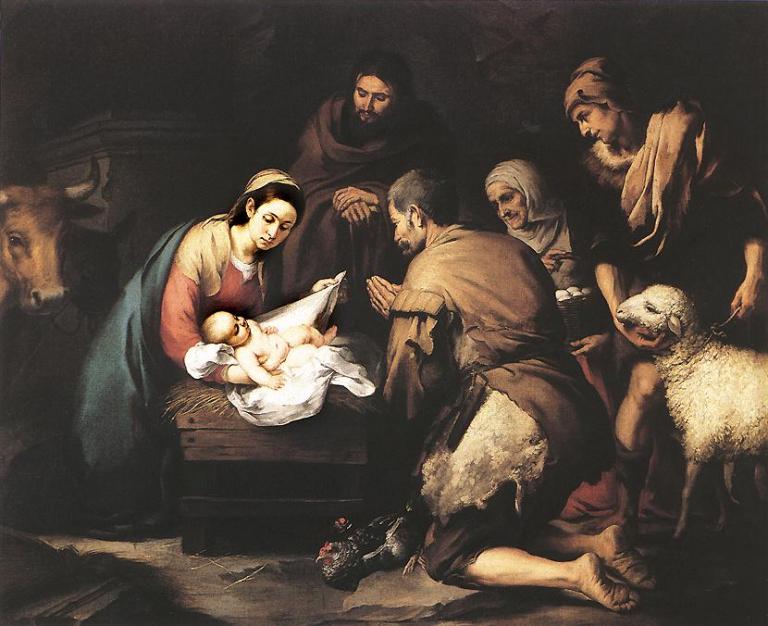
Vartolome Esteban Perez Murillo, “Adoration of the Shepherds,” c. 1650. Creative Commons

Jesus declared, “Blessed are the meek, for they shall inherit the earth” (Matthew 5:5; ESV). Sometimes statements like this beatitude in the Bible are so familiar to us that we no longer take to heart their meaning. Beatitudes easily become platitudes. We must come to terms with the fact that this declaration on meekness was as foreign in Jesus’ day as it is in our own. All too often, people manifest strength out of control with bravado and gusto. In contrast, Jesus’ birth—indeed his entire life—defines and exemplifies divine meekness. Here we find divine power, which is gentle, strength under control.
God takes every ounce of divine strength and energy and wraps it around Jesus lying in a manger. Here’s Luke’s account of events surrounding Jesus’ birth:
And in the same region there were shepherds out in the field, keeping watch over their flock by night. And an angel of the Lord appeared to them, and the glory of the Lord shone around them, and they were filled with great fear. And the angel said to them, “Fear not, for behold, I bring you good news of great joy that will be for all the people. For unto you is born this day in the city of David a Savior, who is Christ the Lord. And this will be a sign for you: you will find a baby wrapped in swaddling cloths and lying in a manger.” And suddenly there was with the angel a multitude of the heavenly host praising God and saying, “Glory to God in the highest, and on earth peace among those with whom he is pleased!” (Luke 2:8-14; ESV).
How startling these words from Matthew 5 and Luke 2 should ever remain to us! Whereas the Pax Romana (peace of Rome) used violence to bring peace to the ancient world, the Pax Christi (peace of Christ) has always employed gentleness from the cradle to the cross to ‘enforce’ peace.
Speaking of violence and gentleness, we could use a whole lot more meekness as we approach the 12 days of Christmas. Just think for a moment about “10 days, 4 hate crimes: The parallel paths of 4 angry men who terrorized America” days before the midterm elections. Just think about the road rage that we witness on American highways and bi-ways. Just think about those incidents where people push and shove to get that last Christmas sale item on Black Friday or one step ahead in the checkout line (Refer here and here). Just think about the violence and hostility in our own hearts…
Let’s do more than just think about the divine meekness that Jesus demonstrates in his birth, indeed, in his entire life. Let’s act on it by constraining and employing our own strength, gently placing it under control. Frederick Dale Bruner reflects upon the quality of meekness on display in Jesus and how it bears upon Jesus’ community of disciples today:
Jesus himself is the best definition of meekness, particularly at his trial (Matt 26–27). We do not exactly see weakness there, but we do not see many claims there either, and not a great deal of aggression. The overall impression of Jesus on trial is an impression of poise. It is the poise of not having to assert oneself. It is the poise, if I may put it this way, of a believer. There is a meekness that is almighty and a gentleness that is strong. In a world threatened by terrorist holocaust macro-cosmically and by the destruction of the family microcosmically, the great need of the age may be this Beatitude’s gentle-men and gentle-women. The Third Beatitude’s little people may well be the hope of the earth, though the rest of the world tells us that the real hope of the earth is the big people and the earth shakers.[1]
May we be this beatitude’s gentle-men and gentle-women. They reflect Jesus’ heart and life and will inherit the earth (Matthew 5:5).
By no means a platitude, like the other beatitudes recorded in Matthew 5, meekness is intended to be lived out, not simply thought about. As I have written elsewhere,
Far from being overused, no longer interesting and meaningful, the Beatitudes are underused. They are not Nietzschean dead metaphors or well-worn, outgrown ethical platitudes. Often, the Beatitudes are not accounted for and applied because they are found to be all-too striking, mind-blowing, and hard. It reminds me of G. K. Chesterton’s claim: “The Christian ideal has not been tried and found wanting. It has been found difficult; and left untried.’[2] If only we would dare try them on for size!”[3]
Yes, may we try Jesus on for size and wrap ourselves in meekness, just as God’s power was wrapped in gentleness, lying in a manger.
For more on my work on the Beatitudes, see my recent book Beatitudes, Not Platitudes: Jesus’ Invitation to the Good Life, and you can see some interviews I did about the book here and here.
_______________
[1]Frederick Dale Bruner, Matthew: A Commentary. Vol 1: The Christbook, Matthew 1–12. Rev. and exp. ed. (Grand Rapids: Eerdmans, 2004), page 161.
[2]G. K. Chesterton, What’s Wrong with the World, Reprint. (San Francisco: Ignatius, 1994), page 37.
[3]Paul Louis Metzger, Beatitudes, Not Platitudes: Jesus’ Invitation to the Good Life (Eugene: Cascade Books, 2018), pages 1-2.
Previous Post

December 13, 2018
God Has Wired Humanity to Exist as Storied Creatures.
Next Post
December 21, 2018 Bush, Mattis and the Importance of Coalitions
Browse Our Archives
Select a Category Uncategorized
Select a Month June 2025 April 2025 March 2025 January 2025 December 2024 November 2024 October 2024 September 2024 August 2024 July 2024 June 2024 May 2024 April 2024 March 2024 February 2024 January 2024 December 2023 November 2023 October 2023 September 2023 August 2023 July 2023 June 2023 May 2023 April 2023 March 2023 February 2023 January 2023 December 2022 November 2022 October 2022 September 2022 August 2022 July 2022 June 2022 May 2022 April 2022 March 2022 February 2022 January 2022 December 2021 November 2021 October 2021 September 2021 August 2021 July 2021 June 2021 May 2021 April 2021 March 2021 February 2021 January 2021 December 2020 November 2020 October 2020 September 2020 August 2020 July 2020 June 2020 May 2020 April 2020 March 2020 February 2020 January 2020 December 2019 November 2019 October 2019 September 2019 August 2019 July 2019 June 2019 May 2019 April 2019 March 2019 February 2019 January 2019 December 2018 November 2018 October 2018 September 2018 August 2018 July 2018 June 2018 May 2018 April 2018 March 2018 February 2018 January 2018 December 2017 November 2017 October 2017 September 2017 August 2017 July 2017 June 2017 May 2017 April 2017 March 2017 February 2017 January 2017 December 2016 November 2016 October 2016 September 2016 August 2016 July 2016 June 2016 May 2016 April 2016 March 2016 February 2016 January 2016 December 2015 November 2015 October 2015 September 2015 August 2015 July 2015 June 2015 May 2015 April 2015 March 2015 February 2015 January 2015 December 2014 November 2014 October 2014 September 2014 August 2014 July 2014 June 2014 May 2014 April 2014 March 2014 February 2014 January 2014 December 2013 November 2013 October 2013 September 2013 August 2013 July 2013 June 2013 May 2013 April 2013 March 2013 February 2013 January 2013 December 2012 November 2012 October 2012 September 2012 August 2012 July 2012 June 2012 May 2012 April 2012 March 2012 February 2012
Follow Us!
TAKE THE
Religious Wisdom Quiz
A hand wrote on the palace wall during a feast, and I interpreted the message: numbered, weighed, divided. What were these three Aramaic words?
Select your answer to see how you score.
Mene, Mene, Tekel, Parsin Babylon, Media, Persia Ichabod, Ebenezer, Beulah Holy, Holy, Holy
Books by This Author Books by Paul Louis Metzger
Related posts from Uncommon God, Common Good

Heavenly Father’s Day on Trinity Sunday

Easter Triduum: Obey Your Thirst—for God

Holy Week Is Humble Week: "Beware of Becoming...

Excavating the Person in a Throwaway Culture
TRENDING AT PATHEOS Evangelical

The REST of Your Life: A Creative Wrestles...
This week I had a conversation with a good friend from church....

How the author of the world's best hymn...
I've been working with John Newton for a while now. This makes...

Long before this Lectio Divina, Psalm 130 - the song - started...

What About the Trees? Another Living Parable
After I finished writing the last article about falling leaves as a...

Why Classical Education Is a Conversation, Not a...
Come and Read: Joy in Classical Education When I was a little...

Cornell University has received a great deal of negative publicity and intense...
view all Evangelical blogs
Ad-Free & Subscriber Log-In Subscription Support
- About Us
- 2026 Calendar
- Videos
- Podcasts
- Library of World Religions
- Faith In Media Tracker
- Advertise With Us
- Write for Us
- Privacy Policy
- Terms of Service
- Do Not Sell My Data
- Contact Us
- Radiant Digital
- Manage Newsletter Subscriptions
- Unsubscribe From Notifications
- Sitemap
Copyright 2008-2026, Patheos. All rights reserved.
Subscription Support Ad-Free & Subscriber Log-In
Follow Patheos