
BuddhistCatholicContemplativeEvangelicalGeneral ChristianHinduJewishLatter-day SaintMuslimNew VisionsProgressive Christian
Beliefs
- Buddhist
- Catholic
- Contemplative
- Evangelical
- General Christian
- Hindu
- Jewish
- Latter-day Saint
- More Voices
- Muslim
- New Visions
- Pagan
- Progressive Christian
Topics
- Religion News
- Food and Religion
- Sports and Religion
- Religious Art
- Religious Music and Entertainment
- Religious Events
- History and Religion
- Style and Religion
- Politics and Religion
- Women in Religion
- Recreation Outdoors and Religion
- Business Finance and Religion
- Careers Workplace and Religion
- Education and Religion
- Family Parenting and Religion
- Health Fitness and Religion
- Home and Religion
- Relationships and Religion
- Technology and Religion
- Travel and Religion
Columnists
- Buddhist Columnists
- Business Finance and Religion Columnists
- Careers Workplace and Religion Columnists
- Catholic Columnists
- Contemplative Columnists
- Education and Religion Columnists
- Evangelists Columnists
- Family Parenting and Religion Columnists
- General Christian Columnists
- Health Fitness and Religion Columnists
- Hindu Columnists
- History and Religion Columnists
- Home and Religion Columnists
- Jewish Columnists
- More Voices Columnists
- Latter Day Columnists
- Muslim Columnists
- New Visions Columnists
- Nonreligious Columnists
- Pagan Columnists
- Politics and Religion Columnists
- Progressive Columnists
- Recreation Outdoors and Religion Columnists
- Relationships and Religion Columnists
- Religion News Columnists
- Religious Art Columnists
- Religious Events Columnists
- Religious Music and Entertainment Columnists
- Sports and Religion Columnists
- Style and Religion Columnists
- Technology and Religion Columnists
- Travel and Religion Columnists
- Women in Religion Columnists
Resource Library
- 2026 Calendar
- Library of World Religions
- The 100 Most Holy Places on Earth
- Patheos Answers
- Podcasts
- Videos
- Faith Leaders Database
- Anglican Episcopalian
- Bahai
- Baptist
- Buddhism
- Christianity
- Confucianism
- Eastern Orthodoxy
- Hinduism
- Holiness and Pentecostal
- ISKCON
- Islam
- Judaism
- Lutheran
- Methodist
- The Church of Jesus Christ of Latter-day Saints
- New Age
- Paganism
- Presbytarian and Reformed
- Protestantism
- Religion Behind the Scenes
- Roman Catholic
- Scientology
- Shia Islam
- Sikhism
- Sufism
- Sunni Islam
- Taoism
- Zen
- See all religions
Research Tools
 Ad-Free & Subscriber Log-In Subscription Support
Ad-Free & Subscriber Log-In Subscription Support
Follow Patheos 

- Trending:
- Forgiveness
- |
- Marriage
- |
- Consciousness
- |
- Death Penalty
- |
- Election
- |
- Halloween

- Home
- Evangelical
- Trump, Roberts and Lady Justice: A Blind Date?
Trump, Roberts and Lady Justice: A Blind Date?
Last updated on: November 25, 2018 at 7:26 am by Paul Louis Metzger
Trump, Roberts and Lady Justice: A Blind Date? 2018-11-25T07:26:00-08:00 Paul Louis Metzger
Patheos Explore the world's faith through different perspectives on religion and spirituality! Patheos has the views of the prevalent religions and spiritualities of the world.
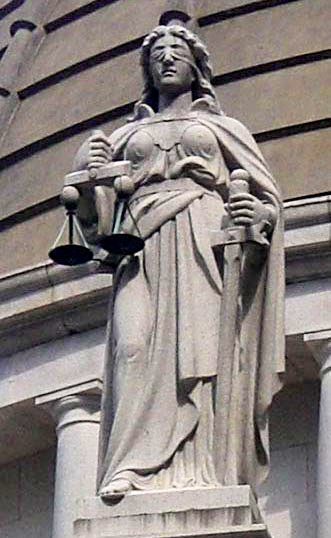
Justitia blindfolded and holding balance scales and a sword. Court of Final Appeal, Hong Kong; Wikimedia; ChvhLR10; Free Art License 1.3 (FAL 1.3)

President Trump and Supreme Court Chief Justice Roberts exchanged strong words over the past few days on the subject of justice. Ross Douthat summarized the initial interaction at The New York Times:
After the president complained that an “Obama judge” from the Ninth Circuit had ruled against his administration’s asylum policy, the chief justice issued a highly unusual rebuke, declaring that “we do not have Obama judges or Trump judges, Bush judges or Clinton judges,” and an “independent judiciary is something we should all be thankful for.” This predictably inspired a tweeted rejoinder from the president: “Sorry Chief Justice John Roberts, but you do indeed have ‘Obama judges,’ ” Trump began, before dilating on his grievances against the Ninth Circuit’s alleged overreach.
Senate Minority Leader Chuck Schumer also weighed in on the debate, siding with Roberts, whom Schumer labeled a Republican who rules at times in a partisan manner. By Schumer’s own account, his affirmation of Roberts was unusual. Here’s Douthat’s citation of Schumer: “I don’t agree very often with Chief Justice Roberts, especially his partisan decisions which seem highly political on Citizens United, Janus, and Shelby. But I am thankful today that he — almost alone among Republicans — stood up to President Trump and for an independent judiciary.”
Roberts is certainly right in terms of affirming the ideals of our democratic system with checks and balances aimed at preserving justice from political encroachments from the right or left. However, both Trump and Schumer illustrated how partisan they perceive the Supreme Court to be. Moreover, Supreme Court appointments over the past several administrations reveal how partisan the process of the selections and review of nominations and final determinations have become. Both sides work extremely hard to put in place appointments that favor what they deem to be favorable to their brand of politics, or at least, interpretation of the law. The recent Kavanaugh selection is only the latest example of this dynamic.
Citing various historical examples, including Andrew Jackson, Abraham Lincoln and FDR, Douthat points out that the Supreme Court’s sovereignty in relation to the U.S. Presidency depends on the President’s willingness to submit to its determinations. What is lacking presently in Douthat’s mind is a robust third arm in federal government–Congress. In Douthat’s estimation, we find ourselves in a tug-of-war between two imperial powers. Only a strong Congress can restore equilibrium. In my estimation, that will require far less partisan wrangling than we witness presently.
Douthat exhorts his readers to consider carefully what may be unfolding in our nation–the deterioration of our republic. It is not simply a matter of Trump vs. Roberts with Schumer weighing in. These accounts are only telling examples of this possible erosion of our government and due process in pursuing justice. Our republic seems to have forgotten that you cannot court true justice with partisan power and prestige. True justice only responds to reason, what is decent, and what is right.
At this point, I turn to the title of this post as well as the accompanying picture. Lady Justice is often pictured as blindfolded, bearing scales and a sword. The blindfold represents impartiality: justice is no respecter of persons, office, position, fame, or power. The scales represent fairness: Lady Justice will carefully weigh the arguments and purported evidence of both sides of a case. Lastly, the sword is often taken to signify authority and the ability to enforce the final decision.
The Romans esteemed Justitia, the goddess who personified the qualities most often depicted by Lady Justice in modern times. These transcendent qualities certainly mirror Christian Scripture’s esteem for God. God rules justly. Divine justice is fair and impartial, but not indifferent. God weighs carefully every aspect of a case. When the divine verdict is declared, God backs it up with all rule and authority. The Apostle Paul gets at these themes in the following address:
He will render to each one according to his works: to those who by patience in well-doing seek for glory and honor and immortality, he will give eternal life; but for those who are self-seeking and do not obey the truth, but obey unrighteousness, there will be wrath and fury. There will be tribulation and distress for every human being who does evil, the Jew first and also the Greek, but glory and honor and peace for everyone who does good, the Jew first and also the Greek. For God shows no partiality. (Romans 2:6-11; ESV)
Elsewhere in Scripture we also find God presented as just and impartial: “For the Lord your God is God of gods and Lord of lords, the great, the mighty, and the awesome God, who is not partial and takes no bribe.” (Deuteronomy 10:17; ESV) Divine justice weighs the evidence carefully, cuts deep, and gets to the heart of the issue. God’s justice revealed in Jesus accounts for all matters of justice, from the least weighty to the matters of greatest gravitational pull. As Jesus declares, “Woe to you, scribes and Pharisees, hypocrites! For you tithe mint and dill and cumin, and have neglected the weightier matters of the law: justice and mercy and faithfulness. These you ought to have done, without neglecting the others. You blind guides, straining out a gnat and swallowing a camel!” (Matthew 23:23-24; ESV)
History is filled with examples of what is called justice going to the highest bidder or being swayed by partisan or public opinion. Even Jesus, by whom God will finally judge the nations (See Matthew 25) was judged wrongly–dying a wrongful death by crucifixion under the Roman governor Pilate. Indeed, given who Jesus was and is, it is fair to say that Jesus’ trial was the greatest travesty of justice in the history of the world. Pilate knew Jesus to be innocent, and yet he washed his hands of him and justice, too (Matthew 27:24).
The Bible does not turn a deaf ear to the cry for justice, or deny that we humans often fail to uphold justice in a court of law. Even so, apart from all the partisan and political posturing, it upholds the ideal that in the end justice will prevail. God will see to it.
Previous Post

November 23, 2018
Thanksgiving Is Not Simply a Holiday, But a Way of Life
Next Post
November 30, 2018 Identity Politics and Zero-Sum Games
Browse Our Archives
Select a Category Uncategorized
Select a Month June 2025 April 2025 March 2025 January 2025 December 2024 November 2024 October 2024 September 2024 August 2024 July 2024 June 2024 May 2024 April 2024 March 2024 February 2024 January 2024 December 2023 November 2023 October 2023 September 2023 August 2023 July 2023 June 2023 May 2023 April 2023 March 2023 February 2023 January 2023 December 2022 November 2022 October 2022 September 2022 August 2022 July 2022 June 2022 May 2022 April 2022 March 2022 February 2022 January 2022 December 2021 November 2021 October 2021 September 2021 August 2021 July 2021 June 2021 May 2021 April 2021 March 2021 February 2021 January 2021 December 2020 November 2020 October 2020 September 2020 August 2020 July 2020 June 2020 May 2020 April 2020 March 2020 February 2020 January 2020 December 2019 November 2019 October 2019 September 2019 August 2019 July 2019 June 2019 May 2019 April 2019 March 2019 February 2019 January 2019 December 2018 November 2018 October 2018 September 2018 August 2018 July 2018 June 2018 May 2018 April 2018 March 2018 February 2018 January 2018 December 2017 November 2017 October 2017 September 2017 August 2017 July 2017 June 2017 May 2017 April 2017 March 2017 February 2017 January 2017 December 2016 November 2016 October 2016 September 2016 August 2016 July 2016 June 2016 May 2016 April 2016 March 2016 February 2016 January 2016 December 2015 November 2015 October 2015 September 2015 August 2015 July 2015 June 2015 May 2015 April 2015 March 2015 February 2015 January 2015 December 2014 November 2014 October 2014 September 2014 August 2014 July 2014 June 2014 May 2014 April 2014 March 2014 February 2014 January 2014 December 2013 November 2013 October 2013 September 2013 August 2013 July 2013 June 2013 May 2013 April 2013 March 2013 February 2013 January 2013 December 2012 November 2012 October 2012 September 2012 August 2012 July 2012 June 2012 May 2012 April 2012 March 2012 February 2012
Follow Us!
TAKE THE
Religious Wisdom Quiz
Who was Abraham's firstborn son?
Select your answer to see how you score.
Esau Ishmael Isaac Jacob
Books by This Author Books by Paul Louis Metzger
Related posts from Uncommon God, Common Good

Heavenly Father’s Day on Trinity Sunday

Easter Triduum: Obey Your Thirst—for God

Holy Week Is Humble Week: "Beware of Becoming...

Excavating the Person in a Throwaway Culture
TRENDING AT PATHEOS Evangelical

The REST of Your Life: A Creative Wrestles...
This week I had a conversation with a good friend from church....

How the author of the world's best hymn...
I've been working with John Newton for a while now. This makes...

Long before this Lectio Divina, Psalm 130 - the song - started...

What About the Trees? Another Living Parable
After I finished writing the last article about falling leaves as a...

Why Classical Education Is a Conversation, Not a...
Come and Read: Joy in Classical Education When I was a little...

Cornell University has received a great deal of negative publicity and intense...
view all Evangelical blogs
Ad-Free & Subscriber Log-In Subscription Support
- About Us
- 2026 Calendar
- Videos
- Podcasts
- Library of World Religions
- Faith In Media Tracker
- Advertise With Us
- Write for Us
- Privacy Policy
- Terms of Service
- Do Not Sell My Data
- Contact Us
- Radiant Digital
- Manage Newsletter Subscriptions
- Unsubscribe From Notifications
- Sitemap
Copyright 2008-2026, Patheos. All rights reserved.
Subscription Support Ad-Free & Subscriber Log-In
Follow Patheos