
BuddhistCatholicContemplativeEvangelicalGeneral ChristianHinduJewishLatter-day SaintMuslimNew VisionsProgressive Christian
Beliefs
- Buddhist
- Catholic
- Contemplative
- Evangelical
- General Christian
- Hindu
- Jewish
- Latter-day Saint
- More Voices
- Muslim
- New Visions
- Pagan
- Progressive Christian
Topics
- Religion News
- Food and Religion
- Sports and Religion
- Religious Art
- Religious Music and Entertainment
- Religious Events
- History and Religion
- Style and Religion
- Politics and Religion
- Women in Religion
- Recreation Outdoors and Religion
- Business Finance and Religion
- Careers Workplace and Religion
- Education and Religion
- Family Parenting and Religion
- Health Fitness and Religion
- Home and Religion
- Relationships and Religion
- Technology and Religion
- Travel and Religion
Columnists
- Buddhist Columnists
- Business Finance and Religion Columnists
- Careers Workplace and Religion Columnists
- Catholic Columnists
- Contemplative Columnists
- Education and Religion Columnists
- Evangelists Columnists
- Family Parenting and Religion Columnists
- General Christian Columnists
- Health Fitness and Religion Columnists
- Hindu Columnists
- History and Religion Columnists
- Home and Religion Columnists
- Jewish Columnists
- More Voices Columnists
- Latter Day Columnists
- Muslim Columnists
- New Visions Columnists
- Nonreligious Columnists
- Pagan Columnists
- Politics and Religion Columnists
- Progressive Columnists
- Recreation Outdoors and Religion Columnists
- Relationships and Religion Columnists
- Religion News Columnists
- Religious Art Columnists
- Religious Events Columnists
- Religious Music and Entertainment Columnists
- Sports and Religion Columnists
- Style and Religion Columnists
- Technology and Religion Columnists
- Travel and Religion Columnists
- Women in Religion Columnists
Resource Library
- 2026 Calendar
- Library of World Religions
- The 100 Most Holy Places on Earth
- Patheos Answers
- Podcasts
- Videos
- Faith Leaders Database
- Anglican Episcopalian
- Bahai
- Baptist
- Buddhism
- Christianity
- Confucianism
- Eastern Orthodoxy
- Hinduism
- Holiness and Pentecostal
- ISKCON
- Islam
- Judaism
- Lutheran
- Methodist
- The Church of Jesus Christ of Latter-day Saints
- New Age
- Paganism
- Presbytarian and Reformed
- Protestantism
- Religion Behind the Scenes
- Roman Catholic
- Scientology
- Shia Islam
- Sikhism
- Sufism
- Sunni Islam
- Taoism
- Zen
- See all religions
Research Tools
 Ad-Free & Subscriber Log-In Subscription Support
Ad-Free & Subscriber Log-In Subscription Support
Follow Patheos 

- Trending:
- Forgiveness
- |
- Marriage
- |
- Consciousness
- |
- Death Penalty
- |
- Election
- |
- Halloween

- Home
- Evangelical
- On Dementia: How Do We Assess Quality of Life?
On Dementia: How Do We Assess Quality of Life?
Last updated on: October 15, 2018 at 10:58 am by Paul Louis Metzger
On Dementia: How Do We Assess Quality of Life? 2018-10-15T10:58:09-07:00 Paul Louis Metzger
Patheos Explore the world's faith through different perspectives on religion and spirituality! Patheos has the views of the prevalent religions and spiritualities of the world.
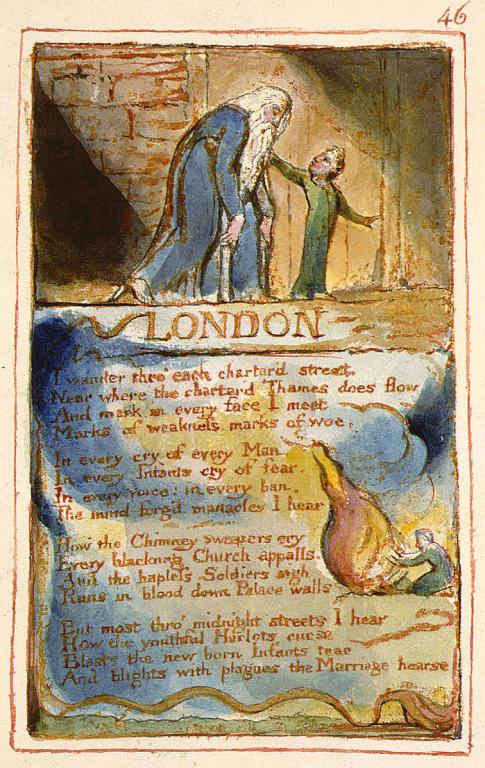
An image of an elderly man being guided by a young child accompanies William Blake’s poem London, from his Songs of Innocence and Experience; Wikimedia Commons; {{PD-1923}}

We were discussing the theme of quality of life recently n one of my ethics courses. A student named Jeff spoke up about his late mother-in-law. No, it was not a mother-in-law joke. Rather, it was a story of how much his mother-in-law meant to him. Jeff’s mother-in-law lived with his family for eighteen years. She suffered from dementia during her final years, where she could only function with assistance.
A family friend once remarked “I’d rather be dead” when observing Jeff’s mother-in-law’s state of dementia. Perhaps we feel the same way given similar situations. The remark sparked a conversation on what determines one’s quality of life.
What struck me most about Jeff’s reflection was his family’s response to his mother-in-law’s situation: “What about our quality of life with her? What about our quality of life if we were without her?” She brought him, his wife and their children great joy. Jeff remarked,
She brought great joy to us. We made her laugh (isn’t that quality of life?), and she made us laugh. We don’t kill our babies, do we? We make them smile and they make us smile. They are unable to be self-motivated or thrive without assistance. To me, this was just reverse engineering. Isn’t this caring for the least vulnerable?
Some of Jeff’s family’s friends argued that unlike little ones, elderly people in demented states don’t have potential. His response:
Well, she still had potential to impact our lives. My children helped with her care and learned valuable lessons because of it. How many 16 and 18 year-old-teenagers have the responsibility at times to change their grandparents’ diapers? Personally, this was a growth experience for them—one that taught patience, love, and service.
Jeff’s entire family’s quality of life grew because of caring for his wife’s mother. Although the care was emotionally and physically trying, they have gained many invaluable life lessons and precious memories.
It’s hard to comprehend what Jeff shared with the class if we look at the quality of someone’s life in individualistic capacity terms. It’s hard enough in our society to care for the elderly given that we are often lured away to bathe in the fountain of youth. Add to that challenge care for an elderly person with dementia, and it is excruciatingly taxing to compute. In fact, such valuation of the elderly person with dementia, as Jeff and his family modeled, might come across as downright crazy.
To make sense of what Jeff shared, we need to look at the quality of someone’s life in communal terms. We are who we are only in relation. Moreover, we need to expand our sense of communion to include those who are not simply young of limb and heart, but also impacted by the wear and tear of age. In spite of their lack of physical strength, the elderly are often strong in experience and wisdom. But what of those like Jeff’s mother-in-law who are no longer able to impart their wisdom to others due to dementia?
The Bible, Confucius’ Analects and tribal traditions here and abroad call on us to honor our elders. How can we abandon those who invested in us and made it possible for us to live out our potential as humans? What would it say about our civilization? It would be uncivilized, no matter how wealthy or technologically advanced we become. A society that abandons its elderly and infirm removes the opportunity to grow in virtuous compassion, which increases with use, as Aristotle and Jeff maintain. If we do not exercise our hearts, limbs and brains, they lose their vitality. Whether Aristotle would have made room in his polis for compassionate care for the elderly who were not of noble birth, or who were/are not virtuous, is worth considering. Also worth considering is the Bible’s emphasis on unconditional love for people no matter their nobility, virtue, wealth, or presumed quality of life.[1] What then is the quality of life for someone or a people who are rich in the world’s eyes, but not rich in looking out and caring for others? Such a family or nation’s quality of life is diminished, withering away in a collective state of dementia.
_______________
[1]“Aristotle is far from ignorant of the importance of human love; indeed, he devotes two whole books (NE VIII and IX) to the topic of friendship…And he notes that there is a sense in which one should love oneself, namely wishing for the very best for oneself (1168b30). But friendship (philia) is, on Aristotle’s conception, only possible with a few people; moreover, it can really exist only between good people. In contrast, the New Testament conception of love (agape, formerly translated as “charity”) is supposed to be universal and unconditional. It involves more, I take it, than Aristotle’s “good will” (NE1166b30). The ideal it puts before us is first that we should be loving or compassionate to all our fellow human beings, regardless of sex, race, class, ethnicity, or nationality. And, second, that our love or compassion should not depend on good behavior or individual talents, so that a change of heart and forgiveness should always be seen as possible. This twin ideal is almost impossibly demanding on our frail human nature. But we may feel that there is something missing from an ethic that does not even set it before us.” Leslie Stevenson, David L. Haberman and Peter Matthews Wright, Twelve Theories of Human Nature, sixth edition (New York: Oxford University Press, 2013), pages 113-114.
Previous Post

October 12, 2018
Allergic Reactions and Pro-action in the Church, Part I.
Next Post
October 19, 2018 Mormons and Buddhists Are Not "Isms" or "Ists." They're People.
Browse Our Archives
Select a Category Uncategorized
Select a Month June 2025 April 2025 March 2025 January 2025 December 2024 November 2024 October 2024 September 2024 August 2024 July 2024 June 2024 May 2024 April 2024 March 2024 February 2024 January 2024 December 2023 November 2023 October 2023 September 2023 August 2023 July 2023 June 2023 May 2023 April 2023 March 2023 February 2023 January 2023 December 2022 November 2022 October 2022 September 2022 August 2022 July 2022 June 2022 May 2022 April 2022 March 2022 February 2022 January 2022 December 2021 November 2021 October 2021 September 2021 August 2021 July 2021 June 2021 May 2021 April 2021 March 2021 February 2021 January 2021 December 2020 November 2020 October 2020 September 2020 August 2020 July 2020 June 2020 May 2020 April 2020 March 2020 February 2020 January 2020 December 2019 November 2019 October 2019 September 2019 August 2019 July 2019 June 2019 May 2019 April 2019 March 2019 February 2019 January 2019 December 2018 November 2018 October 2018 September 2018 August 2018 July 2018 June 2018 May 2018 April 2018 March 2018 February 2018 January 2018 December 2017 November 2017 October 2017 September 2017 August 2017 July 2017 June 2017 May 2017 April 2017 March 2017 February 2017 January 2017 December 2016 November 2016 October 2016 September 2016 August 2016 July 2016 June 2016 May 2016 April 2016 March 2016 February 2016 January 2016 December 2015 November 2015 October 2015 September 2015 August 2015 July 2015 June 2015 May 2015 April 2015 March 2015 February 2015 January 2015 December 2014 November 2014 October 2014 September 2014 August 2014 July 2014 June 2014 May 2014 April 2014 March 2014 February 2014 January 2014 December 2013 November 2013 October 2013 September 2013 August 2013 July 2013 June 2013 May 2013 April 2013 March 2013 February 2013 January 2013 December 2012 November 2012 October 2012 September 2012 August 2012 July 2012 June 2012 May 2012 April 2012 March 2012 February 2012
Follow Us!
TAKE THE
Religious Wisdom Quiz
Who wrote two letters known for emphasizing "truth" and "love"?
Select your answer to see how you score.
Peter John Paul James
Books by This Author Books by Paul Louis Metzger
Related posts from Uncommon God, Common Good

Heavenly Father’s Day on Trinity Sunday

Easter Triduum: Obey Your Thirst—for God

Holy Week Is Humble Week: "Beware of Becoming...

Excavating the Person in a Throwaway Culture
TRENDING AT PATHEOS Evangelical

The REST of Your Life: A Creative Wrestles...
This week I had a conversation with a good friend from church....

How the author of the world's best hymn...
I've been working with John Newton for a while now. This makes...

Long before this Lectio Divina, Psalm 130 - the song - started...

What About the Trees? Another Living Parable
After I finished writing the last article about falling leaves as a...

Why Classical Education Is a Conversation, Not a...
Come and Read: Joy in Classical Education When I was a little...

Cornell University has received a great deal of negative publicity and intense...
view all Evangelical blogs
Ad-Free & Subscriber Log-In Subscription Support
- About Us
- 2026 Calendar
- Videos
- Podcasts
- Library of World Religions
- Faith In Media Tracker
- Advertise With Us
- Write for Us
- Privacy Policy
- Terms of Service
- Do Not Sell My Data
- Contact Us
- Radiant Digital
- Manage Newsletter Subscriptions
- Unsubscribe From Notifications
- Sitemap
Copyright 2008-2026, Patheos. All rights reserved.
Subscription Support Ad-Free & Subscriber Log-In
Follow Patheos