
BuddhistCatholicContemplativeEvangelicalGeneral ChristianHinduJewishLatter-day SaintMuslimNew VisionsProgressive Christian
Beliefs
- Buddhist
- Catholic
- Contemplative
- Evangelical
- General Christian
- Hindu
- Jewish
- Latter-day Saint
- More Voices
- Muslim
- New Visions
- Pagan
- Progressive Christian
Topics
- Religion News
- Food and Religion
- Sports and Religion
- Religious Art
- Religious Music and Entertainment
- Religious Events
- History and Religion
- Style and Religion
- Politics and Religion
- Women in Religion
- Recreation Outdoors and Religion
- Business Finance and Religion
- Careers Workplace and Religion
- Education and Religion
- Family Parenting and Religion
- Health Fitness and Religion
- Home and Religion
- Relationships and Religion
- Technology and Religion
- Travel and Religion
Columnists
- Buddhist Columnists
- Business Finance and Religion Columnists
- Careers Workplace and Religion Columnists
- Catholic Columnists
- Contemplative Columnists
- Education and Religion Columnists
- Evangelists Columnists
- Family Parenting and Religion Columnists
- General Christian Columnists
- Health Fitness and Religion Columnists
- Hindu Columnists
- History and Religion Columnists
- Home and Religion Columnists
- Jewish Columnists
- More Voices Columnists
- Latter Day Columnists
- Muslim Columnists
- New Visions Columnists
- Nonreligious Columnists
- Pagan Columnists
- Politics and Religion Columnists
- Progressive Columnists
- Recreation Outdoors and Religion Columnists
- Relationships and Religion Columnists
- Religion News Columnists
- Religious Art Columnists
- Religious Events Columnists
- Religious Music and Entertainment Columnists
- Sports and Religion Columnists
- Style and Religion Columnists
- Technology and Religion Columnists
- Travel and Religion Columnists
- Women in Religion Columnists
Resource Library
- 2026 Calendar
- Library of World Religions
- The 100 Most Holy Places on Earth
- Patheos Answers
- Podcasts
- Videos
- Faith Leaders Database
- Anglican Episcopalian
- Bahai
- Baptist
- Buddhism
- Christianity
- Confucianism
- Eastern Orthodoxy
- Hinduism
- Holiness and Pentecostal
- ISKCON
- Islam
- Judaism
- Lutheran
- Methodist
- The Church of Jesus Christ of Latter-day Saints
- New Age
- Paganism
- Presbytarian and Reformed
- Protestantism
- Religion Behind the Scenes
- Roman Catholic
- Scientology
- Shia Islam
- Sikhism
- Sufism
- Sunni Islam
- Taoism
- Zen
- See all religions
Research Tools
 Ad-Free & Subscriber Log-In Subscription Support
Ad-Free & Subscriber Log-In Subscription Support
Follow Patheos 

- Trending:
- Forgiveness
- |
- Marriage
- |
- Consciousness
- |
- Death Penalty
- |
- Election
- |
- Halloween

- Home
- Evangelical
- The Great Commission Necessitates Honest Confession
The Great Commission Necessitates Honest Confession
Last updated on: September 9, 2018 at 8:25 am by Paul Louis Metzger
The Great Commission Necessitates Honest Confession 2018-09-09T08:25:25-07:00 Paul Louis Metzger
Patheos Explore the world's faith through different perspectives on religion and spirituality! Patheos has the views of the prevalent religions and spiritualities of the world.
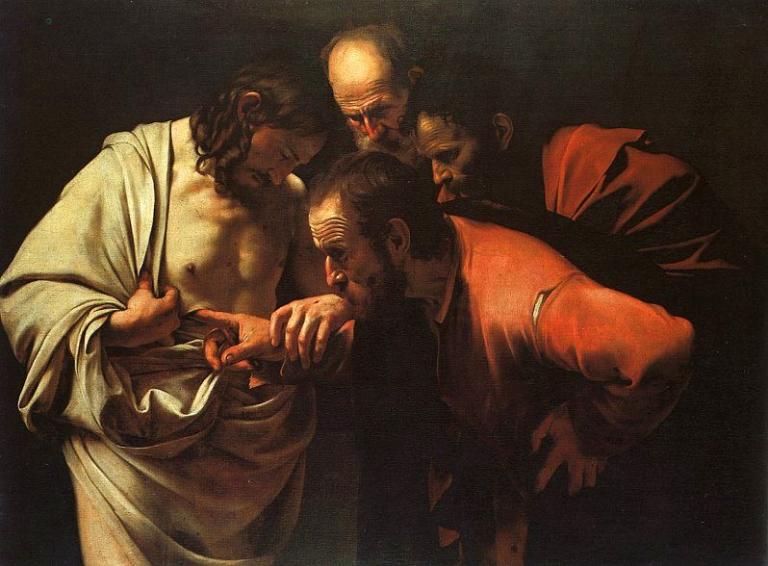
Caravaggio, The Incredulity of Saint Thomas

The Great Commission necessitates honest confession, including doubts.
Recently I read through Matthew’s Gospel for my devotions. I have often been struck by the emphasis on “God with us” in Matthew’s Gospel. Matthew 1:23 and Matthew 28:20 bookend the gospel with their emphasis on God with us at Jesus’ birth (Matthew 1:23) and Jesus being with us always—to the end of the age (Matthew 28:20):
“Behold, the virgin shall conceive and bear a son,
and they shall call his name Immanuel” (which means, God with us).And behold, I am with you always, to the end of the age (Matthew 28:20b).
What struck me in reading Matthew’s Gospel, including Matthew 28, this time around is how Jesus is with us even in our failures, slowness of heart, and doubts.
Perhaps the greatest struggle for Jesus’ disciples is coming to terms with Jesus’ cross and resurrection. Jesus is very straightforward with his disciples about the cross. In Matthew’s Gospel, Jesus predicts four times that he will undergo horrible suffering and death (Matthew 16:21, 17:22-23, 20:17-19, 26:1-2). These predictions signify that the cross is not simply a dramatic and traumatic event in Jesus’ life, but the cause of Jesus’ coming into the world. Jesus came to save people from their sins: “She will bear a son, and you shall call his name Jesus, for he will save his people from their sins” (Matthew 1:21; ESV). Jesus brings salvation through the cross.
At the occasion of the first prediction, Peter rebukes Jesus and tells him he will never undergo suffering and death at the hands of his adversaries. In turn, Jesus rebukes Peter for standing in his way as a stumbling block in fulfilling God’s purpose for him (Matthew 16:21-23). What is perhaps most striking is that this incident follows on the heels of Peter’s confession that Jesus is the Christ, the Son of God (Matthew 16:16). Based on Jesus’ life, words and miraculous actions in conjunction with divine inspiration, Peter comes to the realization that Jesus is the Christ, but he cannot fully come to terms until after the resurrection (perhaps not until Pentecost) that Jesus’ messianic work entails the centrality of the cross.
We find in Matthew 28 that even before the resurrected Jesus, some of Jesus’ eleven disciples doubted. They doubted even while gathering to worship him (Matthew 28:17). One might find the acknowledgment of their doubt problematic and anticlimactic to the telling of Jesus’ story in Matthew’s Gospel. Even more striking is that the acknowledgment of such doubt immediately precedes Jesus’ declaration of the Great Commission. Here’s the text:
Now the eleven disciples went to Galilee, to the mountain to which Jesus had directed them. And when they saw him they worshiped him, but some doubted. And Jesus came and said to them, “All authority in heaven and on earth has been given to me. Go therefore and make disciples of all nations, baptizing them in the name of the Father and of the Son and of the Holy Spirit, teaching them to observe all that I have commanded you. And behold, I am with you always, to the end of the age” (Matthew 28:16-20; ESV).
The Gospel writers do not hide the disciples’ failures, like Peter’s rebuke, or the disciples’ struggles, such as their doubts. Consider also Thomas’ doubt in John chapter 20:24-25: “Unless I see in his hands the mark of the nails, and place my finger into the mark of the nails, and place my hand into his side, I will never believe” (ESV). I love Caravaggio’s painting shown above in which we find Jesus taking Thomas’ hand so that he can place it inside his wound. Jesus is not threatened by the doubt of Thomas who is devoted to truth. Jesus initiates the encounter. He welcomes Thomas’ honest engagement!
If I were one of the disciples responsible for writing the gospel accounts, I might have glossed over their (our) failures as well as struggles with such things as doubt. I might have made us look superhuman, or semi-divine. How striking and refreshing that the gospel writers do not hide these warts and wrinkles, but present them in living color.
Such acknowledgment on the gospel writers’ part only highlights all the more that God is with us in Jesus—not just in the good times, but also in the bad times. Jesus’ presence and his communion with his disciples through the ages through the Spirit is what ultimately serves as the power behind the Great Commission, not the potency of our confession. In fact, our honest confession, including our struggle with doubts, serves to humanize and personalize the good news to people, as well as highlight how great the story is that God is indeed with us in Jesus: God with us, Immanuel! So, let’s be honest with our failures, struggles and doubts when we share the good news. The Great Commission necessitates honest confession.
Previous Post

September 7, 2018
Face to Face: An Interview with Dr. Marty Folsom on the Triune God
Next Post
September 13, 2018 Fences and Front Porches Make for Good Evangelical and Mormon Neighbors
Browse Our Archives
Select a Category Uncategorized
Select a Month June 2025 April 2025 March 2025 January 2025 December 2024 November 2024 October 2024 September 2024 August 2024 July 2024 June 2024 May 2024 April 2024 March 2024 February 2024 January 2024 December 2023 November 2023 October 2023 September 2023 August 2023 July 2023 June 2023 May 2023 April 2023 March 2023 February 2023 January 2023 December 2022 November 2022 October 2022 September 2022 August 2022 July 2022 June 2022 May 2022 April 2022 March 2022 February 2022 January 2022 December 2021 November 2021 October 2021 September 2021 August 2021 July 2021 June 2021 May 2021 April 2021 March 2021 February 2021 January 2021 December 2020 November 2020 October 2020 September 2020 August 2020 July 2020 June 2020 May 2020 April 2020 March 2020 February 2020 January 2020 December 2019 November 2019 October 2019 September 2019 August 2019 July 2019 June 2019 May 2019 April 2019 March 2019 February 2019 January 2019 December 2018 November 2018 October 2018 September 2018 August 2018 July 2018 June 2018 May 2018 April 2018 March 2018 February 2018 January 2018 December 2017 November 2017 October 2017 September 2017 August 2017 July 2017 June 2017 May 2017 April 2017 March 2017 February 2017 January 2017 December 2016 November 2016 October 2016 September 2016 August 2016 July 2016 June 2016 May 2016 April 2016 March 2016 February 2016 January 2016 December 2015 November 2015 October 2015 September 2015 August 2015 July 2015 June 2015 May 2015 April 2015 March 2015 February 2015 January 2015 December 2014 November 2014 October 2014 September 2014 August 2014 July 2014 June 2014 May 2014 April 2014 March 2014 February 2014 January 2014 December 2013 November 2013 October 2013 September 2013 August 2013 July 2013 June 2013 May 2013 April 2013 March 2013 February 2013 January 2013 December 2012 November 2012 October 2012 September 2012 August 2012 July 2012 June 2012 May 2012 April 2012 March 2012 February 2012
Follow Us!
TAKE THE
Religious Wisdom Quiz
What Christian group primarily follows the teachings of Martin Luther?
Select your answer to see how you score.
Baptists Presbyterians Methodists Lutherans
Books by This Author Books by Paul Louis Metzger
Related posts from Uncommon God, Common Good

Heavenly Father’s Day on Trinity Sunday

Easter Triduum: Obey Your Thirst—for God

Holy Week Is Humble Week: "Beware of Becoming...

Excavating the Person in a Throwaway Culture
TRENDING AT PATHEOS Evangelical

The REST of Your Life: A Creative Wrestles...
This week I had a conversation with a good friend from church....

How the author of the world's best hymn...
I've been working with John Newton for a while now. This makes...

Long before this Lectio Divina, Psalm 130 - the song - started...

What About the Trees? Another Living Parable
After I finished writing the last article about falling leaves as a...

Why Classical Education Is a Conversation, Not a...
Come and Read: Joy in Classical Education When I was a little...

Cornell University has received a great deal of negative publicity and intense...
view all Evangelical blogs
Ad-Free & Subscriber Log-In Subscription Support
- About Us
- 2026 Calendar
- Videos
- Podcasts
- Library of World Religions
- Faith In Media Tracker
- Advertise With Us
- Write for Us
- Privacy Policy
- Terms of Service
- Do Not Sell My Data
- Contact Us
- Radiant Digital
- Manage Newsletter Subscriptions
- Unsubscribe From Notifications
- Sitemap
Copyright 2008-2026, Patheos. All rights reserved.
Subscription Support Ad-Free & Subscriber Log-In
Follow Patheos