
BuddhistCatholicContemplativeEvangelicalGeneral ChristianHinduJewishLatter-day SaintMuslimNew VisionsProgressive Christian
Beliefs
- Buddhist
- Catholic
- Contemplative
- Evangelical
- General Christian
- Hindu
- Jewish
- Latter-day Saint
- More Voices
- Muslim
- New Visions
- Pagan
- Progressive Christian
Topics
- Religion News
- Food and Religion
- Sports and Religion
- Religious Art
- Religious Music and Entertainment
- Religious Events
- History and Religion
- Style and Religion
- Politics and Religion
- Women in Religion
- Recreation Outdoors and Religion
- Business Finance and Religion
- Careers Workplace and Religion
- Education and Religion
- Family Parenting and Religion
- Health Fitness and Religion
- Home and Religion
- Relationships and Religion
- Technology and Religion
- Travel and Religion
Columnists
- Buddhist Columnists
- Business Finance and Religion Columnists
- Careers Workplace and Religion Columnists
- Catholic Columnists
- Contemplative Columnists
- Education and Religion Columnists
- Evangelists Columnists
- Family Parenting and Religion Columnists
- General Christian Columnists
- Health Fitness and Religion Columnists
- Hindu Columnists
- History and Religion Columnists
- Home and Religion Columnists
- Jewish Columnists
- More Voices Columnists
- Latter Day Columnists
- Muslim Columnists
- New Visions Columnists
- Nonreligious Columnists
- Pagan Columnists
- Politics and Religion Columnists
- Progressive Columnists
- Recreation Outdoors and Religion Columnists
- Relationships and Religion Columnists
- Religion News Columnists
- Religious Art Columnists
- Religious Events Columnists
- Religious Music and Entertainment Columnists
- Sports and Religion Columnists
- Style and Religion Columnists
- Technology and Religion Columnists
- Travel and Religion Columnists
- Women in Religion Columnists
Resource Library
- 2026 Calendar
- Library of World Religions
- The 100 Most Holy Places on Earth
- Patheos Answers
- Podcasts
- Videos
- Faith Leaders Database
- Anglican Episcopalian
- Bahai
- Baptist
- Buddhism
- Christianity
- Confucianism
- Eastern Orthodoxy
- Hinduism
- Holiness and Pentecostal
- ISKCON
- Islam
- Judaism
- Lutheran
- Methodist
- The Church of Jesus Christ of Latter-day Saints
- New Age
- Paganism
- Presbytarian and Reformed
- Protestantism
- Religion Behind the Scenes
- Roman Catholic
- Scientology
- Shia Islam
- Sikhism
- Sufism
- Sunni Islam
- Taoism
- Zen
- See all religions
Research Tools
 Ad-Free & Subscriber Log-In Subscription Support
Ad-Free & Subscriber Log-In Subscription Support
Follow Patheos 

- Trending:
- Forgiveness
- |
- Marriage
- |
- Consciousness
- |
- Death Penalty
- |
- Election
- |
- Halloween

- Home
- Evangelical
- Don’t Throw Out the Missional Baby with the Dirty Bathwater
Don’t Throw Out the Missional Baby with the Dirty Bathwater
Last updated on: August 8, 2018 at 8:57 am by Paul Louis Metzger
Don’t Throw Out the Missional Baby with the Dirty Bathwater 2018-08-08T08:57:35-07:00 Paul Louis Metzger
Patheos Explore the world's faith through different perspectives on religion and spirituality! Patheos has the views of the prevalent religions and spiritualities of the world.
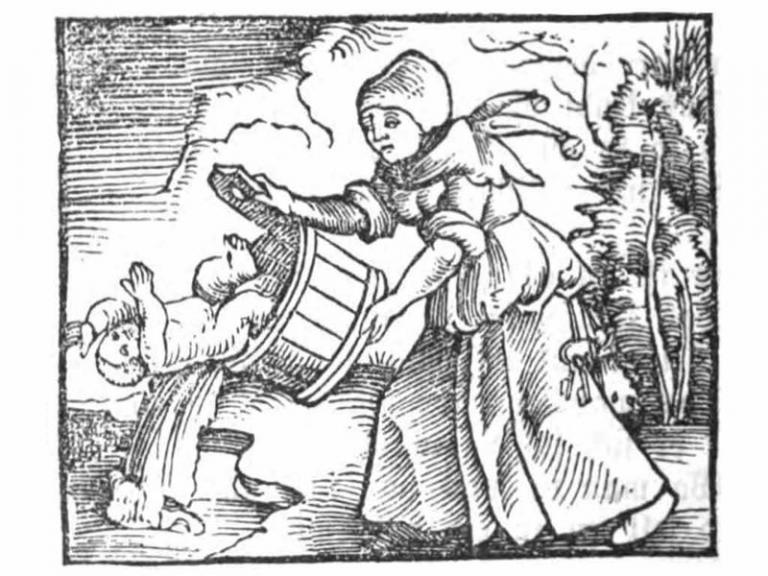
Earliest Known Image of “Don’t Throw The Baby Out With The Bathwater.” Creative Commons

This spring semester, I had the honor of serving as Senior Mission Scholar in Residence at the Overseas Ministries Study Center (OMSC) in New Haven, CT. It was a privilege to learn from missional leaders from around the world, and from OMSC’s Executive Director, Dr. Thomas John Hastings, who served as a mission scholar in Japan for many years. The following is Dr. Hastings’ timely engagement of key concerns pertaining to missional Christianity in our post-colonial world. Here Dr. Hastings accounts for two very different and often combative ways of addressing the global mission enterprise today—conflation on the one hand and separation on the other hand. The first approach only accounts for the dirty bathwater in global missions. The second approach only accounts for the baby, namely, gospel proclamation and missionary heroism, but fails to address important concerns bound up with colonialism and its aftermath. Dr. Hastings engages these two vantage points in critical and constructive terms and introduces us to exciting opportunities available to us today to learn from the global church in the redemptive work of Jesus’ Great Commission. I encourage readers to make themselves familiar with Dr. Hastings’ ministry, as well as OMSC, for further explorations along these lines. OMSC is an incredible incubator for missional imagination and practice today. Here is Dr. Hastings’ reflection and invitation to partner in Jesus’ missional calling on our lives.
The story of the modern missionary movement “from the West to the rest,” which began in the late 18th century, cannot be separated from the story of global political, cultural, and economic hegemony by the Western powers during the same period. Whatever the motivations of individual North American or European missionaries and their supporting churches and societies, it is an undeniable fact that the nations that birthed and backed the call to win the world for Christ also birthed and backed civil wars and revolutions around the world, and sometimes at home, two world wars, a cold war, nuclear arms race, war on terrorism, and other political and economic misadventures with devastating international consequences.
However, while allowing that they intersect at many levels, I am as wary of those who completely conflate these two story lines as I am of those who completely separate them. The “conflaters” try to delegitimize the mission enterprise, expunging the narratives “on the ground” and whatever may be of positive and enduring value, while the “separators” try to legitimize the mission enterprise in their appeal to biblical teaching, church doctrine, or personal heroism, expunging the narratives of political, economic, and cultural machinations and their often disastrous impacts on local peoples. While there are of course variations, today the post-colonial rhetoric of the “conflaters” often holds sway in mainline or conciliar Protestant churches and seminaries while the pietistic rhetoric of the “separators” often holds sway in evangelical Protestant churches and seminaries. In the former group, “mission” is a hotly contested and suspect term, while in the latter, a particular view of “mission” is seen as a mark of genuine discipleship.
I have deliberately described these rival ways of construing the history and ongoing practice of Christian mission to make the point that, while acknowledging that both groups surely have something important to learn from each other as members of the One body of Christ (Romans 12:5), today’s polarizing culture wars make such mutual listening and learning difficult if not impossible.
So where might one go to develop a broader and more nuanced view of mission? Again, while acknowledging that the conflaters and separators each bear a certain degree of truth, I believe that the answer to this question is quite simple, but as with all quests for deeper understanding, it will require us to get personally involved and to move out of the comfort zones of our ideological niches.
As someone who worked under the leadership of Japanese Christians for 20 years as a mission co-worker of the Presbyterian Church (USA), I believe we need to also attend carefully to the stories of national church leaders, laypeople, theologians, and non-Christians. After all, though the Japanese churches with whom we worked are fully independent today, they and their ancestors in faith were on the receiving end of the missionary enterprise. While not uncritical of the missionary movement and its entanglements with colonialism and capitalism, I was surprised to learn from my Japanese sisters and brothers of their sincere sense of gratitude and respect for the missionaries who founded their churches, schools, hospitals, and social welfare institutions.
Having said this, I am of course aware that many will not be able to spend 20 years living in another culture and learning another language, and this is where the ministry of a place like the Overseas Ministries Study Center (OMSC) in New Haven comes into play. Every year, we welcome a community of Christians from every nation and tradition to live, study, and worship together for an entire academic year (September-May). Each cohort is comprised of cross-cultural missionaries, church leaders, scholars, and artists, most of whom come from the “majority” or “non-Western” world. As an example, in the upcoming 2018–2019 year, we will welcome 26 program residents from China, Columbia, India, Myanmar, Nigeria, Paraguay, Peru, South Korea, and Spain. They will participate together in 19 Study Program seminars (see https://www.omsc.org/seminars/), which are facilitated by recognized leaders in their fields and designed to address relevant historical, theological, and practical questions attending the history and current understanding of the churches’ engagement in God’s mission.
In relation to the question of our need to overcome the polarities of the conflaters and separators, consider that most of OMSC’s residents and their faith ancestors were formerly on the “receiving end” of the Western missionary movement. Just imagine the lively interactions that take place in these seminars and in the less formal times of shared community life! You may hear a charismatic Nigerian couple speaking of their respect for Islam and love for their many Muslim friends, a Presbyterian from South Korea recounting her experience of being filled with the Holy Spirit, or a Baptist professor from Myanmar referring to the latest academic scholarship on the Gospel of John.
Our Study Program seminars are open to the public, so why not gather some mission-minded friends from your church or seminary and register for one of our seminars? If you come with an open mind, I guarantee you will come away with a broader and more nuanced view of the church’s participation in the mission of God. You will see why I like to refer to OMSC as an “incubator for missional imagination and practice” (see https://www.omsc.org/video).
Previous Post

August 3, 2018
How Can We Enhance Our Moral Attention Span?
Next Post
August 10, 2018 On Evangelical Theological Method(s): Beyond 'Nike' and 'Mordor'
Browse Our Archives
Select a Category Uncategorized
Select a Month June 2025 April 2025 March 2025 January 2025 December 2024 November 2024 October 2024 September 2024 August 2024 July 2024 June 2024 May 2024 April 2024 March 2024 February 2024 January 2024 December 2023 November 2023 October 2023 September 2023 August 2023 July 2023 June 2023 May 2023 April 2023 March 2023 February 2023 January 2023 December 2022 November 2022 October 2022 September 2022 August 2022 July 2022 June 2022 May 2022 April 2022 March 2022 February 2022 January 2022 December 2021 November 2021 October 2021 September 2021 August 2021 July 2021 June 2021 May 2021 April 2021 March 2021 February 2021 January 2021 December 2020 November 2020 October 2020 September 2020 August 2020 July 2020 June 2020 May 2020 April 2020 March 2020 February 2020 January 2020 December 2019 November 2019 October 2019 September 2019 August 2019 July 2019 June 2019 May 2019 April 2019 March 2019 February 2019 January 2019 December 2018 November 2018 October 2018 September 2018 August 2018 July 2018 June 2018 May 2018 April 2018 March 2018 February 2018 January 2018 December 2017 November 2017 October 2017 September 2017 August 2017 July 2017 June 2017 May 2017 April 2017 March 2017 February 2017 January 2017 December 2016 November 2016 October 2016 September 2016 August 2016 July 2016 June 2016 May 2016 April 2016 March 2016 February 2016 January 2016 December 2015 November 2015 October 2015 September 2015 August 2015 July 2015 June 2015 May 2015 April 2015 March 2015 February 2015 January 2015 December 2014 November 2014 October 2014 September 2014 August 2014 July 2014 June 2014 May 2014 April 2014 March 2014 February 2014 January 2014 December 2013 November 2013 October 2013 September 2013 August 2013 July 2013 June 2013 May 2013 April 2013 March 2013 February 2013 January 2013 December 2012 November 2012 October 2012 September 2012 August 2012 July 2012 June 2012 May 2012 April 2012 March 2012 February 2012
Follow Us!
TAKE THE
Religious Wisdom Quiz
A hand wrote on the palace wall during a feast, and I interpreted the message: numbered, weighed, divided. What were these three Aramaic words?
Select your answer to see how you score.
Mene, Mene, Tekel, Parsin Babylon, Media, Persia Ichabod, Ebenezer, Beulah Holy, Holy, Holy
Books by This Author Books by Paul Louis Metzger
Related posts from Uncommon God, Common Good

Heavenly Father’s Day on Trinity Sunday

Easter Triduum: Obey Your Thirst—for God

Holy Week Is Humble Week: "Beware of Becoming...

Excavating the Person in a Throwaway Culture
TRENDING AT PATHEOS Evangelical

The REST of Your Life: A Creative Wrestles...
This week I had a conversation with a good friend from church....

How the author of the world's best hymn...
I've been working with John Newton for a while now. This makes...

Long before this Lectio Divina, Psalm 130 - the song - started...

What About the Trees? Another Living Parable
After I finished writing the last article about falling leaves as a...

Why Classical Education Is a Conversation, Not a...
Come and Read: Joy in Classical Education When I was a little...

Cornell University has received a great deal of negative publicity and intense...
view all Evangelical blogs
Ad-Free & Subscriber Log-In Subscription Support
- About Us
- 2026 Calendar
- Videos
- Podcasts
- Library of World Religions
- Faith In Media Tracker
- Advertise With Us
- Write for Us
- Privacy Policy
- Terms of Service
- Do Not Sell My Data
- Contact Us
- Radiant Digital
- Manage Newsletter Subscriptions
- Unsubscribe From Notifications
- Sitemap
Copyright 2008-2026, Patheos. All rights reserved.
Subscription Support Ad-Free & Subscriber Log-In
Follow Patheos