
BuddhistCatholicContemplativeEvangelicalGeneral ChristianHinduJewishLatter-day SaintMuslimNew VisionsProgressive Christian
Beliefs
- Buddhist
- Catholic
- Contemplative
- Evangelical
- General Christian
- Hindu
- Jewish
- Latter-day Saint
- More Voices
- Muslim
- New Visions
- Pagan
- Progressive Christian
Topics
- Religion News
- Food and Religion
- Sports and Religion
- Religious Art
- Religious Music and Entertainment
- Religious Events
- History and Religion
- Style and Religion
- Politics and Religion
- Women in Religion
- Recreation Outdoors and Religion
- Business Finance and Religion
- Careers Workplace and Religion
- Education and Religion
- Family Parenting and Religion
- Health Fitness and Religion
- Home and Religion
- Relationships and Religion
- Technology and Religion
- Travel and Religion
Columnists
- Buddhist Columnists
- Business Finance and Religion Columnists
- Careers Workplace and Religion Columnists
- Catholic Columnists
- Contemplative Columnists
- Education and Religion Columnists
- Evangelists Columnists
- Family Parenting and Religion Columnists
- General Christian Columnists
- Health Fitness and Religion Columnists
- Hindu Columnists
- History and Religion Columnists
- Home and Religion Columnists
- Jewish Columnists
- More Voices Columnists
- Latter Day Columnists
- Muslim Columnists
- New Visions Columnists
- Nonreligious Columnists
- Pagan Columnists
- Politics and Religion Columnists
- Progressive Columnists
- Recreation Outdoors and Religion Columnists
- Relationships and Religion Columnists
- Religion News Columnists
- Religious Art Columnists
- Religious Events Columnists
- Religious Music and Entertainment Columnists
- Sports and Religion Columnists
- Style and Religion Columnists
- Technology and Religion Columnists
- Travel and Religion Columnists
- Women in Religion Columnists
Resource Library
- 2026 Calendar
- Library of World Religions
- The 100 Most Holy Places on Earth
- Patheos Answers
- Podcasts
- Videos
- Faith Leaders Database
- Anglican Episcopalian
- Bahai
- Baptist
- Buddhism
- Christianity
- Confucianism
- Eastern Orthodoxy
- Hinduism
- Holiness and Pentecostal
- ISKCON
- Islam
- Judaism
- Lutheran
- Methodist
- The Church of Jesus Christ of Latter-day Saints
- New Age
- Paganism
- Presbytarian and Reformed
- Protestantism
- Religion Behind the Scenes
- Roman Catholic
- Scientology
- Shia Islam
- Sikhism
- Sufism
- Sunni Islam
- Taoism
- Zen
- See all religions
Research Tools
 Ad-Free & Subscriber Log-In Subscription Support
Ad-Free & Subscriber Log-In Subscription Support
Follow Patheos 

- Trending:
- Forgiveness
- |
- Marriage
- |
- Consciousness
- |
- Death Penalty
- |
- Election
- |
- Halloween

- Home
- Evangelical
- Jonathan Edwards, Spider Webs and You, Part II
Jonathan Edwards, Spider Webs and You, Part II
Last updated on: May 4, 2018 at 12:18 pm by Paul Louis Metzger
Jonathan Edwards, Spider Webs and You, Part II 2018-05-04T12:18:32-07:00 Paul Louis Metzger
Patheos Explore the world's faith through different perspectives on religion and spirituality! Patheos has the views of the prevalent religions and spiritualities of the world.
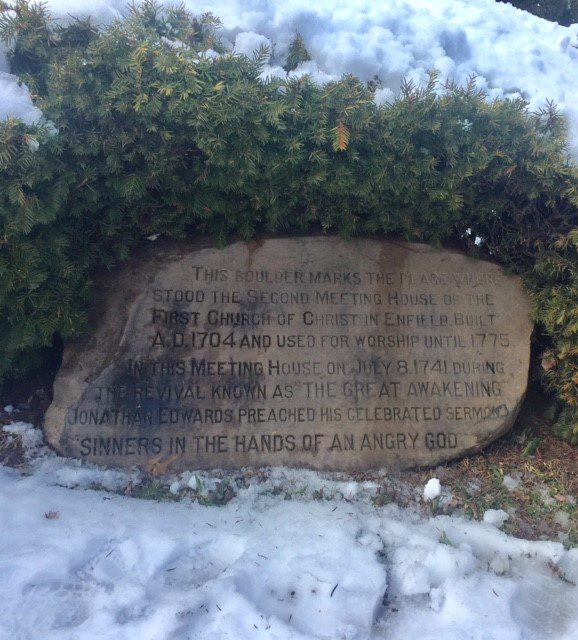
Site where Edwards Preached “Sinners in the Hands of an Angry God,” July 8, 1741; Picture Taken by Paul Louis Metzger
How many spider webs have you seen? Do you find a beautiful symmetry in each design? I don’t find such symmetry in every spider web I see. Some are asymmetrical. Some are exceptionally messy. Now, in light of what we said of Jonathan Edwards’s fascination with spiders (refer here to the first part of this mini-series by the same title), some might consider his theology the equivalent of an asymmetrical spider web. Why is that?
Take for example Edwards’s sermon “Sinners in the Hands of an Angry God.” Edwards describes an angry God dangling the sinner over the flames of hell like a spider over a blazing fire:
The God that holds you over the pit of hell, much as one holds a spider, or some loathsome insect, over the fire, abhors you, and is dreadfully provoked; his wrath towards you burns like fire; he looks upon you as worthy of nothing else, but to be cast into the fire; he is of purer eyes than to bear to have you in his sight; you are ten thousand times so abominable in his eyes as the most hateful venomous serpent is in ours. You have offended him infinitely more than ever a stubborn rebel did his prince: and yet ’tis nothing but his hand that holds you from falling into the fire every moment; ’tis to be ascribed to nothing else, that you did not go to hell the last night; that you was suffered to awake again in this world, after you closed your eyes to sleep: and there is no other reason to be given why you have not dropped into hell since you arose in the morning, but that God’s hand has held you up; there is no other reason to be given why you han’t gone to hell since you have sat here in the house of God, provoking his pure eyes by your sinful wicked manner of attending his solemn worship: yea, there is nothing else that is to be given as a reason why you don’t this very moment drop down into hell.[1]
Based on this sermon, you might think Edwards was morbid, fixated on judgment and hell—a real pessimist. If true, Edwards’s literary spider web, which he spun, would lack any sense of hope, optimism, and beauty, and ultimately, aesthetic wholeness. Now, depending on who you ask,[2] that would be a mistaken assessment, and not simply because Edwards loved symmetry. Besides noting Edwards’s love of beauty and proportion, “Sinners in the Hands of an Angry God” does not reveal the totality of Edwards’s sermonic repertoire. The editors of A Jonathan Edwards Reader assert,
As important as Sinners is…it cannot stand alone. Enveloping it is a cosmic optimism so inclusive that it binds individuals and planets into a universe of ultimate judgment and redemption. Even in Sinners, the reader discovers that all is not lost. The pessimism of sin and an angry God is overcome by the comforting hope of salvation through a triumphant, loving Savior. Whenever Edwards preached terror, it was part of a larger campaign to turn sinners from their disastrous path and to the rightful object of their affections, Jesus Christ.[3]
Moreover, the editors refer their readers to A Divine and Supernatural Light, which presents God’s love and grace in glorious terms. This particular work addresses the individual. Edwards’s publication, A History of Redemption, provides a cosmic vision of the redemption from a Trinitarian perspective.[4]
I was thinking of the apparent quest for symmetry in Edwards’s theology and sermons as I looked back on OMSC’s Jonathan Edwards tour this past winter, and as I have been pondering more recently Edwards’s aesthetic imagination. Our guide (Jon Hinkson of the Rivendell Institute at Yale University) spoke on the theme of the “pervasiveness of death” at one point on the tour. He noted how “much of Puritan instruction was designed to show how precarious life is.” Parents instructed their children that sleep is itself a type of death and taught their little ones this prayer: “This day is past, but tell me who can say, That I shall surely live another day.” The concern was more than imagined. Life in colonial America was exceptionally precarious. Our guide also quoted, “Nothing is more certain than death. Take no delay in the great work of preparing for death.” He shared that during Edwards’s senior year at Yale, he became deathly sick. Edwards painfully sensed that he was not prepared to meet his maker, remarking that the experience “shook me over the pit of hell.”
No doubt, the constant, close proximity of death to life for the very young to the very old, and Edwards’s own early encounter with the impending threat of death, shaped Edwards’s sermon, as well as his audience’s response. I got a taste of what these early Americans experienced as our narrator took us from a graveyard to the stone that marks the site (shown above) where Edwards preached this famous sermon during “The Great Awakening.”
One would have thought the imagery of the sermon, including God dangling the sinner over hell like a spider over a flame, was enough to warm my body as we stood in the snow as a strong wind hit our backs. However, perhaps I am just too cold-hearted, which is what Edwards feared for this congregation to whom he spoke as a guest preacher on July 8, 1741 (not 1941, as originally printed in this post!–thank you for the keen eye, Salvatore Anthony Luiso) in Enfield, MA. Theologians will debate the most effective way to awaken and warm souls—to move from the fear of God to the love of God, as Edwards appeared to do here, or from the love of God to the fear of God, as Karl Barth sought to do. Regardless what one makes of Edwards’s methodology in this sermon, and how it fits into his larger body of writings, one should not question his motive: to help his audience prepare to meet God so that they may not be ashamed and dismayed on the day of the divine visitation and the judgment to come. As Hebrews 9:27 declares, no one will escape mortality. All will have to give an account before God for our lives here below: “…it is appointed for mortals to die once, and after that the judgment” (Hebrews 9:27; NRSV).
Perhaps Edwards’s theology lacked aesthetic wholeness, but one cannot accuse him of falling for naïve optimism that fails to see the lesser angels of our nature’s advance. Nor can one accuse Edwards of falling prey to morbid pessimism that never looks for the light which will lead us out of the darkness of despair. The Niebuhrs were drawn to Edwards’s bridling of the former tendency in our modern world,[5] while Martin Luther King, Jr. likely would have commended him for holding in check the latter tendency as well as the former.
Which tendency do you and I struggle most to overcome—naïve optimism or morbid pessimism? If we are not careful and do not tend to the state of our souls, we will get caught and trapped in the asymmetrical and messy spider web of our own making unto our undoing.
_______________
[1]Jonathan Edwards, “Sinners in the Hands of an Angry God,” in A Jonathan Edwards Reader, ed. John E. Smith, Harry S. Stout, and Kenneth P. Minkema (New Haven: Yale University Press, 1995), pages 97-98.
[2]Consider Amy Plantinga Pauw’s discussion of Edwards’s theological program: “Edwards’s conception of God’s trinitarian union with creation could have funded a deep and expansive theology of cosmic redemption that embraced the groanings of all creation for liberation from its bondage to decay.” Pauw goes on to write that, “Yet it did not, and we find instead a drastic truncation of the moral and theological significance of the creaturely world within Edwards’s thought. Instead of a cosmic redemption, there is a cosmic holocaust: the earth created by God is annihilated in a paroxysm of apocalyptic violence, and the vast majority of God’s creatures are eternally bereft of the communications of God’s goodness and love that were God’s end in creation. Edwards’s treatment of sin, exacerbated by the idealist and rationalist impulses of his theology, is largely to blame for the failures of his doctrine of creation.” Lastly, “In Edwards’s theology, human and angelic sin strikes a blow from which God’s gracious end in creating the world never recovers: creaturely sin occasions the eternal destruction of the earth and most of its creatures.” Amy Plantinga Pauw, The Supreme Harmony of All: The Trinitarian Theology of Jonathan Edwards (Grand Rapids: Eerdmans, 2002), page 132. Later, Pauw writes of Edwards’s “cobbled Trinitarianism” that does not evidence the kind of coherence found in systematic theology in the modern period. His pastoral context where biblical and theological reflection was bound up with the immediate needs of congregants was a factor in this eclecticism. Pauw also reasons that the way in which Edwards drew upon psychological and social Trinitarian models in the development of his theology also led to a cobbled quality to his thought (pages 185-187).
[3]“Editor’s Introduction,” in A Jonathan Edwards Reader, ed. John E. Smith, Harry S. Stout, and Kenneth P. Minkema (New Haven: Yale University Press, 1995), page xviii.
[4]“Editor’s Introduction,” in Edwards Reader, page xix.
[5]“Editor’s Introduction,” in Edwards Reader, page xvii-xviii.
Previous Post

April 28, 2018
Hebrews' Closing Announcements: Missional Action Steps
Next Post
May 5, 2018 How to Build a Global Missional Movement: Be Open to Change
Browse Our Archives
Select a Category Uncategorized
Select a Month June 2025 April 2025 March 2025 January 2025 December 2024 November 2024 October 2024 September 2024 August 2024 July 2024 June 2024 May 2024 April 2024 March 2024 February 2024 January 2024 December 2023 November 2023 October 2023 September 2023 August 2023 July 2023 June 2023 May 2023 April 2023 March 2023 February 2023 January 2023 December 2022 November 2022 October 2022 September 2022 August 2022 July 2022 June 2022 May 2022 April 2022 March 2022 February 2022 January 2022 December 2021 November 2021 October 2021 September 2021 August 2021 July 2021 June 2021 May 2021 April 2021 March 2021 February 2021 January 2021 December 2020 November 2020 October 2020 September 2020 August 2020 July 2020 June 2020 May 2020 April 2020 March 2020 February 2020 January 2020 December 2019 November 2019 October 2019 September 2019 August 2019 July 2019 June 2019 May 2019 April 2019 March 2019 February 2019 January 2019 December 2018 November 2018 October 2018 September 2018 August 2018 July 2018 June 2018 May 2018 April 2018 March 2018 February 2018 January 2018 December 2017 November 2017 October 2017 September 2017 August 2017 July 2017 June 2017 May 2017 April 2017 March 2017 February 2017 January 2017 December 2016 November 2016 October 2016 September 2016 August 2016 July 2016 June 2016 May 2016 April 2016 March 2016 February 2016 January 2016 December 2015 November 2015 October 2015 September 2015 August 2015 July 2015 June 2015 May 2015 April 2015 March 2015 February 2015 January 2015 December 2014 November 2014 October 2014 September 2014 August 2014 July 2014 June 2014 May 2014 April 2014 March 2014 February 2014 January 2014 December 2013 November 2013 October 2013 September 2013 August 2013 July 2013 June 2013 May 2013 April 2013 March 2013 February 2013 January 2013 December 2012 November 2012 October 2012 September 2012 August 2012 July 2012 June 2012 May 2012 April 2012 March 2012 February 2012
Follow Us!
TAKE THE
Religious Wisdom Quiz
What does "Genesis" mean?
Select your answer to see how you score.
Wisdom Law History Origin or beginning
Books by This Author Books by Paul Louis Metzger
Related posts from Uncommon God, Common Good

Heavenly Father’s Day on Trinity Sunday

Easter Triduum: Obey Your Thirst—for God

Holy Week Is Humble Week: "Beware of Becoming...

Excavating the Person in a Throwaway Culture
TRENDING AT PATHEOS Evangelical

The REST of Your Life: A Creative Wrestles...
This week I had a conversation with a good friend from church....

How the author of the world's best hymn...
I've been working with John Newton for a while now. This makes...

Long before this Lectio Divina, Psalm 130 - the song - started...

What About the Trees? Another Living Parable
After I finished writing the last article about falling leaves as a...

Why Classical Education Is a Conversation, Not a...
Come and Read: Joy in Classical Education When I was a little...

Cornell University has received a great deal of negative publicity and intense...
view all Evangelical blogs
Ad-Free & Subscriber Log-In Subscription Support
- About Us
- 2026 Calendar
- Videos
- Podcasts
- Library of World Religions
- Faith In Media Tracker
- Advertise With Us
- Write for Us
- Privacy Policy
- Terms of Service
- Do Not Sell My Data
- Contact Us
- Radiant Digital
- Manage Newsletter Subscriptions
- Unsubscribe From Notifications
- Sitemap
Copyright 2008-2026, Patheos. All rights reserved.
Subscription Support Ad-Free & Subscriber Log-In
Follow Patheos