
BuddhistCatholicContemplativeEvangelicalGeneral ChristianHinduJewishLatter-day SaintMuslimNew VisionsProgressive Christian
Beliefs
- Buddhist
- Catholic
- Contemplative
- Evangelical
- General Christian
- Hindu
- Jewish
- Latter-day Saint
- More Voices
- Muslim
- New Visions
- Pagan
- Progressive Christian
Topics
- Religion News
- Food and Religion
- Sports and Religion
- Religious Art
- Religious Music and Entertainment
- Religious Events
- History and Religion
- Style and Religion
- Politics and Religion
- Women in Religion
- Recreation Outdoors and Religion
- Business Finance and Religion
- Careers Workplace and Religion
- Education and Religion
- Family Parenting and Religion
- Health Fitness and Religion
- Home and Religion
- Relationships and Religion
- Technology and Religion
- Travel and Religion
Columnists
- Buddhist Columnists
- Business Finance and Religion Columnists
- Careers Workplace and Religion Columnists
- Catholic Columnists
- Contemplative Columnists
- Education and Religion Columnists
- Evangelists Columnists
- Family Parenting and Religion Columnists
- General Christian Columnists
- Health Fitness and Religion Columnists
- Hindu Columnists
- History and Religion Columnists
- Home and Religion Columnists
- Jewish Columnists
- More Voices Columnists
- Latter Day Columnists
- Muslim Columnists
- New Visions Columnists
- Nonreligious Columnists
- Pagan Columnists
- Politics and Religion Columnists
- Progressive Columnists
- Recreation Outdoors and Religion Columnists
- Relationships and Religion Columnists
- Religion News Columnists
- Religious Art Columnists
- Religious Events Columnists
- Religious Music and Entertainment Columnists
- Sports and Religion Columnists
- Style and Religion Columnists
- Technology and Religion Columnists
- Travel and Religion Columnists
- Women in Religion Columnists
Resource Library
- 2026 Calendar
- Library of World Religions
- The 100 Most Holy Places on Earth
- Patheos Answers
- Podcasts
- Videos
- Faith Leaders Database
- Anglican Episcopalian
- Bahai
- Baptist
- Buddhism
- Christianity
- Confucianism
- Eastern Orthodoxy
- Hinduism
- Holiness and Pentecostal
- ISKCON
- Islam
- Judaism
- Lutheran
- Methodist
- The Church of Jesus Christ of Latter-day Saints
- New Age
- Paganism
- Presbytarian and Reformed
- Protestantism
- Religion Behind the Scenes
- Roman Catholic
- Scientology
- Shia Islam
- Sikhism
- Sufism
- Sunni Islam
- Taoism
- Zen
- See all religions
Research Tools
 Ad-Free & Subscriber Log-In Subscription Support
Ad-Free & Subscriber Log-In Subscription Support
Follow Patheos 

- Trending:
- Forgiveness
- |
- Marriage
- |
- Consciousness
- |
- Death Penalty
- |
- Election
- |
- Halloween

- Home
- Evangelical
- If You Could Be God, What Kind of God Would You Be?
If You Could Be God, What Kind of God Would You Be?
Last updated on: April 9, 2018 at 2:15 pm by Paul Louis Metzger
If You Could Be God, What Kind of God Would You Be? 2018-04-09T14:15:48-07:00 Paul Louis Metzger
Patheos Explore the world's faith through different perspectives on religion and spirituality! Patheos has the views of the prevalent religions and spiritualities of the world.
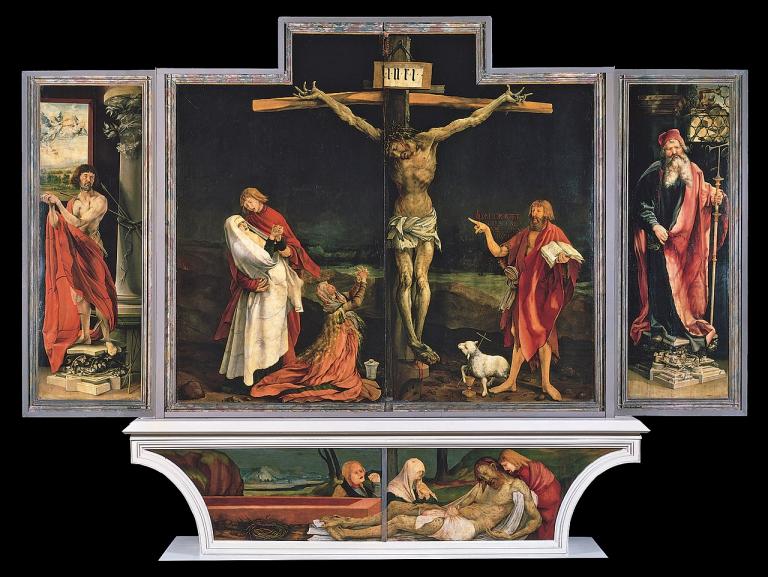
Isenheim altarpiece – First view; Mathias Grünewald, Public Domain
If you could be God, what kind of God would you be? A God of power like Zeus, or of heathen revelry like Dionysus? Would you ever consider becoming the God who becomes a lowly neighbor who is pushed off history’s stage with all who are marginalized? While Nietzsche’s version of Dionysus is not given to debauchery, but tragic heroism, nonetheless, the will to power doctrine entails that his Dionysus contends against Jesus, the crucified Messiah, who is the lowly neighbor.
Nietzsche provides us with the doctrine of humanity come of age, Renaissance man, the “final European,” as Karl Barth refers to him. Nietzsche repudiates the crucified God, who is the neighbor. In Jesus’ place, one finds Dionysus and the Übermensch, who for Nietzsche is the true goal of humanity.[1]
One could make a case that Barth developed his theology as a response to Nietzsche and Ludwig Feuerbach. Barth writes that the question posed by Feuerbach to the theology of Schleiermacher and his disciples concerns “whether and how far religion, revelation, the relation between God and man, can be made understandable as a predicate of man. Theology had let itself be driven by the upsurge of a self-glorifying and self-satisfied humanism from Pietism over the Enlightenment to Romanticism.” In the end, was not the result “the apotheosis of man?”[2]
The move to displace God did not begin with the masters of suspicion like Nietzsche and Feuerbach, though. According to the biblical narrative, it began in Genesis chapter 3. Our primal story entails wanting to be like God without God–autonomy. According to the New Testament, only Jesus operates differently. He takes on himself our isolation. Even though he is in the nature of God, he did not consider deity something he had to grasp, and so made himself nothing for others. As a result, God glorified him above all others. No wonder, St. Paul instructs us to consider Jesus. He is the model for considering others better than ourselves and so live in a manner pleasing to God.
Now Nietzsche believed that the Crucified God is the church’s projected attempt at becoming God. How so? In his mind, the clergy seeks to gain control over others who should lay their lives down for the church just as Jesus laid down his life. In Nietzsche’s estimation, it is an insidious, but quite successful move to put down the aristocrats and gain power over the people (Refer here for a helpful treatment of Nietzsche’s Beyond Good and Evil and On the Genealogy of Morals, Essay III). Here’s Nietzsche’s charge of projectionism: “God on the cross—are the horrible secret thoughts behind this symbol not understood yet? All that suffers, all that is nailed to the cross, is divine. All of us are nailed to the cross, consequently we are divine. We alone are divine. Christianity was a victory, a nobler outlook perished of it—Christianity has been the greatest misfortune of mankind so far.”[3] But what if the church does not seek to gain power through the guise of servanthood in pursuit of divinity, but release and share power with those in need and those in the margins–from the margins, just like our Lord, and like his servant Timothy. Paul says of his son in the faith that Timothy is unique in this regard: “For I have no one like him, who will be genuinely concerned for your welfare. For they all seek their own interests, not those of Jesus Christ” (Philippians 2:20-21; ESV). The only way to counter Nietzsche’s charge of projectionism is not to project false testimony, but embody cruciform witness through participation in Christ Jesus’ life.
For Barth, God demonstrates Jesus’ deity in his divine humiliation, not our humiliation. God exalts humanity in Jesus’ ascent, just as he undertakes the far journey of divine isolation and humiliation in his descent.[4] The only way to counter Nietzsche and Feuerbach’s charge is not simply to observe Jesus’ story, but to embrace it as our own. And why would we want to do so? It is because Jesus’ story is by no means a projection of self-love in the ceaseless, joyless attempt to knock off the aristocracy and become God in their place. Rather, Jesus’ story is the ultimate revelation of selfless, unceasing joyful love through which God shares the divine life with us for all eternity.
_______________
[1]Karl Barth, Church Dogmatics, vol. III/2, The Doctrine of Creation, ed. G. W. Bromiley and T. F. Torrance (Edinburgh: T. & T. Clark, 1960), page 236. See Barth’s entire treatment of Nietzsche on this subject on pages 231-242. Nietzsche speaks of Christ as a neighbor in his work, The Will to Power. See Friedrich W. Nietzsche, The Will to Power, ed. Walter Kaufmann, trans. Walter Kaufmann and R. J. Hollingdale (New York: Random House, 1967), pages 107-108. See also Barth, Church Dogmatics, vol. III/2, pages 239, 240. For Nietzsche’s opposition of Dionysus to the Crucified, see Friedrich W. Nietzsche, Ecce Homo, ed. Walter Kaufmann (New York: Vintage Books, 1969), pages 332-335. See also Barth, Church Dogmatics, vol. III/2, pages 236-242. Here’s Walter Kaufmann’s explanation of this particular Nietzschean take on Dionysus: “Looking for a pre-Christian, Greek symbol that he might oppose to ‘the Crucified,’ Nietzsche found Dionysius. His ‘Dionysius’ is neither the god of the ancient Dionysian festivals nor the god Nietzsche had played off against Apollo in The Birth of Tragedy, although he does, of course, bear some of the features of both. In the later works of Nietzsche, ‘Dionysius’ is no longer the spirit of unrestrained passion, but the symbol of the affirmation of life with all its suffering and terror. ‘The problem,’ Nietzsche explained in a note that was later included in the posthumous Will to Power (section 1052), ‘is that of the meaning of suffering: whether a Christian meaning or a tragic meaning…. The tragic man affirms even the harshest suffering.’ And Ecce Homo is, not least of all, Nietzsche’s final affirmation of his own cruel life.” Walter Kaufmann, “Editor’s Introduction” to Ecce Homo, in Basic Writings of Nietzsche, edited by Walter Kaufmann (New York: The Modern Library, 1992), page 665. See also Nietzsche’s account of the tragic figure’s embrace of all of life as it is on pages 762, 765, 783, and 787 of Ecce Homo.
[2]Karl Barth, “Ludwig Feuerbach,” in Theology and Church: Shorter Writings, 1920-1928, with an introduction by T. F. Torrance, trans. Louise Pettibone Smith (New York: Harper & Row, Publishers, 1962), page 227. See also Ludwig Feuerbach, Lectures on the Essence of Religion, trans. Ralph Manheim (New York, Evanston, and London: Harper & Row, Publishers, 1967), page 17.
[3]See the whole context of this statement in Friedrich Nietzsche, The Antichrist, in The Portable Nietzsche, ed. Walter Kaufmann (New York: The Viking Press, 1968), pages 633-644.
[4]See Karl Barth, Church Dogmatics. vol. IV/1, The Doctrine of Reconciliation, ed. G. W. Bromiley and T. F. Torrance (Edinburgh: T. & T. Clark, 1956); Church Dogmatics. vol. IV/2, The Doctrine of Reconciliation, ed. by G. W. Bromiley and T. F. Torrance. (Edinburgh: T. & T. Clark, 1958).
Previous Post

April 4, 2018
Dr King Speaks Today. Are We Listening?
Next Post
April 14, 2018 Faith Alone Does Not Mean You Have to Go It Alone
Browse Our Archives
Select a Category Uncategorized
Select a Month June 2025 April 2025 March 2025 January 2025 December 2024 November 2024 October 2024 September 2024 August 2024 July 2024 June 2024 May 2024 April 2024 March 2024 February 2024 January 2024 December 2023 November 2023 October 2023 September 2023 August 2023 July 2023 June 2023 May 2023 April 2023 March 2023 February 2023 January 2023 December 2022 November 2022 October 2022 September 2022 August 2022 July 2022 June 2022 May 2022 April 2022 March 2022 February 2022 January 2022 December 2021 November 2021 October 2021 September 2021 August 2021 July 2021 June 2021 May 2021 April 2021 March 2021 February 2021 January 2021 December 2020 November 2020 October 2020 September 2020 August 2020 July 2020 June 2020 May 2020 April 2020 March 2020 February 2020 January 2020 December 2019 November 2019 October 2019 September 2019 August 2019 July 2019 June 2019 May 2019 April 2019 March 2019 February 2019 January 2019 December 2018 November 2018 October 2018 September 2018 August 2018 July 2018 June 2018 May 2018 April 2018 March 2018 February 2018 January 2018 December 2017 November 2017 October 2017 September 2017 August 2017 July 2017 June 2017 May 2017 April 2017 March 2017 February 2017 January 2017 December 2016 November 2016 October 2016 September 2016 August 2016 July 2016 June 2016 May 2016 April 2016 March 2016 February 2016 January 2016 December 2015 November 2015 October 2015 September 2015 August 2015 July 2015 June 2015 May 2015 April 2015 March 2015 February 2015 January 2015 December 2014 November 2014 October 2014 September 2014 August 2014 July 2014 June 2014 May 2014 April 2014 March 2014 February 2014 January 2014 December 2013 November 2013 October 2013 September 2013 August 2013 July 2013 June 2013 May 2013 April 2013 March 2013 February 2013 January 2013 December 2012 November 2012 October 2012 September 2012 August 2012 July 2012 June 2012 May 2012 April 2012 March 2012 February 2012
Follow Us!
TAKE THE
Religious Wisdom Quiz
What foreign power destroyed Jerusalem, ending the kingdom of Judah?
Select your answer to see how you score.
Babylon Assyria Persia Egypt
Books by This Author Books by Paul Louis Metzger
Related posts from Uncommon God, Common Good

Heavenly Father’s Day on Trinity Sunday

Easter Triduum: Obey Your Thirst—for God

Holy Week Is Humble Week: "Beware of Becoming...

Excavating the Person in a Throwaway Culture
TRENDING AT PATHEOS Evangelical

The REST of Your Life: A Creative Wrestles...
This week I had a conversation with a good friend from church....

How the author of the world's best hymn...
I've been working with John Newton for a while now. This makes...

Long before this Lectio Divina, Psalm 130 - the song - started...

What About the Trees? Another Living Parable
After I finished writing the last article about falling leaves as a...

Why Classical Education Is a Conversation, Not a...
Come and Read: Joy in Classical Education When I was a little...

Cornell University has received a great deal of negative publicity and intense...
view all Evangelical blogs
Ad-Free & Subscriber Log-In Subscription Support
- About Us
- 2026 Calendar
- Videos
- Podcasts
- Library of World Religions
- Faith In Media Tracker
- Advertise With Us
- Write for Us
- Privacy Policy
- Terms of Service
- Do Not Sell My Data
- Contact Us
- Radiant Digital
- Manage Newsletter Subscriptions
- Unsubscribe From Notifications
- Sitemap
Copyright 2008-2026, Patheos. All rights reserved.
Subscription Support Ad-Free & Subscriber Log-In
Follow Patheos