
BuddhistCatholicContemplativeEvangelicalGeneral ChristianHinduJewishLatter-day SaintMuslimNew VisionsProgressive Christian
Beliefs
- Buddhist
- Catholic
- Contemplative
- Evangelical
- General Christian
- Hindu
- Jewish
- Latter-day Saint
- More Voices
- Muslim
- New Visions
- Pagan
- Progressive Christian
Topics
- Religion News
- Food and Religion
- Sports and Religion
- Religious Art
- Religious Music and Entertainment
- Religious Events
- History and Religion
- Style and Religion
- Politics and Religion
- Women in Religion
- Recreation Outdoors and Religion
- Business Finance and Religion
- Careers Workplace and Religion
- Education and Religion
- Family Parenting and Religion
- Health Fitness and Religion
- Home and Religion
- Relationships and Religion
- Technology and Religion
- Travel and Religion
Columnists
- Buddhist Columnists
- Business Finance and Religion Columnists
- Careers Workplace and Religion Columnists
- Catholic Columnists
- Contemplative Columnists
- Education and Religion Columnists
- Evangelists Columnists
- Family Parenting and Religion Columnists
- General Christian Columnists
- Health Fitness and Religion Columnists
- Hindu Columnists
- History and Religion Columnists
- Home and Religion Columnists
- Jewish Columnists
- More Voices Columnists
- Latter Day Columnists
- Muslim Columnists
- New Visions Columnists
- Nonreligious Columnists
- Pagan Columnists
- Politics and Religion Columnists
- Progressive Columnists
- Recreation Outdoors and Religion Columnists
- Relationships and Religion Columnists
- Religion News Columnists
- Religious Art Columnists
- Religious Events Columnists
- Religious Music and Entertainment Columnists
- Sports and Religion Columnists
- Style and Religion Columnists
- Technology and Religion Columnists
- Travel and Religion Columnists
- Women in Religion Columnists
Resource Library
- 2026 Calendar
- Library of World Religions
- The 100 Most Holy Places on Earth
- Patheos Answers
- Podcasts
- Videos
- Faith Leaders Database
- Anglican Episcopalian
- Bahai
- Baptist
- Buddhism
- Christianity
- Confucianism
- Eastern Orthodoxy
- Hinduism
- Holiness and Pentecostal
- ISKCON
- Islam
- Judaism
- Lutheran
- Methodist
- The Church of Jesus Christ of Latter-day Saints
- New Age
- Paganism
- Presbytarian and Reformed
- Protestantism
- Religion Behind the Scenes
- Roman Catholic
- Scientology
- Shia Islam
- Sikhism
- Sufism
- Sunni Islam
- Taoism
- Zen
- See all religions
Research Tools
 Ad-Free & Subscriber Log-In Subscription Support
Ad-Free & Subscriber Log-In Subscription Support
Follow Patheos 

- Trending:
- Forgiveness
- |
- Marriage
- |
- Consciousness
- |
- Death Penalty
- |
- Election
- |
- Halloween

- Home
- Evangelical
- Baptism and the Lord’s Supper Are Rites of Passage from “Egypt” to the “Promised Land,” not Symbols of a “Babylonian Captivity”
Baptism and the Lord’s Supper Are Rites of Passage from “Egypt” to the “Promised Land,” not Symbols of a “Babylonian Captivity”
Last updated on: April 21, 2017 at 8:22 am by Paul Louis Metzger
Baptism and the Lord’s Supper Are Rites of Passage from “Egypt” to the “Promised Land,” not Symbols of a “Babylonian Captivity” 2017-04-21T08:22:01-07:00 Paul Louis Metzger
Patheos Explore the world's faith through different perspectives on religion and spirituality! Patheos has the views of the prevalent religions and spiritualities of the world.
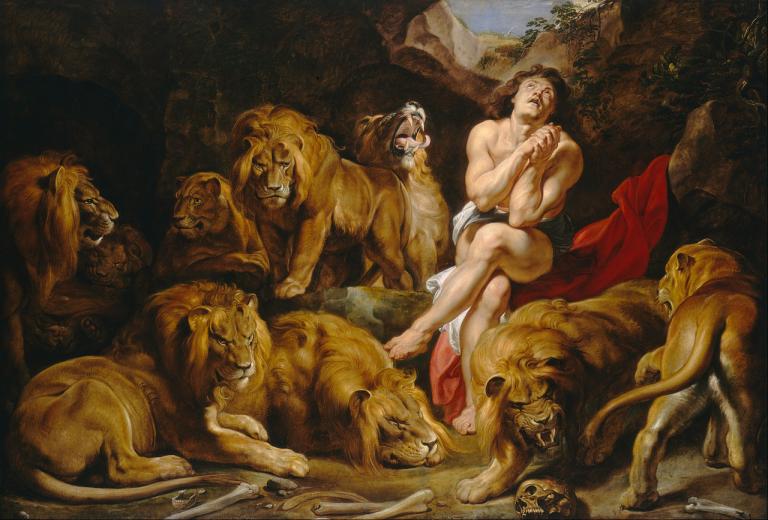
Daniel in the Lion’s Den in Babylon, by Peter Paul Rubens, 1615 A.D., Creative Commons

Baptism and the Lord’s Supper are rites of passage from “Egypt” to the “Promised Land,” not symbols of a Babylonian Captivity. Rites of passage are ceremonies or celebrations that occur when people leave one group to join another. So, which group is it that we leave and what group are we entering when celebrating Baptism and the Lord’s Supper?
Ultimately, baptism signifies death to our old humanity and new life in Jesus, the truly human and the personal ground of our new humanity. We died with Jesus and have been raised with him through our union by faith in the Spirit. As a result, we are to live no longer as slaves to sin, but as slaves to righteousness (See Romans 6). Whereas baptism refers to the beginning of the Christian life, the Lord’s Supper refers to the continuation and maturation of the Christian life. Having been cleansed (1 Peter 3:21) and baptized into Jesus’ body through the Spirit (See 1 Peter 3:21; 1 Corinthians 12:13), we find our nourishment as we feast upon Jesus through his Word in faith, recollecting his sacrificial work (1 Corinthians 11:23-26), participating in his presence (1 Corinthians 10:14-22), and anticipating his return (Luke 22:15-18; 1 Corinthians 11:26).
According to 1st Corinthians 10, the people of Israel were baptized into Moses at the Red Sea (1 Corinthians 10:2; see also Exodus 14). Moreover, they ate the Passover Meal in preparation for their exodus from Egypt (Exodus 12). Every baptism in the Church and every celebration of the Lord’s Supper reenacts the Church’s participation and ultimate fulfillment of this story in Jesus of Nazareth through whom all God’s people receive their eternal inheritance (Hebrews 11:39-40). Luke 22:7-23 depicts the Lord’s Supper, which Paul recounts in 1 Corinthians 11, and alludes to in chapter ten.
Paul warns the Corinthian Christians to refrain from sexual immorality and idolatry (chapter 10) and divisions in the body, including exclusion based on the “haves” and “have not’s” (chapter 11).[1] He warns them in light of Israel’s fate in the wilderness (chapter 10:5) and in light of how some of them have already died because of partaking of the Table in an unworthy manner (chapter 11:29-30). Contrary to what some might have thought or took for granted, these rites were not mere symbols, but vital signs that expressed their life with God in Jesus, and with which no one should trifle. And yet, they did trifle. They failed to account for the spiritual significance of these sacred signs. Like Israel of old, they were in danger of heading back to spiritual slavery in Egypt, dying in the spiritual wasteland, or falling prey to spiritual exile in Babylon.
Sometimes, people have confused the rites of passage from Egypt to the Promised Land with entrance into other domains, such as sub-cultures or even nation states and empires. Throughout much of western church history, Baptism and the Lord’s Supper were not simply rites of passage into Church fellowship, but entrance into the larger sub-culture, or at times, the whole society. The connection between the Church and State was, and still is in some places, a very synthetic or cohesive one. It entailed what many refer to as Christendom in which to be an Englishman or a German or an Italian or an American meant being a Christian, and vice versa. Going way back, once the Church received official recognition by the Roman Empire, it was no longer persecuted. Such official recognition led to the Holy Roman Empire in which the citizens of the empire and God’s kingdom were one. As a result, some claimed that the Church went from one persecution to another—namely, the “Babylonian Captivity” or “Egyptian Captivity,” however one wishes to express Empire.
Interestingly enough, Martin Luther spoke of the Babylonian Captivity of the Church in relation to the sacraments. In his work by that title, “The Babylonian Captivity of the Church,” Luther addresses the seven sacraments of the Roman Catholic Church, rejects several of them, restores the cup to the laity in his emerging network of churches, dismisses Transubstantiation (while still affirming Christ’s real presence), and repudiates the idea that Christ is sacrificed anew in the Mass. Luther’s critique of sacramentalism was devastating to the priestly powers (sacerdotalism). Still, in the case of the Mass, Luther’s aim was not to destroy or undermine the priesthood, as the Luther scholar Roland Bainton argues. Bainton writes, “His concerns were always primarily religious and only incidentally ecclesiastical or sociological. His first insistence was that the sacrament of the mass must be not magical but mystical, not the performance of a rite but the experience of a presence.”[2]
But did Luther go far enough with his critique? While Luther made the Lord’s Supper’s efficacy dependent upon the individual participant’s faith, he went in another direction with infant baptism. He did not renounce infant baptism. Rather, he made its efficacy dependent upon the faith of a child’s sponsor. Thus, water baptism remained a “sociological sacrament.” Bainton reflects upon the matter:
One cannot die for another, but one can in a sense be initiated for another into a Christian community. For that reason baptism rather than the Lord’s Supper is the sacrament which links the Church to society. It is the sociological sacrament. For the medieval community every child outside the ghetto was by birth a citizen and by baptism a Christian. Regardless of personal conviction the same persons constituted the state and the Church. An alliance of the two institutions was thus natural. Here was a basis for a Christian society. The greatness and the tragedy of Luther was that he could never relinquish either the individualism of the eucharistic cup or the corporateness of the baptismal font. He would have been a troubled spirit in a tranquil age.[3]
For all Luther’s talk that the Church was held captive through faulty teachings and related practices pertaining to the sacraments, he did not make a clean break himself.
This is not to say that it is only adherents of infant baptism who can easily confuse Church and State, whether historically or presently. I have witnessed a great deal of believer baptism communities that tend to view the baptismal act as salutary and ultimately a rite of passage into the society at large, and not into a vibrant community of living faith. No matter if we are Roman Catholic, Lutheran or Baptist, we must guard against an ex opera operato orientation in which active faith is missing and salvation is mediated simply by the ceremonious act itself.
The sacraments or ordinances as the case may be can function as rites of passage[4] into a vibrant and liberating community of living faith in Jesus. We must not discount their spiritual significance, nor confuse these rites with entrance into society at large or the State. When such disregard or confusion occurs, we go from celebrating our freedom in Christ Jesus to being enslaved by other lords—like “Babylonian Captivities” of old. When such disregard or confusion occurs, we move from finding our ultimate identities and imaginations enwrapped in Christ’s kingdom reality to this or that social club’s marketing pitch and brand, or nation state’s creed and flag. When that occurs, the church will require a revival in God’s Spirit—a true baptism by fire!
_______________
[1]According to Gordon Fee, the Lord’s Supper was probably part of a common meal. The ‘haves’ and ‘have-nots’ were likely divided during this celebration, as it was “sociologically natural for the host to invite those of his/her own class to eat” in the dining room. Those not of their class (the less fortunate here in Corinth) ate in the courtyard. Gordon D. Fee, The First Epistle to the Corinthians, The New International Commentary on the New Testament, vol. 7 (Grand Rapids: Eerdmans, 1987), pages 533-34.
[2]Roland H. Bainton, Here I Stand: A Life of Martin Luther (New York: A Mentor Book, 1977), page 107. On the devastating blow to the medieval church that resulted from this treatise, see pages 105-106 of Bainton.
[3]Bainton, Here I Stand, page 110.
[4]I do not have opportunity in this post given the limits of space to address the subject of baptismal regeneration by water, a doctrine I reject. Nonetheless, I maintain that there is a subtle connection between spiritual and physical reality, as Scripture conveys spiritual realities through physical means. Thus, while not effectual, water baptism and the Lord’s Supper participate in the spiritual realities to which they point: namely, God’s Trinitarian mystical (not magical) operations in the life of the believer and believing community through faith in God’s Word.
Next Post

April 22, 2017 If the World Were to End Tomorrow, Would You Plant a Tree on Earth Day?
Browse Our Archives
Select a Category Uncategorized
Select a Month June 2025 April 2025 March 2025 January 2025 December 2024 November 2024 October 2024 September 2024 August 2024 July 2024 June 2024 May 2024 April 2024 March 2024 February 2024 January 2024 December 2023 November 2023 October 2023 September 2023 August 2023 July 2023 June 2023 May 2023 April 2023 March 2023 February 2023 January 2023 December 2022 November 2022 October 2022 September 2022 August 2022 July 2022 June 2022 May 2022 April 2022 March 2022 February 2022 January 2022 December 2021 November 2021 October 2021 September 2021 August 2021 July 2021 June 2021 May 2021 April 2021 March 2021 February 2021 January 2021 December 2020 November 2020 October 2020 September 2020 August 2020 July 2020 June 2020 May 2020 April 2020 March 2020 February 2020 January 2020 December 2019 November 2019 October 2019 September 2019 August 2019 July 2019 June 2019 May 2019 April 2019 March 2019 February 2019 January 2019 December 2018 November 2018 October 2018 September 2018 August 2018 July 2018 June 2018 May 2018 April 2018 March 2018 February 2018 January 2018 December 2017 November 2017 October 2017 September 2017 August 2017 July 2017 June 2017 May 2017 April 2017 March 2017 February 2017 January 2017 December 2016 November 2016 October 2016 September 2016 August 2016 July 2016 June 2016 May 2016 April 2016 March 2016 February 2016 January 2016 December 2015 November 2015 October 2015 September 2015 August 2015 July 2015 June 2015 May 2015 April 2015 March 2015 February 2015 January 2015 December 2014 November 2014 October 2014 September 2014 August 2014 July 2014 June 2014 May 2014 April 2014 March 2014 February 2014 January 2014 December 2013 November 2013 October 2013 September 2013 August 2013 July 2013 June 2013 May 2013 April 2013 March 2013 February 2013 January 2013 December 2012 November 2012 October 2012 September 2012 August 2012 July 2012 June 2012 May 2012 April 2012 March 2012 February 2012
Follow Us!
TAKE THE
Religious Wisdom Quiz
How was Haman punished for his plot?
Select your answer to see how you score.
He was beheaded He was hanged on the gallows he built He was exiled He was turned into a pillar of salt
Books by This Author Books by Paul Louis Metzger
Related posts from Uncommon God, Common Good

Heavenly Father’s Day on Trinity Sunday

Easter Triduum: Obey Your Thirst—for God

Holy Week Is Humble Week: "Beware of Becoming...

Excavating the Person in a Throwaway Culture
TRENDING AT PATHEOS Evangelical

How the author of the world's best hymn...
I've been working with John Newton for a while now. This makes...

Long before this Lectio Divina, Psalm 130 - the song - started...

What About the Trees? Another Living Parable
After I finished writing the last article about falling leaves as a...

Why Classical Education Is a Conversation, Not a...
Come and Read: Joy in Classical Education When I was a little...

Falling Leaves: A Living Parable on Letting Go
I’ve spent the vast majority of my life in the southeast corner...

Cornell University has received a great deal of negative publicity and intense...
view all Evangelical blogs
Ad-Free & Subscriber Log-In Subscription Support
- About Us
- 2026 Calendar
- Videos
- Podcasts
- Library of World Religions
- Faith In Media Tracker
- Advertise With Us
- Write for Us
- Privacy Policy
- Terms of Service
- Do Not Sell My Data
- Contact Us
- Radiant Digital
- Manage Newsletter Subscriptions
- Unsubscribe From Notifications
- Sitemap
Copyright 2008-2026, Patheos. All rights reserved.
Subscription Support Ad-Free & Subscriber Log-In
Follow Patheos