
BuddhistCatholicContemplativeEvangelicalGeneral ChristianHinduJewishLatter-day SaintMuslimNew VisionsProgressive Christian
Beliefs
- Buddhist
- Catholic
- Contemplative
- Evangelical
- General Christian
- Hindu
- Jewish
- Latter-day Saint
- More Voices
- Muslim
- New Visions
- Pagan
- Progressive Christian
Topics
- Religion News
- Food and Religion
- Sports and Religion
- Religious Art
- Religious Music and Entertainment
- Religious Events
- History and Religion
- Style and Religion
- Politics and Religion
- Women in Religion
- Recreation Outdoors and Religion
- Business Finance and Religion
- Careers Workplace and Religion
- Education and Religion
- Family Parenting and Religion
- Health Fitness and Religion
- Home and Religion
- Relationships and Religion
- Technology and Religion
- Travel and Religion
Columnists
- Buddhist Columnists
- Business Finance and Religion Columnists
- Careers Workplace and Religion Columnists
- Catholic Columnists
- Contemplative Columnists
- Education and Religion Columnists
- Evangelists Columnists
- Family Parenting and Religion Columnists
- General Christian Columnists
- Health Fitness and Religion Columnists
- Hindu Columnists
- History and Religion Columnists
- Home and Religion Columnists
- Jewish Columnists
- More Voices Columnists
- Latter Day Columnists
- Muslim Columnists
- New Visions Columnists
- Nonreligious Columnists
- Pagan Columnists
- Politics and Religion Columnists
- Progressive Columnists
- Recreation Outdoors and Religion Columnists
- Relationships and Religion Columnists
- Religion News Columnists
- Religious Art Columnists
- Religious Events Columnists
- Religious Music and Entertainment Columnists
- Sports and Religion Columnists
- Style and Religion Columnists
- Technology and Religion Columnists
- Travel and Religion Columnists
- Women in Religion Columnists
Resource Library
- 2026 Calendar
- Library of World Religions
- The 100 Most Holy Places on Earth
- Patheos Answers
- Podcasts
- Videos
- Faith Leaders Database
- Anglican Episcopalian
- Bahai
- Baptist
- Buddhism
- Christianity
- Confucianism
- Eastern Orthodoxy
- Hinduism
- Holiness and Pentecostal
- ISKCON
- Islam
- Judaism
- Lutheran
- Methodist
- The Church of Jesus Christ of Latter-day Saints
- New Age
- Paganism
- Presbytarian and Reformed
- Protestantism
- Religion Behind the Scenes
- Roman Catholic
- Scientology
- Shia Islam
- Sikhism
- Sufism
- Sunni Islam
- Taoism
- Zen
- See all religions
Research Tools
 Ad-Free & Subscriber Log-In Subscription Support
Ad-Free & Subscriber Log-In Subscription Support
Follow Patheos 

- Trending:
- Forgiveness
- |
- Marriage
- |
- Consciousness
- |
- Death Penalty
- |
- Election
- |
- Halloween

- Home
- Evangelical
- Unmask Halloween and Humanity
Unmask Halloween and Humanity
Last updated on: October 28, 2015 at 3:47 pm by Paul Louis Metzger
Unmask Halloween and Humanity 2015-10-28T15:47:32-07:00 Paul Louis Metzger
Patheos Explore the world's faith through different perspectives on religion and spirituality! Patheos has the views of the prevalent religions and spiritualities of the world.
©iStock
By Paul Louis Metzger and John W. Morehead*
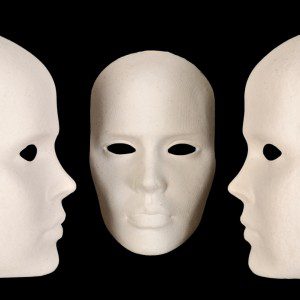
Masks and costumes shroud people at Halloween. Halloween is also shrouded in many circles, albeit in ignorance and superstition. For example, Ronald Hutton claims in an article titled, “Halloween: It’s More than Trick or Treat,” that in the 1980s, “some American evangelical Christians” condemned “the festival as a glorification of the powers of evil (thus missing all its historical associations)….” What were the historical associations that were/are often lost on Evangelicals?
Many Evangelicals have embraced assumptions that Halloween as it is practiced today is completely pagan in origin, that the holiday incorporates pagan symbols and practices, and that it glorifies death. But we need to look a little more carefully at the history of Halloween. When we do it is clear that the present form of Halloween celebrated in America incorporates a number of influences. One major influence is pagan. The Celtic celebration of Samhain (pronounced “sow-ween” or “sow-in”) in Ireland was an agricultural festival that celebrated the end of summer, and the transition to winter with all of its challenges, including the increasing possibility of death in the coming cold months ahead. But there are other influences beyond pagan sources. Christianity has had its imprint as well. This came in the form of Catholicism with its All Souls’ and All Saints’ Day. held on Nov. 1. As what would eventually become Halloween continued its journey through history and various cultures, it came to America through Irish immigrants; eventually it became secularized. In its present form it has lost all religious connotations, symbolism and rites, and is largely a secular and commercial holiday associated with children’s costuming, and trick or treating for candy.
But what of Christian fears associated with Halloween? As noted previously, although Halloween does have pagan influences historically, it is not pagan in its present form. And when it comes to Halloween and death, this is a subject that Christians should want to grapple with, and do so carefully. Halloween gives us an opportunity to do just this. As Hutton has noted, “a Christian feast of the dead is thoroughly embedded in the history of Hallowe’en.” See his work, The Stations of the Sun: A History of the Ritual Year in Britain (Oxford: Oxford University Press, 1996). This embedded trait continues through the Roman Catholic Church. Beyond that, the Christian tradition is concerned with death, as the gospel includes the story of Christ overcoming death through his own death and resurrection.
It is not our intention to tell Evangelicals that they should or should not celebrate Halloween. However, it is important that we think more carefully about the historical development of Halloween (and other holidays, including Christmas with its various sources) so that we don’t make distorted claims. Moreover, an awareness of the historical features and emphases can provide us with opportunities to reflect on elements of our Christian life, including Christ’s victory over the grave. Moreover, while Christ’s life, death and resurrection are alone meritorious, remembrance at this time of year of martyred saints throughout the ages should inspire us to bear faithful witness to Christ as our sure hope.
It is important that we unmask ignorance and superstition, so that we see them for what they are. As Protestant Evangelicals, we remember fondly Martin Luther’s 95 theses, which we purportedly nailed to the Wittenberg Castle church door on October 31st 1517 (the day we celebrate Halloween; refer here for a treatment of the history and legend surrounding the 95 Theses). Among other things, Luther sought to unmask superstition bound up with indulgences, merits of the saints and other distorted beliefs and practices that clouded the good news of Jesus Christ. In keeping with Luther’s instincts, the Reformation principle of returning again daily to be reformed by the Word is an important safeguard that, when practiced, helps protect Christians from cementing their views of God and others, but keeps us open to fresh, authentic and truthful encounters.
Like the humanist emphasis on returning to the sources, this Reformation principle should be at work as we engage religion. It should also be at work, as we engage the religious other, including Pagans, whom Christians often view in distorted ways. We must be on guard not to mask them with labels that keep us from seeing them for who they are. So despite Evangelical fears regarding Halloween that is associated with its alleged Pagan and Satanic connotations, the reality is very different. Pagans don’t celebrate Halloween. Instead, they celebrate Samhain based upon a seasonal sacred calendar. While Satanists do celebrate Halloween as one of three primary holidays, at least in LaVeyan Satanism, our secular Halloween has nothing to do with personalized Satanic associations drawn from horror films (it is important to note that most Satanists do not believe in a supernatural being called Satan, but are radical individualists). Anton LaVey wrote concerning Halloween that it is celebrated by Satanists “… as a time when one’s inner-self might be explored through the use of a costume, or one might recall those of importance in one’s life who have died — as was done on that night in European tradition” (This statement is taken from the F.A.Q. Holidays, churchofsatan.com.) The point to take away here is that when Evangelicals mistakenly identify Halloween as Pagan or Satanic, we are putting a mask on others that misrepresents their actual practices and beliefs. We believe it is a Christian virtue to seek to understand and represent others accurately and fairly, particularly in a culture where are divisions are so often the focus of conflict in the public square (See one of our attempts at seeking to understand contemporary Paganism rightly at the blog post “Idol Makers”). Why should those of other traditions seek to understand and represent our convictions and practices fairly if we shroud them with caricatures and distorted images?
While it is important to unmask images that distort religion and religious others, there are times when a particular form of masking can prove beneficial. Take for example identity play associated with Halloween. Dressing up in various costumes for Halloween is not only the stuff of children. In recent years, dressing up has become increasingly popular among adults who go to parties. There seems to be more than partying and play at work here. A close examination of the scholarship on festivals in history (such as the Feast of Fools, Carnival and Lent), as well as related present festival and festive practices, reveals a long interest of participation in events that provide the opportunity to assume temporarily other people’s identities. Many of these festivals were linked to the feasts of the church. The costuming, identity play and subversive practiced connected to these festivals have not only been done for entertainment purposes, but have also included religious connotations. For example, Max Harris has connected such festivity to the Magnificat from the first chapter of Luke’s Gospel. He discusses the connection between the identity play and social inversion of festival and the Judeo-Christian scriptural narratives in this area: “The Feast of Fools, with its explicit justification in the Magnificat, noisily proclaimed the Christian basis for festive roles of reversal…. [This is echoed in] Christ’s utterances about children and the Kingdom of Heaven, Isaiah’s prophecy that a little child shall lead them (Isaiah 11:6), and the theme of inversion and the world turned upside-down found in texts like the ‘Magnificat.’” For more on this, see his work Carnival and Other Christian Festivals: Folk Theology and Folk Performance (Oxford University Press, 1996).
Perhaps Evangelicals can use the costuming and identify experimentation associated with Halloween as an opportunity to think critically on their spiritual identities. Are we authentic in our identities and in our relationships with God and others? Or are we, too, wearing masks and playing parts that are as unreal and fleeting as the costumed children knocking on doors asking for candy this Halloween?
*Paul Louis Metzger serves as the Director of The Institute for the Theology of Culture: New Wine, New Wineskins at Multnomah University, and as a Senior Fellow of the Foundation for Religious Diplomacy. In addition to his work with diverse religious communities such as Buddhism, Islam and Paganism, he is the author of numerous books, including Connecting Christ: How to Discuss Jesus in a World of Diverse Paths, as well as Evangelical Zen: A Christian’s Spiritual Travels with a Buddhist Friend (with a foreword and responses by Kyogen Carlson). John W. Morehead is the Custodian of the Evangelical Chapter of the Foundation for Religious Diplomacy, the Director of the Western Institute for Intercultural Studies, and has been involved in interreligious dialogue and religious diplomacy for many years in the contexts of Islam, Mormonism, and Paganism. He is team leader for the Multifaith Matters grant project, and editor of Beyond the Burning Times: A Pagan and Christian in Dialogue, by Philip Johnson and Gus diZerega.
Previous Post
October 20, 2015
Don't Compromise on Multi-Faith Dialogue
Browse Our Archives
Select a Category Uncategorized
Select a Month June 2025 April 2025 March 2025 January 2025 December 2024 November 2024 October 2024 September 2024 August 2024 July 2024 June 2024 May 2024 April 2024 March 2024 February 2024 January 2024 December 2023 November 2023 October 2023 September 2023 August 2023 July 2023 June 2023 May 2023 April 2023 March 2023 February 2023 January 2023 December 2022 November 2022 October 2022 September 2022 August 2022 July 2022 June 2022 May 2022 April 2022 March 2022 February 2022 January 2022 December 2021 November 2021 October 2021 September 2021 August 2021 July 2021 June 2021 May 2021 April 2021 March 2021 February 2021 January 2021 December 2020 November 2020 October 2020 September 2020 August 2020 July 2020 June 2020 May 2020 April 2020 March 2020 February 2020 January 2020 December 2019 November 2019 October 2019 September 2019 August 2019 July 2019 June 2019 May 2019 April 2019 March 2019 February 2019 January 2019 December 2018 November 2018 October 2018 September 2018 August 2018 July 2018 June 2018 May 2018 April 2018 March 2018 February 2018 January 2018 December 2017 November 2017 October 2017 September 2017 August 2017 July 2017 June 2017 May 2017 April 2017 March 2017 February 2017 January 2017 December 2016 November 2016 October 2016 September 2016 August 2016 July 2016 June 2016 May 2016 April 2016 March 2016 February 2016 January 2016 December 2015 November 2015 October 2015 September 2015 August 2015 July 2015 June 2015 May 2015 April 2015 March 2015 February 2015 January 2015 December 2014 November 2014 October 2014 September 2014 August 2014 July 2014 June 2014 May 2014 April 2014 March 2014 February 2014 January 2014 December 2013 November 2013 October 2013 September 2013 August 2013 July 2013 June 2013 May 2013 April 2013 March 2013 February 2013 January 2013 December 2012 November 2012 October 2012 September 2012 August 2012 July 2012 June 2012 May 2012 April 2012 March 2012 February 2012
Follow Us!
TAKE THE
Religious Wisdom Quiz
What did Jesus say about worrying about tomorrow?
Select your answer to see how you score.
Do not worry Worry every day Plan for every detail Ignore today
Books by This Author Books by Paul Louis Metzger
Related posts from Uncommon God, Common Good

Heavenly Father’s Day on Trinity Sunday

Easter Triduum: Obey Your Thirst—for God

Holy Week Is Humble Week: "Beware of Becoming...

Excavating the Person in a Throwaway Culture
TRENDING AT PATHEOS Evangelical

The REST of Your Life: A Creative Wrestles...
This week I had a conversation with a good friend from church....

How the author of the world's best hymn...
I've been working with John Newton for a while now. This makes...

Long before this Lectio Divina, Psalm 130 - the song - started...

What About the Trees? Another Living Parable
After I finished writing the last article about falling leaves as a...

Why Classical Education Is a Conversation, Not a...
Come and Read: Joy in Classical Education When I was a little...

Cornell University has received a great deal of negative publicity and intense...
view all Evangelical blogs
Ad-Free & Subscriber Log-In Subscription Support
- About Us
- 2026 Calendar
- Videos
- Podcasts
- Library of World Religions
- Faith In Media Tracker
- Advertise With Us
- Write for Us
- Privacy Policy
- Terms of Service
- Do Not Sell My Data
- Contact Us
- Radiant Digital
- Manage Newsletter Subscriptions
- Unsubscribe From Notifications
- Sitemap
Copyright 2008-2026, Patheos. All rights reserved.
Subscription Support Ad-Free & Subscriber Log-In
Follow Patheos