
BuddhistCatholicContemplativeEvangelicalGeneral ChristianHinduJewishLatter-day SaintMuslimNew VisionsProgressive Christian
Beliefs
- Buddhist
- Catholic
- Contemplative
- Evangelical
- General Christian
- Hindu
- Jewish
- Latter-day Saint
- More Voices
- Muslim
- New Visions
- Pagan
- Progressive Christian
Topics
- Religion News
- Food and Religion
- Sports and Religion
- Religious Art
- Religious Music and Entertainment
- Religious Events
- History and Religion
- Style and Religion
- Politics and Religion
- Women in Religion
- Recreation Outdoors and Religion
- Business Finance and Religion
- Careers Workplace and Religion
- Education and Religion
- Family Parenting and Religion
- Health Fitness and Religion
- Home and Religion
- Relationships and Religion
- Technology and Religion
- Travel and Religion
Columnists
- Buddhist Columnists
- Business Finance and Religion Columnists
- Careers Workplace and Religion Columnists
- Catholic Columnists
- Contemplative Columnists
- Education and Religion Columnists
- Evangelists Columnists
- Family Parenting and Religion Columnists
- General Christian Columnists
- Health Fitness and Religion Columnists
- Hindu Columnists
- History and Religion Columnists
- Home and Religion Columnists
- Jewish Columnists
- More Voices Columnists
- Latter Day Columnists
- Muslim Columnists
- New Visions Columnists
- Nonreligious Columnists
- Pagan Columnists
- Politics and Religion Columnists
- Progressive Columnists
- Recreation Outdoors and Religion Columnists
- Relationships and Religion Columnists
- Religion News Columnists
- Religious Art Columnists
- Religious Events Columnists
- Religious Music and Entertainment Columnists
- Sports and Religion Columnists
- Style and Religion Columnists
- Technology and Religion Columnists
- Travel and Religion Columnists
- Women in Religion Columnists
Resource Library
- 2026 Calendar
- Library of World Religions
- The 100 Most Holy Places on Earth
- Patheos Answers
- Podcasts
- Videos
- Faith Leaders Database
- Anglican Episcopalian
- Bahai
- Baptist
- Buddhism
- Christianity
- Confucianism
- Eastern Orthodoxy
- Hinduism
- Holiness and Pentecostal
- ISKCON
- Islam
- Judaism
- Lutheran
- Methodist
- The Church of Jesus Christ of Latter-day Saints
- New Age
- Paganism
- Presbytarian and Reformed
- Protestantism
- Religion Behind the Scenes
- Roman Catholic
- Scientology
- Shia Islam
- Sikhism
- Sufism
- Sunni Islam
- Taoism
- Zen
- See all religions
Research Tools
 Ad-Free & Subscriber Log-In Subscription Support
Follow Patheos 

- Trending:
- Advent
- |
- Forgiveness
- |
- Thanksgiving
- |
- Election
- |
- Seasonal Holidays
- |
- Marriage

- Home
- Evangelical
- “Blessed are the meek”—not those who are easily provoked
“Blessed are the meek”—not those who are easily provoked
Last updated on: January 19, 2015 at 1:28 pm by Paul Louis Metzger
“Blessed are the meek”—not those who are easily provoked 2015-01-19T13:28:44-08:00 Paul Louis Metzger
Patheos Explore the world's faith through different perspectives on religion and spirituality! Patheos has the views of the prevalent religions and spiritualities of the world.
 Alert: This post may contain spoilers of the movie, Selma. The biblical content referenced here may also spoil our desire to rule over others.
Those who take themselves too seriously are easily slighted; they are not meek. Jesus says, “Blessed are the meek, for they shall inherit the earth” (Matthew 5:5; ESV). The meek are not easily provoked. Following on from the preceding beatitudes in Matthew 5, those who are poor in spirit mourn their sinful, fragile, and broken state; such awareness makes them meek. This progression reminds me of David of old. David did not react to Shimei’s ridicule when he fled from Absalom’s revolt, which was bound up with the aftermath of David’s own sin (2 Samuel 16:5-14). All the more significant is Jesus, who though pure and innocent is the epitome of being meek, humble, and gentle (Matthew 11:29). Jesus was not and is not easily angered, though he was often slighted during his life on earth (See the prophetic allusion of Isaiah 53:7). Even on the cross, he asked his Father to forgive those who were responsible for his crucifixion (Luke 23:24).
If Jesus were easily angered, what would become of me? The thought of his mercy should be enough to make me poor in spirit, mournful, and meek. It should also cause me to hunger and thirst for real righteousness, not petty pound of flesh retributive repayments. The negative cycle of the latter never really ends.
One should not take from this reflection that the meek are doormats. If anything, those who are easily provoked are subject to the rule of others; people rule over those who are easily angered, as they react quickly, even to minor offenses. Albert Barnes offers a helpful reflection on this subject in his treatment of Matthew 5:5 in Notes on the Bible: “Meekness is patience in the reception of injuries. It is neither meanness nor a surrender of our rights, nor cowardice; but it is the opposite of sudden anger, of malice, of long-harbored vengeance.” Meekness is not weakness: According to Wayne Jackson in the Christian Courier, “‘meek’ is from the Greek term praus. It does not suggest weakness; rather, it denotes strength brought under control. The ancient Greeks employed the term to describe a wild horse tamed to the bridle.”
During his trial before the high priest, Jesus spoke up firmly and in a controlled manner when he was struck unjustly: “If what I said is wrong, bear witness about the wrong; but if what I said is right, why do you strike me?” (John 18:23; ESV) Although he was silent before Pilate during his execution trial, he spoke up in a similar manner when Pilate warned him of his authority to have Jesus executed. Jesus corrected Pilate; in other words, he put him in his place. Jesus answered Pilate, “You would have no authority over me at all unless it had been given you from above. Therefore he who delivered me over to you has the greater sin” (John 19:11, ESV; see the entire context of verses 1-16).
Jesus spoke up for what was right and just; he did not speak out regarding minor offenses of personal fancy. How do we know that we are not petty in our grievances, but profound? We embody profound values when we take offense against injustice. Concern for justice is vitally important. Justice entails rightful concern for God’s honor and acknowledgment of God’s kingdom authority, as when Jesus rebuked Pilate. It also showed in Jesus’ concern for the people; when we don’t care for those in need, we don’t care for Jesus, who always speaks out against injustice on behalf of the discounted and exploited (Matthew 25:31-46).
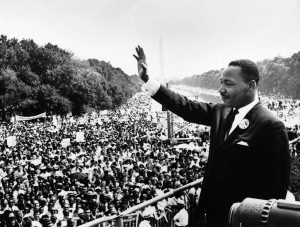
The Baptist minister Dr. Martin Luther King, Jr. spoke out against injustices against an oppressed people; he also showed evidence of shrugging off the slights committed against him. These qualities came through in the movie Selma, which my wife and I went to see this weekend. The movie chronicles critical events surrounding King’s and the people’s struggle in the Civil Rights movement in 1965 in Selma, Alabama; the historic march from Selma to Montgomery climaxed in President Johnson’s signing of the Voting Rights Act that year. For King, the gospel compelled him to lead a movement for justice birthed in the African American church in a non-violent manner.
The movie Selma shows King’s colleague Andrew Young explaining to someone wishing to react violently to their oppressors that the people would not have stood a chance if they had resorted to guns and violence against the unjust authorities at Selma; their only chance to win rights was to operate in a non-violent manner. Above and beyond the strategic wisdom of this approach in contending against an overwhelming unjust force, King grounded the movement and approach in Jesus’ love ethic. King believed that such love was not simply essential to bringing about reconciliation between individuals, but also critical to effecting social transformation on a massive scale.[1]
One should not think that Jesus or King’s meek, non-retaliatory approach toward one’s oppressors entails groveling in the dirt. In Jesus’ day, turning the other cheek toward one’s oppressor did not rob people of their dignity; it caused the offending party to have to look at those they slapped as equals. The slapping of someone on the right cheek most likely entailed in Jesus’ context a humiliating strike with the backside of the right hand intended for an inferior. If the person intended to strike again, the offer of the left cheek repositioned the conflict as one between equals.[2] In the Civil Rights era, King and his movement did not stoop to the inhumanity of their oppressors. The injustice they endured served to prick the American conscience, as multitudes of people witnessed via the national news the horrors committed by those seeking to enforce segregation and inequality. In view of Jesus and his servant King, those who think they are superior to those they oppress need to realize that only by becoming meek do they become truly human.
As early as 1957, King spoke of such non-violent confrontation grounded in love. Here is what King said in a sermon at Christmas in 1957 at Dexter Avenue Baptist Church in Montgomery, Alabama,
To our most bitter opponents we say: “We shall match your capacity to inflict suffering by our capacity to endure suffering. We shall meet your physical force with soul force. Do to us what you will, and we shall continue to love you. We cannot in all good conscience obey your unjust laws because noncooperation with evil is as much a moral obligation as is cooperation with good. Throw us in jail and we shall still love you. Bomb our homes and threaten our children, and we shall still love you. Send your hooded perpetrators of violence into our community at the midnight hour and beat us and leave us half dead, and we shall still love you. But be ye assured that we will wear you down by our capacity to suffer. One day we shall win freedom but not only for ourselves. We shall so appeal to your heart and conscience that we shall win you in the process and our victory will be a double victory.” (One can find the message here; accessed on 1/19/15)[3]
King’s non-violent protest flowed from Jesus’ call to love our enemies and pray for those who persecute us (Matthew 5:44). The late Evangelical Anglican statesman John R. W. Stott claimed that King was the greatest model of Jesus’ ethic disclosed in this text in the modern age.[4]
King and company witnessed President Johnson’s action on their behalf, as he eventually signed the Voting Rights Act in 1965. Perhaps many in the Civil Rights movement felt at the signing of the law that they were on their way to inherit the earth. Certainly Jesus had in mind the eventual restoration of all things at the end of history in his kingdom reign, when he spoke of the meek inheriting the earth. Still, the Civil Rights reform of 1965 bore witness to that just state of affairs at the end of history and foreshadowed it in some way. When we are meek, not weak, working on behalf of Jesus’ just kingdom, sensing our desperate need for Jesus’ intervention and mourning our sinful condition and that of the world, we can take comfort in knowing that we will inherit the earth.
How do you and I want to go down in history? Do we want to rise up with the just or go down with the unjust, up with the meek or down with those who promote an unjust peace? Psalm 37:10-11 declares, “In just a little while, the wicked will be no more; though you look carefully at his place, he will not be there. But the meek shall inherit the land and delight themselves in abundant peace” (Psalm 37:10-11; ESV).
President Johnson did not want history to see him taking sides with Governor Wallace of Alabama on the critical events surrounding Selma, as disclosed in the movie. Rather, he wanted posterity to view him as being on the side of justice by siding with King’s strong, resilient community of meekness. In the end, how will Jesus view us—as those on the side of cruel weakness or meek strength? Only the latter will inherit the earth.
_______________
[1]See The Autobiography of Martin Luther King, Jr., ed. Clayborne Carson (New York: Warner Books, Inc., 1998), pages 23-24.
[2]See N. T. Wright, Matthew for Everyone, Part I, Chapters 1-15, 2nd ed. (London: SPCK & Louisville: Westminster/John Knox, 2004), pages 49-53.
[3]Compare this message with his Christmas sermon delivered in 1967 at Ebenezer Baptist Church in Atlanta, Georgia (One can find the message here). King remained vigilant and consistent in his message during the ongoing struggle.
[4]John R. W. Stott, The Message of the Sermon on the Mount (Matthew 5–7): Christian Counter-Culture, The Bible Speaks Today (Downers Grove, IL: Inter-Varsity Press, 1978), page 113.
Previous Post

January 17, 2015
Trinity Academy: A Prophetic Complement to Public School Education
Next Post

January 24, 2015 “Food Fight—A Civil Dialogue over Our Daily Bread”
Browse Our Archives
Select a Category Uncategorized
Select a Month June 2025 April 2025 March 2025 January 2025 December 2024 November 2024 October 2024 September 2024 August 2024 July 2024 June 2024 May 2024 April 2024 March 2024 February 2024 January 2024 December 2023 November 2023 October 2023 September 2023 August 2023 July 2023 June 2023 May 2023 April 2023 March 2023 February 2023 January 2023 December 2022 November 2022 October 2022 September 2022 August 2022 July 2022 June 2022 May 2022 April 2022 March 2022 February 2022 January 2022 December 2021 November 2021 October 2021 September 2021 August 2021 July 2021 June 2021 May 2021 April 2021 March 2021 February 2021 January 2021 December 2020 November 2020 October 2020 September 2020 August 2020 July 2020 June 2020 May 2020 April 2020 March 2020 February 2020 January 2020 December 2019 November 2019 October 2019 September 2019 August 2019 July 2019 June 2019 May 2019 April 2019 March 2019 February 2019 January 2019 December 2018 November 2018 October 2018 September 2018 August 2018 July 2018 June 2018 May 2018 April 2018 March 2018 February 2018 January 2018 December 2017 November 2017 October 2017 September 2017 August 2017 July 2017 June 2017 May 2017 April 2017 March 2017 February 2017 January 2017 December 2016 November 2016 October 2016 September 2016 August 2016 July 2016 June 2016 May 2016 April 2016 March 2016 February 2016 January 2016 December 2015 November 2015 October 2015 September 2015 August 2015 July 2015 June 2015 May 2015 April 2015 March 2015 February 2015 January 2015 December 2014 November 2014 October 2014 September 2014 August 2014 July 2014 June 2014 May 2014 April 2014 March 2014 February 2014 January 2014 December 2013 November 2013 October 2013 September 2013 August 2013 July 2013 June 2013 May 2013 April 2013 March 2013 February 2013 January 2013 December 2012 November 2012 October 2012 September 2012 August 2012 July 2012 June 2012 May 2012 April 2012 March 2012 February 2012
Follow Us!
TAKE THE
Religious Wisdom Quiz
Which king saw "the handwriting on the wall"?
Select your answer to see how you score.
Cyrus Belshazzar Nebuchadnezzar Artaxerxes
Books by This Author Books by Paul Louis Metzger
Related posts from Uncommon God, Common Good

Heavenly Father’s Day on Trinity Sunday

Easter Triduum: Obey Your Thirst—for God

Holy Week Is Humble Week: "Beware of Becoming...

Excavating the Person in a Throwaway Culture
TRENDING AT PATHEOS Evangelical

Making Stones Into Bread: Choosing the “Right” Work
I was on my online arts ministry Zoom meeting with the International...

Ukraine’s exhausted Christians face fifth winter of war
By Julian Lukins The full-scale war in Ukraine is taking “a serious...

Russell Brand's Conviction is not anti-Christian Persecution
How do we shed the reputation that the Church is OK with...

Have you ever caught yourself saying, “I’ll do it tomorrow,” or “Now...

Write Your Story: A Great Way to Find...
A few month’s back, my son was scrolling around Facebook and saw...

Throughout history, people have pursued pleasure, possessions, relationships, and success in an...
view all Evangelical blogs
Ad-Free & Subscriber Log-In Subscription Support
- About Us
- 2026 Calendar
- Videos
- Podcasts
- Library of World Religions
- Faith In Media Tracker
- Advertise With Us
- Write for Us
- Privacy Policy
- Terms of Service
- Do Not Sell My Data
- Contact Us
- Radiant Digital
- Manage Newsletter Subscriptions
- Unsubscribe From Notifications
- Sitemap
Copyright 2008-2026, Patheos, part of the Radiant Digital network of media brands. All rights reserved.
Subscription Support Ad-Free & Subscriber Log-In
Follow Patheos