
BuddhistCatholicContemplativeEvangelicalGeneral ChristianHinduJewishLatter-day SaintMuslimNew VisionsProgressive Christian
Beliefs
- Buddhist
- Catholic
- Contemplative
- Evangelical
- General Christian
- Hindu
- Jewish
- Latter-day Saint
- More Voices
- Muslim
- New Visions
- Pagan
- Progressive Christian
Topics
- Religion News
- Food and Religion
- Sports and Religion
- Religious Art
- Religious Music and Entertainment
- Religious Events
- History and Religion
- Style and Religion
- Politics and Religion
- Women in Religion
- Recreation Outdoors and Religion
- Business Finance and Religion
- Careers Workplace and Religion
- Education and Religion
- Family Parenting and Religion
- Health Fitness and Religion
- Home and Religion
- Relationships and Religion
- Technology and Religion
- Travel and Religion
Columnists
- Buddhist Columnists
- Business Finance and Religion Columnists
- Careers Workplace and Religion Columnists
- Catholic Columnists
- Contemplative Columnists
- Education and Religion Columnists
- Evangelists Columnists
- Family Parenting and Religion Columnists
- General Christian Columnists
- Health Fitness and Religion Columnists
- Hindu Columnists
- History and Religion Columnists
- Home and Religion Columnists
- Jewish Columnists
- More Voices Columnists
- Latter Day Columnists
- Muslim Columnists
- New Visions Columnists
- Nonreligious Columnists
- Pagan Columnists
- Politics and Religion Columnists
- Progressive Columnists
- Recreation Outdoors and Religion Columnists
- Relationships and Religion Columnists
- Religion News Columnists
- Religious Art Columnists
- Religious Events Columnists
- Religious Music and Entertainment Columnists
- Sports and Religion Columnists
- Style and Religion Columnists
- Technology and Religion Columnists
- Travel and Religion Columnists
- Women in Religion Columnists
Resource Library
- 2026 Calendar
- Library of World Religions
- The 100 Most Holy Places on Earth
- Patheos Answers
- Podcasts
- Videos
- Faith Leaders Database
- Anglican Episcopalian
- Bahai
- Baptist
- Buddhism
- Christianity
- Confucianism
- Eastern Orthodoxy
- Hinduism
- Holiness and Pentecostal
- ISKCON
- Islam
- Judaism
- Lutheran
- Methodist
- The Church of Jesus Christ of Latter-day Saints
- New Age
- Paganism
- Presbytarian and Reformed
- Protestantism
- Religion Behind the Scenes
- Roman Catholic
- Scientology
- Shia Islam
- Sikhism
- Sufism
- Sunni Islam
- Taoism
- Zen
- See all religions
Research Tools
 Ad-Free & Subscriber Log-In Subscription Support
Ad-Free & Subscriber Log-In Subscription Support
Follow Patheos 

- Trending:
- Forgiveness
- |
- Marriage
- |
- Consciousness
- |
- Death Penalty
- |
- Election
- |
- Halloween

- Home
- Evangelical
- Grateful for the Dead
Grateful for the Dead
Last updated on: October 17, 2014 at 10:13 am by Paul Louis Metzger
Grateful for the Dead 2014-10-17T10:13:32-07:00 Paul Louis Metzger
Patheos Explore the world's faith through different perspectives on religion and spirituality! Patheos has the views of the prevalent religions and spiritualities of the world.
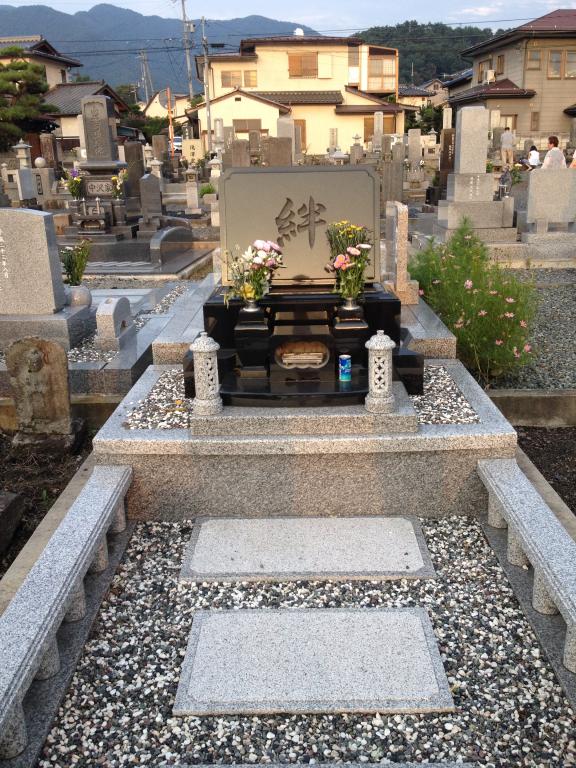
Editors’ Note: This article is part of the Public Square on Remembering Our Dead: Ancestors, Rituals, Relics. Read other perspectives from the Patheos community here.
Are you grateful for the dead—any dead? One of the major holidays in Japan is Obon or Bon. The holiday celebration centers on honoring one’s ancestors who are believed to return home during the celebration in mid-August of every year.
People in Japan don’t walk away from the dead. There is a living bond or connection. The picture to the left was taken during Obon in August of this year. The Japanese word on the grave stone (“kizuna”) means “connection” as in an unbreakable bond by blood. If you look carefully, you can see a man and his daughter in the background at the graveyard tending to the grave of a family member as a sign of respect. The same kind of respect is shown at the butsudan or family altar in many Japanese Buddhist homes where individual families honor their deceased ancestors on a daily basis.
In my limited experience, Christians in Japan have often found it extremely difficult to show appreciation for Obon or the butsudan. Many Christians view such remembrance as worship of the dead. I know of one situation where a man who became a Christian destroyed the family altar or butsudan. No doubt, for him it was an idol. No doubt, for many of his Japanese neighbors, this action signified extreme dishonor, perhaps even destruction, of his ancestors.
Is it always the case that Japanese people worship the dead, or could regular remembrance simply be a form of honor and gratitude for the deceased? In answer to the latter question, one conservative Evangelical Brethren church in Japan with which I am familiar connects with their community by holding remembrance (not worship) services. They invite community members to come and express gratitude for deceased loved ones.
Again, is it always the case that Japanese people worship the dead? A former Buddhist priest, who is now a Christian pastor (Matsuoka Hirokazu), claims that Japanese hearts are not toward Buddha, but dead ancestors, in their approach to the deceased. In his estimation, they are remembering and appreciating their loved ones who have passed away. He states that their mindset is not much different than that of those who participate in memorial or remembrance services held by some churches in Japan. It is not worship or a form of idolatry (See page 151 of Forest Books’ Japanese edition of The Buddhist Priest Who Met Jesus; there is now an English edition of the work titled Buddhist Priest Meets Jesus).
I believe it is very difficult for many people from the West to appreciate the connection many Japanese feel with their ancestors. All too often in the West, we walk away from the dead. At times, it is as if they are out of sight and therefore out of mind. The same goes for many American Christians as it pertains to church history. It is almost as if the church began the day they became Christians. Thankfully, this is not always the case. Take for example my friends at a local Orthodox church in Portland (and those like it), where pictures of saints who lived long ago hang from the walls in the church to signify that somehow the great cloud of witnesses mentioned in Hebrews 12:1 is present.
While Christians must not worship their dead ancestors in the faith, we do worship Jesus who died and who rose again to eternal life. It is also important to our faith to recount the hall of fame of faith (See Hebrews 11). Such remembrance energizes us: we are not alone.
Just as we are not alone, we would not be here without them. As in the case of the significance of remembering deceased ancestors in the Christian faith like St. Paul, Polycarp, Irenaeus of Lyons, Augustine of Hippo, Dietrich Bonhoeffer, Martin Luther King, Jr. and some of my own personal theological mentors like Kenneth Kantzer and Colin Gunton, I think it is also important to recount with gratitude the faithfulness of one’s biological parents and ancestors who made it possible for us to be here today. Where would we be without them? Where would I be without my Christian father and my Japanese father-in-law who passed away not so long ago? There is a vital sense in which they live on through me. The same goes for friends who have since departed. There is a vital sense in which my late friend, Kyogen Carlson, a Buddhist priest, lives on through me, just as a part of me died with him (Click here to see my recent blog post in his honor). Where would I be without them?
Can we really live well on life’s long journey if we lack gratitude for those who have paved the way for us, even to the point of death? There is nothing morbid about remembrance with gratitude. Such remembrance is actually quite life-giving. Are you grateful for the dead today?
Previous Post

October 2, 2014
Kyogen Carlson: Bridge-Builder over Troubled Waters
Next Post
October 11, 2014 Aristotle and Luther: On Justice, Virtue and the Reformation of Values
Browse Our Archives
Select a Category Uncategorized
Select a Month June 2025 April 2025 March 2025 January 2025 December 2024 November 2024 October 2024 September 2024 August 2024 July 2024 June 2024 May 2024 April 2024 March 2024 February 2024 January 2024 December 2023 November 2023 October 2023 September 2023 August 2023 July 2023 June 2023 May 2023 April 2023 March 2023 February 2023 January 2023 December 2022 November 2022 October 2022 September 2022 August 2022 July 2022 June 2022 May 2022 April 2022 March 2022 February 2022 January 2022 December 2021 November 2021 October 2021 September 2021 August 2021 July 2021 June 2021 May 2021 April 2021 March 2021 February 2021 January 2021 December 2020 November 2020 October 2020 September 2020 August 2020 July 2020 June 2020 May 2020 April 2020 March 2020 February 2020 January 2020 December 2019 November 2019 October 2019 September 2019 August 2019 July 2019 June 2019 May 2019 April 2019 March 2019 February 2019 January 2019 December 2018 November 2018 October 2018 September 2018 August 2018 July 2018 June 2018 May 2018 April 2018 March 2018 February 2018 January 2018 December 2017 November 2017 October 2017 September 2017 August 2017 July 2017 June 2017 May 2017 April 2017 March 2017 February 2017 January 2017 December 2016 November 2016 October 2016 September 2016 August 2016 July 2016 June 2016 May 2016 April 2016 March 2016 February 2016 January 2016 December 2015 November 2015 October 2015 September 2015 August 2015 July 2015 June 2015 May 2015 April 2015 March 2015 February 2015 January 2015 December 2014 November 2014 October 2014 September 2014 August 2014 July 2014 June 2014 May 2014 April 2014 March 2014 February 2014 January 2014 December 2013 November 2013 October 2013 September 2013 August 2013 July 2013 June 2013 May 2013 April 2013 March 2013 February 2013 January 2013 December 2012 November 2012 October 2012 September 2012 August 2012 July 2012 June 2012 May 2012 April 2012 March 2012 February 2012
Follow Us!
TAKE THE
Religious Wisdom Quiz
Rejoice greatly, Daughter Zion! See, your king comes to you, righteous and victorious, yet humble and riding on what?
Select your answer to see how you score.
A white horse A donkey A camel A chariot
Books by This Author Books by Paul Louis Metzger
Related posts from Uncommon God, Common Good

Heavenly Father’s Day on Trinity Sunday

Easter Triduum: Obey Your Thirst—for God

Holy Week Is Humble Week: "Beware of Becoming...

Excavating the Person in a Throwaway Culture
TRENDING AT PATHEOS Evangelical

The REST of Your Life: A Creative Wrestles...
This week I had a conversation with a good friend from church....

How the author of the world's best hymn...
I've been working with John Newton for a while now. This makes...

Long before this Lectio Divina, Psalm 130 - the song - started...

What About the Trees? Another Living Parable
After I finished writing the last article about falling leaves as a...

Why Classical Education Is a Conversation, Not a...
Come and Read: Joy in Classical Education When I was a little...

Cornell University has received a great deal of negative publicity and intense...
view all Evangelical blogs
Ad-Free & Subscriber Log-In Subscription Support
- About Us
- 2026 Calendar
- Videos
- Podcasts
- Library of World Religions
- Faith In Media Tracker
- Advertise With Us
- Write for Us
- Privacy Policy
- Terms of Service
- Do Not Sell My Data
- Contact Us
- Radiant Digital
- Manage Newsletter Subscriptions
- Unsubscribe From Notifications
- Sitemap
Copyright 2008-2026, Patheos. All rights reserved.
Subscription Support Ad-Free & Subscriber Log-In
Follow Patheos