
BuddhistCatholicContemplativeEvangelicalGeneral ChristianHinduJewishLatter-day SaintMuslimNew VisionsProgressive Christian
Beliefs
- Buddhist
- Catholic
- Contemplative
- Evangelical
- General Christian
- Hindu
- Jewish
- Latter-day Saint
- More Voices
- Muslim
- New Visions
- Pagan
- Progressive Christian
Topics
- Religion News
- Food and Religion
- Sports and Religion
- Religious Art
- Religious Music and Entertainment
- Religious Events
- History and Religion
- Style and Religion
- Politics and Religion
- Women in Religion
- Recreation Outdoors and Religion
- Business Finance and Religion
- Careers Workplace and Religion
- Education and Religion
- Family Parenting and Religion
- Health Fitness and Religion
- Home and Religion
- Relationships and Religion
- Technology and Religion
- Travel and Religion
Columnists
- Buddhist Columnists
- Business Finance and Religion Columnists
- Careers Workplace and Religion Columnists
- Catholic Columnists
- Contemplative Columnists
- Education and Religion Columnists
- Evangelists Columnists
- Family Parenting and Religion Columnists
- General Christian Columnists
- Health Fitness and Religion Columnists
- Hindu Columnists
- History and Religion Columnists
- Home and Religion Columnists
- Jewish Columnists
- More Voices Columnists
- Latter Day Columnists
- Muslim Columnists
- New Visions Columnists
- Nonreligious Columnists
- Pagan Columnists
- Politics and Religion Columnists
- Progressive Columnists
- Recreation Outdoors and Religion Columnists
- Relationships and Religion Columnists
- Religion News Columnists
- Religious Art Columnists
- Religious Events Columnists
- Religious Music and Entertainment Columnists
- Sports and Religion Columnists
- Style and Religion Columnists
- Technology and Religion Columnists
- Travel and Religion Columnists
- Women in Religion Columnists
Resource Library
- 2026 Calendar
- Library of World Religions
- The 100 Most Holy Places on Earth
- Patheos Answers
- Podcasts
- Videos
- Faith Leaders Database
- Anglican Episcopalian
- Bahai
- Baptist
- Buddhism
- Christianity
- Confucianism
- Eastern Orthodoxy
- Hinduism
- Holiness and Pentecostal
- ISKCON
- Islam
- Judaism
- Lutheran
- Methodist
- The Church of Jesus Christ of Latter-day Saints
- New Age
- Paganism
- Presbytarian and Reformed
- Protestantism
- Religion Behind the Scenes
- Roman Catholic
- Scientology
- Shia Islam
- Sikhism
- Sufism
- Sunni Islam
- Taoism
- Zen
- See all religions
Research Tools
 Ad-Free & Subscriber Log-In Subscription Support
Ad-Free & Subscriber Log-In Subscription Support
Follow Patheos 

- Trending:
- Forgiveness
- |
- Marriage
- |
- Consciousness
- |
- Death Penalty
- |
- Election
- |
- Halloween
 Unbelievable?
- Home
- Evangelical
- Alister McGrath: A world expert on CS Lewis shares his thoughts
Alister McGrath: A world expert on CS Lewis shares his thoughts
Last updated on: December 26, 2020 at 3:16 pm by Ruth Jackson
Alister McGrath: A world expert on CS Lewis shares his thoughts 2020-12-22T15:17:31-05:00 Ruth Jackson
Patheos Explore the world's faith through different perspectives on religion and spirituality! Patheos has the views of the prevalent religions and spiritualities of the world.
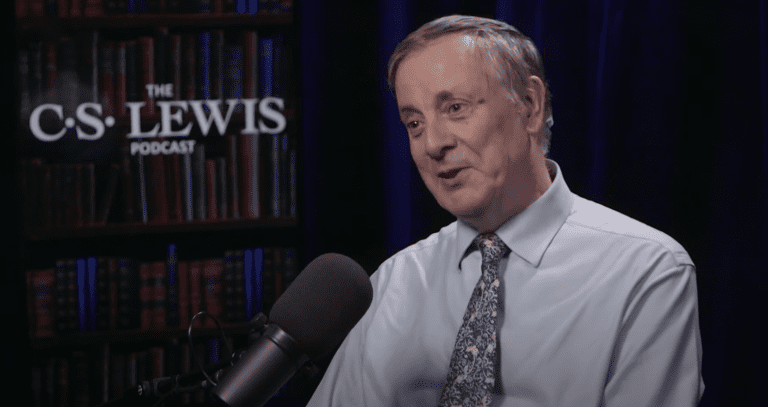 Rev Alister McGrath is the Andreas Idreos Professor of Science and Religion at Oxford University. He holds three Oxford doctorates: a doctoral degree in molecular biophysics, a Doctor of Divinity degree in theology and a Doctor of Letters degree in intellectual history. McGrath is a prolific author on many topics including science, faith, apologetics, CS Lewis, doctrine and church history. We recently spoke to him on the release of his latest (and final) book Through a Glass Darkly: Journeys Through science, Faith and Doubt – a Memoir.
How has lockdown been for you?
Well, seven months ago, I had never heard of zoom! It’s one of the things I’ve discovered and it’s great – it means I can keep in touch with my students who I’m not allowed to meet. But I’m just seeing faces on screens. I wish I could say hello or make them a cup of tea. It’s all very strange and I’m not sure I like this new world.
This moment of crisis in Covid is bringing home to us that we are vulnerable and precarious. It causes us to ask: What can we hold on to in a world that is broken, damaged and apparently falling to bits? Where do we find security, where do we find love? And, of course, the Christian answer is that God is with us even in these dark times.
What does the title of your new book mean?
When I was a teenager, I longed for absolute certainty. I couldn’t cope with ambiguity. In one sense, the book is describing how I realised that you can’t be absolutely certain, in the sense that you cannot prove things that really matter to be true, even though in your heart you know that they are.
Through a glass darkly, of course, is from Paul’s letter to the Corinthians (chapter 13). It’s the idea that here on earth, we see things a bit fuzzily, but one day we will see them as they really are.
Was your conversion one definitive moment? Or were there numerous points along the way that gradually led you from atheism towards theism?
There were a series of points. For example, I began to think, I’m very critical of religious people – I ask them to prove there’s a God and they can’t. But actually, if they were to ask me: “Can you prove there is no God?” The answer would be no! There was a series of things like that, which made me realise atheism was not as intellectually secure as I would have liked. There wasn’t a sudden blinding flash, it was more of a growing realisation that atheism just doesn’t work. And Christianity, which I hadn’t really understood, actually seems to be really rather exciting. And it might work.
Christianity’s ability to make sense of things was really important. And reading CS Lewis really helped with that. Of course, that’s only one of Christianity’s multiple aspects. It does so much more than that. But for me, that drew me to faith and everything else followed in due course.
Was there something in particular about CS Lewis that drew you to his writing?
You mustn’t laugh, but I had just become a Christian and was asking my Christian friends all these difficult questions. They got fed up and one of them, exasperated, said: “Why don’t you read CS Lewis?” I knew he had written a book about lions and wardrobes or something, so I bought one of his books and started to read. And it was as if someone turned the light on, as if something clicked. I suddenly realised this makes sense. Nearly 50 years later I’m still reading, I’m still getting more out of CS Lewis, because there’s so much there to discover.
CS Lewis really knows what he’s talking about. He writes extremely well and he avoids this very dull, simple appeal to reason. I value that, but there’s more to it than that. What Lewis helps us to realise is that Christianity gives us a new vision of reality, it excites us, it enables us to picture Christianity in our minds.

CS Lewis provided answers for many of your questions, but you also say that we need to learn to live with a level of uncertainty. So, how do we practically live with those unanswered questions?
I was an atheist who doubted and I think that’s a very important point. Doubt is not specific to Christianity. Everyone’s in the same boat yet, we Christians are just honest about. If you’re an atheist, you haven’t proved there’s no God, you believe there’s no God. When I moved from atheism to Christianity, I moved from a faith that there is no god to a faith that there is a God.
The really big things are just too big for us to get our heads around. So, we can learn to live with a degree of uncertainty. But that does not mean we’re doubting. It just means that we know these things are so important, so massive that we can’t actually prove they are right. What you can say is I trust that this is right, this seems to work, it’s wonderful.
Christian apologetics says there are excellent reasons for thinking this is right. But in the end, you can’t absolutely prove this is right. That’s why faith is so important. Faith is not saying “I’m just going to take a leap into the dark”, it’s saying: “This is so good. I feel in my heart of hearts this actually is right. I feel that God is calling me.” It’s an informed faith. It’s not leaping into the darkness, but into the hands of a God who knows me and loves me. And that’s a very different thing.
It’s very important to talk to people about these issues and realise that maybe they experience them as well. In Matthew 28 the risen Christ appears to his disciples. It says some worshipped him, but others doubted – they weren’t really sure. But I think perhaps they became sure later. It’s very natural to doubt and doubt, very often, is about realising the questions we haven’t thought through. As an apologist, I very often find that my own doubts set my agenda for engagement and discovery: “I’m not sure about this, right I’m going to look into it.” That sorts me out and maybe I can help other people as well.
You can hear more from Alister McGrath on the Unbelievable? podcast
Find out more about The CS Lewis Podcast with Alister McGrath, which will launch this spring.
Subscribe to the Unbelievable? podcast
Previous Post

December 22, 2020
John Lennox: Why a scientist can believe in the miracle of Christmas

Browse Our Archives
Select a Category Uncategorized
Select a Month April 2023 August 2022 June 2021 May 2021 April 2021 March 2021 February 2021 January 2021 December 2020 November 2020 October 2020 September 2020
Follow Us!
TAKE THE
Religious Wisdom Quiz
What did Nebuchadnezzar see inside the fiery furnace along with the three men?
Select your answer to see how you score.
A great cloud of smoke A fourth figure like "a son of the gods" A vision of his own kingdom An angel with a sword
Related posts from Unbelievable?
Praying for Unity: A Christian Response to Critical...

3 Tips to Help Find Common Ground

If AI needs an intelligent creator, so do...

Fearfully and wonderfully made: The promise and perils...
TRENDING AT PATHEOS Evangelical

How the author of the world's best hymn...
I've been working with John Newton for a while now. This makes...

Long before this Lectio Divina, Psalm 130 - the song - started...

What About the Trees? Another Living Parable
After I finished writing the last article about falling leaves as a...

Why Classical Education Is a Conversation, Not a...
Come and Read: Joy in Classical Education When I was a little...

Falling Leaves: A Living Parable on Letting Go
I’ve spent the vast majority of my life in the southeast corner...

Cornell University has received a great deal of negative publicity and intense...
view all Evangelical blogs
Ad-Free & Subscriber Log-In Subscription Support
- About Us
- 2026 Calendar
- Videos
- Podcasts
- Library of World Religions
- Faith In Media Tracker
- Advertise With Us
- Write for Us
- Privacy Policy
- Terms of Service
- Do Not Sell My Data
- Contact Us
- Radiant Digital
- Manage Newsletter Subscriptions
- Unsubscribe From Notifications
- Sitemap
Copyright 2008-2026, Patheos. All rights reserved.
Subscription Support Ad-Free & Subscriber Log-In
Follow Patheos