
BuddhistCatholicContemplativeEvangelicalGeneral ChristianHinduJewishLatter-day SaintMuslimNew VisionsProgressive Christian
Beliefs
- Buddhist
- Catholic
- Contemplative
- Evangelical
- General Christian
- Hindu
- Jewish
- Latter-day Saint
- More Voices
- Muslim
- New Visions
- Pagan
- Progressive Christian
Topics
- Religion News
- Food and Religion
- Sports and Religion
- Religious Art
- Religious Music and Entertainment
- Religious Events
- History and Religion
- Style and Religion
- Politics and Religion
- Women in Religion
- Recreation Outdoors and Religion
- Business Finance and Religion
- Careers Workplace and Religion
- Education and Religion
- Family Parenting and Religion
- Health Fitness and Religion
- Home and Religion
- Relationships and Religion
- Technology and Religion
- Travel and Religion
Columnists
- Buddhist Columnists
- Business Finance and Religion Columnists
- Careers Workplace and Religion Columnists
- Catholic Columnists
- Contemplative Columnists
- Education and Religion Columnists
- Evangelists Columnists
- Family Parenting and Religion Columnists
- General Christian Columnists
- Health Fitness and Religion Columnists
- Hindu Columnists
- History and Religion Columnists
- Home and Religion Columnists
- Jewish Columnists
- More Voices Columnists
- Latter Day Columnists
- Muslim Columnists
- New Visions Columnists
- Nonreligious Columnists
- Pagan Columnists
- Politics and Religion Columnists
- Progressive Columnists
- Recreation Outdoors and Religion Columnists
- Relationships and Religion Columnists
- Religion News Columnists
- Religious Art Columnists
- Religious Events Columnists
- Religious Music and Entertainment Columnists
- Sports and Religion Columnists
- Style and Religion Columnists
- Technology and Religion Columnists
- Travel and Religion Columnists
- Women in Religion Columnists
Resource Library
- 2026 Calendar
- Library of World Religions
- The 100 Most Holy Places on Earth
- Patheos Answers
- Podcasts
- Videos
- Faith Leaders Database
- Anglican Episcopalian
- Bahai
- Baptist
- Buddhism
- Christianity
- Confucianism
- Eastern Orthodoxy
- Hinduism
- Holiness and Pentecostal
- ISKCON
- Islam
- Judaism
- Lutheran
- Methodist
- The Church of Jesus Christ of Latter-day Saints
- New Age
- Paganism
- Presbytarian and Reformed
- Protestantism
- Religion Behind the Scenes
- Roman Catholic
- Scientology
- Shia Islam
- Sikhism
- Sufism
- Sunni Islam
- Taoism
- Zen
- See all religions
Research Tools
 Ad-Free & Subscriber Log-In Subscription Support
Ad-Free & Subscriber Log-In Subscription Support
Follow Patheos 

- Trending:
- Forgiveness
- |
- Marriage
- |
- Consciousness
- |
- Death Penalty
- |
- Election
- |
- Halloween
 Unbelievable?
- Home
- Evangelical
- When atheism becomes unfalsifiable. Peter Atkins and the problem of evidence
When atheism becomes unfalsifiable. Peter Atkins and the problem of evidence
Last updated on: November 6, 2020 at 1:29 pm by Erik Strandness
When atheism becomes unfalsifiable. Peter Atkins and the problem of evidence 2020-11-06T13:29:05-05:00 Erik Strandness
Patheos Explore the world's faith through different perspectives on religion and spirituality! Patheos has the views of the prevalent religions and spiritualities of the world.
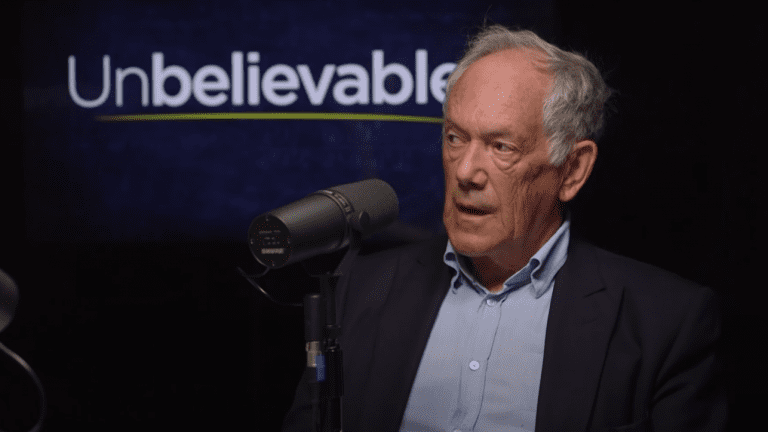
When an investigator excludes God from a theory, are they engaging in cutting edge science or do they have an axe to grind?
Justin Brierley frequently ends his Unbelievable? shows by posing a powerful question to his guests: “What type of evidence would cause you to change your mind about the existence or non-existence of God?” The reason it is such a powerful question is because it filters out the truth-seekers from the talking heads, the instigators from the inquisitive and the demagogue from the discerner.
Experts speaking in public forums are required to disclose any financial interest they may have in their topic because the listener needs to know if they are hearing an honest argument or an academic infomercial. Maybe Brierley should open rather than close each show with this question so that we know ahead of time whether we are just being sold a bill of goods or witnessing intellectual commerce in the marketplace of ideas.
While most of his guests are willing to engage in an intellectual give and take, occasionally it becomes clear that one party has an agenda that prohibits them from entertaining other viewpoints. The debate between atheist physical chemist Peter Atkins and Christian cosmologist Hugh Ross over the origin of the laws of nature, highlighted this very problem.
In a very telling exchange, Brierley explored the sincerity of Atkins’ commitment to intellectual integrity by asking him whether he could think of any evidence that might persuade him that God exists or Christianity is true.
Here’s what happened:
Atkins: I find that a very difficult question. If I were looking in the Bible for evidence (heaven forbid), I would expect to see maybe ‘Increase in entropy is equal to Q reversible divided by temperature’. If there was an equation in the Bible rather than all this wishy washy elastic writing.
Justin: So if there was something like that they discovered in the Bible…
Atkins: Then I’d think it was probably a forgery.
Justin: Well that’s the problem… Is there any evidence in the universe? If the stars lined up to spell ‘Peter please believe in me, it’s about time’?
Atkins: I’d put it down to personal madness.
Ross: It sounds Peter like there’s no evidence that would persuade you away from atheism.
Atkins: To be honest I think that’s probably the case
Justin: Do you even have an evidence-based view if you are committed to atheism a priori?
Atkins: Well, I’m predicting that there will be no such evidence. It’s not quite the same thing as being committed to it a priori. I’d think it much more likely that I would have gone mad than such evidence would have been provided.
Justin: So in principle it’s impossible to persuade you that God exists?
Atkins: I didn’t quite say that…
Ross: So what would persuade you?
Atkins: I can’t conceive… I suppose if I died and was confronted with St Peter, saying, ‘welcome to Heaven’. I’d probably think I was dreaming.
Despite Atkins protestations, it seems fair to conclude that the scientist is more or less immune to the evidence for God because of his a priori atheism. You can watch the exchange below.
Hugh Ross, on the other hand, was much more open to the question because he recognized that the beauty of science is that it is always open to being falsifiable. He offered up several pieces of evidence that would change his mind including the discovery that the universe really didn’t have a beginning, that humans were not exceptional and that the resurrection never occurred.
Napping on Knowledge
While I am concentrating on the tail end of the Unbelievable? show, we did get some clues at the beginning of the show that shed light on the sincerity of the discussion to come. Atkins dismissed theistic explanations for scientific data as academically lazy, while Ross countered that it was actually intellectually lazier to limit the scope of possibilities to the material realm alone. Ross said that we need to take all the scientific evidence from the past, present and future and be willing to continually revisit the question of whether a theistic or atheistic view of the world better explains the data.
Intellectual laziness cannot be condoned but the back stories of Ross and Atkins may shed some light on their respective approaches. Ross was raised an atheist but was confronted with the overwhelming scientific evidence that the universe had a beginning, prompting him to begin a scientific, philosophical and religious search for the best explanation of the data.
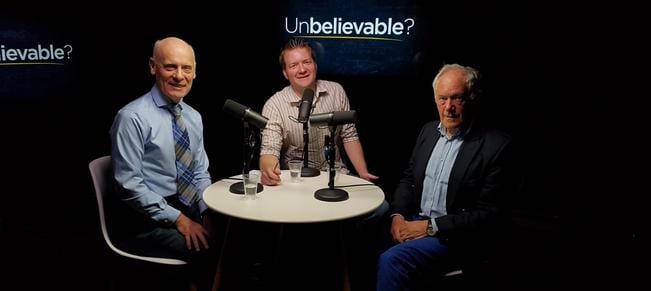
Atkins, on the other hand, was raised in the Anglican church as an “unthinking child” until he entered college and discovered that “one could have ideas of one’s own.” He then shed the “religious carapace that had been pressed” upon him and became an atheist. Atkins became appropriately skeptical of unthinking religion but then sadly missed the fact that the Bible frequently appeals to a wisdom that is:
“… first pure, then peaceable, gentle, open to reason, full of mercy and good fruits, impartial and sincere.” (James 3:17)
Ross views religion as one more avenue of intellectual pursuit while Atkins views it as a dead end. Ironically, the close-mindedness of Atkins’ religious upbringing was replaced by the close-mindedness of his atheistic materialism.
It’s that Simple
Atkins finds the God explanation too complex. He said that scientists are “hewers of simplicity from complexity” and while the world seems amazingly complex it had very simple origins. He stated that the goal of every scientist should be to “hack away at those simple seeds.”
In the show, Atkins suggested that the universe could be reduced to simple laws, but as physicist and mathematician Sir James Jeans pointed out, the more we investigate the world around us the more “the universe begins to look more like a great thought than like a great machine.”
Atkins may want to reduce the universe to a child reciting its ABC’s but the more we turn up the scientific volume the more it sounds like the commencement speech of a divine mind.
Atkins’ Holy Trinity
Atkins suggests that the laws of nature are based on three principles; indolence, anarchy and ignorance, and then proceeds to use them to dismiss God:
“If you haven’t got anything going on that is guided then you don’t need a guider.”
Sadly, I find nothing in his holy trinity that inspires scientific investigation. Personally, I would rather investigate the workings of a divine mind than try to make sense of a lazy, disorganized, mindless demiurge. Atkins believes that God as an explanation is unnecessary and that:“The real answer lies in a mechanism which only science can identify.” However, I’m not sure how a “mechanism” qualifies as indolent, anarchical or ignorant.
Ross, however, pointed out that there are several very important questions about the world that cannot be reduced to matter in motion and require a supernatural explanation, such as the origin of the universe, the origin of life, the exceptionalism of humans and the fine tuning of the universe. A theistic model does a much better job of explaining all the data because it provides a first cause, a law giver, a Breath of life and an image-bearing template.
While Atkins attributed the Bible to “a group of old men sitting around several thousand years ago writing down fantasies,” Ross countered that “those fantasies turned out to be correct.” It’s fascinating that Genesis continues to be a part of our current scientific discussion when every other religious origins text has long since been dismissed. It appears that we are still talking about Genesis because Genesis is still talking about us.
A God who had an immaterial thought made it a physical reality through divine speech. The information rich words He spoke into existence are ordered, complex and surprisingly understandable by a creature equipped with divine voice recognition software. God is not a placeholder for scientific ignorance but the mind behind it all. When scientists enter the laboratory they are not imposing their intellectual will upon the universe but rather attempting to get inside the mind of God and rethink His thoughts.
Much Ado About Nothing
Similar to Lawrence Krauss, Atkins attempts to get the universe from nothing. He outlines his thoughts in his book, Conjuring the Universe: The Origins of the Laws of the Nature. I found it interesting that he felt the need to use a mystical word like ‘conjure’ in the title of a book grounded in materialism.
Atkins theorizes that “nothing is the foundation of everything”. He expands on this idea by suggesting that “space-time inherits the uniformity of absolutely nothing”. He then posits that the uniformity of space-time becomes the law of the conservation of energy and you end up with “the whole concept of causality and the existence of scientific explanation”.
I enjoyed Atkins’ book but it is built on the premise that “nothing” is an actual entity with the property of symmetry. He offers interesting ideas about how this “nothingness” through indolence, anarchy and ignorance became a universe, but in the end I was left with the nagging feeling that it was much ado about nothing. I admire the fact that he tried to reduce everything to perhaps the simplest notion of all, nothingness, but he lost me when he started attributing properties to it, which in my mind transformed his nothing into something.
Atkins’ “nothing” turns out to be just a very boring something. He made it clear that he was unwilling to yield to an unmoved mover so he posited an unnothing nothing. Atkins frequently appealed to the great tapestry that science has weaved but sadly his theory of nothing doesn’t tell us where he got the yarn.
Atkins feels one of the problems with the Bible is the way in which God brought the world into being. How does “something outside space and time put its shoulder to the cosmos and get it moving”? But I would similarly ask if his theory was likewise up to the task. Does “nothing” have broad enough shoulders to push the universe across the starting line?
Atkins may not like a God outside time and space causing time and space, but nothingness outside somethingness causing time and space seems just as problematic. He may be reluctant to use the “G” word but it appears that these two positions are really just a matter of semantics. If Peter considers God a nothing burger and appears OK with conjuring something from nothing then he may be more spiritual than he lets on.
Chemical Home Schooling
The question of how something comes from nothing, how the material comes from the immaterial and how the physical comes from spirit, needs to be answered by atheist and Christian alike. Christianity, however, has an advantage in that it already recognizes an immaterial realm. It is one step ahead of the atheist worldview because it doesn’t have to conjure matter out of nothing.
I think it is more elegant to believe that the universe was a thought in the mind of a Teacher rather than the home schooling of a chemical. Maybe that’s why the early philosophers were interested in the logos and why primitive man was interested in the gods – they saw the world as a great thought, not as chemical babble.
Peter Atkins is a very good writer and speaker and we need to give his interesting ideas a fair hearing, but it is a bit disappointing that he is unwilling to even consider theistic arguments. Anyone who follows Hugh Ross knows that he takes science very seriously and is always willing to test his theism against every new finding. In a day and age where civil discourse is ebbing away, it is refreshing that a show like Unbelievable? is willing to entertain various viewpoints with gentleness and respect but also encourages those who live in Christian and atheist silos to step outside for an intellectual meet and greet.
Watch Peter Atkins and Hugh Ross debate where the laws of nature came from
Subscribe to the Unbelievable? podcast
Previous Post

November 3, 2020
Christians are split on Critical Race Theory. This debate shows why.
Browse Our Archives
Select a Category Uncategorized
Select a Month April 2023 August 2022 June 2021 May 2021 April 2021 March 2021 February 2021 January 2021 December 2020 November 2020 October 2020 September 2020
Follow Us!
TAKE THE
Religious Wisdom Quiz
What was the name of the sea Jesus calmed during a storm?
Select your answer to see how you score.
Sea of Galilee Red Sea Mediterranean Sea Dead Sea
Related posts from Unbelievable?

Praying for Unity: A Christian Response to Critical...

3 Tips to Help Find Common Ground
If AI needs an intelligent creator, so do...

Fearfully and wonderfully made: The promise and perils...
TRENDING AT PATHEOS Evangelical

How the author of the world's best hymn...
I've been working with John Newton for a while now. This makes...

Long before this Lectio Divina, Psalm 130 - the song - started...

What About the Trees? Another Living Parable
After I finished writing the last article about falling leaves as a...

Why Classical Education Is a Conversation, Not a...
Come and Read: Joy in Classical Education When I was a little...

Falling Leaves: A Living Parable on Letting Go
I’ve spent the vast majority of my life in the southeast corner...

Cornell University has received a great deal of negative publicity and intense...
view all Evangelical blogs
Ad-Free & Subscriber Log-In Subscription Support
- About Us
- 2026 Calendar
- Videos
- Podcasts
- Library of World Religions
- Faith In Media Tracker
- Advertise With Us
- Write for Us
- Privacy Policy
- Terms of Service
- Do Not Sell My Data
- Contact Us
- Radiant Digital
- Manage Newsletter Subscriptions
- Unsubscribe From Notifications
- Sitemap
Copyright 2008-2026, Patheos. All rights reserved.
Subscription Support Ad-Free & Subscriber Log-In
Follow Patheos