
BuddhistCatholicContemplativeEvangelicalGeneral ChristianHinduJewishLatter-day SaintMuslimNew VisionsProgressive Christian
Beliefs
- Buddhist
- Catholic
- Contemplative
- Evangelical
- General Christian
- Hindu
- Jewish
- Latter-day Saint
- More Voices
- Muslim
- New Visions
- Pagan
- Progressive Christian
Topics
- Religion News
- Food and Religion
- Sports and Religion
- Religious Art
- Religious Music and Entertainment
- Religious Events
- History and Religion
- Style and Religion
- Politics and Religion
- Women in Religion
- Recreation Outdoors and Religion
- Business Finance and Religion
- Careers Workplace and Religion
- Education and Religion
- Family Parenting and Religion
- Health Fitness and Religion
- Home and Religion
- Relationships and Religion
- Technology and Religion
- Travel and Religion
Columnists
- Buddhist Columnists
- Business Finance and Religion Columnists
- Careers Workplace and Religion Columnists
- Catholic Columnists
- Contemplative Columnists
- Education and Religion Columnists
- Evangelists Columnists
- Family Parenting and Religion Columnists
- General Christian Columnists
- Health Fitness and Religion Columnists
- Hindu Columnists
- History and Religion Columnists
- Home and Religion Columnists
- Jewish Columnists
- More Voices Columnists
- Latter Day Columnists
- Muslim Columnists
- New Visions Columnists
- Nonreligious Columnists
- Pagan Columnists
- Politics and Religion Columnists
- Progressive Columnists
- Recreation Outdoors and Religion Columnists
- Relationships and Religion Columnists
- Religion News Columnists
- Religious Art Columnists
- Religious Events Columnists
- Religious Music and Entertainment Columnists
- Sports and Religion Columnists
- Style and Religion Columnists
- Technology and Religion Columnists
- Travel and Religion Columnists
- Women in Religion Columnists
Resource Library
- 2026 Calendar
- Library of World Religions
- The 100 Most Holy Places on Earth
- Patheos Answers
- Podcasts
- Videos
- Faith Leaders Database
- Anglican Episcopalian
- Bahai
- Baptist
- Buddhism
- Christianity
- Confucianism
- Eastern Orthodoxy
- Hinduism
- Holiness and Pentecostal
- ISKCON
- Islam
- Judaism
- Lutheran
- Methodist
- The Church of Jesus Christ of Latter-day Saints
- New Age
- Paganism
- Presbytarian and Reformed
- Protestantism
- Religion Behind the Scenes
- Roman Catholic
- Scientology
- Shia Islam
- Sikhism
- Sufism
- Sunni Islam
- Taoism
- Zen
- See all religions
Research Tools
 Ad-Free & Subscriber Log-In Subscription Support
Ad-Free & Subscriber Log-In Subscription Support
Follow Patheos 

- Trending:
- Forgiveness
- |
- Marriage
- |
- Consciousness
- |
- Death Penalty
- |
- Election
- |
- Halloween
 Unbelievable?
- Home
- Evangelical
- A chemical conundrum: does materialism explain our ability to reason?
A chemical conundrum: does materialism explain our ability to reason?
Last updated on: October 30, 2020 at 8:15 am by Erik Strandness
A chemical conundrum: does materialism explain our ability to reason? 2020-10-30T08:15:14-05:00 Erik Strandness
Patheos Explore the world's faith through different perspectives on religion and spirituality! Patheos has the views of the prevalent religions and spiritualities of the world.
Mind as the fundamental reality behind the universe, whether the logos of the philosophers, the whims of the gods or the declarations of the heavens, was the default metaphysical understanding of the cosmos for hundreds of years until the enlightenment project took it to the lab, lobotomized it and replaced it with collocating chemicals.
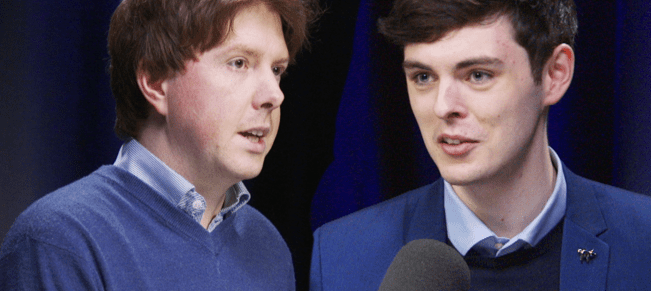
C.S. Lewis rejected this reductionist approach by arguing that our ability to reason must come from an immaterial mind and not a chemical quagmire. Unbelievable? tackled the validity of this argument by asking whether or not rationality disproves naturalism.
Dr Max Baker-Hytch, a philosopher from Wycliffe Hall in Oxford, argued that a materialist account of reality was insufficient to account for our ability to reason, while his debate partner, Alex O’ Connor, otherwise known as ‘Cosmic Skeptic’, argued that a naturalistic understanding of the universe was perfectly compatible with the human ability to contemplate.
C.S. Lewis’ argument has gone through some permutations, but for the sake of the debate was summarized by Baker-Hytch in this way:
“If my mental processes are determined wholly by the motion of atoms in my brain, I have no reason to suppose that my beliefs are true. They may be sound chemically, but that doesn’t make them sound logically.”
The argument suggests that a brain composed of randomly assembling atoms cannot be trusted to tell us anything true because non-rational chemical processes are incapable of rational thought.
Truth or Consequences
The correspondence theory of truth posits that truth is the correspondence of thought and reality. In other words, when the thoughts in our brain correctly comprehend reality, we are able to effectively navigate the world around us.
The problem with using truth as the end point for the argument from reason is that it can just as easily be explained as the natural outworking of an evolutionary process of success and failure where an effective biological algorithm is gradually engraved on our neural network.
The materialist escapes the problems of a discerning mind by claiming we are just beneficiaries of millions of years of dumb luck. We may think we are reasoning but that is merely the synaptic validation that our meat computer is working just fine. O’Connor summarizes this idea:
“Although natural selection is selecting for survival, the most consistent way to ensure the survival of a conscious agent is its ability to realistically understand the world around it…I think the definition of reason is acting and thinking in accordance with truth and to survive you have to act in accordance with the truth of the material world around you.”
Chemical Legos or Transcendent Logos
Baker-Hytch recognizes that relying on truth as the end point of the argument can be problematic. He therefore prefers to take it deeper by positing that materialism is incapable of furnishing the building blocks necessary to construct an entity which exhibits the immaterial properties of consciousness, purpose and intentionality. The issue for him isn’t the remarkable effectiveness of the brain, but the prerequisite need for mindful chemicals. Baker-Hytch doesn’t see why the immateriality of reason would be built with chemical Legos when transcendent logos is a far superior substrate:
“The sort of building blocks that you get if you have a physicalist naturalist ontology don’t give you what you need in order to get things like intentionality.”
Reason, for O’Connor, is the retrospective acknowledgment of successful determinism and, while he admits that it is unclear how this acknowledgment actually takes place, he doesn’t believe that it disqualifies a materialist explanation:
“I think reason and rationality can essentially just be defined as acting in accordance with what’s true of the world. And how we might know that we’re doing so is a difficult question. But the ability to do so on a naturalistic worldview, I think is certainly not ruled out.”
Drooling Over Darwin
On the show, O’Connor asked: “Why does this (consciousness) have to be some kind of different category of evolutionary development to the development of fingers?” I found him all too eager to appeal to evolution to support his materialistic view of reason.
The problem with Neo-Darwinian evolutionary theory is that it requires random genetic mistakes filtered through the cruel colander of natural selection. It requires specific genes and identifiable environmental pressures in order to work its magic. What is the atomic structure of an abstract thought? What is the chemical reaction for intentionality?
O’Connor believes that reasoning is akin to the processing of a computer, where decisions are merely a series of 1’s and 0’s determined by years of evolutionary programming. The computer may appear to be thinking, but that is an illusion.
Baker-Hytch, however, suggested that we reason not because of a biological Mother board but because we were created in the image of a Father figure. I think the more interesting question is not whether reason looks like a biological algorithm, but rather why is O’Connor able to transcend his existence and step outside the circle of life to marvel at his instinctual abilities?
Baker-Hytch makes the point that evolutionary theory, even when extended into the field of psychology, is inadequate to explain consciousness and our ability to reason:
“Evolution doesn’t explain intentionality. Evolutionary psychology presupposes intentionality…evolutionary psychology says you’ve got these bricks, which are the capacity for human thoughts and then how do they get arranged into this very impressive building?…In essence, all that it’s getting at is that once you’ve got the bricks, how do they get arranged? It doesn’t buy the bricks in the first place.”
Psychology is traditionally understood as the study of the mind-body interface but evolutionary psychology reduces it to nothing but chemical engineering.
I suspect if I was caring for O’Connor’s baby, he would want me to choose the proper technology, drug or therapeutic regimen based on my ability to reason through the disease process, rather than leaving the fate of his child to a medical procedure determined by millions of years of evolutionary pressure where the only treatment criteria was the survival fitness of his offspring.
A Spandrel in the Works
Consciousness is a significant problem for the materialist. Two of the more common explanations offered to explain the mind are emergence and spandrels. Emergence is the appearance of immaterial entities from accumulated material complexity, while evolutionary spandrels are unintended immaterial properties that emerge from the natural selection process.
The problem with appealing to emergent properties is that they represent a god-of-the-gaps argument where an immaterial explanation is offered to fill the space of the materially unexplained. The problem with consciousness as a spandrel is that rather than being a decorative add on to survival of the fittest, it seems to be the foundation of who we are.
Materialists can’t just jump on the emergent bandwagon without a physical bus pass and appealing to consciousness as a lovely ornamental feature of evolution just throws a spandrel in the works.
PhD of Transcendence
I find it interesting that O’Connor is pursuing a degree in a field that demands that he transcend his chemicals with every exam he takes and every paper he writes. I’m sorry to say that his choice of philosophy may just be one of the least important fields of enquiry when faced with the environmental pressure of being the most fit survivor. The ability to contemplate one’s navel would seem quite useless when one’s stomach is growling for food.
It’s astonishing that some of the smartest people on the planet, those who have spent lifetimes tacking letters of scholastic achievement to their names, are frequently the ones who ardently support the notion that man is just a smarter animal. These academically gifted human beings, who are arguably the most intellectually different from every other animal on the planet, make the incredible claim that they are just fine-tuned apes.
The multiple PhDs of human transcendence have somehow convinced them that they are nothing but the ABCs of immanence. They speak of evolution as if it were a series of collegiate weeding-out classes crafted to prepare us for the graduate school of humanity, but the problem is that there is no good evidence that our primate ancestors ever graduated and left the Animal House.
O’Connor said that we didn’t evolve to understand the micro or the macro. Why, if the nano and the nebular have no survival advantage, would he waste money on an advanced academic degree? Does tenure make one a more fit survivor?
The odd thing about the efforts of many atheists to demote mankind to the lowly status of mere links in the evolutionary chain is that they have to dabble in the ‘dark arts’ of transcendence in order to prove their point. They have to step outside of evolutionary theory to gain enough perspective to declare that we don’t transcend anything. I would argue that the very act of declaring that humans are insignificant is in itself quite significant. G.K. Chesterton stated it quite simply: “Man is not merely an evolution but rather a revolution.”
Chemical Conclusions
I would encourage everyone to take a listen to the show. Baker-Hytch and O’Connor were thoughtful, kind and expressed themselves eloquently. The argument from reason is but one more angle from which to address the larger question of how mind and body, consciousness and chemicals, and thought and deed interface.
While the materialist must explain how immaterial qualities arise from matter, the Christian must also explain how a spirit God can create a physical world. It is an important question that both believer and unbeliever must answer and I am grateful that Unbelievable? has provided an academically respectable forum where these questions can be discussed with gentleness and respect.
Watch Max Baker-Hytch and Cosmic Skeptic on Unbelievable?
Subscribe to the Unbelievable? podcast

Next Post

November 3, 2020 Christians are split on Critical Race Theory. This debate shows why.
Browse Our Archives
Select a Category Uncategorized
Select a Month April 2023 August 2022 June 2021 May 2021 April 2021 March 2021 February 2021 January 2021 December 2020 November 2020 October 2020 September 2020
Follow Us!
TAKE THE
Religious Wisdom Quiz
Who alone went up the mountain with Moses to meet God?
Select your answer to see how you score.
Hur Miriam Aaron Joshua
Related posts from Unbelievable?

Praying for Unity: A Christian Response to Critical...

3 Tips to Help Find Common Ground
If AI needs an intelligent creator, so do...

Fearfully and wonderfully made: The promise and perils...
TRENDING AT PATHEOS Evangelical

How the author of the world's best hymn...
I've been working with John Newton for a while now. This makes...

Long before this Lectio Divina, Psalm 130 - the song - started...

What About the Trees? Another Living Parable
After I finished writing the last article about falling leaves as a...

Why Classical Education Is a Conversation, Not a...
Come and Read: Joy in Classical Education When I was a little...

Falling Leaves: A Living Parable on Letting Go
I’ve spent the vast majority of my life in the southeast corner...

Cornell University has received a great deal of negative publicity and intense...
view all Evangelical blogs
Ad-Free & Subscriber Log-In Subscription Support
- About Us
- 2026 Calendar
- Videos
- Podcasts
- Library of World Religions
- Faith In Media Tracker
- Advertise With Us
- Write for Us
- Privacy Policy
- Terms of Service
- Do Not Sell My Data
- Contact Us
- Radiant Digital
- Manage Newsletter Subscriptions
- Unsubscribe From Notifications
- Sitemap
Copyright 2008-2026, Patheos. All rights reserved.
Subscription Support Ad-Free & Subscriber Log-In
Follow Patheos