
BuddhistCatholicContemplativeEvangelicalGeneral ChristianHinduJewishLatter-day SaintMuslimNew VisionsProgressive Christian
Beliefs
- Buddhist
- Catholic
- Contemplative
- Evangelical
- General Christian
- Hindu
- Jewish
- Latter-day Saint
- More Voices
- Muslim
- New Visions
- Pagan
- Progressive Christian
Topics
- Religion News
- Food and Religion
- Sports and Religion
- Religious Art
- Religious Music and Entertainment
- Religious Events
- History and Religion
- Style and Religion
- Politics and Religion
- Women in Religion
- Recreation Outdoors and Religion
- Business Finance and Religion
- Careers Workplace and Religion
- Education and Religion
- Family Parenting and Religion
- Health Fitness and Religion
- Home and Religion
- Relationships and Religion
- Technology and Religion
- Travel and Religion
Columnists
- Buddhist Columnists
- Business Finance and Religion Columnists
- Careers Workplace and Religion Columnists
- Catholic Columnists
- Contemplative Columnists
- Education and Religion Columnists
- Evangelists Columnists
- Family Parenting and Religion Columnists
- General Christian Columnists
- Health Fitness and Religion Columnists
- Hindu Columnists
- History and Religion Columnists
- Home and Religion Columnists
- Jewish Columnists
- More Voices Columnists
- Latter Day Columnists
- Muslim Columnists
- New Visions Columnists
- Nonreligious Columnists
- Pagan Columnists
- Politics and Religion Columnists
- Progressive Columnists
- Recreation Outdoors and Religion Columnists
- Relationships and Religion Columnists
- Religion News Columnists
- Religious Art Columnists
- Religious Events Columnists
- Religious Music and Entertainment Columnists
- Sports and Religion Columnists
- Style and Religion Columnists
- Technology and Religion Columnists
- Travel and Religion Columnists
- Women in Religion Columnists
Resource Library
- 2026 Calendar
- Library of World Religions
- The 100 Most Holy Places on Earth
- Patheos Answers
- Podcasts
- Videos
- Faith Leaders Database
- Anglican Episcopalian
- Bahai
- Baptist
- Buddhism
- Christianity
- Confucianism
- Eastern Orthodoxy
- Hinduism
- Holiness and Pentecostal
- ISKCON
- Islam
- Judaism
- Lutheran
- Methodist
- The Church of Jesus Christ of Latter-day Saints
- New Age
- Paganism
- Presbytarian and Reformed
- Protestantism
- Religion Behind the Scenes
- Roman Catholic
- Scientology
- Shia Islam
- Sikhism
- Sufism
- Sunni Islam
- Taoism
- Zen
- See all religions
Research Tools
 Ad-Free & Subscriber Log-In Subscription Support
Ad-Free & Subscriber Log-In Subscription Support
Follow Patheos 

- Trending:
- Forgiveness
- |
- Marriage
- |
- Consciousness
- |
- Death Penalty
- |
- Election
- |
- Halloween
 Turn. Love. Repeat.
- Home
- Catholic
- None Greater Than John the Baptist
None Greater Than John the Baptist
Last updated on: June 24, 2021 at 1:45 pm by Fr. Stephanos Pedrano, O.S.B.
None Greater Than John the Baptist 2021-06-24T13:45:49-08:00 Fr. Stephanos Pedrano, O.S.B.
Patheos Explore the world's faith through different perspectives on religion and spirituality! Patheos has the views of the prevalent religions and spiritualities of the world.
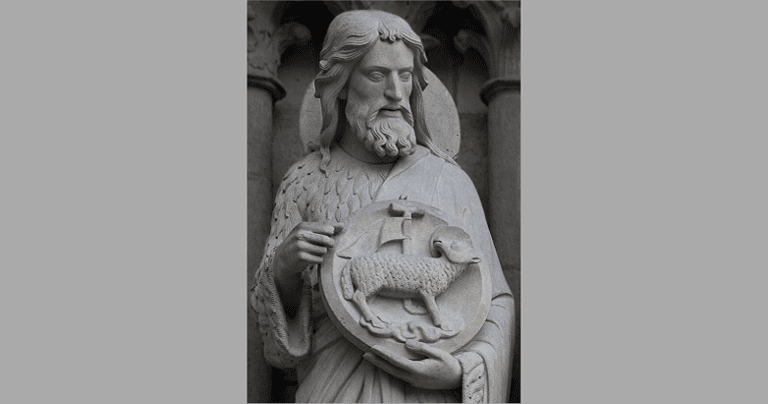
None Greater Than John. “Saint John the Baptist, Notre-Dame de Paris.” Wikimedia Commons / Public Domain.
Jesus said: None greater than John the Baptist has
arisen among those born of women. [Mt. 11:11]
For the Solemnity of the Nativity of Saint John the Baptist, June 24: Luke 1:57-66,80.
From the time of John’s birth his father speaks to him of the tender mercy of our God.
And you, child, will be called prophet of the Most High,
for you will go before the Lord to prepare his ways,
to give his people knowledge of salvation
through the forgiveness of their sins,
because of the tender mercy of our God
by which the daybreak from on high will visit us
to shine on those who sit in darkness and death’s shadow,
to guide our feet into the path of peace. [Lk. 1:76-79]
How did John grow up into a man who punished his own body and threatened people with hellfire?
And what did John do that God the Son said None greater than John the Baptist has arisen among those born of women?
We don’t know for certain when John had his first face-to-face meeting with the Incarnate Mercy of God.
The first time we see them meet face to face, John is baptizing crowds of sinners in the Jordan River, and Jesus is among them.
John looks into the crowd, sees Jesus and says aloud: Behold, the Lamb of God, who takes away the sin of the world!
Right there in that cry of recognition and that choice of words is a clue for reconciling John’s prophetic penances with the tender mercy of his God.
We might like to think that God’s mercy simply consists in God saying, “Forget it ever happened— I’ve wiped it off the face of history.”
Instead, God has chosen to do infinitely much more than that.
He became a real man of real human flesh and blood.
Behold, the Lamb of God whose flesh and blood will be sacrifice to atone for sin and pay for mercy.
God’s mercy in Christ is not the mere cancellation of a debt.
God’s mercy in Christ consists in God paying the price for his own mercy— paying off the debt of sin with his own flesh and blood.
However, his flesh and blood belong to our humanity.
In Christ, our nature, bodies, flesh and blood have become the place, the event and the price of God’s mercy.
We are not spectators, but participants.
Christ’s human flesh and blood, sacrificed for sin, and present in the Eucharist— soon present on this very altar— the human body and blood of God the Son are given to us, his brothers and sisters in flesh and blood— his brothers and sisters in God the Father.
The Eucharist is the price of God’s mercy.
In the Body and Blood of Christ, we are not mere spectators of this price.
We are participants.
We are participants in Christ’s Body and Blood that prove, proclaim and pay the price of God’s mercy.
The Eucharist is the prodigy, the promise, the presence and the price God paid for mercy.
John’s penance is not an effort to buy God’s mercy.
Rather, his penance is a sign of love and thanksgiving, yearning to point forward to and echo the price of God’s mercy— a price paid in flesh and blood so as to offer more than a mere cancellation of debt.
John’s rough diet, his camel skin clothing and solitary life in the desert all point towards the price God paid for mercy.
John, then, does not contradict the song of tender mercy his father sang when John was born.
Blessed be the Lord, the God of Israel,
for he has visited and brought redemption to his people.
He has raised up a horn for our salvation
within the house of David his servant,
even as he promised through the mouth of his holy prophets from of old:
salvation from our enemies and from the hand of all who hate us,
to show mercy to our fathers and to be mindful of his holy covenant
and of the oath he swore to Abraham our father,
and to grant us that, rescued from the hand of enemies,
without fear we might worship him in holiness and righteousness
before him all our days.
And you, child, will be called prophet of the Most High,
for you will go before the Lord to prepare his ways,
to give his people knowledge of salvation
through the forgiveness of their sins,
because of the tender mercy of our God
by which the daybreak from on high will visit us
to shine on those who sit in darkness and death’s shadow,
to guide our feet into the path of peace. [Lk. 1:68-79]
Turn. Love. Repeat.
Previous Post
June 20, 2021
To Cross Through Life With God.
Next Post

June 26, 2021 Do Not Be Afraid
Browse Our Archives
Select a Category Uncategorized
Select a Month July 2021 June 2021 May 2021 April 2021 March 2021 February 2021 January 2021 December 2020 November 2020 October 2020 September 2020 August 2020 July 2020 June 2020 May 2020 April 2020 March 2020 February 2020 January 2020 December 2019
Follow Us!
TAKE THE
Religious Wisdom Quiz
How many books are in the New Testament?
Select your answer to see how you score.
22 66 27 39
Related posts from Turn. Love. Repeat.
John: Cut and Named in the Gospel at...

Mary Greeted, Elizabeth Heard, John Leaped, the Spirit...
Christlike, Namely, "a Glutton and a Drunkard, a...
TRENDING AT PATHEOS Catholic

Rejecting Doom: Christian Hope And Human Action
Christianity is a religion of hope. We are to have hope and...

It’s What Comes From Within Which Matters
One of the most difficult things for us to understand is why...

Why I Choose the Eucharist Over the Sermon
Choose the Eucharist, Not the Sermon What are we supposed to get...

5 Design Elements Found in Spiritually Rooted Homes
Putting Spirituality Into Home Decor Our homes are more than our living...

Credo: A Story of God Told with the...
About 10 years ago, I began to imagine a personal "Credo" that...

The Anatomy of Divine Revelation in Catholic Thought
The claim that God has made Himself known to human beings is...
view all Catholic blogs
Ad-Free & Subscriber Log-In Subscription Support
- About Us
- 2026 Calendar
- Videos
- Podcasts
- Library of World Religions
- Faith In Media Tracker
- Advertise With Us
- Write for Us
- Privacy Policy
- Terms of Service
- Do Not Sell My Data
- Contact Us
- Radiant Digital
- Manage Newsletter Subscriptions
- Unsubscribe From Notifications
- Sitemap
Copyright 2008-2026, Patheos. All rights reserved.
Subscription Support Ad-Free & Subscriber Log-In
Follow Patheos