
BuddhistCatholicContemplativeEvangelicalGeneral ChristianHinduJewishLatter-day SaintMuslimNew VisionsProgressive Christian
Beliefs
- Buddhist
- Catholic
- Contemplative
- Evangelical
- General Christian
- Hindu
- Jewish
- Latter-day Saint
- More Voices
- Muslim
- New Visions
- Pagan
- Progressive Christian
Topics
- Religion News
- Food and Religion
- Sports and Religion
- Religious Art
- Religious Music and Entertainment
- Religious Events
- History and Religion
- Style and Religion
- Politics and Religion
- Women in Religion
- Recreation Outdoors and Religion
- Business Finance and Religion
- Careers Workplace and Religion
- Education and Religion
- Family Parenting and Religion
- Health Fitness and Religion
- Home and Religion
- Relationships and Religion
- Technology and Religion
- Travel and Religion
Columnists
- Buddhist Columnists
- Business Finance and Religion Columnists
- Careers Workplace and Religion Columnists
- Catholic Columnists
- Contemplative Columnists
- Education and Religion Columnists
- Evangelists Columnists
- Family Parenting and Religion Columnists
- General Christian Columnists
- Health Fitness and Religion Columnists
- Hindu Columnists
- History and Religion Columnists
- Home and Religion Columnists
- Jewish Columnists
- More Voices Columnists
- Latter Day Columnists
- Muslim Columnists
- New Visions Columnists
- Nonreligious Columnists
- Pagan Columnists
- Politics and Religion Columnists
- Progressive Columnists
- Recreation Outdoors and Religion Columnists
- Relationships and Religion Columnists
- Religion News Columnists
- Religious Art Columnists
- Religious Events Columnists
- Religious Music and Entertainment Columnists
- Sports and Religion Columnists
- Style and Religion Columnists
- Technology and Religion Columnists
- Travel and Religion Columnists
- Women in Religion Columnists
Resource Library
- 2026 Calendar
- Library of World Religions
- The 100 Most Holy Places on Earth
- Patheos Answers
- Podcasts
- Videos
- Faith Leaders Database
- Anglican Episcopalian
- Bahai
- Baptist
- Buddhism
- Christianity
- Confucianism
- Eastern Orthodoxy
- Hinduism
- Holiness and Pentecostal
- ISKCON
- Islam
- Judaism
- Lutheran
- Methodist
- The Church of Jesus Christ of Latter-day Saints
- New Age
- Paganism
- Presbytarian and Reformed
- Protestantism
- Religion Behind the Scenes
- Roman Catholic
- Scientology
- Shia Islam
- Sikhism
- Sufism
- Sunni Islam
- Taoism
- Zen
- See all religions
Research Tools
 Ad-Free & Subscriber Log-In Subscription Support
Ad-Free & Subscriber Log-In Subscription Support
Follow Patheos 

- Trending:
- Forgiveness
- |
- Marriage
- |
- Consciousness
- |
- Death Penalty
- |
- Election
- |
- Halloween
 Turn. Love. Repeat.
- Home
- Catholic
- God Binding God to Us: The New and Eternal Covenant
God Binding God to Us: The New and Eternal Covenant
Last updated on: June 5, 2021 at 7:58 pm by Fr. Stephanos Pedrano, O.S.B.
God Binding God to Us: The New and Eternal Covenant 2021-06-05T19:58:55-08:00 Fr. Stephanos Pedrano, O.S.B.
Patheos Explore the world's faith through different perspectives on religion and spirituality! Patheos has the views of the prevalent religions and spiritualities of the world.
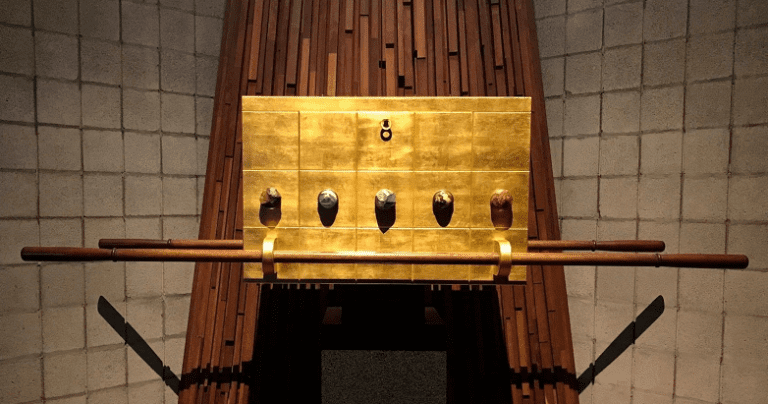
Ark of the Covenant for the Eucharistic Tabernacle at Prince of Peace Abbey
The Body and the Blood of the
New and Eternal Covenant
Today the three readings from the Lord bear witness that God has joined with humanity in a flesh-and-blood bond— a covenant.
The highest, deepest and eternal covenant is the one that binds God to us in the Body and Blood of Christ.
Before Christ, God took on a bond with humanity by the blood of a sacrificial animal.
Today in the Book of Exodus we see Moses take the blood of bulls.
Following God’s instruction, Moses pours half the blood on the altar.
The altar represents God.
The blood on the altar is the sign that God is making a self-binding, life-and-death promise to the people.
After the people promise to obey God, Moses then sprinkles the other half of the bull’s blood on them.
The blood on them is a sign of their life-and-death promise binding them to God.
This is not God’s blood or human blood.
It is the blood of a mere animal.
However, the death and the blood of that animal became the chosen sign of a life-and-death promise between God and Israel to be faithful to each other.
Before there were any human beings, before there was a universe, the Son of God stood everlastingly faithful before the loving Father in the Spirit of thankfulness and communion.
Before they made the universe— with or without the universe— the Son and Father have one Spirit as their eternal, faithful covenant with each other.
The eternal Son came to earth two thousand years ago and received the name Jesus.
On the day of his earthly arrival, a human heart, a human mind, a human body— human flesh and blood— began to belong to the Son of God in person.
Alive in the human Body and Blood of Christ Jesus is the covenant— the relationship— of the eternal Son with the eternal Father.
When we eat and drink the Body and Blood of Christ, we are entering not only a relationship of human persons with God.
In the Body and Blood of Christ we are entering God’s relationship with God.
The second letter of Saint Peter [1:4] dares to say we become communicants or sharers in God’s nature [theías koinonoì phúseos].
In Christ’s Eucharistic Body and Blood, we take, eat, drink, live off and share in the relationship of God the Son with God the Father in God the Holy Spirit.
Not just our relationship with God, but God’s relationship with God!
On the day Christ calls us to rise from the dead in the new heavens and the new earth, we will know and enjoy with unspeakable pleasure that God’s love for God is alive in us— alive in our own personal hearts and minds, alive in our own personal body and blood.
Let us keep in mind the relationship of Christ and the Father as we hear of it in one of the prayers at Mass [Eucharistic Prayer I].
On the day before he was to suffer,
he took bread in his holy and venerable hands,
and with eyes raised to heaven
to you, O God, his almighty Father,
giving you thanks, he said the blessing,
broke the bread
and gave it to his disciples saying:
Take this, all of you, and eat of it,
FOR THIS IS MY BODY,
WHICH WILL BE GIVEN UP FOR YOU.
In a similar way, when supper was ended,
he took this precious chalice
in his holy and venerable hands,
and once more giving you thanks, he said the blessing
and gave the chalice to his disciples, saying:
TAKE THIS, ALL OF YOU, AND DRINK FROM IT,
FOR THIS IS THE CHALICE OF MY BLOOD,
THE BLOOD OF THE NEW AND ETERNAL COVENANT,
WHICH WILL BE POURED OUT FOR YOU AND FOR MANY
FOR THE FORGIVENESS OF SINS.
The new and eternal COVENANT!
On this solemn festival day of the Body and Blood Covenant of Christ, the Mass offers the following Prayer after Communion.
Grant, O Lord, we pray,
that we may delight for all eternity
in that share in your divine life,
which is foreshadowed in the present age
by our reception of your precious Body and Blood.
Together with Christ and by the power of the Spirit, may we always live for the Father!
And together with Christ and by the power of the Spirit, may we always rejoice in knowing that the Father lives for us!
Turn. Love. Repeat.
Previous Post

June 1, 2021
Between Haters of Rome and Friends of Rome
Next Post
June 9, 2021 The Word, the Love Letter, Is God, and God Is Love
Browse Our Archives
Select a Category Uncategorized
Select a Month July 2021 June 2021 May 2021 April 2021 March 2021 February 2021 January 2021 December 2020 November 2020 October 2020 September 2020 August 2020 July 2020 June 2020 May 2020 April 2020 March 2020 February 2020 January 2020 December 2019
Follow Us!
TAKE THE
Religious Wisdom Quiz
Which principle is behind "Turn the other cheek"?
Select your answer to see how you score.
Do not retaliate Start a fight Ignore injustice Hit back harder
Related posts from Turn. Love. Repeat.
Pandemic, Social Distancing, Masks, Houses of Worship
A Piece of Baked Fish: The Risen One’s...
My Kingdom Is Not of This World
Slave, Scapegoat, Banquet and Savior of Sinners
TRENDING AT PATHEOS Catholic

The Parable Of The Sower And The Word...
One of Christ’s most famous parables is that of the sower who...

Rejecting Doom: Christian Hope And Human Action
Christianity is a religion of hope. We are to have hope and...

Why I Choose the Eucharist Over the Sermon
Choose the Eucharist, Not the Sermon What are we supposed to get...

5 Design Elements Found in Spiritually Rooted Homes
Putting Spirituality Into Home Decor Our homes are more than our living...

Credo: A Story of God Told with the...
About 10 years ago, I began to imagine a personal "Credo" that...

The Anatomy of Divine Revelation in Catholic Thought
The claim that God has made Himself known to human beings is...
view all Catholic blogs
Ad-Free & Subscriber Log-In Subscription Support
- About Us
- 2026 Calendar
- Videos
- Podcasts
- Library of World Religions
- Faith In Media Tracker
- Advertise With Us
- Write for Us
- Privacy Policy
- Terms of Service
- Do Not Sell My Data
- Contact Us
- Radiant Digital
- Manage Newsletter Subscriptions
- Unsubscribe From Notifications
- Sitemap
Copyright 2008-2026, Patheos. All rights reserved.
Subscription Support Ad-Free & Subscriber Log-In
Follow Patheos