
BuddhistCatholicContemplativeEvangelicalGeneral ChristianHinduJewishLatter-day SaintMuslimNew VisionsProgressive Christian
Beliefs
- Buddhist
- Catholic
- Contemplative
- Evangelical
- General Christian
- Hindu
- Jewish
- Latter-day Saint
- More Voices
- Muslim
- New Visions
- Pagan
- Progressive Christian
Topics
- Religion News
- Food and Religion
- Sports and Religion
- Religious Art
- Religious Music and Entertainment
- Religious Events
- History and Religion
- Style and Religion
- Politics and Religion
- Women in Religion
- Recreation Outdoors and Religion
- Business Finance and Religion
- Careers Workplace and Religion
- Education and Religion
- Family Parenting and Religion
- Health Fitness and Religion
- Home and Religion
- Relationships and Religion
- Technology and Religion
- Travel and Religion
Columnists
- Buddhist Columnists
- Business Finance and Religion Columnists
- Careers Workplace and Religion Columnists
- Catholic Columnists
- Contemplative Columnists
- Education and Religion Columnists
- Evangelists Columnists
- Family Parenting and Religion Columnists
- General Christian Columnists
- Health Fitness and Religion Columnists
- Hindu Columnists
- History and Religion Columnists
- Home and Religion Columnists
- Jewish Columnists
- More Voices Columnists
- Latter Day Columnists
- Muslim Columnists
- New Visions Columnists
- Nonreligious Columnists
- Pagan Columnists
- Politics and Religion Columnists
- Progressive Columnists
- Recreation Outdoors and Religion Columnists
- Relationships and Religion Columnists
- Religion News Columnists
- Religious Art Columnists
- Religious Events Columnists
- Religious Music and Entertainment Columnists
- Sports and Religion Columnists
- Style and Religion Columnists
- Technology and Religion Columnists
- Travel and Religion Columnists
- Women in Religion Columnists
Resource Library
- 2026 Calendar
- Library of World Religions
- The 100 Most Holy Places on Earth
- Patheos Answers
- Podcasts
- Videos
- Faith Leaders Database
- Anglican Episcopalian
- Bahai
- Baptist
- Buddhism
- Christianity
- Confucianism
- Eastern Orthodoxy
- Hinduism
- Holiness and Pentecostal
- ISKCON
- Islam
- Judaism
- Lutheran
- Methodist
- The Church of Jesus Christ of Latter-day Saints
- New Age
- Paganism
- Presbytarian and Reformed
- Protestantism
- Religion Behind the Scenes
- Roman Catholic
- Scientology
- Shia Islam
- Sikhism
- Sufism
- Sunni Islam
- Taoism
- Zen
- See all religions
Research Tools
 Ad-Free & Subscriber Log-In Subscription Support
Ad-Free & Subscriber Log-In Subscription Support
Follow Patheos 

- Trending:
- Forgiveness
- |
- Marriage
- |
- Consciousness
- |
- Death Penalty
- |
- Election
- |
- Halloween
 Truth to Power
- Home
- Muslim
- Protecting the Light of Black Muslims pt 1.
Protecting the Light of Black Muslims pt 1.
Last updated on: January 26, 2017 at 3:12 pm by Hakeem Muhammad
Protecting the Light of Black Muslims pt 1. 2017-01-26T15:12:36-05:00 Hakeem Muhammad
Patheos Explore the world's faith through different perspectives on religion and spirituality! Patheos has the views of the prevalent religions and spiritualities of the world.
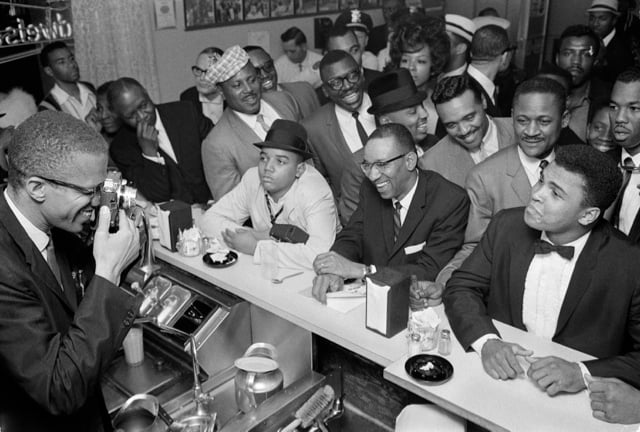
Wikimedia Commons.
Analyzing the impact of Islam upon Black America, in The First Next Time, Black Intellectual, James Baldwin states that Islam has been able to accomplish what welfare workers and various city agencies have attempted to do but failed to do; making drunkards sober and lowering the recidivism rate of prisoners.
Most significantly, Baldwin states that Islam has been able to, ’invest both male and female with the pride and serenity that hang about them like unfailing light.’” In Baldwin’s perspective, the manner in which the Black Muslim Movement intimidated white liberals demonstrated that,” They could deal with the Negro as a symbol or a victim but had no sense of him as a man.” Malcolm X was one of the most iconic examples of the light for which Islam was able to bring within Black America.
Upon being freed from prison, Malcolm X went to the Mosque for the very first time and became sorrowful because it was not filled to capacity despite the fact that Detroit’s ghettos were filled with brainwashed black brothers and sisters involved in numerous vices which Islam had the ability to cure.
Malcolm began diligently traveling in Detroit’s ghettos inviting people into the Mosque from gang-bangers, drug addicts, to prostitutes. Summarizing his sincere devotion, Malcolm X states, “Islam meant more to me than anything I ever had known in my life.” Examining the life of Malcolm X, In Islamic Liberation Theology Resisting the Empire by Hamid Dabashi, Dabashi writes:
In over 200 years of contact with colonial modernity, the emergence of numerous Islamic revivalist movement, and numerous Islamic thinkers, none comes even close to Malcolm X in the liberating, global, and visionary grasp of his faith and its place in facing the barefaced barbarity of economic and military world domination.(Islamic Liberation Theology: resisting the Empire)
Without reviving the legacy of Malcolm X in making Islam speak to the oppressed and marginalized, Dabashi states that, “Islam will become the fatuous faith of the Khaliji, Kuwaiti, and Saudi sheikhs having difficulty bending over their overfed bellies when pretending to prostrate to pray.” What lends some credence to Dabashi’s statement is the contrasting experience of which Minister Louis Farrakhan describes first meeting Malcolm X to his first time meeting with various sheikhs of Saudi Arabia.
Malcolm X and Saudi Sheikhs
Min. Farrakhan stated that first time he went to Mosque #7, upon hearing the words of Malcolm X observing the studious and productive manner by which black Muslims carried themselves, Min. Farrakhan said he actually began to cry. Many of the brothers within the Mosque began looking at him strangely pondering to themselves how a grown man could actually be crying. However, at this moment Min. Farrakhan said he promised himself that he would become Muslim and work to share this message among black people.
After attending for a few weeks, Malcolm X asked Min. Farrakhan to speak on how Islam had done to improve his life. Upon speaking upon what Islam had done for his life, the entire audience began applauding, and Malcolm X appointed Min Farrakhan to attend the Nation of Islam’s ministry school.
What is particularly significant is the manner in which the ministry of Min. Farrakhan, (which is integrally connected with the legacy of Malcolm X) during the second rise of the Nation of Islam, posits a very profound critique to Arab cultural imperialism of black Muslims, anti-blackness in the Muslim community, and most critically the inability or perhaps unwillingness of scholars of the Muslim world to evoke their tradition and scholarship for the purposes of combating white supremacy and working toward black liberation.
In the mid seventies during the transitionary period of the Nation of Islam to the World Community of Al-Islam in the West, James Baldwin approached Min. Farrakhan about a movie script that he made on the life of Malcolm X. Believing that it would be a great way to inspire the black people of America to look into Islam, Min. Farrakhan went to to Saudi Arabia in efforts to raise funding for the movie.
Describing his experience Min. Farrakhan says, “I went to Mecca and sat with the scholars in Mecca about making a movie about Malcolm X. ‘They told me, “All images are of the devil.’ They sounded silly to me.” While in Saudi Arabia, Min. Farrakhan reports being extremely disillusioned with what he perceived to be the stagnant and ritualistic manner in which Islam was practiced.
In contrast to the alive, inspiring,and justice-oriented Islam that he describes when he first met Malcolm X, Farrakhan describes Saudi Arabia as consisting of “Big Belly Sheikhs walking around with oil wealth while the people are in squalor and poverty.” Discussing his former mentor Malcolm X, Min. Farrakhan says he had a zeal for Islam enabling him with the ability to transform human life. This ability of Malcolm X, Min. Farrakhan states, “is not in Mecca or in Medina or in Al-Azhar in Egypt.
Min. Farrakhan challenges the legitimacy and authority of Saudi Arabia’s universities to even teach black Americans. Islam, “A woman can’t even drive a car in Saudi Arabia? They don’t even allow her to have a license who are they to be my example? “ Min. Farrakhan characterizes the Muslim world as decadent, divided, and in need of reformation. Lastly, he warns black Muslims “You can’t go and put your light under the Arab world.” Was the light of black Muslims which James Baldwin once spoke of concealed by being under foreign tutelage?
The Light of Black Muslims
In Islam and the Blackamerica: Looking Toward the Third Resurrection, Dr. Sherman Jackson states the growth of the Nation of Islam from 1930 to 1975 was part of a holy protest against white supremacy and antiblackness. Many in the Muslim world would like to write the Nation of Islam out of history on theological grounds. Yet, this movement gave birth to many of the most iconic, influential and admired Muslims of the past two centuries from Malcolm X, Muhammad Ali and Imam Warrith Deen Muhammad.
Perhaps, if there was only one such individual this reality could be written off as an anomaly. However, when a movement consistently gives birth to such people it deserves to be analysed and studied. In particular, what deserves to be examined is how the second rise of the Nation of Islam from 1977 to the present continues this protest against white supremacy and anti-blackness but also includes a protest of Arab cultural imperialism of black Muslims, anti-blackness in the Muslim world, and the inability, unwillingness, or apathy of the ulema or scholars of the Muslim World to confront anti-blackness. In addition to this, there is also a critique of the dimming of the light whilst under the tutelage of foreign powers.
In the next article, we will examine this critique further and discuss why it is imperative the Muslim World must address this critique.
Minister Farrakhan. Dr. Sherman jackson
Previous Post
January 4, 2017
Long Live Muhammad! African-American Muslims in 1975.
Next Post
February 1, 2017 5 Hidden Black Muslim History Facts!
Browse Our Archives
Select a Category Cultural Stories Hip-Hop Halaqas History Philosophy Self-Improvement Social Justice Uncategorized
Select a Month May 2018 February 2018 January 2018 December 2017 October 2017 September 2017 August 2017 July 2017 June 2017 May 2017 April 2017 March 2017 February 2017 January 2017 December 2016 November 2016 October 2016 September 2016 August 2016 July 2016 June 2016 May 2016 April 2016
Follow Us!
TAKE THE
Religious Wisdom Quiz
True or False: Gideon defeated the Midianites with an army of just 3,000 men.
Select your answer to see how you score.
TRUE FALSE
Related posts from Truth to Power

Dawah in 21st Century Black America: A Message...
France’s System White Supremacy & The Qu’ran of...

When Muslims Join Forces with an Anti-Black Hate...

Hoda Katebi exposes the real enemy: White Supremacy
TRENDING AT PATHEOS Muslim

25 Years Later: How Much Has Changed for...
As we approach the 25th anniversary of September 11th, I’ve found myself...

Podcast: Third Spaces & The Rise of Yemeni...
In the latest episode of The Artistic Foodies Podcast, hosts Abbas...

HalalFest Picks: Best 60 Halal Spots for Super...
Back in 2016, I came up with a list of 29...

Unity Is America’s Strength — Division Is Its...
by Hidayatullah Ahsan When Valentina Gomez, a Republican candidate for Congress in...

Zohran Mamdani and New York’s Fight Against Islamophobia
This past June, against all odds, Zohran Mamdani won the Democratic primary...

What the Fourth of July Means to a...
As we mark another Fourth of July, millions of Americans will celebrate...
view all Muslim blogs
Ad-Free & Subscriber Log-In Subscription Support
- About Us
- 2026 Calendar
- Videos
- Podcasts
- Library of World Religions
- Faith In Media Tracker
- Advertise With Us
- Write for Us
- Privacy Policy
- Terms of Service
- Do Not Sell My Data
- Contact Us
- Radiant Digital
- Manage Newsletter Subscriptions
- Unsubscribe From Notifications
- Sitemap
Copyright 2008-2026, Patheos. All rights reserved.
Subscription Support Ad-Free & Subscriber Log-In
Follow Patheos