
BuddhistCatholicContemplativeEvangelicalGeneral ChristianHinduJewishLatter-day SaintMuslimNew VisionsProgressive Christian
Beliefs
- Buddhist
- Catholic
- Contemplative
- Evangelical
- General Christian
- Hindu
- Jewish
- Latter-day Saint
- More Voices
- Muslim
- New Visions
- Pagan
- Progressive Christian
Topics
- Religion News
- Food and Religion
- Sports and Religion
- Religious Art
- Religious Music and Entertainment
- Religious Events
- History and Religion
- Style and Religion
- Politics and Religion
- Women in Religion
- Recreation Outdoors and Religion
- Business Finance and Religion
- Careers Workplace and Religion
- Education and Religion
- Family Parenting and Religion
- Health Fitness and Religion
- Home and Religion
- Relationships and Religion
- Technology and Religion
- Travel and Religion
Columnists
- Buddhist Columnists
- Business Finance and Religion Columnists
- Careers Workplace and Religion Columnists
- Catholic Columnists
- Contemplative Columnists
- Education and Religion Columnists
- Evangelists Columnists
- Family Parenting and Religion Columnists
- General Christian Columnists
- Health Fitness and Religion Columnists
- Hindu Columnists
- History and Religion Columnists
- Home and Religion Columnists
- Jewish Columnists
- More Voices Columnists
- Latter Day Columnists
- Muslim Columnists
- New Visions Columnists
- Nonreligious Columnists
- Pagan Columnists
- Politics and Religion Columnists
- Progressive Columnists
- Recreation Outdoors and Religion Columnists
- Relationships and Religion Columnists
- Religion News Columnists
- Religious Art Columnists
- Religious Events Columnists
- Religious Music and Entertainment Columnists
- Sports and Religion Columnists
- Style and Religion Columnists
- Technology and Religion Columnists
- Travel and Religion Columnists
- Women in Religion Columnists
Resource Library
- 2026 Calendar
- Library of World Religions
- The 100 Most Holy Places on Earth
- Patheos Answers
- Podcasts
- Videos
- Faith Leaders Database
- Anglican Episcopalian
- Bahai
- Baptist
- Buddhism
- Christianity
- Confucianism
- Eastern Orthodoxy
- Hinduism
- Holiness and Pentecostal
- ISKCON
- Islam
- Judaism
- Lutheran
- Methodist
- The Church of Jesus Christ of Latter-day Saints
- New Age
- Paganism
- Presbytarian and Reformed
- Protestantism
- Religion Behind the Scenes
- Roman Catholic
- Scientology
- Shia Islam
- Sikhism
- Sufism
- Sunni Islam
- Taoism
- Zen
- See all religions
Research Tools
 Ad-Free & Subscriber Log-In Subscription Support
Ad-Free & Subscriber Log-In Subscription Support
Follow Patheos 

- Trending:
- Forgiveness
- |
- Marriage
- |
- Consciousness
- |
- Death Penalty
- |
- Election
- |
- Halloween
 Truth to Power
- Home
- Muslim
- Islamophobia and Anti-Blackness: The Historical Connection pt. 1
Islamophobia and Anti-Blackness: The Historical Connection pt. 1
Last updated on: May 13, 2016 at 10:56 am by Hakeem Muhammad
Islamophobia and Anti-Blackness: The Historical Connection pt. 1 2016-05-13T10:56:53-05:00 Hakeem Muhammad
Patheos Explore the world's faith through different perspectives on religion and spirituality! Patheos has the views of the prevalent religions and spiritualities of the world.
Editor’s Note: This is part one of a ten part series exploring how anti-blackness and Islamophobia are interconnected.
A world which is anti-Black must be anti-Islam, because Islam in the psyche of white civil society has been a 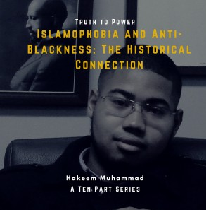 formidable force in catalyzing resistance among Blacks to not acquiesce to the position of the slave. The historical record of European political theorists gives clear indication that the power of Islam functioned to them as a menacing impediment to their attempts to secure an unjust racial caste system that marked Blacks as slave flesh to be dominated by whites.
According to Calvin Warren in Black Nihilism and the Politics of Hope, the horrific Middle Passage voyage trapped Blacks in a world of existential absurdity in which all, “meaning is lost for the black.” In the slave narrative of Abu Bakr, he demonstrates an unbreakable conviction in Islam that actively ruptures the nihilism that the Middle Passage sought to solidify:
” I tasted the bitterness of slavery from them and its oppressiveness. But praise be to God under whose power are all things. He does whatsoever he wills! He is our master. In God, therefore let all the faithful put their trust!”
Abu Bakr could be alienated from kinship structures and his culture, but not his relationship with God, whom he acknowledges as his true master. As a hafi of the Qu’ran, Abu Bakr would have been familiar with verses urging believers to be unwearied in the face of hindrances and to never let any worldly catastrophe disturb their peace of mind or purpose.
With firmness of purpose, Black Muslims enduring captivity in Brazil commemorated the projected anniversary of the Qur’anic revelation to the Prophet(pbuh) known as the Night of Power, by initiating what historian Reis referred to as “the most effective urban slave rebellion ever to occur on the American continent.” Licutan, an Islamic scholar and the mastermind behind the revolt, would be placed under interrogation after the revolt was finally quelled.
When Licutan would be asked for his name, court documents reveal that he continuously referred to himself as a Bilal. Both the judge and the court prosecutors were infuriated by this action, insisting that they knew his actual name was Licutan, oblivious to the symbolic significance. Licutan was identifying with a leading companion of the Prophet Muhammad(pbuh), Bilal Ibn Rabah(RA)!
The Male’ Slave Revolt and The Middle Passage
The aim of the Middle Passage was to trap Black into a world of existential absurdity by robbing them of any purpose outside of that of a tool. Despite this objective, historian Dr.Enrico Dal lago indicates that the Black Muslim slave rebellion in Brazil, “followed a similar pattern to the jihad that characterized Sokoto expansion, almost to the point of being a transatlantic extension of the latter in the Americas.” If the Male’ Slave Rebellion was a transatlantic extension of the Islamic movements that went into the establishment of the Sokoto Caliphate, then far from succeeding in robbing Black Muslim slaves of meaning, many who experienced the Middle Passage, merely saw it as a free voyage granting them to opportunity to struggle for Islam in the western hemisphere!
While the Middle Passage sought to destroy within its victims the ability to determine their own meaning, Islam provided slaves with active resistance to this process. What was to be done about a belief set that still inculcated within its followers meaning, purpose, and unending determination even after the Middle Passage? Dr. George Junne notes that African Muslims were heavily persecuted and even African ethnic groups merely thought of having Muslim ties were treated by authorities with extreme caution.
Anti-Black Epistemology and Islamophobia:
Uncoincidentally, Anti-Black political treatise among Europeans often correlated with rampant Islamophobia. Meticulous in their ardent desire to maintain an anti-black world in the face of revolts, Stoddard Lothrop, a European political thinker would publish the book The Rising Tide of Color Against White World-Supremacy. This book was not a fringe publication, rather it influenced the elites in white civil society, having been read and even recommended by President Warren G. Harding*.*
Stoddard gives an account of how the various religions of Blacks would impact the European quest for racial supremacy, Stoddard writes, “In so far as he is Christianized, the Negro’s savage instincts will be restrained and he will be disposed to acquiescence in white tutelage. In so far as he is Islamized, the negro’s warlike propensities will be inflamed…” Though in Stoddard’s analysis Blacks are naturally bestial, savage, and warlike, he firmly believed that Christianity would be able to tame these tendencies and cause them to accept white dominance.
At the top of the priorities for Stoddard stopping the spread of Islam among Blacks, he writes, “Islam is as yet unknown south of the Zambezi, but white men universally dread the possibility of its appearance, fearing its effect upon the natives.” In their mind, Blackness within Christianity came to represent Blackness tamed and unable to resist the anti-black world, whereas blackness with indigenous African faiths came to represent blackness in a savage, bestial, and primitive state but one that could potentially be open to Christian civilizing.
Thus, Blackness with Islam represented something untamable and irredeemable. Blackness in opposition to white dominance and an amplification of the inherent warlike qualities they believed were already inherent in Blacks that would fiercely threaten their agenda for racial supremacy.
The universal dread of Islam that Stoddard speaks of existed among white civil society demonstrates that Islamophobia manifests as a fear that Islam would motivate Blacks to not accept the position of a slave and to actively resist it.
—–
In part two of the series, we will examine the cosmological significance of Black Muslims in Brazil choosing Layl Qadr to spark their slave rebellion and Licutan’s identification with Bilal Ibn Rabah(RA).
Previous Post
May 6, 2016
The Triple Evils & The Prophetic Cure
Next Post
May 14, 2016 Black Muslims reject extremism and Call For Moderates.
Browse Our Archives
Select a Category Cultural Stories Hip-Hop Halaqas History Philosophy Self-Improvement Social Justice Uncategorized
Select a Month May 2018 February 2018 January 2018 December 2017 October 2017 September 2017 August 2017 July 2017 June 2017 May 2017 April 2017 March 2017 February 2017 January 2017 December 2016 November 2016 October 2016 September 2016 August 2016 July 2016 June 2016 May 2016 April 2016
Follow Us!
TAKE THE
Religious Wisdom Quiz
My name is Amos, before God called me to prophesy against Israel what was my occupation?
Select your answer to see how you score.
Priest in the temple Shepherd and farmer Spinner of cloth Fisherman
Related posts from Truth to Power

Dawah in 21st Century Black America: A Message...
France’s System White Supremacy & The Qu’ran of...
When Muslims Join Forces with an Anti-Black Hate...
Imam Makandal and the end of White Power...
TRENDING AT PATHEOS Muslim

25 Years Later: How Much Has Changed for...
As we approach the 25th anniversary of September 11th, I’ve found myself...

Podcast: Third Spaces & The Rise of Yemeni...
In the latest episode of The Artistic Foodies Podcast, hosts Abbas...

HalalFest Picks: Best 60 Halal Spots for Super...
Back in 2016, I came up with a list of 29...

Unity Is America’s Strength — Division Is Its...
by Hidayatullah Ahsan When Valentina Gomez, a Republican candidate for Congress in...

Zohran Mamdani and New York’s Fight Against Islamophobia
This past June, against all odds, Zohran Mamdani won the Democratic primary...

What the Fourth of July Means to a...
As we mark another Fourth of July, millions of Americans will celebrate...
view all Muslim blogs
Ad-Free & Subscriber Log-In Subscription Support
- About Us
- 2026 Calendar
- Videos
- Podcasts
- Library of World Religions
- Faith In Media Tracker
- Advertise With Us
- Write for Us
- Privacy Policy
- Terms of Service
- Do Not Sell My Data
- Contact Us
- Radiant Digital
- Manage Newsletter Subscriptions
- Unsubscribe From Notifications
- Sitemap
Copyright 2008-2026, Patheos. All rights reserved.
Subscription Support Ad-Free & Subscriber Log-In
Follow Patheos