
BuddhistCatholicContemplativeEvangelicalGeneral ChristianHinduJewishLatter-day SaintMuslimNew VisionsProgressive Christian
Beliefs
- Buddhist
- Catholic
- Contemplative
- Evangelical
- General Christian
- Hindu
- Jewish
- Latter-day Saint
- More Voices
- Muslim
- New Visions
- Pagan
- Progressive Christian
Topics
- Religion News
- Food and Religion
- Sports and Religion
- Religious Art
- Religious Music and Entertainment
- Religious Events
- History and Religion
- Style and Religion
- Politics and Religion
- Women in Religion
- Recreation Outdoors and Religion
- Business Finance and Religion
- Careers Workplace and Religion
- Education and Religion
- Family Parenting and Religion
- Health Fitness and Religion
- Home and Religion
- Relationships and Religion
- Technology and Religion
- Travel and Religion
Columnists
- Buddhist Columnists
- Business Finance and Religion Columnists
- Careers Workplace and Religion Columnists
- Catholic Columnists
- Contemplative Columnists
- Education and Religion Columnists
- Evangelists Columnists
- Family Parenting and Religion Columnists
- General Christian Columnists
- Health Fitness and Religion Columnists
- Hindu Columnists
- History and Religion Columnists
- Home and Religion Columnists
- Jewish Columnists
- More Voices Columnists
- Latter Day Columnists
- Muslim Columnists
- New Visions Columnists
- Nonreligious Columnists
- Pagan Columnists
- Politics and Religion Columnists
- Progressive Columnists
- Recreation Outdoors and Religion Columnists
- Relationships and Religion Columnists
- Religion News Columnists
- Religious Art Columnists
- Religious Events Columnists
- Religious Music and Entertainment Columnists
- Sports and Religion Columnists
- Style and Religion Columnists
- Technology and Religion Columnists
- Travel and Religion Columnists
- Women in Religion Columnists
Resource Library
- 2026 Calendar
- Library of World Religions
- The 100 Most Holy Places on Earth
- Patheos Answers
- Podcasts
- Videos
- Faith Leaders Database
- Anglican Episcopalian
- Bahai
- Baptist
- Buddhism
- Christianity
- Confucianism
- Eastern Orthodoxy
- Hinduism
- Holiness and Pentecostal
- ISKCON
- Islam
- Judaism
- Lutheran
- Methodist
- The Church of Jesus Christ of Latter-day Saints
- New Age
- Paganism
- Presbytarian and Reformed
- Protestantism
- Religion Behind the Scenes
- Roman Catholic
- Scientology
- Shia Islam
- Sikhism
- Sufism
- Sunni Islam
- Taoism
- Zen
- See all religions
Research Tools
 Ad-Free & Subscriber Log-In Subscription Support
Ad-Free & Subscriber Log-In Subscription Support
Follow Patheos 

- Trending:
- Forgiveness
- |
- Marriage
- |
- Consciousness
- |
- Death Penalty
- |
- Election
- |
- Halloween
 Truth Mission
- Home
- Evangelical
- Relationships and Religion
- The Law and the Prophets: Part 1–Seek Justice, Love Mercy
The Law and the Prophets: Part 1–Seek Justice, Love Mercy
Last updated on: December 20, 2023 at 10:23 am by M. Scott Coffman
The Law and the Prophets: Part 1–Seek Justice, Love Mercy 2023-12-20T10:23:08-06:00 M. Scott Coffman
Patheos Explore the world's faith through different perspectives on religion and spirituality! Patheos has the views of the prevalent religions and spiritualities of the world.
The Lord always does right and wants justice done. Everyone who does right will see his face. Psalm 11:7 (CEV)
Last May, we defined justice as “getting what you deserve.”
However, from the quote above, we can see that the Bible has more than one definition of justice, depending on the translation. It wouldn’t make sense to interpret that God wants to see everyone get what they deserve, when His Word clearly states:
He doesn’t want to destroy anyone but wants all people to have an opportunity to turn to him and change the way they think and act. 2 Peter 3:9b (GW)
Instead, what the verse is saying is that the Lord does right, so that everyone who does what He does, having been created in His own image, will get to be with Him. With this context, we can see that “justice” is referring to righteous deeds, that is, deeds done in the name of Jesus.
Now we also have established that salvation is by grace alone, and that through faith. Our righteous deeds do not save us; rather, they are the evidence of our salvation. Our making the decision to follow God and join Him in His work is what leads us to a state of righteousness.
Taking that into consideration, we can see that there is no separation between being “saved” and acting justly. Doing justice (acting righteously) is the evidence of our salvation, because we are reflecting the image of the One who created us, the One who always does what is just.
Justice and Righteousness
Abraham is a perfect example of how this plays out. Back when Abraham was still “Abram,” God made him a promise regarding the abundance of his descendants. Abram believed this promise, even though he had no logical reason to do so. Genesis 15:6 says, “Abram believed, and it was credited to him as righteousness.”
People frequently cite this example when explaining salvation by faith, but there is more going on here. Abram’s act of faith entered him into a covenant with God. God bound Himself with a promise because Abram fulfilled his part of the covenant, which was to believe and conform to God’s plan. Therefore, the “righteousness” with which he was “credited” is something like a legal standing. Abram isn’t just a good guy; he has a distinct position because of his act of faith.
In other words, he did the right thing, and it had a good result. His salvation was through God’s grace, but it was also an act of justice. Abram got what he deserved because he did what God expected him to do.
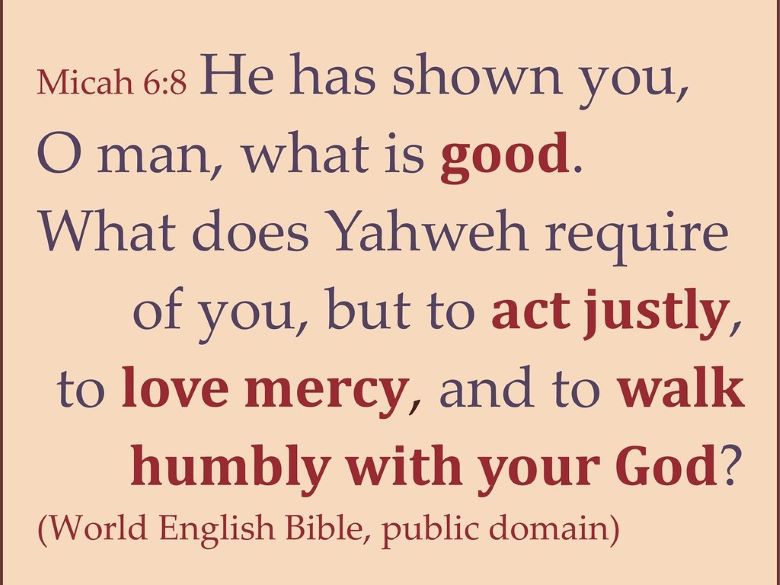
(Martin LaBar/flickr)
Seek Justice, Love Mercy
The prophet Micah, in chapter 6 of the book bearing his name, asks rhetorically what we have to do to get God’s attention and earn His forgiveness. Then he answers his own question, saying:
The Lord has shown you what is good. He has told you what he requires of you. You must act with justice. You must love to show mercy. And you must be humble as you live in the sight of your God. Micah 6:8 (NIRV)
The key word in that quote is “act.” God wants us to do justice, not just think happy thoughts about it. And how do we do that?
The simplest way is to stop thinking of ourselves first. God wants us to think of Him first, because of who He is. Next, as written in Philippians 2:4, He wants us to “look out for each other’s interests and not just for your own.”
Doing this can be temporarily inconvenient, but it will yield great rewards.
How to Show Mercy
Do to others what you would want them to do to you. If you love only the people who love you, what praise should you get? Even sinners love the people who love them. If you do good only to those who do good to you, what praise should you get? Even sinners do that! If you lend things to people, always hoping to get something back, what praise should you get? Even sinners lend to other sinners so that they can get back the same amount! But love your enemies, do good to them, and lend to them without hoping to get anything back. Then you will have a great reward, and you will be children of the Most High God, because he is kind even to people who are ungrateful and full of sin. Show mercy, just as your Father shows mercy. Luke 6:31-36 (NCV)
Many people believe in the Golden Rule—Do unto others as you would have them do unto you. Yet, it seems that many folks are waiting to be done unto before they do any doing.
In the passage above, Jesus is advocating a totally different strategy—mercy. Mercy is not concerned with everyone behaving properly or with showing favoritism toward those who do.
As Christians, we are called to set ourselves apart by being merciful as our Father is merciful.
So what does that look like?
Romans 5:8 says, “…while we were still sinners, Christ died for us.” Jesus didn’t wait for us to get in line to meet His standard (which is impossible anyway). He didn’t ask, or even consider, what we could do for Him. He went first.
This is probably the easiest way to define mercy—mercy goes first. Mercy looks to the needs of others, and sets about meeting them before considering anything else.
This doesn’t come naturally to most of us. In our culture, we’re used to “getting what we paid for.” If we are going to exchange our money, time, or talent, we generally expect to get something in return. For this reason, it seems natural for us to think about how we’re going to be paid back before we make an investment.
The thing is the people who are the most in need of mercy tend to be the ones who CAN’T pay you back. But they CAN pay your mercy forward.
Kindness
Have you ever found yourself in a situation where you relied on someone else’s mercy, knowing you wouldn’t be able to reciprocate? You might have felt gratitude at first, but later, the sense of indebtedness might have made you feel guilty.
Don’t go there. There’s a better way. Instead of focusing on what you can’t do for the person who helped you out, think instead of what you ARE able to do for someone else who is in a more desperate situation than you are. There’s always someone.
Here’s the catch, though.
The person most in need of your mercy might be someone you don’t like.
This is where the “love your enemies” bit comes in. Jesus never asked us to LIKE our enemies. Remember though that agape love is not a feeling; it is an action. As such, it is perfectly possible to show mercy toward someone who has been adversarial to us, even if there’s still a part of us that wants to push them down the stairs.
But here’s the part we all need to remember. We were just as adversarial to God when He chased us down. He continues to bless us, even when we don’t thank Him. So if we are endeavoring to be “sons of the Most High,” we shouldn’t be standing around waiting for thanks either. It feels nice to be appreciated, but remember, this is not the goal of mercy.
This is mercy–to listen with compassion to the people who annoy you the most in order to learn what their greatest burden is, then to speak only that which will help relieve them of that burden, and if that is not possible, to remain silent and allow God to do His work in them, rather than burden them further with opinions and judgment.
And that is what God offers to us all day, every day. Think about that for a second. How does it make you feel to know that you don’t ever have to put on a fake face for God to receive His mercy?
Now how does it make you feel to know that you have the power to make somebody else feel a little bit of that? So go and do it. And focus more on the “you’re welcome” than the “thank you.”
More applications of the Golden Rule to follow in Part 2. Click on the Free Newsletter Link to be notified when it’s ready to read!
General Christian
Home and Religion
Previous Post

December 9, 2023
...and How to Let Go of Them (6 Excuses: Part 2)
Next Post

December 20, 2023 Respect and Faithfulness (The Law and the Prophets: Part 2)
Recent Comments
"Sorry Frank, didn't mean to leave you hanging. There's a problem with my notifications that ..."
What “Forgiveness of Sins” Means
"as a cradle 66 yr SDA, I will say you highlighted some fine points many ..."
What “Forgiveness of Sins” Means
"I am honored. Thank you!"
What the Bible Says about the ..."
"For even more fun, read the latter part of Daniel 7. Then consider Rome's 10 ..."
The Trouble with Tribulation (What the ..."
Browse Our Archives
Select a Category apologetics Bible Study Eschatology Evangelism Exegesis Family Life God and money Government Life on Mission Money Philosophy Politics Pop Culture Prayer Relationships Salvation Spiritual Growth us and them
Select a Month July 2024 June 2024 May 2024 April 2024 March 2024 February 2024 January 2024 December 2023 November 2023 October 2023 September 2023 August 2023 July 2023 June 2023 May 2023 April 2023
Follow Us!
TAKE THE
Religious Wisdom Quiz
Why was Jesus' eating with tax collectors controversial?
Select your answer to see how you score.
They were wealthy They were healthy They were famous They were viewed as sinners
Related posts from Truth Mission
What "Forgiveness of Sins" Means

The Purpose of Testing (Humility Month: Part Two)
Your Own Understanding (Why God Opposes Pride--Part 2)

The Trouble with Tribulation (What the Bible Says...Part...
TRENDING AT PATHEOS Evangelical

The REST of Your Life: A Creative Wrestles...
This week I had a conversation with a good friend from church....

How the author of the world's best hymn...
I've been working with John Newton for a while now. This makes...

Long before this Lectio Divina, Psalm 130 - the song - started...

What About the Trees? Another Living Parable
After I finished writing the last article about falling leaves as a...

Why Classical Education Is a Conversation, Not a...
Come and Read: Joy in Classical Education When I was a little...

Cornell University has received a great deal of negative publicity and intense...
view all Evangelical blogs
Ad-Free & Subscriber Log-In Subscription Support
- About Us
- 2026 Calendar
- Videos
- Podcasts
- Library of World Religions
- Faith In Media Tracker
- Advertise With Us
- Write for Us
- Privacy Policy
- Terms of Service
- Do Not Sell My Data
- Contact Us
- Radiant Digital
- Manage Newsletter Subscriptions
- Unsubscribe From Notifications
- Sitemap
Copyright 2008-2026, Patheos. All rights reserved.
Subscription Support Ad-Free & Subscriber Log-In
Follow Patheos