
BuddhistCatholicContemplativeEvangelicalGeneral ChristianHinduJewishLatter-day SaintMuslimNew VisionsProgressive Christian
Beliefs
- Buddhist
- Catholic
- Contemplative
- Evangelical
- General Christian
- Hindu
- Jewish
- Latter-day Saint
- More Voices
- Muslim
- New Visions
- Pagan
- Progressive Christian
Topics
- Religion News
- Food and Religion
- Sports and Religion
- Religious Art
- Religious Music and Entertainment
- Religious Events
- History and Religion
- Style and Religion
- Politics and Religion
- Women in Religion
- Recreation Outdoors and Religion
- Business Finance and Religion
- Careers Workplace and Religion
- Education and Religion
- Family Parenting and Religion
- Health Fitness and Religion
- Home and Religion
- Relationships and Religion
- Technology and Religion
- Travel and Religion
Columnists
- Buddhist Columnists
- Business Finance and Religion Columnists
- Careers Workplace and Religion Columnists
- Catholic Columnists
- Contemplative Columnists
- Education and Religion Columnists
- Evangelists Columnists
- Family Parenting and Religion Columnists
- General Christian Columnists
- Health Fitness and Religion Columnists
- Hindu Columnists
- History and Religion Columnists
- Home and Religion Columnists
- Jewish Columnists
- More Voices Columnists
- Latter Day Columnists
- Muslim Columnists
- New Visions Columnists
- Nonreligious Columnists
- Pagan Columnists
- Politics and Religion Columnists
- Progressive Columnists
- Recreation Outdoors and Religion Columnists
- Relationships and Religion Columnists
- Religion News Columnists
- Religious Art Columnists
- Religious Events Columnists
- Religious Music and Entertainment Columnists
- Sports and Religion Columnists
- Style and Religion Columnists
- Technology and Religion Columnists
- Travel and Religion Columnists
- Women in Religion Columnists
Resource Library
- 2026 Calendar
- Library of World Religions
- The 100 Most Holy Places on Earth
- Patheos Answers
- Podcasts
- Videos
- Faith Leaders Database
- Anglican Episcopalian
- Bahai
- Baptist
- Buddhism
- Christianity
- Confucianism
- Eastern Orthodoxy
- Hinduism
- Holiness and Pentecostal
- ISKCON
- Islam
- Judaism
- Lutheran
- Methodist
- The Church of Jesus Christ of Latter-day Saints
- New Age
- Paganism
- Presbytarian and Reformed
- Protestantism
- Religion Behind the Scenes
- Roman Catholic
- Scientology
- Shia Islam
- Sikhism
- Sufism
- Sunni Islam
- Taoism
- Zen
- See all religions
Research Tools
 Ad-Free & Subscriber Log-In Subscription Support
Ad-Free & Subscriber Log-In Subscription Support
Follow Patheos 

- Trending:
- Forgiveness
- |
- Marriage
- |
- Consciousness
- |
- Death Penalty
- |
- Election
- |
- Halloween
 Troubler of Israel
- Home
- Evangelical
- Whose Face Did Mary Kiss? (A Reply to Douglas Wilson)
Whose Face Did Mary Kiss? (A Reply to Douglas Wilson)
Last updated on: December 14, 2018 at 12:51 pm by G. Shane Morris
Whose Face Did Mary Kiss? (A Reply to Douglas Wilson) 2018-12-14T12:51:44-04:00 G. Shane Morris
Patheos Explore the world's faith through different perspectives on religion and spirituality! Patheos has the views of the prevalent religions and spiritualities of the world.
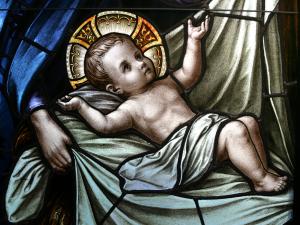
I think pastor Doug Wilson and I would agree that the Christmas song wars are more obnoxious and pointless than most of the songs that inspire them. In the broader culture, the current bogey is “Baby, It’s Cold Outside.” In the theological literati subculture it’s “Mary, Did You Know?”. The complaint against the second boils down to people not understanding lyrical pedagogy. Yes, Mary knew much of what Mark Lowry asks, though she was probably fuzzy on the details. Nevertheless, as he sings, Mary’s Son had indeed “walked where angels trod,” and when she kissed her little baby, she most certainly “kissed the face of God.”
This is true in more than a merely poetic sense. It is true in the deep-down, bone-and-marrow theological sense of Christianity’s greatest creeds. In the Incarnation, God the Son, in whom dwells the fullness of Deity, took on a face, flesh, blood, and eyes which (as Wilson says) looked very much like His mother’s. He did this so He could dwell with us, which is in fact the meaning of the name Isaiah gave to the Messiah: Immanuel—“God with us.”
 Most evangelical Protestants, like pastor Wilson, take issue with very similar language that calls Mary the “mother of God,” something which I argued here is an inescapable consequence of Chalcedonian Christology, and nothing we Protestants should fear. Pastor Wilson disagrees, and in his response to me, insists it isn’t Nestorian to reject the title “mother of God” in favor of the original Greek “theotokos,” or the less wieldy “mother-of-the-One-who-is-God.” I don’t know how he feels about “Mary, Did You Know?” but I do know that rank-and-file evangelicals love the song, despite the fact that most of them would join Wilson in demurring from the “mother of God” terminology.
But if evangelicals are willing to admit that God has a face, and that His mom kissed it, then there is hope that what we’re dealing with here is an inconsistency born of overreaction against Roman Catholicism, not a departure from conciliar orthodoxy.
Let me just say that I appreciate pastor Wilson’s polite engagement—especially since, considering our relative ages, credentials, levels of education, and the debt of discipleship-by-blog I owe him, this isn’t anything like a fair fight. Here’s why I’m sticking to my guns, despite all of this:
Two chapters after naming the Messiah “God with us,” Isaiah gives Him the additional titles “Wonderful Counselor,” “Mighty God,” “Everlasting Father,” and “Prince of Peace.” I got goosebumps hearing these sung by a choir and orchestra performing Handel’s “Messiah” Tuesday night. My one-year-old son was less impressed. But the fact that Isaiah ascribes deity to Jesus wasn’t lost on the authors of the gospels, nor was it lost on Paul who says in Acts 20:28 that God bought the church “with His own blood.”
The point is that Jesus is God, full stop, no “ifs,” “ands” or “buts.” When we talk of Jesus doing, being, or experiencing something, we can talk of God doing, being, or experiencing that thing without qualification or hesitation. That is the full, knock-the-wind-out-of-you impact of the Incarnation. The immutable God changes. The impassible God feels. The omnipresent God travels. The omniscient God learns. The self-sufficient God hungers. The immortal God dies. Anyone who has read the gospel accounts and does not believe the Lord Jesus was pulling the wool over our eyes with some Docetic hocus-pocus knows this is so. He was not pretending. As Aslan said, He was and is a true beast.
Pastor Wilson seems to agree with this. He writes:
“That which is predicated of one nature (Deity) may be predicated of the person (the Lord Jesus). That which is predicated of the other nature (humanity) can also be predicated of the person (the Lord Jesus). Thus we can say the Lord Jesus is Almighty God. Jesus is Jehovah. And we can also say that characteristics of finite humanity can be applied to Jesus, without qualification. He slept because He was tired. He ate because He was hungry. He walked because He needed to get there.”
Here Pastor Wilson is 100% correct. Natures do not sleep. Natures do not eat. Natures do not walk. They do not do anything, strictly speaking. They are the ontic means by which persons do these things. And to reify a nature, whether human or Divine, is to create a functional second person. It means you have two Christs in place of one—a human Christ and a Divine Christ.
Pastor Wilson continues: “But that which is predicated of one nature cannot be predicated of the other nature. That way lies madness. Infinitude is not finite.”
Again, well said. But I am afraid that we part ways, here. Because what he does next is conflate or at least confuse natures with persons. Referring to the Lutheran view of the Lord’s Supper (which as best I understand it, says that Christ’s Divine nature imparts the attribute of omnipresence to His human body) Wilson suggests that the term “mother of God” similarly blends Christ’s two natures. He writes:
“So then, do I confess that Mary is theotokos, God-bearer? I most certainly do — as regards His manhood. This is not a Nestorian reading.”
What Pastor Wilson misses is that theotokos and ‘mother of God’ both depend on a relation between *persons,* not natures. When Chalcedon called Mary ‘bearer/birth-giver of God,’ they were not affirming that Mary bore or created Divinity, but rather that she bore a Divine Person, according to His human nature. The distinction is fine but very important.
Natures do not have mothers. They do not have disciples. They do not perform miracles. They do not die on crosses or rise on the third day. Persons do these things *according to* natures. My mother is not the mother of my human nature (though she is one of the sources of it). She is the mother of me, the person. In the same way, Mary is not the mother of a human nature, but of God the Son *according to* His human nature. When Mary kissed her little baby, she indeed kissed the face of God. He was, after all, “with us,” not off somewhere else. But reverse the equation: if God was a baby, then that baby had a mother. All babies do.
Calling Mary “the mother of God” doesn’t confuse Jesus’ natures, at all, because Mary is not the mother of His human nature, but of His Person. As Chalcedon says, she bore God. And she is not a flatbed truck. She is a woman. And when women “bear” persons, we have a word to describe what they become: mothers.
No one believes (or as best I can tell, has ever believed) that Mary was the source of Jesus’ Divine nature. This has never been what the title “Mother of God” denotes. Rather, she stands in the personal relation to Him which we call “motherhood”—that relation constituted by having conceived, gestated, and given birth to a person. He is her Son.
If, as Chalcedon said, Mary bore God, how is that different (as Wilson believes) from calling her the “mother of God”? Who, exactly, did she bear, if not God incarnate? Whose face did she kiss? Who, according to Isaiah, came to dwell with us? Who shed His blood for His Church? It was not an impersonal human nature that did all this. It was the one true God, by virtue of the human nature He assumed in Mary’s womb. There is only one Logos. There is only one God the Son. He has existed from all eternity. But if He was not the son of Mary, then who on earth was in that manger?
Previous Post

December 12, 2018
The Misguided Backlash Against ‘Purity Culture’
Next Post

January 7, 2019 Church Membership Isn’t Optional
Browse Our Archives
Select a Category Abortion Animals Apologetics Archaeology Atheism Bible Books Church Creationism Culture of Death Debate Devotion Economics Ethics Free Will Gender Issues History Holidays Intelligent Design Islam Liberalism Life Advice Media Movies Music Nature Parenting Philosophy Politics Prayer Race Relationships Science Sex Stories Technology Terrorism The Point Theology Uncategorized Youth
Select a Month July 2021 June 2021 April 2021 March 2021 November 2020 September 2020 May 2020 April 2020 February 2020 January 2020 November 2019 October 2019 August 2019 July 2019 June 2019 May 2019 April 2019 February 2019 January 2019 December 2018 November 2018 October 2018 September 2018 August 2018 July 2018 June 2018 May 2018 April 2018 March 2018 February 2018 January 2018 December 2017 November 2017 October 2017 September 2017 August 2017 July 2017 June 2017 May 2017 April 2017 March 2017 February 2017 January 2017 December 2016 November 2016 October 2016 September 2016 August 2016 July 2016 June 2016
Follow Us!
TAKE THE
Religious Wisdom Quiz
What language was most of the Old Testament originally written in?
Select your answer to see how you score.
Hebrew Greek Latin Aramaic
Related posts from Troubler of Israel


Why Music Opens Hearts and Minds

Why Was the Forbidden Fruit Forbidden?

What If Suffering Is God’s Secret Weapon?
TRENDING AT PATHEOS Evangelical

How the author of the world's best hymn...
I've been working with John Newton for a while now. This makes...

Long before this Lectio Divina, Psalm 130 - the song - started...

What About the Trees? Another Living Parable
After I finished writing the last article about falling leaves as a...

Why Classical Education Is a Conversation, Not a...
Come and Read: Joy in Classical Education When I was a little...

Falling Leaves: A Living Parable on Letting Go
I’ve spent the vast majority of my life in the southeast corner...

Cornell University has received a great deal of negative publicity and intense...
view all Evangelical blogs
Ad-Free & Subscriber Log-In Subscription Support
- About Us
- 2026 Calendar
- Videos
- Podcasts
- Library of World Religions
- Faith In Media Tracker
- Advertise With Us
- Write for Us
- Privacy Policy
- Terms of Service
- Do Not Sell My Data
- Contact Us
- Radiant Digital
- Manage Newsletter Subscriptions
- Unsubscribe From Notifications
- Sitemap
Copyright 2008-2026, Patheos. All rights reserved.
Subscription Support Ad-Free & Subscriber Log-In
Follow Patheos