
BuddhistCatholicContemplativeEvangelicalGeneral ChristianHinduJewishLatter-day SaintMuslimNew VisionsProgressive Christian
Beliefs
- Buddhist
- Catholic
- Contemplative
- Evangelical
- General Christian
- Hindu
- Jewish
- Latter-day Saint
- More Voices
- Muslim
- New Visions
- Pagan
- Progressive Christian
Topics
- Religion News
- Food and Religion
- Sports and Religion
- Religious Art
- Religious Music and Entertainment
- Religious Events
- History and Religion
- Style and Religion
- Politics and Religion
- Women in Religion
- Recreation Outdoors and Religion
- Business Finance and Religion
- Careers Workplace and Religion
- Education and Religion
- Family Parenting and Religion
- Health Fitness and Religion
- Home and Religion
- Relationships and Religion
- Technology and Religion
- Travel and Religion
Columnists
- Buddhist Columnists
- Business Finance and Religion Columnists
- Careers Workplace and Religion Columnists
- Catholic Columnists
- Contemplative Columnists
- Education and Religion Columnists
- Evangelists Columnists
- Family Parenting and Religion Columnists
- General Christian Columnists
- Health Fitness and Religion Columnists
- Hindu Columnists
- History and Religion Columnists
- Home and Religion Columnists
- Jewish Columnists
- More Voices Columnists
- Latter Day Columnists
- Muslim Columnists
- New Visions Columnists
- Nonreligious Columnists
- Pagan Columnists
- Politics and Religion Columnists
- Progressive Columnists
- Recreation Outdoors and Religion Columnists
- Relationships and Religion Columnists
- Religion News Columnists
- Religious Art Columnists
- Religious Events Columnists
- Religious Music and Entertainment Columnists
- Sports and Religion Columnists
- Style and Religion Columnists
- Technology and Religion Columnists
- Travel and Religion Columnists
- Women in Religion Columnists
Resource Library
- 2026 Calendar
- Library of World Religions
- The 100 Most Holy Places on Earth
- Patheos Answers
- Podcasts
- Videos
- Faith Leaders Database
- Anglican Episcopalian
- Bahai
- Baptist
- Buddhism
- Christianity
- Confucianism
- Eastern Orthodoxy
- Hinduism
- Holiness and Pentecostal
- ISKCON
- Islam
- Judaism
- Lutheran
- Methodist
- The Church of Jesus Christ of Latter-day Saints
- New Age
- Paganism
- Presbytarian and Reformed
- Protestantism
- Religion Behind the Scenes
- Roman Catholic
- Scientology
- Shia Islam
- Sikhism
- Sufism
- Sunni Islam
- Taoism
- Zen
- See all religions
Research Tools
 Ad-Free & Subscriber Log-In Subscription Support
Ad-Free & Subscriber Log-In Subscription Support
Follow Patheos 

- Trending:
- Forgiveness
- |
- Marriage
- |
- Consciousness
- |
- Death Penalty
- |
- Election
- |
- Halloween
 Troubler of Israel
- Home
- Evangelical
- Why Every Villain Speech Is a Paraphrase of Nietzsche
Why Every Villain Speech Is a Paraphrase of Nietzsche
Last updated on: March 7, 2018 at 8:19 pm by G. Shane Morris
Why Every Villain Speech Is a Paraphrase of Nietzsche 2018-03-07T20:19:26-04:00 G. Shane Morris
Patheos Explore the world's faith through different perspectives on religion and spirituality! Patheos has the views of the prevalent religions and spiritualities of the world.
I’m reading (and thoroughly enjoying) Benjamin Wiker’s “10 Books that Screwed Up the World (And 5 Others that Didn’t Help).” The chapter on Nietzsche’s “Beyond Good and Evil” was beyond good (sorry). In truth it was cursory. This is a popular-level and somewhat tongue-in-cheek treatment of a lot of very complex ideas. One should (and I intend) to read Nietzsche’s work firsthand.
But Wiker is as thorough as his medium will allow, and based on his sketch of Nietzsche, I was struck by just how much this favorite thinker of angsty undergraduate atheists sounds like pretty much every villain in the the canon of 20th-century fiction–you know, those villains who, at that climactic moment of the story when they think they’re about to kill off the protagonist, reveal their master plan.
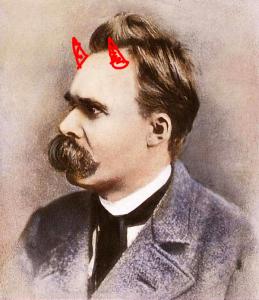
I don’t think this is because Wiker has given Nietzsche cartoon horns, nor do I think it’s a coincidence that our cinematic and literary bad guys sound so much like him. It’s no secret that Nietzsche’s work was favorite reading for some of the most notorious real-life villains of the 20th century (although the debate rages over how consistent with fascism or Nazism his philosophy really was). His own megalomania and insanity at the end of his life, at least, testify to the psychologically corrosive nature of his ideas.
A couple of quotations in particular reminded me of moments in three of my favorite fantasy novels, two by C. S. Lewis (“The Magician’s Nephew” and “Out of the Silent Planet”), and one by J. K. Rowling (“Harry Potter and the Deathly Hallows”). Since these authors both lived well after Nietzsche, and almost certainly had some acquaintance with him, I can only assume the resemblance between the words of their villains and the words of this existentialist philosopher were deliberate. The fact that both appear in books thick with allusions to Nazi Germany only supports this observation.
Dominion of the Solar System
I’ll start with Dr. Edward Weston, the antagonist of the first two books in Lewis’ “Space Trilogy,” who evolves into a fully Satanic vessel in “Perelandra.” At this point, he is merely a sort of hyperactive social Darwinist and imperialist who sees the conquest of another planet and the destruction of inferior races as crucial to the survival of the human race. In his speech to the residents of Mars, Dr. Weston explains why the human race, which he takes to be more advanced, has a right to dominate and eventually exterminate them:
“To you I may seem a vulgar robber, but I bear on my shoulders the destiny of the human race. Your tribal life with its stone-age weapons and bee-hive huts, its primitive coracles and elementary social structure, has nothing to compare with our civilization – with our science, medicine and law, our armies, our architecture, our commerce, and our transport system which is rapidly annihilating space and time. Our right to supersede you is the right of the higher over the lower.”
Compare this with Nitetzsche’s argument for European dominance in “Beyond Good and Evil,” as quoted by Wiker:
“I mean such an increase in the menace of Russia [for example] that Europe would have to resolve to become menacing, too, namely, to acquire one will by means of a new caste that would rule Europe, a long, terrible will of its own that would be able to cast its goals millennia hence–so that the long, drawn-out comedy of its many splinter states as well as its dynamic and democratic splinter wills would come to an end. The time for petty politics is over: the very next century will bring the fight for the dominion of the earth–the compulsion to large-scale politics.”
Weston takes his compulsion to large-scale politics as a mandate to colonize and conquer Mars for the eternal perpetuation of the human race. Rather than dominion of the Earth, he is fighting for dominion of the Solar System, all on the very Nietzschean ground that certain groups of beings are the natural rulers of the universe–a sort of galactic aristocracy whose tragic but noble duty is to subdue the lesser races. This character, fascinatingly, goes on to become not the Übermensch (Over-Man) he anticipates, but the Un-Man–a puppet of Hell intent on corrupting the infant world of Perelandra.
Master Morality and Slave Morality
Another quotation brought to mind Empress Jadis of Charn from “The Magician’s Nephew,” (known to most as the White Witch in “The Lion, The Witch, and The Wardrobe”). Nietzsche writes:
“None of these ponderous herd animals with their unquiet consciences . . . wants to know or even sense that ‘the general welfare’ is no ideal, no goal, no remotely intelligible concept, but only an emitic—that what is fair for one cannot by any means for that reason alone also be fair for others; that the demand of one morality for all is detrimental for the higher men; in short, that there is an order of rank between man and man, hence also between morality and morality.”
Explaining to Digory and Polly why it was acceptable for her to use the Deplorable Word to wipe out every other living being in her world, Empress Jadis says:
“I had forgotten that you are only a common boy. How should you understand reasons of the State? You must learn, child, that what would be wrong for you or for any of the common people is not wrong in a great Queen such as I. The weight of the world is on our shoulders. We must be freed from all rules. Ours is a high and lonely destiny.”
There are two moralities, you see: one for slaves and peasants, the other for nobility and rulers who bear the weight of nations on their shoulders. The tragic and heroic tone with which both Nitetzsche and Jadis make this claim is as important to notice as the claim itself.
Nietzsche is here arguing against utilitarian morality, which like the other morality he hates (Christianity), demands one standard for everyone. He thinks there are people with a duty to transcend this standard–people beyond the traditional norms of good and evil, who must make great sacrifices if necessary to take the next step in evolution beyond mere manhood into Over-Manhood.
It’s eerily reminiscent of Jadis’ claim to own the unfortunate masses whose lives she brought to an end, and her confidence that Digory’s pedestrian convictions about what “hard luck” this was for them are irrelevant to her, a mighty queen. Her words echo those of Digory’s Uncle Andrew earlier in the story, who claims that no great discovery can be made without sacrifices, and that however “well and good” keeping promises is for common people, “men of science” are above such scruples. Nietzsche’s words pass between the mouths of one villain to another like their native language.
A Choice Type of Wizard
Finally, Nietzsche informs us that the aristocracy must have a different morality than the slave castes precisely because society exists for the sake the aristocracy. The most elite men, their achievements, and their pursuit of Over-Manhood are the only really worthwhile goals:
“The essential characteristic of a good and healthy aristocracy . . . is that it experiences itself not as a function (whether of the monarchy or of the commonwealth) but as their meaning and highest justification—that it therefore accepts with a good conscience the sacrifice of untold human beings who, for its sake, must be reduced and lowered to incomplete human beings, to slaves, to instruments. The fundamental faith simply has to be that society must not exist for society’s sake but only as the foundation and scaffolding on which a choice type of being is able to raise itself to its higher task and to a higher state of being.”
J. K. Rowling may have had this very passage in mind when she wrote of a scene in the Ministry of Magic–headquarters of the Wizarding government in Britain. The Dark Lord Voldemort has conquered the Ministry and replaced a statue of different races of man and magical creatures standing shoulder-to-shoulder in the lobby with a much more sinister one:
“A gigantic statue of black stone dominated the scene. It was rather frightening, this vast sculpture of a witch and wizard sitting on ornately carved thrones…Engraved in foot-high letters at the base of the statue were the words MAGIC IS MIGHT…Harry looked more closely and realised that what he had thought were decoratively carved thrones were actually mounds of carved humans: hundreds and hundreds of naked bodies, men, women, and children, all with rather stupid, ugly faces, twisted and pressed together to support the weight of the handsomely robed wizards.”
Society–meaning common people–exist as a mere scaffolding which choice individuals are able to climb in pursuit of a higher state of being. Rowling’s dark statue is almost a literal depiction of Nietzsche’s ideal social hierarchy, and an illustration of why his words always sound so good in the mouths of bad guys: Nietzsche’s philosophy really was poison, of the sort that degrades and kills cultures. His idea of Over-Men beyond morality is a corrosive acid opposite Karl Marx’s searing basic elixir of class warfare. The scarcity of fictional villains who sound like communists should probably concern us. But the abundance of baddies who sound like Nietzsche shouldn’t surprise us, at all. Evil people in both the imaginary and real worlds almost never believe they are evil. They think (like Nietzsche) that they are benefiting mankind by stepping Beyond Good and Evil. Both are wrong.
Previous Post

February 22, 2018
Billy Graham Came Just As He Was
Next Post

March 13, 2018 The Deep-Heavenly Symbolism of Sex
Browse Our Archives
Select a Category Abortion Animals Apologetics Archaeology Atheism Bible Books Church Creationism Culture of Death Debate Devotion Economics Ethics Free Will Gender Issues History Holidays Intelligent Design Islam Liberalism Life Advice Media Movies Music Nature Parenting Philosophy Politics Prayer Race Relationships Science Sex Stories Technology Terrorism The Point Theology Uncategorized Youth
Select a Month July 2021 June 2021 April 2021 March 2021 November 2020 September 2020 May 2020 April 2020 February 2020 January 2020 November 2019 October 2019 August 2019 July 2019 June 2019 May 2019 April 2019 February 2019 January 2019 December 2018 November 2018 October 2018 September 2018 August 2018 July 2018 June 2018 May 2018 April 2018 March 2018 February 2018 January 2018 December 2017 November 2017 October 2017 September 2017 August 2017 July 2017 June 2017 May 2017 April 2017 March 2017 February 2017 January 2017 December 2016 November 2016 October 2016 September 2016 August 2016 July 2016 June 2016
Follow Us!
TAKE THE
Religious Wisdom Quiz
What did Elisha heal by throwing salt into it?
Select your answer to see how you score.
A fig tree River Jordan A spring of water A pot of stew
Related posts from Troubler of Israel


Dunning-Kruger, Cultural Amnesia, and Tyrannosaurus rex


Taking the Plunge Into God’s Story
TRENDING AT PATHEOS Evangelical

The REST of Your Life: A Creative Wrestles...
This week I had a conversation with a good friend from church....

How the author of the world's best hymn...
I've been working with John Newton for a while now. This makes...

Long before this Lectio Divina, Psalm 130 - the song - started...

What About the Trees? Another Living Parable
After I finished writing the last article about falling leaves as a...

Why Classical Education Is a Conversation, Not a...
Come and Read: Joy in Classical Education When I was a little...

Cornell University has received a great deal of negative publicity and intense...
view all Evangelical blogs
Ad-Free & Subscriber Log-In Subscription Support
- About Us
- 2026 Calendar
- Videos
- Podcasts
- Library of World Religions
- Faith In Media Tracker
- Advertise With Us
- Write for Us
- Privacy Policy
- Terms of Service
- Do Not Sell My Data
- Contact Us
- Radiant Digital
- Manage Newsletter Subscriptions
- Unsubscribe From Notifications
- Sitemap
Copyright 2008-2026, Patheos. All rights reserved.
Subscription Support Ad-Free & Subscriber Log-In
Follow Patheos