
BuddhistCatholicContemplativeEvangelicalGeneral ChristianHinduJewishLatter-day SaintMuslimNew VisionsProgressive Christian
Beliefs
- Buddhist
- Catholic
- Contemplative
- Evangelical
- General Christian
- Hindu
- Jewish
- Latter-day Saint
- More Voices
- Muslim
- New Visions
- Pagan
- Progressive Christian
Topics
- Religion News
- Food and Religion
- Sports and Religion
- Religious Art
- Religious Music and Entertainment
- Religious Events
- History and Religion
- Style and Religion
- Politics and Religion
- Women in Religion
- Recreation Outdoors and Religion
- Business Finance and Religion
- Careers Workplace and Religion
- Education and Religion
- Family Parenting and Religion
- Health Fitness and Religion
- Home and Religion
- Relationships and Religion
- Technology and Religion
- Travel and Religion
Columnists
- Buddhist Columnists
- Business Finance and Religion Columnists
- Careers Workplace and Religion Columnists
- Catholic Columnists
- Contemplative Columnists
- Education and Religion Columnists
- Evangelists Columnists
- Family Parenting and Religion Columnists
- General Christian Columnists
- Health Fitness and Religion Columnists
- Hindu Columnists
- History and Religion Columnists
- Home and Religion Columnists
- Jewish Columnists
- More Voices Columnists
- Latter Day Columnists
- Muslim Columnists
- New Visions Columnists
- Nonreligious Columnists
- Pagan Columnists
- Politics and Religion Columnists
- Progressive Columnists
- Recreation Outdoors and Religion Columnists
- Relationships and Religion Columnists
- Religion News Columnists
- Religious Art Columnists
- Religious Events Columnists
- Religious Music and Entertainment Columnists
- Sports and Religion Columnists
- Style and Religion Columnists
- Technology and Religion Columnists
- Travel and Religion Columnists
- Women in Religion Columnists
Resource Library
- 2026 Calendar
- Library of World Religions
- The 100 Most Holy Places on Earth
- Patheos Answers
- Podcasts
- Videos
- Faith Leaders Database
- Anglican Episcopalian
- Bahai
- Baptist
- Buddhism
- Christianity
- Confucianism
- Eastern Orthodoxy
- Hinduism
- Holiness and Pentecostal
- ISKCON
- Islam
- Judaism
- Lutheran
- Methodist
- The Church of Jesus Christ of Latter-day Saints
- New Age
- Paganism
- Presbytarian and Reformed
- Protestantism
- Religion Behind the Scenes
- Roman Catholic
- Scientology
- Shia Islam
- Sikhism
- Sufism
- Sunni Islam
- Taoism
- Zen
- See all religions
Research Tools
 Ad-Free & Subscriber Log-In Subscription Support
Ad-Free & Subscriber Log-In Subscription Support
Follow Patheos 

- Trending:
- Forgiveness
- |
- Marriage
- |
- Consciousness
- |
- Death Penalty
- |
- Election
- |
- Halloween
 Troubler of Israel
- Home
- Evangelical
- Should Christians Carry Guns in Church?
Should Christians Carry Guns in Church?
Last updated on: November 9, 2017 at 8:43 am by G. Shane Morris
Should Christians Carry Guns in Church? 2017-11-09T08:43:45-04:00 G. Shane Morris
Patheos Explore the world's faith through different perspectives on religion and spirituality! Patheos has the views of the prevalent religions and spiritualities of the world.
Is it okay for Christians to bring weapons into church for self-defense? The shooting at First Baptist Church in Sutherland Springs has renewed the urgency of this controversial question. Conservative writer Tom Nichols caught flak on Twitter for opposing the idea of parishioners packing in the pews. A colleague of mine suggested Saint Paul might have some stern words for those who armed themselves with more than the metaphorical sword of the Spirit in God’s house.
 But objectively, guns were used to defend life as well as take it on Sunday. CNN reports that Stephen Willeford, a Sutherland Springs resident who lives next door to First Baptist used the very same rifle type as the shooter to exchange fire with and ultimately kill him. “He’s a hero,” said Wilson County Sherriff, Joe Tackitt Jr. “Had he not done that, we could have lost more people.”
The shooting, which left 26 people dead and at least 20 more injured, has convinced many Christians that the risk of worshiping unarmed has become too great. But the question of deadly force in the sanctuary, itself—while we are engaged in the most sacred of activities—is uniquely thorny.
Why? Because at first blush, it seems contrary to the example set in the New Testament. Jesus says “Blessed are the peacemakers, for they will be called sons of God” (Matthew 5:9). He tells His disciples to “turn the other cheek” (Matthew 5:38-40). He rebukes Peter and tells him to put away his sword, “for all who take the sword will perish by the sword” (Matthew 26:52). Paul tells us that the weapons of our warfare “are not the weapons of the world” (2 Corinthians 10:4), and that “we wrestle not against flesh and blood, but against principalities, against powers, against the rulers of the darkness of this world…” (Ephesians 6:12). More broadly speaking, the apostles endure imprisonment, beatings, torture, and martyrdom at the hands of their enemies, and never once lift a finger to defend themselves through violent means.
Some take this precedent as a requirement for pacifism—no violence, at any time, for any reason. You have, in other words, an obligation to be a victim. While most Christians outside the Anabaptist, Mennonite, Quaker, and Amish traditions wouldn’t go this far, we do have to ask ourselves: If these examples don’t prohibit Christians in the very act of worship from drawing the sword in defense of themselves and fellow worshipers, what do they prohibit?
A fuller reading of Scripture further complicates things. God prescribes death as the penalty for murder in Genesis 9:6 (“Whoever sheds the blood of man, by man shall his blood be shed, for God made man in his own image.”). Exodus 22:2 instructs that a homeowner who strikes a thief in the night and kills him “is not guilty of bloodshed,” in contrast with a homeowner who strikes and kills the thief during the day. This is because, as Swiss scholastic theologian Francis Turretin remarks, the master of the house cannot be expected to know whether a thief in the darkness is there to kill or merely to steal. Under the Law of Moses, self-defense was an appropriate grounds on which to kill. Property-defense was not.
In the closing chapters of Esther, Xerxes grants the Jews permission to violently defend themselves against the plot of Haman the Agagite, and God’s people come to celebrate this as a feast day. This legal, national self-defense is the implied reason for which Esther was brought into the palace “for such a time as this.”
Then there is the less well-known corollary to the “live by the sword, die by the sword,” passage—the reason Peter was armed at Gethsemane in the first place. Luke 22 records that Jesus gives the disciples new instructions about their traveling accoutrements:
“…let the one who has no sword sell his cloak and buy one. For I tell you that this Scripture must be fulfilled in me: ‘And he was numbered with the transgressors.’”
The disciples respond, “Look, Lord, here are two swords.”
Jesus, replies tersely: “It is enough.”
Both John Calvin and John Gill call the disciples “stupid” for taking Jesus’ instructions about swords here literally. Rather, “In metaphorical language,” writes Calvin, “[Jesus] threatens that they will soon meet with great troubles and fierce attacks…And yet he does not call them to an outward conflict, but only, under the comparison of fighting, he warns them of the severe struggles of temptations which they must undergo, and of the fierce attacks which they must sustain in spiritual contests.”
However (and this is the part where I stop raising new questions and start suggesting an answer) it’s important to note that even if Jesus was making a spiritual point by referring to “swords,” He nowhere condemns defensive violence as such. He never tells Peter to get rid of his sword, any more than He tells the Centurion in Matthew 8 to get rid of his. Rather, He tells Peter to “put it back in its place,” implying, as another commentator points out, that swords have a proper use. Presumably, Peter and at least one other disciple had these swords on hand for the defense of their little band during the sometimes dangerous travels from Galilee to Judea. We have no record that Jesus was ever bothered by this.
All of these passages come into sharper focus when we recall a foundational truth of Christian worldview thinking: All believers, even Christ Himself during His earthly life, occupy what Augustine called the two cities.
“Render unto Caesar what is Caesar’s, and unto God what is God’s,” Jesus famously said in Matthew 22, setting up a distinction that would inform Christian theology for the next two millennia.
We live simultaneously in the city of man and in the City of God—in society and in the Church—in creation and New Creation. We have duties and roles in each, and where they don’t conflict, we must carry out both. In fact, being a good citizen of God’s City usually means being a good citizen in man’s, insofar as it depends on us.
“There is in man,” wrote Calvin, “two worlds, over which two different kings and different laws have authority.”
Christ Himself occupied these different kingdoms during His earthly life and ministry. He was a son under the authority of Joseph and Mary. At the same time, He was their Creator. He was a rabbi with authority over a band of disciples, who paid the Temple tax and observed the Jewish festivals. At the same time, He was the true High Priest and true Temple, who came to fulfill and dismiss the types and shadows of Sinai. He was a subject of Caesar who paid tribute, obeyed the law, and recognized the authority given to the Roman procurator. At the same time, He was the King of creation, before whom every knee was destined to bow.
Christ bade Peter to put away his sword, not because self-defense is wrong, but because on the road to Calvary, the duties of man’s kingdom conflicted with the duties of God’s. The Good Shepherd came to lay down His life for the sheep. He didn’t need the sheep to take up arms in His defense.
Likewise, the apostles, imprisoned for their witness and facing an empire which they could never practically resist through violent means, rightly chose martyrdom over insurrection. They had no God-ordained earthly government en route in squad cars, coming to take up arms in their defense, as the churchgoers in Sutherland Springs did. Their witness for the City of God would have died in obscurity had they chosen to resist Caesar with literal swords. They chose to demolish spiritual strongholds, instead.
But we’re not called to make such a choice, at least not right now. We’re not called to stand and suffer martyrdom at the hands of a crazed and lone gunman. Quite the opposite: Guarding human life against imminent and unjust violence, as Augustine would argue with his principles of Just War, is a created duty. It is part of loving your neighbor. And while Paul teaches in Romans 13 that the governing authorities “do not bear the sword for nothing,” the governing authorities are not always on hand when the wicked strike.
That’s why for us, if no conflict exists between our spiritual and temporal duties—if the warfare in which our weapons are spiritual does not call us to lay down our physical arms—then we are permitted to use those arms, even as Christians, and even in church. At least, as far as I can tell.
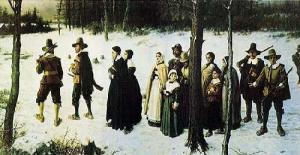
Image: “Pilgrims Going To Church,” George Henry Boughton, 1867, Wikimedia Commons

Previous Post

November 2, 2017
'It's the Current Year!' Is Not a Good Argument
Next Post

November 15, 2017 Voting for Grishnákh: A Reductio-ad-Orc for ‘Lesser of Two Evils’ Logic
Browse Our Archives
Select a Category Abortion Animals Apologetics Archaeology Atheism Bible Books Church Creationism Culture of Death Debate Devotion Economics Ethics Free Will Gender Issues History Holidays Intelligent Design Islam Liberalism Life Advice Media Movies Music Nature Parenting Philosophy Politics Prayer Race Relationships Science Sex Stories Technology Terrorism The Point Theology Uncategorized Youth
Select a Month July 2021 June 2021 April 2021 March 2021 November 2020 September 2020 May 2020 April 2020 February 2020 January 2020 November 2019 October 2019 August 2019 July 2019 June 2019 May 2019 April 2019 February 2019 January 2019 December 2018 November 2018 October 2018 September 2018 August 2018 July 2018 June 2018 May 2018 April 2018 March 2018 February 2018 January 2018 December 2017 November 2017 October 2017 September 2017 August 2017 July 2017 June 2017 May 2017 April 2017 March 2017 February 2017 January 2017 December 2016 November 2016 October 2016 September 2016 August 2016 July 2016 June 2016
Follow Us!
TAKE THE
Religious Wisdom Quiz
In the Parable of the Pearl of Great Price, what does the merchant do?
Select your answer to see how you score.
Sells all to buy the pearl Builds a bigger barn Finds a lost coin Buys many pearls
Related posts from Troubler of Israel


Dunning-Kruger, Cultural Amnesia, and Tyrannosaurus rex

Why Music Opens Hearts and Minds

Why Was the Forbidden Fruit Forbidden?
TRENDING AT PATHEOS Evangelical

The REST of Your Life: A Creative Wrestles...
This week I had a conversation with a good friend from church....

How the author of the world's best hymn...
I've been working with John Newton for a while now. This makes...

Long before this Lectio Divina, Psalm 130 - the song - started...

What About the Trees? Another Living Parable
After I finished writing the last article about falling leaves as a...

Why Classical Education Is a Conversation, Not a...
Come and Read: Joy in Classical Education When I was a little...

Cornell University has received a great deal of negative publicity and intense...
view all Evangelical blogs
Ad-Free & Subscriber Log-In Subscription Support
- About Us
- 2026 Calendar
- Videos
- Podcasts
- Library of World Religions
- Faith In Media Tracker
- Advertise With Us
- Write for Us
- Privacy Policy
- Terms of Service
- Do Not Sell My Data
- Contact Us
- Radiant Digital
- Manage Newsletter Subscriptions
- Unsubscribe From Notifications
- Sitemap
Copyright 2008-2026, Patheos. All rights reserved.
Subscription Support Ad-Free & Subscriber Log-In
Follow Patheos