
BuddhistCatholicContemplativeEvangelicalGeneral ChristianHinduJewishLatter-day SaintMuslimNew VisionsProgressive Christian
Beliefs
- Buddhist
- Catholic
- Contemplative
- Evangelical
- General Christian
- Hindu
- Jewish
- Latter-day Saint
- More Voices
- Muslim
- New Visions
- Pagan
- Progressive Christian
Topics
- Religion News
- Food and Religion
- Sports and Religion
- Religious Art
- Religious Music and Entertainment
- Religious Events
- History and Religion
- Style and Religion
- Politics and Religion
- Women in Religion
- Recreation Outdoors and Religion
- Business Finance and Religion
- Careers Workplace and Religion
- Education and Religion
- Family Parenting and Religion
- Health Fitness and Religion
- Home and Religion
- Relationships and Religion
- Technology and Religion
- Travel and Religion
Columnists
- Buddhist Columnists
- Business Finance and Religion Columnists
- Careers Workplace and Religion Columnists
- Catholic Columnists
- Contemplative Columnists
- Education and Religion Columnists
- Evangelists Columnists
- Family Parenting and Religion Columnists
- General Christian Columnists
- Health Fitness and Religion Columnists
- Hindu Columnists
- History and Religion Columnists
- Home and Religion Columnists
- Jewish Columnists
- More Voices Columnists
- Latter Day Columnists
- Muslim Columnists
- New Visions Columnists
- Nonreligious Columnists
- Pagan Columnists
- Politics and Religion Columnists
- Progressive Columnists
- Recreation Outdoors and Religion Columnists
- Relationships and Religion Columnists
- Religion News Columnists
- Religious Art Columnists
- Religious Events Columnists
- Religious Music and Entertainment Columnists
- Sports and Religion Columnists
- Style and Religion Columnists
- Technology and Religion Columnists
- Travel and Religion Columnists
- Women in Religion Columnists
Resource Library
- 2026 Calendar
- Library of World Religions
- The 100 Most Holy Places on Earth
- Patheos Answers
- Podcasts
- Videos
- Faith Leaders Database
- Anglican Episcopalian
- Bahai
- Baptist
- Buddhism
- Christianity
- Confucianism
- Eastern Orthodoxy
- Hinduism
- Holiness and Pentecostal
- ISKCON
- Islam
- Judaism
- Lutheran
- Methodist
- The Church of Jesus Christ of Latter-day Saints
- New Age
- Paganism
- Presbytarian and Reformed
- Protestantism
- Religion Behind the Scenes
- Roman Catholic
- Scientology
- Shia Islam
- Sikhism
- Sufism
- Sunni Islam
- Taoism
- Zen
- See all religions
Research Tools
 Ad-Free & Subscriber Log-In Subscription Support
Ad-Free & Subscriber Log-In Subscription Support
Follow Patheos 

- Trending:
- Forgiveness
- |
- Marriage
- |
- Consciousness
- |
- Death Penalty
- |
- Election
- |
- Halloween
 Troubler of Israel
- Home
- Evangelical
- Dear Liberals: Jesus Didn’t Write the Red Letters
Dear Liberals: Jesus Didn’t Write the Red Letters
Last updated on: September 13, 2017 at 12:30 pm by G. Shane Morris
Dear Liberals: Jesus Didn’t Write the Red Letters 2017-09-13T12:30:46-04:00 G. Shane Morris
Patheos Explore the world's faith through different perspectives on religion and spirituality! Patheos has the views of the prevalent religions and spiritualities of the world.
Of all the defenses progressive Christians offer for egalitarian and pro-LGBT theology, the most puzzling has to be the assertion that “Jesus never said anything” about either topic.
The first and most obvious problem with this claim is how it relies on a fantasy version of Jesus–a vaguely recollected mishmash of Sunday School lessons, songs, and apocryphal stories who seems to live in a cozy Yoda-hut at the back of every theological liberal’s mind, occasionally reminding them to “judge not,” and “do or do not, there is no try.”
This character is more John Lennon than Jesus of Nazareth, preferring to wink at sin and affirm people’s lifestyles, rather than reassert “every dot and iota” of the Old Testament Law, rehearse people’s sexual sins and failed marriages, and preach about the “unquenchable fire” of hell, as the real Jesus did. But Hippie Yoda Jesus exercises a tremendous influence over the theology and imaginations of the Christian left.
Take, for example, the ladies of The View, who assured Masterpiece Cake Shop owner, Jack Phillips, that Jesus would have baked a gay wedding cake. How they know this with such certainty is a total mystery. As liberals are fond of pointing out, Jesus never (as far as we know) directly addressed the question of homosexuality, and among His recorded words, we have precious few devoted to the subject of marriage. But when He did speak on the topic, He was far less permissive than the religious leaders of His time, to say nothing of the hosts on “The View”:
He answered, “Have you not read that he who created them from the beginning made them male and female, and said, ‘Therefore a man shall leave his father and his mother and hold fast to his wife, and the two shall become one flesh’? So they are no longer two but one flesh. What therefore God has joined together, let not man separate.'” They said to him, “Why then did Moses command one to give a certificate of divorce and to send her away?” He said to them, “Because of your hardness of heart Moses allowed you to divorce your wives, but from the beginning it was not so. And I say to you: whoever divorces his wife, except for sexual immorality, and marries another, commits adultery.” (Matthew 19:4-9)
In contrast to the Pharisees, who permitted divorce “for any cause,” Jesus returns to the creation account and the origin of marriage to show that God intended the one-flesh union to be indissoluble. In doing so, He implicitly forbids any notion of same-sex “marriage,” which can neither fulfill the created categories of “male and female,” nor the purpose of marriage to “be fruitful and multiply” (Genesis 1:28), and “produce godly offspring” (Malachi 2:15).
From whence do liberals get this notion of a Jesus who would bake a gay wedding cake? Not from the canonical gospels, where Christ is portrayed as always doing the Father’s will (John 5:19). What is the Father’s will? Certainly not that men marry men and women marry women, if any other biblical revelation holds the slightest weight.
This, of course, leads us to the second and arguably more serious problem with theological progressives who want to affirm every aspect of the sexual revolution: their ever-shrinking canon of Scripture.
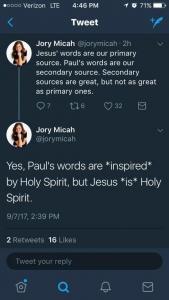 “Advocate, Writer, and Preacher” Jory Micah put this tendency on display in a recent Twitter thread, contending that “Jesus’ words are our primary source. Paul’s words are our secondary source. Secondary sources are great, but not as great as primary ones.”
Let’s ignore for the moment Micah’s misunderstanding of what “primary” and “secondary” sources are, as well as the blatant trinitarian heresy in her subsequent tweet (equating God the Son with God the Holy Spirit). Her red-letterism is what’s most distressing, here.
In Micah’s telling, the God-breathed words of the Apostle Paul, and presumably all of the other apostles, are on a lower plain of inspiration and therefore authority than the words of Jesus. That she draws this distinction to delegitimize the parts of the New Testament that are most inconvenient for her theology is in little doubt. It’s a common maneuver these days.
The biggest problem with her effort to demote Paul’s epistles to Scripture second-class when compared with the gospels is that Jesus didn’t write the gospels. In fact, He didn’t directly write a solitary word of Scripture, at least not after His incarnation (many ascribe the Ten Commandments at Mount Sinai to the pre-incarnate Son).
The gospels were written by two of the twelve disciples (Matthew and John), a friend of the Apostle Peter (Mark), and a physician who traveled with the Apostle Paul (Luke). Furthermore, the synoptic gospels (all but John) are generally regarded as later entries in the New Testament, long preceded by 1 Thessalonians, Galatians, and 1 and 2 Corinthians–all undisputed writings of Paul. John probably wrote his gospel even later.
In other words, the gospels, themselves, are the definition of “secondary sources.” They are strategic organizations of Jesus’ words and deeds designed to make different theological points. They come to us through the agency of people who (like Paul) met and talked with Jesus, and (in Luke’s case) someone who probably never met Jesus in person.
The red letters carry neither greater authority nor firmer textual certainty than the black. They are both the words and work of human authors–authors whom, to be sure, the Holy Spirit guided, superintended, and preserved from all error. But neither comes directly from Jesus’ mouth or pen without the mediation of an inspired writer. As far as we know, Jesus never wrote down a single saying in His life.
Micah denies that she’s dismissing the letters of Paul. But she openly admits that her approach amounts to a two-tiered canon:
Concerning Pauline letters; I’m in no way implying that we can disregard them. I’m not a “red letter only” Christian. But, I do think that even Paul Himself would elevate the words of Jesus’ [sic] as greater than his own. I do believe Paul’s letters to be inspired by God, & useful for teaching. But, I think there is a difference of authority between his words & the very words of Christ. Even Paul says at times he is sharing his own preferences; not necessarily God’s words (ex:// he wished everyone would be celibate).
She’s referring here to 1 Corinthians 7, in which Paul expresses his wish that his readers would remain unmarried, but calls it a “concession, not a command.” He similarly qualifies his counsel regarding unbelieving spouses in verse 12, writing, “To the rest I say this (I, not the Lord)…” Micah apparently takes this as proof that Paul switched off the Holy Spirit for a quick sec and began writing stuff that doesn’t belong in the Bible. But as many commentators have noted, a much simpler understanding is that Paul here switched from divinely inspired command to divinely inspired advice, given “in light of the present distress” confronting his readers (v. 26).
But even granting Micah’s point, it’s difficult to see how Paul’s uninspired aside undermines the inspiration of the many other passages she wants to relegate to second-class status. She presumably admits that if Paul was speaking for himself in verses 12-16, he resumes speaking for “the Lord,” in verse 17. This, of course, would place his words on par with those of Jesus. But Micah and other theological progressives can’t have that. Because among Paul’s words are nasty passages about how those who practice homosexuality won’t inherit the kingidom of God, how wives must submit to their husbands, and how women must not hold spiritual authority over men.
Which is why, no matter how little sense it makes, liberal Christians will continue claiming the red letters are extra-inspired, and that somewhere between the lines, Jesus is quoting the lyrics from “Imagine.”
Previous Post

September 1, 2017
Millennials, It's Time To Retire the 'Why I Left the Church' Genre
Next Post

September 14, 2017 On Living As if God Is Real
Browse Our Archives
Select a Category Abortion Animals Apologetics Archaeology Atheism Bible Books Church Creationism Culture of Death Debate Devotion Economics Ethics Free Will Gender Issues History Holidays Intelligent Design Islam Liberalism Life Advice Media Movies Music Nature Parenting Philosophy Politics Prayer Race Relationships Science Sex Stories Technology Terrorism The Point Theology Uncategorized Youth
Select a Month July 2021 June 2021 April 2021 March 2021 November 2020 September 2020 May 2020 April 2020 February 2020 January 2020 November 2019 October 2019 August 2019 July 2019 June 2019 May 2019 April 2019 February 2019 January 2019 December 2018 November 2018 October 2018 September 2018 August 2018 July 2018 June 2018 May 2018 April 2018 March 2018 February 2018 January 2018 December 2017 November 2017 October 2017 September 2017 August 2017 July 2017 June 2017 May 2017 April 2017 March 2017 February 2017 January 2017 December 2016 November 2016 October 2016 September 2016 August 2016 July 2016 June 2016
Follow Us!
TAKE THE
Religious Wisdom Quiz
What does Paul tell the Philippians to rejoice in always?
Select your answer to see how you score.
Their salvation All circumstances God's goodness The Lord
Related posts from Troubler of Israel


Why Music Opens Hearts and Minds

Why Was the Forbidden Fruit Forbidden?

What If Suffering Is God’s Secret Weapon?
TRENDING AT PATHEOS Evangelical

The REST of Your Life: A Creative Wrestles...
This week I had a conversation with a good friend from church....

How the author of the world's best hymn...
I've been working with John Newton for a while now. This makes...

Long before this Lectio Divina, Psalm 130 - the song - started...

What About the Trees? Another Living Parable
After I finished writing the last article about falling leaves as a...

Why Classical Education Is a Conversation, Not a...
Come and Read: Joy in Classical Education When I was a little...

Cornell University has received a great deal of negative publicity and intense...
view all Evangelical blogs
Ad-Free & Subscriber Log-In Subscription Support
- About Us
- 2026 Calendar
- Videos
- Podcasts
- Library of World Religions
- Faith In Media Tracker
- Advertise With Us
- Write for Us
- Privacy Policy
- Terms of Service
- Do Not Sell My Data
- Contact Us
- Radiant Digital
- Manage Newsletter Subscriptions
- Unsubscribe From Notifications
- Sitemap
Copyright 2008-2026, Patheos. All rights reserved.
Subscription Support Ad-Free & Subscriber Log-In
Follow Patheos