
BuddhistCatholicContemplativeEvangelicalGeneral ChristianHinduJewishLatter-day SaintMuslimNew VisionsProgressive Christian
Beliefs
- Buddhist
- Catholic
- Contemplative
- Evangelical
- General Christian
- Hindu
- Jewish
- Latter-day Saint
- More Voices
- Muslim
- New Visions
- Pagan
- Progressive Christian
Topics
- Religion News
- Food and Religion
- Sports and Religion
- Religious Art
- Religious Music and Entertainment
- Religious Events
- History and Religion
- Style and Religion
- Politics and Religion
- Women in Religion
- Recreation Outdoors and Religion
- Business Finance and Religion
- Careers Workplace and Religion
- Education and Religion
- Family Parenting and Religion
- Health Fitness and Religion
- Home and Religion
- Relationships and Religion
- Technology and Religion
- Travel and Religion
Columnists
- Buddhist Columnists
- Business Finance and Religion Columnists
- Careers Workplace and Religion Columnists
- Catholic Columnists
- Contemplative Columnists
- Education and Religion Columnists
- Evangelists Columnists
- Family Parenting and Religion Columnists
- General Christian Columnists
- Health Fitness and Religion Columnists
- Hindu Columnists
- History and Religion Columnists
- Home and Religion Columnists
- Jewish Columnists
- More Voices Columnists
- Latter Day Columnists
- Muslim Columnists
- New Visions Columnists
- Nonreligious Columnists
- Pagan Columnists
- Politics and Religion Columnists
- Progressive Columnists
- Recreation Outdoors and Religion Columnists
- Relationships and Religion Columnists
- Religion News Columnists
- Religious Art Columnists
- Religious Events Columnists
- Religious Music and Entertainment Columnists
- Sports and Religion Columnists
- Style and Religion Columnists
- Technology and Religion Columnists
- Travel and Religion Columnists
- Women in Religion Columnists
Resource Library
- 2026 Calendar
- Library of World Religions
- The 100 Most Holy Places on Earth
- Patheos Answers
- Podcasts
- Videos
- Faith Leaders Database
- Anglican Episcopalian
- Bahai
- Baptist
- Buddhism
- Christianity
- Confucianism
- Eastern Orthodoxy
- Hinduism
- Holiness and Pentecostal
- ISKCON
- Islam
- Judaism
- Lutheran
- Methodist
- The Church of Jesus Christ of Latter-day Saints
- New Age
- Paganism
- Presbytarian and Reformed
- Protestantism
- Religion Behind the Scenes
- Roman Catholic
- Scientology
- Shia Islam
- Sikhism
- Sufism
- Sunni Islam
- Taoism
- Zen
- See all religions
Research Tools
 Ad-Free & Subscriber Log-In Subscription Support
Ad-Free & Subscriber Log-In Subscription Support
Follow Patheos 

- Trending:
- Forgiveness
- |
- Marriage
- |
- Consciousness
- |
- Death Penalty
- |
- Election
- |
- Halloween
 Troubler of Israel
- Home
- Evangelical
- If You’re Going to Condemn the Reformation, Do It Like a Man
If You’re Going to Condemn the Reformation, Do It Like a Man
Last updated on: October 31, 2016 at 3:54 pm by G. Shane Morris
If You’re Going to Condemn the Reformation, Do It Like a Man 2016-10-31T15:54:40-04:00 G. Shane Morris
Patheos Explore the world's faith through different perspectives on religion and spirituality! Patheos has the views of the prevalent religions and spiritualities of the world.
“Men or nations who think they can revive the Faith in order to make a good society might just as well think they can use the stairs of Heaven as a short cut to the nearest chemist’s shop. Fortunately it is quite easy to coax humans round this little corner. Only today I have found a passage in a Christian writer where he recommends his own version of Christianity on the ground that ‘only such a faith can outlast the death of old cultures and the birth of new civilisations’. You see the little rift? ‘Believe this, not because it is true, but for some other reason.’ That’s the game”
-C. S. Lewis, “The Screwtape Letters”
So many of the popular critiques of the Reformation these days are weaselly and disingenuous. They presuppose that the Reformers were either wrong to take the stands the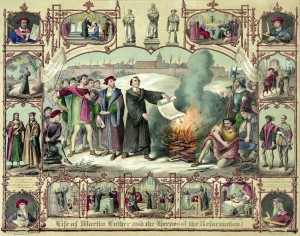 y did, or that their protest was over unimportant issues. But they never bother arguing for these positions. Rather, they just assume Protestant distinctives are false and move straight to denouncing them as “divisive,” or “schismatic.”
This is a bit like the Pharisees denouncing the infant Christian Church for tearing the Jewish world asunder. And the correct response echoes Gamaliel’s response to his fellows in Acts 5: What does it matter that Martin Luther’s movement causes division, if justification really is by faith alone? If this Reformation is from God, you can do nothing to stop it!
If you’re wondering what I’m talking about, let me explain. Around Reformation Day, non-Protestants start complaining that Protestant distinctives (i.e., Sola Scriptura, Sola Fide, etc.) divide Christendom. Nevermind that this presupposes a Protestant ecclesiology (that those outside the Roman Catholic Church are, in fact, part of Christ’s Body). The important thing is that it assumes Rome is basically right in identifying Protestant distinctives as errors.
Therein hides the weasel. Whenever someone says, “Sola Fide is a divisive doctrine, so you Protestants should give it up and come home,” they’re ignoring (or, perhaps, intentionally evading) the main issue. If Scripture teaches us one thing, it’s that God cares very little whether a given doctrine is divisive. Mostly, He cares whether it’s true. If Jesus Christ, the Second Person of the Trinity and the Truth incarnate, attracted primarily fishermen, and could not persuade more than two or three of the religious leaders to follow His teaching, we should hardly expect fallible humans to do better, even with truth entirely on their side. Yet this argument assumes we should.
Let me illustrate this by way of analogy. If the entire world was arguing that God is not Father, Son, and Holy Spirit, and a group of “protesters” were kicked out of the institutional church for upholding the Trinity, would anti-Protestants ask these folks, “Why are you holding on to your divisive distinction between essence and persons?” Would they ask when this factious Trinitarian protest will end so Christendom can resume its sweet, organizational unity?
I should hope not. But that’s how anti-Protestants sound to Protestants when they make this sort of comment. Only by assuming that Rome was right and the Reformers wrong about the core issues of the Reformation can the argument from “unity” have any real force. Truth trumps unity. Every time.
Let me state this principle more boldly, still: No one should ever give up a doctrine they firmly believe simply because it divides people. To do so is to deny that doctrine or even propositional truth matter in the first place! Like Uncle Screwtape, those who urge us to abandon the Reformation because it is “divisive” are effectively whispering in our ears, “Believe this, not because it is true, but for some other reason.”
The only reasons a person should ever give up a divisive doctrine are a.) he becomes convinced that it is false, or b.) he becomes convinced that it’s a matter of secondary importance, i.e., not worth dividing the church over.
As long as neither of these criteria are fulfilled, he must remain steadfast on that doctrine. Anything less is the basest kind of cowardice and servility.
Still, someone may ask, isn’t disunity itself a sign of false doctrine? Can’t we condemn or at least criticize Sola Scriptura and Sola Fide on the basis that they have caused myriad fractures in the body of Christ?No. This still presupposes Rome’s position in order to argue for it. Which claimed “truth” of the Reformation, we might ask this critic, divides the church? Sola Fide? Sola Scriptura? Why these? Why not their Roman Catholic counterparts?
In order to argue that the Protestant gloss on justification or authority is divisive and therefore likely wrong, the critic must first assume that it was the Protestant doctrine, and not the Roman analog, which was an innovation. But even if one views the Reformation as a winnowing of pre-existing streams of thought on justification and authority, Rome undeniably chose one stream over and against the Reformers, thus fundamentally changing its position from one of latitude to narrowness. Even if one grants that the Tridentine doctrine of justification was not fundamentally new, it still represents a narrowing of the spectrum of allowable doctrines so as to exclude Protestants.
Only by assuming that Rome was fundamentally right on these questions and church history, and that the Reformers were unscrupulous innovators, can you paint Protestant distinctives as somehow more divisive than those of Rome.
These kind of weaselly, disingenuous arguments against Protestantism need to end. The question of whether a doctrine is divisive or not is entirely pointless. We should all drop the subterfuge and just debate whether or not these doctrines are true. That’s ultimately all that matters. Surely even the staunchest traditional Catholics will admit that if the Protestants were, in fact, right on justification, it was an issue worth dividing the church over. If the Protestants were and are right about justification, it doesn’t matter that our doctrine is divisive. We have the truth.
Image: H. Schile, Wikimedia Commons

Previous Post

October 24, 2016
Halloween and the Aesthetic of Evil
Next Post

November 7, 2016 Four Reasons You Should Stop ‘Voting Against’ Candidates
Browse Our Archives
Select a Category Abortion Animals Apologetics Archaeology Atheism Bible Books Church Creationism Culture of Death Debate Devotion Economics Ethics Free Will Gender Issues History Holidays Intelligent Design Islam Liberalism Life Advice Media Movies Music Nature Parenting Philosophy Politics Prayer Race Relationships Science Sex Stories Technology Terrorism The Point Theology Uncategorized Youth
Select a Month July 2021 June 2021 April 2021 March 2021 November 2020 September 2020 May 2020 April 2020 February 2020 January 2020 November 2019 October 2019 August 2019 July 2019 June 2019 May 2019 April 2019 February 2019 January 2019 December 2018 November 2018 October 2018 September 2018 August 2018 July 2018 June 2018 May 2018 April 2018 March 2018 February 2018 January 2018 December 2017 November 2017 October 2017 September 2017 August 2017 July 2017 June 2017 May 2017 April 2017 March 2017 February 2017 January 2017 December 2016 November 2016 October 2016 September 2016 August 2016 July 2016 June 2016
Follow Us!
TAKE THE
Religious Wisdom Quiz
What is the name for a Christian adult education class, especially for converts?
Select your answer to see how you score.
Exegesis Martyrdom Ecumenism Catechism
Related posts from Troubler of Israel


Dunning-Kruger, Cultural Amnesia, and Tyrannosaurus rex

Why Music Opens Hearts and Minds

Why Was the Forbidden Fruit Forbidden?
TRENDING AT PATHEOS Evangelical

The REST of Your Life: A Creative Wrestles...
This week I had a conversation with a good friend from church....

How the author of the world's best hymn...
I've been working with John Newton for a while now. This makes...

Long before this Lectio Divina, Psalm 130 - the song - started...

What About the Trees? Another Living Parable
After I finished writing the last article about falling leaves as a...

Why Classical Education Is a Conversation, Not a...
Come and Read: Joy in Classical Education When I was a little...

Cornell University has received a great deal of negative publicity and intense...
view all Evangelical blogs
Ad-Free & Subscriber Log-In Subscription Support
- About Us
- 2026 Calendar
- Videos
- Podcasts
- Library of World Religions
- Faith In Media Tracker
- Advertise With Us
- Write for Us
- Privacy Policy
- Terms of Service
- Do Not Sell My Data
- Contact Us
- Radiant Digital
- Manage Newsletter Subscriptions
- Unsubscribe From Notifications
- Sitemap
Copyright 2008-2026, Patheos. All rights reserved.
Subscription Support Ad-Free & Subscriber Log-In
Follow Patheos