
BuddhistCatholicContemplativeEvangelicalGeneral ChristianHinduJewishLatter-day SaintMuslimNew VisionsProgressive Christian
Beliefs
- Buddhist
- Catholic
- Contemplative
- Evangelical
- General Christian
- Hindu
- Jewish
- Latter-day Saint
- More Voices
- Muslim
- New Visions
- Pagan
- Progressive Christian
Topics
- Religion News
- Food and Religion
- Sports and Religion
- Religious Art
- Religious Music and Entertainment
- Religious Events
- History and Religion
- Style and Religion
- Politics and Religion
- Women in Religion
- Recreation Outdoors and Religion
- Business Finance and Religion
- Careers Workplace and Religion
- Education and Religion
- Family Parenting and Religion
- Health Fitness and Religion
- Home and Religion
- Relationships and Religion
- Technology and Religion
- Travel and Religion
Columnists
- Buddhist Columnists
- Business Finance and Religion Columnists
- Careers Workplace and Religion Columnists
- Catholic Columnists
- Contemplative Columnists
- Education and Religion Columnists
- Evangelists Columnists
- Family Parenting and Religion Columnists
- General Christian Columnists
- Health Fitness and Religion Columnists
- Hindu Columnists
- History and Religion Columnists
- Home and Religion Columnists
- Jewish Columnists
- More Voices Columnists
- Latter Day Columnists
- Muslim Columnists
- New Visions Columnists
- Nonreligious Columnists
- Pagan Columnists
- Politics and Religion Columnists
- Progressive Columnists
- Recreation Outdoors and Religion Columnists
- Relationships and Religion Columnists
- Religion News Columnists
- Religious Art Columnists
- Religious Events Columnists
- Religious Music and Entertainment Columnists
- Sports and Religion Columnists
- Style and Religion Columnists
- Technology and Religion Columnists
- Travel and Religion Columnists
- Women in Religion Columnists
Resource Library
- 2026 Calendar
- Library of World Religions
- The 100 Most Holy Places on Earth
- Patheos Answers
- Podcasts
- Videos
- Faith Leaders Database
- Anglican Episcopalian
- Bahai
- Baptist
- Buddhism
- Christianity
- Confucianism
- Eastern Orthodoxy
- Hinduism
- Holiness and Pentecostal
- ISKCON
- Islam
- Judaism
- Lutheran
- Methodist
- The Church of Jesus Christ of Latter-day Saints
- New Age
- Paganism
- Presbytarian and Reformed
- Protestantism
- Religion Behind the Scenes
- Roman Catholic
- Scientology
- Shia Islam
- Sikhism
- Sufism
- Sunni Islam
- Taoism
- Zen
- See all religions
Research Tools
 Ad-Free & Subscriber Log-In Subscription Support
Ad-Free & Subscriber Log-In Subscription Support
Follow Patheos 

- Trending:
- Forgiveness
- |
- Marriage
- |
- Consciousness
- |
- Death Penalty
- |
- Election
- |
- Halloween
 Troubler of Israel
- Home
- Evangelical
- Prayer Is Not a Placebo
Prayer Is Not a Placebo
Last updated on: June 20, 2016 at 11:56 am by G. Shane Morris
Prayer Is Not a Placebo 2016-06-20T11:56:47-04:00 G. Shane Morris
Patheos Explore the world's faith through different perspectives on religion and spirituality! Patheos has the views of the prevalent religions and spiritualities of the world.
It’s become an all-too-common trope, especially in my own Reformed circles, to say that “the purpose of prayer is to change us, not God.”
I really dislike this statement. On one level, it’s true, of course. We can change, and God does not. He is immutable. But on another level, it’s unscriptural nonsense. Prayer is not some psychotropic therapy we perform to make ourselves feel better. It is not a placebo. It really serves a purpose. It is the conversation of children with their Father (Romans 8:15), a bride with her Groom (Ephesians 5:22-33), and priests with their God (1 Peter 2:9). The Bible is abundantly clear that prayer “avails much” (James 5:16), that God will give us what we ask for in His name (John 14:13-14), and that if we don’t ask, we shouldn’t expect to receive (James 4:2-3). Jesus compares God’s role in prayer to that of a loving Father, delighted to give His children what they ask (Luke 11:11-13). Jesus, Who is God in human flesh, constantly lifted up thanks and petitions to His Father, even asking for something which He knew to be contrary to God’s ordained will (Luke 22:42). And when asked to teach them how to pray, Jesus gave the disciples a prayer filled with petitions for God’s kingdom to come on earth, for bodily provision, for forgiveness, and protection from temptation. (Matthew 6:5-15).
 In the Old Testament, God is portrayed as responding to prayer and even changing His mind (Genesis 18:24-32, Exodus 32:14, 2 Samuel 24:16). While we know by comparing these passages with others (Numbers 23:19, James 1:17), that God does not truly change, but rather uses anthropomorphic language in His dealings with man, these don’t mean that, in a conditional sense, prayer does not change things. It does. It was prayer that saved Nineveh (Jonah 3:10), prayer that caused Jesus to become incarnate in Mary’s womb (Luke 1:38), prayer that freed Peter from prison (Acts 12:5-17), and prayer that expresses the faith which unites us to Christ, and changes our eternal fate (1 John 1:9, Luke 18:13, Romans 10:9, Acts 16:25-40). Indeed, when we pray, we’re told that God the Spirit joins us and makes up for the deficiencies in our prayers with “groans that cannot be uttered.” (Romans 8:26-27).
So does prayer change us, or does it change God? That’s the wrong question, and it betrays a stunted view of God’s sovereignty. God, knowing all because He ordains all, does not change through prayer. Instead, He has appointed prayer as a means through which we can participate in His work. He has decreed that certain things will happen. And the prayers of His people are the means through which He has decreed they will happen. Pitting prayer against God is like pitting the Bible against God. Does God need the Bible to save someone? Of course not. But it is the means by which He has chosen to save. When a condemned sinner cries out to Heaven for mercy, he does not change God’s plan his life. He brings that plan to fruition. When the High Priest intercedes and sacrifices for the people, He really does, in the rawest sense, turn away God’s wrath. But don’t forget: the High Priest and the Altar are all there by God’s instruction.
The answer, then, is this: prayer changes us, yes. But that’s not primarily why we pray. We pray because God is so sovereign that He has invited us to enter into His counsels and participate in working out His unchangeable plan.
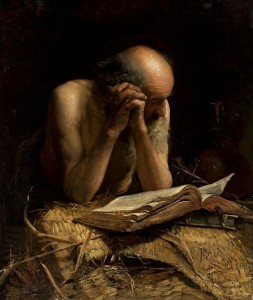
Image: Ejsmond The Anchorite, Wikimedia Commons
Previous Post
June 14, 2016
Exploitation Fatigue and Chick-fil-A
Next Post

June 27, 2016 Jim Dobson and Rusty Red Vans
Browse Our Archives
Select a Category Abortion Animals Apologetics Archaeology Atheism Bible Books Church Creationism Culture of Death Debate Devotion Economics Ethics Free Will Gender Issues History Holidays Intelligent Design Islam Liberalism Life Advice Media Movies Music Nature Parenting Philosophy Politics Prayer Race Relationships Science Sex Stories Technology Terrorism The Point Theology Uncategorized Youth
Select a Month July 2021 June 2021 April 2021 March 2021 November 2020 September 2020 May 2020 April 2020 February 2020 January 2020 November 2019 October 2019 August 2019 July 2019 June 2019 May 2019 April 2019 February 2019 January 2019 December 2018 November 2018 October 2018 September 2018 August 2018 July 2018 June 2018 May 2018 April 2018 March 2018 February 2018 January 2018 December 2017 November 2017 October 2017 September 2017 August 2017 July 2017 June 2017 May 2017 April 2017 March 2017 February 2017 January 2017 December 2016 November 2016 October 2016 September 2016 August 2016 July 2016 June 2016
Follow Us!
TAKE THE
Religious Wisdom Quiz
How many years did it take Solomon to build his palace?
Select your answer to see how you score.
13 years 10 years 15 years 7 years
Related posts from Troubler of Israel


Why Music Opens Hearts and Minds


Why Was the Forbidden Fruit Forbidden?
TRENDING AT PATHEOS Evangelical

The REST of Your Life: A Creative Wrestles...
This week I had a conversation with a good friend from church....

How the author of the world's best hymn...
I've been working with John Newton for a while now. This makes...

Long before this Lectio Divina, Psalm 130 - the song - started...

What About the Trees? Another Living Parable
After I finished writing the last article about falling leaves as a...

Why Classical Education Is a Conversation, Not a...
Come and Read: Joy in Classical Education When I was a little...

Cornell University has received a great deal of negative publicity and intense...
view all Evangelical blogs
Ad-Free & Subscriber Log-In Subscription Support
- About Us
- 2026 Calendar
- Videos
- Podcasts
- Library of World Religions
- Faith In Media Tracker
- Advertise With Us
- Write for Us
- Privacy Policy
- Terms of Service
- Do Not Sell My Data
- Contact Us
- Radiant Digital
- Manage Newsletter Subscriptions
- Unsubscribe From Notifications
- Sitemap
Copyright 2008-2026, Patheos. All rights reserved.
Subscription Support Ad-Free & Subscriber Log-In
Follow Patheos