
BuddhistCatholicContemplativeEvangelicalGeneral ChristianHinduJewishLatter-day SaintMuslimNew VisionsProgressive Christian
Beliefs
- Buddhist
- Catholic
- Contemplative
- Evangelical
- General Christian
- Hindu
- Jewish
- Latter-day Saint
- More Voices
- Muslim
- New Visions
- Pagan
- Progressive Christian
Topics
- Religion News
- Food and Religion
- Sports and Religion
- Religious Art
- Religious Music and Entertainment
- Religious Events
- History and Religion
- Style and Religion
- Politics and Religion
- Women in Religion
- Recreation Outdoors and Religion
- Business Finance and Religion
- Careers Workplace and Religion
- Education and Religion
- Family Parenting and Religion
- Health Fitness and Religion
- Home and Religion
- Relationships and Religion
- Technology and Religion
- Travel and Religion
Columnists
- Buddhist Columnists
- Business Finance and Religion Columnists
- Careers Workplace and Religion Columnists
- Catholic Columnists
- Contemplative Columnists
- Education and Religion Columnists
- Evangelists Columnists
- Family Parenting and Religion Columnists
- General Christian Columnists
- Health Fitness and Religion Columnists
- Hindu Columnists
- History and Religion Columnists
- Home and Religion Columnists
- Jewish Columnists
- More Voices Columnists
- Latter Day Columnists
- Muslim Columnists
- New Visions Columnists
- Nonreligious Columnists
- Pagan Columnists
- Politics and Religion Columnists
- Progressive Columnists
- Recreation Outdoors and Religion Columnists
- Relationships and Religion Columnists
- Religion News Columnists
- Religious Art Columnists
- Religious Events Columnists
- Religious Music and Entertainment Columnists
- Sports and Religion Columnists
- Style and Religion Columnists
- Technology and Religion Columnists
- Travel and Religion Columnists
- Women in Religion Columnists
Resource Library
- 2026 Calendar
- Library of World Religions
- The 100 Most Holy Places on Earth
- Patheos Answers
- Podcasts
- Videos
- Faith Leaders Database
- Anglican Episcopalian
- Bahai
- Baptist
- Buddhism
- Christianity
- Confucianism
- Eastern Orthodoxy
- Hinduism
- Holiness and Pentecostal
- ISKCON
- Islam
- Judaism
- Lutheran
- Methodist
- The Church of Jesus Christ of Latter-day Saints
- New Age
- Paganism
- Presbytarian and Reformed
- Protestantism
- Religion Behind the Scenes
- Roman Catholic
- Scientology
- Shia Islam
- Sikhism
- Sufism
- Sunni Islam
- Taoism
- Zen
- See all religions
Research Tools
 Ad-Free & Subscriber Log-In Subscription Support
Ad-Free & Subscriber Log-In Subscription Support
Follow Patheos 

- Trending:
- Forgiveness
- |
- Marriage
- |
- Consciousness
- |
- Death Penalty
- |
- Election
- |
- Halloween
 Translating Worlds
- Home
- Pagan
- Liturgy and Ritual
Liturgy and Ritual
Last updated on: September 24, 2018 at 9:15 pm by Samuel Wagar
Liturgy and Ritual 2018-09-24T21:15:11-07:00 Samuel Wagar
Patheos Explore the world's faith through different perspectives on religion and spirituality! Patheos has the views of the prevalent religions and spiritualities of the world.
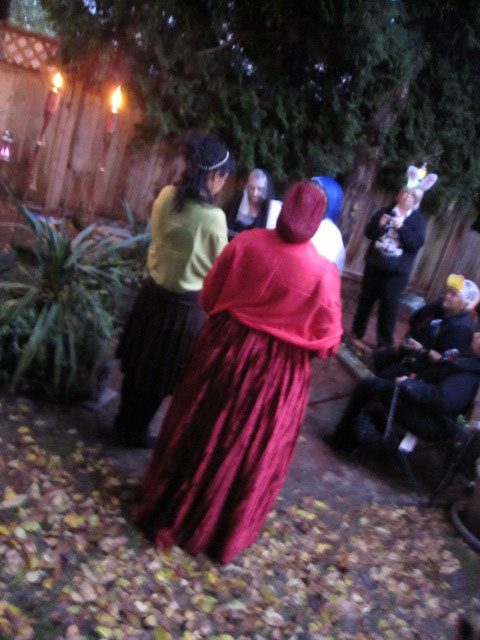
(c) 2018 Sam Wagar. Part of a backyard wedding.
One key activity, the central activity of public temples, is ritual performance. Training in liturgy and the performance of effective ritual is more important than training in theology and the minutia of organization and bureaucracy, more important than training in ethics. This is how we awaken the sacred in all parts of life and all of the stages of life in our activities.
Every religion has elements that work on all of the various levels of human life to help us connect with the divine, to live our lives with greater clarity and joy, to give us ethical and moral guidance, and to help us through the little and big difficulties of life as well as celebrate our successes and happy times. These ideas are often expressed through rituals. Rituals can come at any scale – for individuals, couples, families, for covens, Moon groups and temples, and in the larger communities, cities, nations and as human beings all living together here on this beautiful planet Earth.
This is too much to talk about here in any detail, (and I already have done a series of posts on ritual – look back a couple of months, starting with http://www.patheos.com/blogs/translatingworlds/2018/05/notes-on-ritual-theory-for-the-wiccan-priest-ess/) but I will begin to approach the topic. Ritual acts are those acts that refer to meaning outside of the act itself – although we may eat a meal with friends regularly, by saying some significant words and making special gestures, by eating specific foods in a special way at a specific time, we make the meal into a ritual. By the ritual gestures we say that the meal means “sharing in the death and life of the God who gives his life in the grain to feed us”, for example.
(c) 2018 Sam Wagar
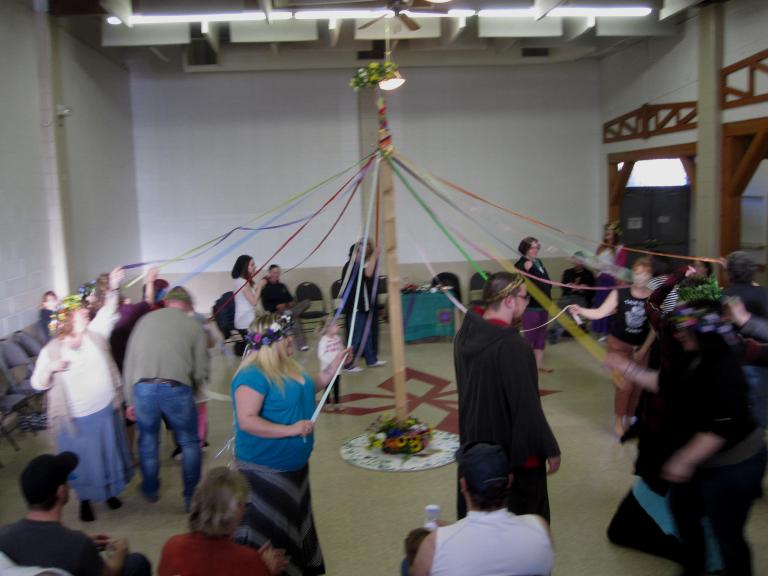
Liturgy and the cycle of rituals in a year can be shaped around many things – the observed cycles of the seasons (celebrating planting and harvest, the big food events of the year, the winter and spring migrations of birds), or events in the life of a great hero, or the lunar and solar cycles of Full and New Moons and Solstices and Equinoxes. Ritual cycles are a mixture of these elements. They work on several levels as well – on the community level to bring temples together to celebrate their broadly shared beliefs and values, on the small group level to precipitate inner journeying and experience, and on the individual level to strengthen will-power and re-confirm attachment to virtuous behaviour and ideals. Rituals can be written for each level and adapted by individuals or groups to work on all three simultaneously.
A standard format and common elements are very important to allow the participants in the rituals to easily surrender to the experience and go deeper. The Wiccan group ritual standard format (in coven as well as public temples) is:
- Physical preparation of the space that will be used for ritual – moving furniture out of the way, vacuuming and cleaning, gathering together all of the supplies and ritual tools that will be used and preparing the altars with the tools set out;
- Priestess and Priest robe up and prepare themselves by grounding;
- The circle is cast by sweeping (symbolically) the space and then by its boundary being outlined by PS and P walking around it reciting “This is a place that is not a place and a time that is not a time, halfway between the worlds of Gods and mortals.”;
- The congregation assembled is then welcomed into the circle in some way – greeted at the entrance and blessed and welcomed;
- The directions are greeted and the five elements are asked to be present (Air at East, then clockwise Fire, Water, Earth and Spirit in the centre);
- The Goddess and God (or specific Goddesses and Gods) are invited to be present;
- Whatever ritual business is planned is carried out – seasonal ritual, lecture, lesson, magick working;
- Food and drink are blessed and shared – several forms of blessing can be used, depending on the theological basis of the temple, with the common element of bringing an awareness of the divinity in the material world and in the act of nourishing each other,
- A period of conversation and fellowship;
- Formal closing of the ritual – it is important that the ceremony not just peter out but that all of the Gods, elements, and powers are thanked and the congregation steps out into the world again.
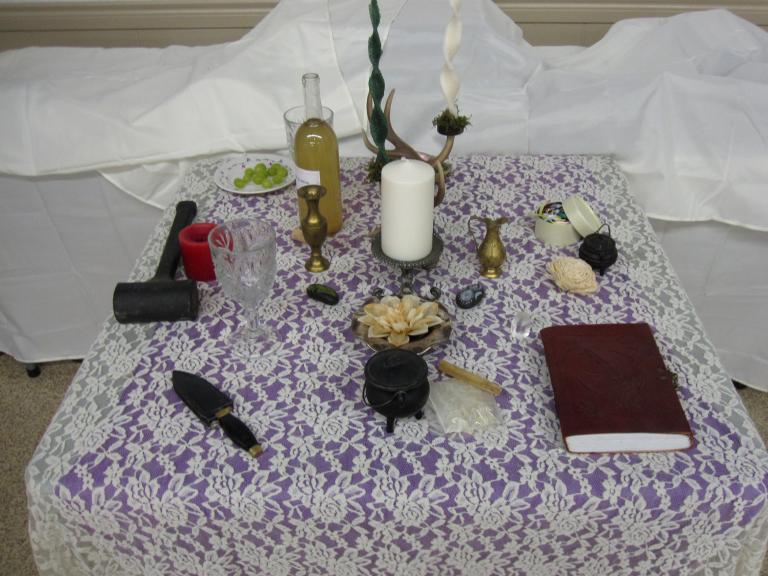
(c) Sam Wagar 2018
The clergy and the leadership are not the only source of ritual. By sharing rituals and customs of our families, both old ones and new ones that we are developing to help us live and grow as Pagans in families, we strengthen ourselves as both Pagans and as families. Families are, for better or worse, the foundation of our lives and of society at large. That is where we learn to love, where we are first disappointed in love and first hurt, where we learn the basic lessons about how to behave as human beings together. Our families, good or bad, and some, I recognize, are very bad, shape us as human beings on the deepest levels of our psyches.
We understand our friendships, our intimate relationships, the world itself, through the prism of our families. Since very few of us grew up in Pagan families we have had to take family customs and ideas and reshape them to fit our Pagan view of the world, we have had to invent customs and traditions and draw from ancient lore. Because we are building a new set of family religious traditions here, we are very creative, not confined in the past or trapped in our ancient hurts or bound to celebrate only as our ancestors did. But we also do not have the sense of belonging, and rightness that comes from true tradition, not yet.
Family traditions and family-centred ritual is a profound and powerful foundation to lasting spiritual community and to a sense of values and belonging. A religion centred on families, like the Jewish religion in which the temple rituals are secondary and family celebrations are primary, can be deep and rich and nourishing. This is what we want Paganism and Wicca to be for all of its practitioners, not only for clergy or only for the highly involved few.
Most Wiccans and other Pagans are solitary in our practice and many only show up at temple or group activities occasionally. But we can still share the rituals, customs and traditions that we have developed in our families, to help other families build a Pagan way of life. Ritual meals, food blessings, family customs, baby blessings, weddings, funerals, memorials, coming of age ceremonies, house blessings – all of the things that you might have done with just your family and friends can be valuable celebrations to share with your temple and enrich other families.
We will be richer, our families and our communities and our religion will be richer, because we share these things.

About Samuel Wagar
I've been doing this Witch thing for a long time (since 1982) but I'm still having fun. Now that I'm an old fart, my focus has switched from doing a lot of things to mentoring, teaching, and writing. I'm a chaplain at University of Alberta, in charge of the Congregationalist Wiccan Assembly of Alberta's clergy training program, a doctoral candidate in theology, and the dean of the baby Edmonton Wiccan Seminary. You can read more about the author here.
Previous Post
September 19, 2018
Slice of Life
Next Post

September 26, 2018 LGBTQ+ Affirming Wicca
Browse Our Archives
Select a Category Uncategorized
Select a Month September 2018 August 2018 July 2018 June 2018 May 2018 April 2018
Follow Us!
TAKE THE
Religious Wisdom Quiz
What did Isaiah see in his vision in Isaiah 6?
Select your answer to see how you score.
The Lord seated on His throne A chariot of fire A burning bush A ladder to heaven
Related posts from Translating Worlds



Temple Publicity and Public Information Tips
Just the Start of School Again
TRENDING AT PATHEOS Pagan

I was recently chatting with someone on Instagram. She asked me what...

While there are many people who share their results, the end of...

On July 23, I saw Christopher Nolan's The Odyssey which is Homer’s...

As I write this two big events have just finished up. One...

Restoring the Watershed of Divine Love
Perhaps cooperation is not something we manufacture through legislation, ideology, or moral...

Many UUs don’t pray because of bad experiences in a previous religion,...
view all Pagan blogs
Ad-Free & Subscriber Log-In Subscription Support
- About Us
- 2026 Calendar
- Videos
- Podcasts
- Library of World Religions
- Faith In Media Tracker
- Advertise With Us
- Write for Us
- Privacy Policy
- Terms of Service
- Do Not Sell My Data
- Contact Us
- Radiant Digital
- Manage Newsletter Subscriptions
- Unsubscribe From Notifications
- Sitemap
Copyright 2008-2026, Patheos. All rights reserved.
Subscription Support Ad-Free & Subscriber Log-In
Follow Patheos