
BuddhistCatholicContemplativeEvangelicalGeneral ChristianHinduJewishLatter-day SaintMuslimNew VisionsProgressive Christian
Beliefs
- Buddhist
- Catholic
- Contemplative
- Evangelical
- General Christian
- Hindu
- Jewish
- Latter-day Saint
- More Voices
- Muslim
- New Visions
- Pagan
- Progressive Christian
Topics
- Religion News
- Food and Religion
- Sports and Religion
- Religious Art
- Religious Music and Entertainment
- Religious Events
- History and Religion
- Style and Religion
- Politics and Religion
- Women in Religion
- Recreation Outdoors and Religion
- Business Finance and Religion
- Careers Workplace and Religion
- Education and Religion
- Family Parenting and Religion
- Health Fitness and Religion
- Home and Religion
- Relationships and Religion
- Technology and Religion
- Travel and Religion
Columnists
- Buddhist Columnists
- Business Finance and Religion Columnists
- Careers Workplace and Religion Columnists
- Catholic Columnists
- Contemplative Columnists
- Education and Religion Columnists
- Evangelists Columnists
- Family Parenting and Religion Columnists
- General Christian Columnists
- Health Fitness and Religion Columnists
- Hindu Columnists
- History and Religion Columnists
- Home and Religion Columnists
- Jewish Columnists
- More Voices Columnists
- Latter Day Columnists
- Muslim Columnists
- New Visions Columnists
- Nonreligious Columnists
- Pagan Columnists
- Politics and Religion Columnists
- Progressive Columnists
- Recreation Outdoors and Religion Columnists
- Relationships and Religion Columnists
- Religion News Columnists
- Religious Art Columnists
- Religious Events Columnists
- Religious Music and Entertainment Columnists
- Sports and Religion Columnists
- Style and Religion Columnists
- Technology and Religion Columnists
- Travel and Religion Columnists
- Women in Religion Columnists
Resource Library
- 2026 Calendar
- Library of World Religions
- The 100 Most Holy Places on Earth
- Patheos Answers
- Podcasts
- Videos
- Faith Leaders Database
- Anglican Episcopalian
- Bahai
- Baptist
- Buddhism
- Christianity
- Confucianism
- Eastern Orthodoxy
- Hinduism
- Holiness and Pentecostal
- ISKCON
- Islam
- Judaism
- Lutheran
- Methodist
- The Church of Jesus Christ of Latter-day Saints
- New Age
- Paganism
- Presbytarian and Reformed
- Protestantism
- Religion Behind the Scenes
- Roman Catholic
- Scientology
- Shia Islam
- Sikhism
- Sufism
- Sunni Islam
- Taoism
- Zen
- See all religions
Research Tools
 Ad-Free & Subscriber Log-In Subscription Support
Ad-Free & Subscriber Log-In Subscription Support
Follow Patheos 

- Trending:
- Forgiveness
- |
- Marriage
- |
- Consciousness
- |
- Death Penalty
- |
- Election
- |
- Halloween
 Translating Worlds
- Home
- Pagan
- Growth and reproduction of Wiccan Temples
Growth and reproduction of Wiccan Temples
Last updated on: September 3, 2018 at 11:40 pm by Samuel Wagar
Growth and reproduction of Wiccan Temples 2018-09-03T23:40:00-07:00 Samuel Wagar
Patheos Explore the world's faith through different perspectives on religion and spirituality! Patheos has the views of the prevalent religions and spiritualities of the world.

(c) 2018 Samuel Wagar. The view outside my office at U of Alberta, mid-August 2018.
A mission of social, personal, and religious transformation cannot be accomplished by simply maintaining what we have already or by continuing to only relate to our in-groups. We must aim toward growth in numbers and in influence. This must be true at every level from the individual through the small groups, temples and religious movement as a whole, although most pronounced at the temple level, where the bulk of services are delivered to the public and the members.
Groups should be set up to multiply as soon as it is organically feasible and possible. Leadership should be trained to lead and to build new groups, and group structure should focus on outreach and fulfilling our mission rather than simply maintenance. We must broaden and deepen our leadership base, identify and mentor lay leaders and clergy candidates, and view our current situation as a step toward the future.
All leaders need to begin with the mission of the group, and constantly refer to it. This mission is not the mission of an individual but is a calling to the whole group. Clergy leaders fit into five main roles: Missional dealing with strategic issues, Visionary concerned with discerning the wills of the gods, Outreach with recruitment, Care in creating a loving and spiritually mature network of relationships, and training people to care for each other in a spiritually grounded way, and Teaching who focus on discernment, guidance, and deepening religious understanding and self-awareness. Organizational lay leadership concerns itself with membership records, money and fundraising, and the nuts and bolts of renting meeting space and organizing volunteers.
Gathering together resources enough to pay the rent and engage in outreach is a practical key. Financially exploiting members or expecting the clergy and Board to pick up any shortfall is not viable or ethical. A temple that is growing in members and activities will attract more resources and be self-sustaining. An average attendance at open circles of thirty to forty people and about twenty-five full voting members is enough for a volunteer-run group.
Clergy training and seeding of new groups is more effective with centralized support in the areas of liturgy, training resources, charitable and book keeping, and travelling teachers and other institutional support. Bringing together temples into provincial or regional associations pulls together more of these resources.

(c) 2018 Samuel Wagar
A regional office will often be the first contact point for individuals looking for a group to learn from or work with. As well, all temples will keep a record of attendance and send it to the central office, including the contact information of visitors to their rituals. From these contacts the provincial office can organize visits of traveling priesthood to encourage the seeding of new groups in areas where numbers warrant. And, if a group falls apart, the provincial office will be able to keep in contact with the people of the group and provide resources to encourage the formation of new worship groups from the ashes.
The regional office and travelling priesthood should be proactive, looking for potential member groups and contacting them with information in a friendly exchange. Groups can be part of the broader Wiccan movement or the broader Pagan stream but not interested in joining forces with us and still be allies and friends around specific initiatives and projects.
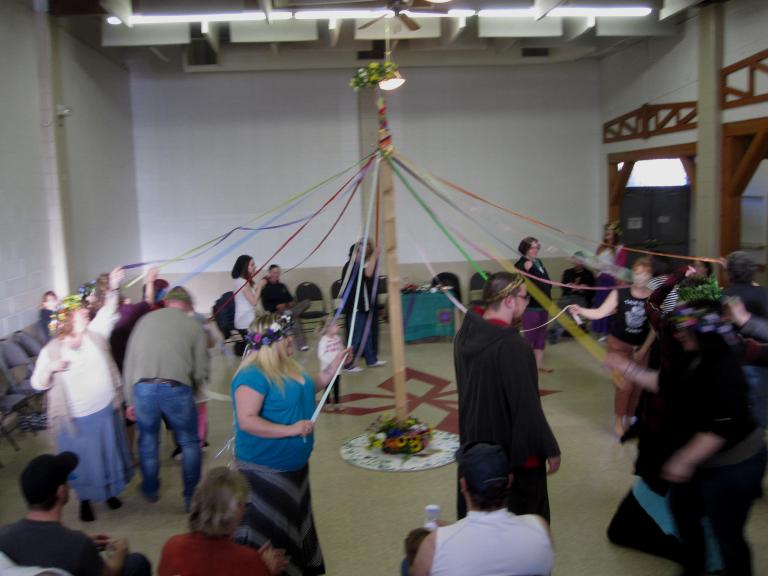
(c) 2018 Samuel Wagar.
Groups must self-finance, to the extent possible, the travel expenses of bringing in specialized assistance and training during the period of seeding temples in new areas. A pool of clergy recognized and authorized to do this work should be identified and be extensively and regularly involved in planning and outreach efforts, in assisting new groups to bud off existing temples as well as forming new ones in areas where they are absent. In areas where there are already groups outreach responsibilities will be shared between them and the provincial body. The travelling priesthood also will mentor the clergy in their area of responsibility and be available to them even after their Ordinations.
Seeing our association as self-initiating, reproducing, fully-devoted small groups and Priestesses and Priests of their Gods, reproducing leaders, temples and broader movements all based on shared foundational beliefs and held together through personal ties and conscious networking, mentoring and discussion, means seeing it as a institutional outgrowth of a dynamic and fluid movement rather than a static assortment of hierarchic structures. Each group is pregnant with the seeds of other groups and new communities.
The most important means of growth must always be through people already involved in the temples. People are attracted to people more than they are to ideas. People go where their friends are. So, community building and strengthening is important to both attracting and keeping people – the temples must be caring environments which give tangible spiritual and personal support to the members. There must be measurable benefits to belonging, benefits only available to members. At the same time members must be encouraged to be engaged with their families and their communities in tune with our values. This means that our influence reaches out into the larger world to improve it, and that people we are in contact with can freely come and check us out and become involved if they wish.
There should be people that have a special responsibility to speak to newcomers at our temple meetings, so they’ll feel welcomed and have a person to ask questions of, and not only the clergy people. There also should be public spokespeople, mostly clergy members, who deliberately seek out opportunities to talk with media and groups in the community.
The most effective recruitment moves through pre-existing social networks. People come to check out the temple that their friends and family belong to. For this reason, it produces less growth if a group focuses principally on befriending lonely and isolated newcomers to the community. It is important to have a public presence so that people who are looking for us can easily find us.
At the very start of all training the obligation for outreach and future growth must be planted in our temples, groups and leaders. We must be constantly out of our comfortable homes acting in the world as the expression of that 5th element, of spirit. The idea of religious service is vital here – service to ones Matron and Patron deities as well as friendly recognition of other Gods, and service to the future needs of Their people.

About Samuel Wagar
I've been doing this Witch thing for a long time (since 1982) but I'm still having fun. Now that I'm an old fart, my focus has switched from doing a lot of things to mentoring, teaching, and writing. I'm a chaplain at University of Alberta, in charge of the Congregationalist Wiccan Assembly of Alberta's clergy training program, a doctoral candidate in theology, and the dean of the baby Edmonton Wiccan Seminary. You can read more about the author here.
Previous Post

August 30, 2018
Affirmation and Sacrifice
Next Post

September 5, 2018 Parent Rite of Passage
Browse Our Archives
Select a Category Uncategorized
Select a Month September 2018 August 2018 July 2018 June 2018 May 2018 April 2018
Follow Us!
TAKE THE
Religious Wisdom Quiz
What food did God provide from heaven to the Israelites in the wilderness?
Select your answer to see how you score.
Grapes Manna Olives Quail
Related posts from Translating Worlds



Temple Publicity and Public Information Tips
TRENDING AT PATHEOS Pagan

I was recently chatting with someone on Instagram. She asked me what...

While there are many people who share their results, the end of...

On July 23, I saw Christopher Nolan's The Odyssey which is Homer’s...

As I write this two big events have just finished up. One...

Restoring the Watershed of Divine Love
Perhaps cooperation is not something we manufacture through legislation, ideology, or moral...

Many UUs don’t pray because of bad experiences in a previous religion,...
view all Pagan blogs
Ad-Free & Subscriber Log-In Subscription Support
- About Us
- 2026 Calendar
- Videos
- Podcasts
- Library of World Religions
- Faith In Media Tracker
- Advertise With Us
- Write for Us
- Privacy Policy
- Terms of Service
- Do Not Sell My Data
- Contact Us
- Radiant Digital
- Manage Newsletter Subscriptions
- Unsubscribe From Notifications
- Sitemap
Copyright 2008-2026, Patheos. All rights reserved.
Subscription Support Ad-Free & Subscriber Log-In
Follow Patheos