
BuddhistCatholicContemplativeEvangelicalGeneral ChristianHinduJewishLatter-day SaintMuslimNew VisionsProgressive Christian
Beliefs
- Buddhist
- Catholic
- Contemplative
- Evangelical
- General Christian
- Hindu
- Jewish
- Latter-day Saint
- More Voices
- Muslim
- New Visions
- Pagan
- Progressive Christian
Topics
- Religion News
- Food and Religion
- Sports and Religion
- Religious Art
- Religious Music and Entertainment
- Religious Events
- History and Religion
- Style and Religion
- Politics and Religion
- Women in Religion
- Recreation Outdoors and Religion
- Business Finance and Religion
- Careers Workplace and Religion
- Education and Religion
- Family Parenting and Religion
- Health Fitness and Religion
- Home and Religion
- Relationships and Religion
- Technology and Religion
- Travel and Religion
Columnists
- Buddhist Columnists
- Business Finance and Religion Columnists
- Careers Workplace and Religion Columnists
- Catholic Columnists
- Contemplative Columnists
- Education and Religion Columnists
- Evangelists Columnists
- Family Parenting and Religion Columnists
- General Christian Columnists
- Health Fitness and Religion Columnists
- Hindu Columnists
- History and Religion Columnists
- Home and Religion Columnists
- Jewish Columnists
- More Voices Columnists
- Latter Day Columnists
- Muslim Columnists
- New Visions Columnists
- Nonreligious Columnists
- Pagan Columnists
- Politics and Religion Columnists
- Progressive Columnists
- Recreation Outdoors and Religion Columnists
- Relationships and Religion Columnists
- Religion News Columnists
- Religious Art Columnists
- Religious Events Columnists
- Religious Music and Entertainment Columnists
- Sports and Religion Columnists
- Style and Religion Columnists
- Technology and Religion Columnists
- Travel and Religion Columnists
- Women in Religion Columnists
Resource Library
- 2026 Calendar
- Library of World Religions
- The 100 Most Holy Places on Earth
- Patheos Answers
- Podcasts
- Videos
- Faith Leaders Database
- Anglican Episcopalian
- Bahai
- Baptist
- Buddhism
- Christianity
- Confucianism
- Eastern Orthodoxy
- Hinduism
- Holiness and Pentecostal
- ISKCON
- Islam
- Judaism
- Lutheran
- Methodist
- The Church of Jesus Christ of Latter-day Saints
- New Age
- Paganism
- Presbytarian and Reformed
- Protestantism
- Religion Behind the Scenes
- Roman Catholic
- Scientology
- Shia Islam
- Sikhism
- Sufism
- Sunni Islam
- Taoism
- Zen
- See all religions
Research Tools
 Ad-Free & Subscriber Log-In Subscription Support
Ad-Free & Subscriber Log-In Subscription Support
Follow Patheos 

- Trending:
- Forgiveness
- |
- Marriage
- |
- Consciousness
- |
- Death Penalty
- |
- Election
- |
- Halloween
 Translating Worlds
- Home
- Pagan
- More Temple Organizing Thoughts
More Temple Organizing Thoughts
Last updated on: August 14, 2018 at 12:14 pm by Samuel Wagar
More Temple Organizing Thoughts 2018-08-14T12:14:58-07:00 Samuel Wagar
Patheos Explore the world's faith through different perspectives on religion and spirituality! Patheos has the views of the prevalent religions and spiritualities of the world.
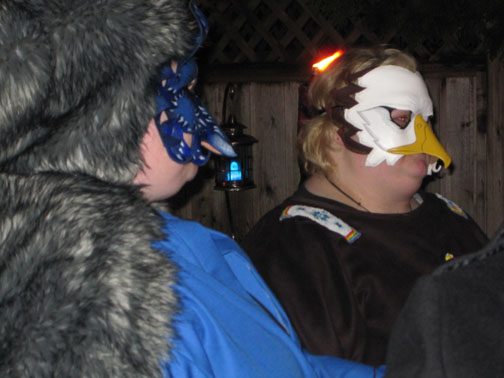
(c) 2018 Sam Wagar
My church is a federation of self-governing temples. Our bylaws and organizing principles make forming new congregations and temples under our umbrella easy. The reasons for this are both pragmatic, reflecting the reality on the ground in the Pagan communities as well as the nature of the tasks ahead of us, and defensive – better to have several ambitious Priestesses out building their own temples rather than fighting over the control of a single larger group. Small groups are simply better suited to accomplishing our goals. Because we are polytheistic and each temple will have a different assortment of deities to whom they give their principal devotion, a more focused and effective service to the Gods will emerge from a smaller group as well.
Effective temple groups can be no larger than about 150 people. Informal ties of friendship and social reinforcement break down and formal and coercive structures are needed in larger groups. That number is quite a bit larger than what most Wiccan temples have achieved. But the idea of face-to-face groups and an abundance of leadership are key and valuable to keep in mind if we are to flourish. Formal and coercive mechanisms are much less flexible and effective in responding to challenges and new opportunities and larger, more impersonal, groups do not nourish individuals in their spiritual growth or growth in leadership skills as well as smaller ones.
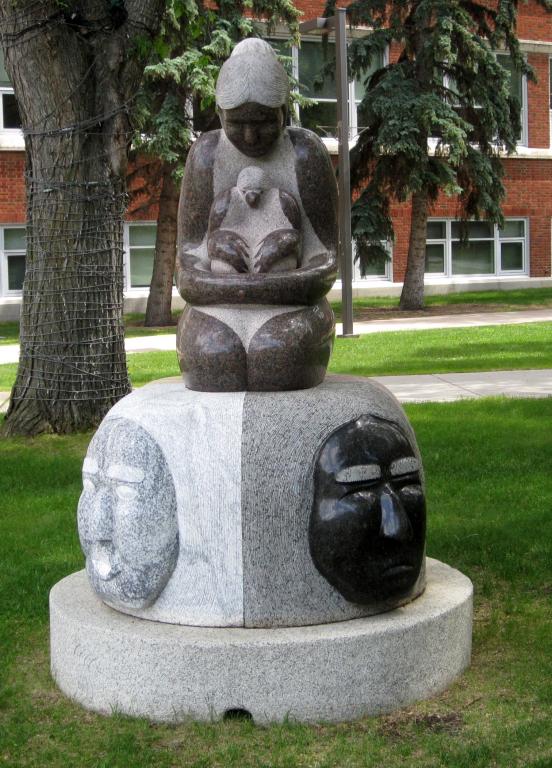
(c) 2018 Sam Wagar. Sculpture by Stewart Steinhauer – temporarily installed on U of Alberta. The Eagle Child represents the second creation of human culture.
The advantages and benefits to being members of a small group include the deeper social connections and development of friendships, more direct and personal mentoring and a more pastoral style of leadership and care. Economies of scale allow larger groups at the temple scale of a few dozen to a hundred or so to undertake larger projects and offer more programs and religious education to their members and to the larger community. And a provincial and national association of thousands of members can offer specialized services and benefits beyond those which a smaller group could provide. Greater involvement by individual members will provide greater benefits to them, and at the same time the combined efforts of many will accumulate a pool of capital goods and social capital which can be drawn upon by the whole group.
Temple Wicca is still a minority of even the Wicca-identified Pagans. We are organizationally-minded but we are building many small groups, not aiming toward one very large one. Our small size and lack of money and property are assets in this, really – we can more readily avoid the illusion that our little church is the whole Wiccan community. Smaller groups have a larger ‘surface area’ with more connections to the outside world, less need to spend money, volunteer energy or other resources on maintenance, and less tendency to become complacent in their mission, although with a greater centripetal force and need to consciously foster close connections and mutual support among their members. Small outward-looking groups also face the reality of being a small minority in a big pool of people with different beliefs, which can be both daunting and discouraging and challenge them to greater clarity and dedication to their path.
One organizational challenge is the fantasy of effort-free online networking, with ever more proliferations of online webs and discussion groups. The only way to build lasting, real, supportive community is face to face. Online efforts can provide the initial connection point, often do for people that are otherwise weakly connected in their community and with few real world Pagan contacts, but these contacts must be followed up in person and the people must come out to rituals or discussion groups in person and form face-to-face social bonds in order to benefit from these connections and to develop personally and build groups, temples or church.
A virtual temple is not spiritually nourishing in the way that regular practice in person is. Audience cults and client cults can be maintained in the online fora because they both demand much less from members (generally only money and consumption of the spiritual goods on offer) but also give so many fewer benefits. So, an emphasis on coffee meetings in person, reading and discussion groups, rituals in physical locations and face to face meetings of all sorts is essential to build community around temples. But these things take more time, energy, money and commitment than signing onto a Facebook group. We cannot avoid the labour – there is no free lunch, reading a book does not make you a High Priestess, and this useful tool should not be the centre of our organizing efforts.

(c) 2018 Sam Wagar my Temple marching in Edmonton Pride Parade.
The ideas of British Traditional Wicca, with tweaking, make a good model for our movement’s growth and deepening. We are based on smaller cells (covens and moon groups) that have more intense and specific bonds and Inner Court ritual work emphasizing trance and ecstasy, and which co-operate together in larger public temple groups (which are also open to the general public). These temples are based on a set of practices that embody our core beliefs rather than creedal statements, consciously engaging in spiritual discipline, religious education and clergy training of its members. They work at creating community feeling and support, integrating our spiritual practice them into our lives, reaching out on the basis of them with a goal of general social transformation to reflect them, passion in our worship and prayer and the development of effective liturgy, and the goal for each individual of a transformed and deeper personhood, in tune with the divine as we understand it.
The natural tendency is for separate power centres and factions to grow around smaller groups inside growing temples. As quickly as possible these factions should be encouraged to spin off as new temples. By making the method of temple division transparent and simple, as well as sensible – new groups should only be established if they are reasonably likely to be viable- conflict can be minimized and the energy of ambitious clergy harnessed to the use of the movement and the church.
A realistic approach to religion that includes people’s everyday needs and connections, addresses their hopes and fears, provide support with life, is a real religion, not a hobby. Each of us is born weak and helpless into a family, which is more or less nourishing and where we learn the foundation of love and how to live a good life (or not – one fact is the amount of dysfunctional families). We grow from dependent infancy though childhood learning to eventually becoming free adults and make our own way in the world. All of us experience love and loss, success and disappointment, illness and health and the whole spectrum of life. We will grow old, fall in love, marry, most of us will have children, we will see our parents grow old and die, we ourselves will grow old and die. Community and religion include and celebrate the beauty and power in all of the stages of life, live the wonder of the child discovering something new, celebrate the coming into power and accomplishment of the young woman and man, and listen to the stories of life from the Elders.

(c) 2018 Sam Wagar.
The great majority of the religious work happens through local temples. There are initiatives, however, that must be supported on a province wide or national level – the larger religious education initiatives, specialized services, group building and establishment of new Temples, and dealing with the other national or provincial bodies, including governments. It’s important that there is a means to decide what the priorities are and to authorize specific people and bodies to organize them on behalf of the smaller groups, to keep authority concentrated on the face-to-face local level.
Wicca based on solitary practice supplemented by small discussion groups and private by-invitation rituals among friends is limited, ineffectual, exclusive, and discriminatory against those who are not or cannot be tied into the friendship networks. Those who do not fit into what already exists because of class, race, parental status or personality will inevitably be discouraged from trying to participate. I am proposing that we add open public Temples which take our religious ideas and work to transform all of life and society in tune with them to the benefit of all who involve themselves in our religion.

About Samuel Wagar
I've been doing this Witch thing for a long time (since 1982) but I'm still having fun. Now that I'm an old fart, my focus has switched from doing a lot of things to mentoring, teaching, and writing. I'm a chaplain at University of Alberta, in charge of the Congregationalist Wiccan Assembly of Alberta's clergy training program, a doctoral candidate in theology, and the dean of the baby Edmonton Wiccan Seminary. You can read more about the author here.
Previous Post

August 8, 2018
Connecting With Your Matron and Patron Deities
Next Post
August 15, 2018 Blood and Social Justice
Browse Our Archives
Select a Category Uncategorized
Select a Month September 2018 August 2018 July 2018 June 2018 May 2018 April 2018
Follow Us!
TAKE THE
Religious Wisdom Quiz
What was the occupation of Lydia, the first European convert in Acts?
Select your answer to see how you score.
Tentmaker Seller of purple cloth Baker Fisherwoman
Related posts from Translating Worlds



Temple Publicity and Public Information Tips
TRENDING AT PATHEOS Pagan

I was recently chatting with someone on Instagram. She asked me what...

While there are many people who share their results, the end of...

On July 23, I saw Christopher Nolan's The Odyssey which is Homer’s...

As I write this two big events have just finished up. One...

Restoring the Watershed of Divine Love
Perhaps cooperation is not something we manufacture through legislation, ideology, or moral...

Many UUs don’t pray because of bad experiences in a previous religion,...
view all Pagan blogs
Ad-Free & Subscriber Log-In Subscription Support
- About Us
- 2026 Calendar
- Videos
- Podcasts
- Library of World Religions
- Faith In Media Tracker
- Advertise With Us
- Write for Us
- Privacy Policy
- Terms of Service
- Do Not Sell My Data
- Contact Us
- Radiant Digital
- Manage Newsletter Subscriptions
- Unsubscribe From Notifications
- Sitemap
Copyright 2008-2026, Patheos. All rights reserved.
Subscription Support Ad-Free & Subscriber Log-In
Follow Patheos