
BuddhistCatholicContemplativeEvangelicalGeneral ChristianHinduJewishLatter-day SaintMuslimNew VisionsProgressive Christian
Beliefs
- Buddhist
- Catholic
- Contemplative
- Evangelical
- General Christian
- Hindu
- Jewish
- Latter-day Saint
- More Voices
- Muslim
- New Visions
- Pagan
- Progressive Christian
Topics
- Religion News
- Food and Religion
- Sports and Religion
- Religious Art
- Religious Music and Entertainment
- Religious Events
- History and Religion
- Style and Religion
- Politics and Religion
- Women in Religion
- Recreation Outdoors and Religion
- Business Finance and Religion
- Careers Workplace and Religion
- Education and Religion
- Family Parenting and Religion
- Health Fitness and Religion
- Home and Religion
- Relationships and Religion
- Technology and Religion
- Travel and Religion
Columnists
- Buddhist Columnists
- Business Finance and Religion Columnists
- Careers Workplace and Religion Columnists
- Catholic Columnists
- Contemplative Columnists
- Education and Religion Columnists
- Evangelists Columnists
- Family Parenting and Religion Columnists
- General Christian Columnists
- Health Fitness and Religion Columnists
- Hindu Columnists
- History and Religion Columnists
- Home and Religion Columnists
- Jewish Columnists
- More Voices Columnists
- Latter Day Columnists
- Muslim Columnists
- New Visions Columnists
- Nonreligious Columnists
- Pagan Columnists
- Politics and Religion Columnists
- Progressive Columnists
- Recreation Outdoors and Religion Columnists
- Relationships and Religion Columnists
- Religion News Columnists
- Religious Art Columnists
- Religious Events Columnists
- Religious Music and Entertainment Columnists
- Sports and Religion Columnists
- Style and Religion Columnists
- Technology and Religion Columnists
- Travel and Religion Columnists
- Women in Religion Columnists
Resource Library
- 2026 Calendar
- Library of World Religions
- The 100 Most Holy Places on Earth
- Patheos Answers
- Podcasts
- Videos
- Faith Leaders Database
- Anglican Episcopalian
- Bahai
- Baptist
- Buddhism
- Christianity
- Confucianism
- Eastern Orthodoxy
- Hinduism
- Holiness and Pentecostal
- ISKCON
- Islam
- Judaism
- Lutheran
- Methodist
- The Church of Jesus Christ of Latter-day Saints
- New Age
- Paganism
- Presbytarian and Reformed
- Protestantism
- Religion Behind the Scenes
- Roman Catholic
- Scientology
- Shia Islam
- Sikhism
- Sufism
- Sunni Islam
- Taoism
- Zen
- See all religions
Research Tools
 Ad-Free & Subscriber Log-In Subscription Support
Ad-Free & Subscriber Log-In Subscription Support
Follow Patheos 

- Trending:
- Forgiveness
- |
- Marriage
- |
- Consciousness
- |
- Death Penalty
- |
- Election
- |
- Halloween
 Translating Worlds
- Home
- Pagan
- Connecting With Your Matron and Patron Deities
Connecting With Your Matron and Patron Deities
Last updated on: August 13, 2018 at 11:00 am by Samuel Wagar
Connecting With Your Matron and Patron Deities 2018-08-13T11:00:47-07:00 Samuel Wagar
Patheos Explore the world's faith through different perspectives on religion and spirituality! Patheos has the views of the prevalent religions and spiritualities of the world.

(c) 2018 Sam Wagar Sculpture on U of Alberta – The Sweetgrass Bear, by Stewart Steinhauer.
My version of Wiccan theology is panentheistic and polytheistic. The goddesses and gods are present and partly embodied in every aspect of the material world, numerous individual beings with different sets of specific powers and interests. Human beings also differ and have different interests that predispose both humans and deities to form relationships with one another based on our affinities. Although all Gods of both sexes and a range of genders could potentially be one’s Matron or Patron, we usually begin by building relationships with the most generic and least personal (the female principle and the male principle) and the sex that corresponds to the physical sex of the person connecting with the deity.
The Gods have Their own opinions and often a specific Goddess or God will come to a person and claim a person as Their servant. This highly prized development is one goal of early stages of coven training – to acquire a Matron (and eventually also a Patron) deity to oversee and participate in the Wiccan’s training. In a polytheistic religion people have relationships of respect and worship with several different Goddesses and Gods while being really close and tight with only a couple.
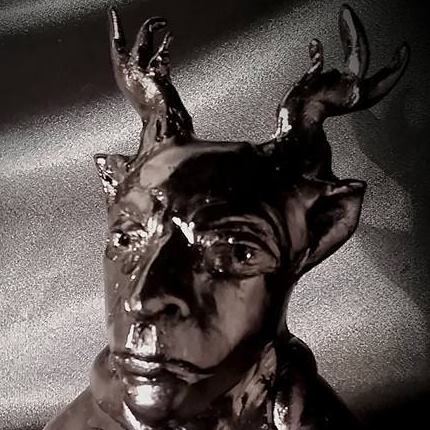
(c) 2018 Sam Wagar – small horned god statue by Keegan Quinton.
There are generally three ways that Matron or Patron relationships are formed (and, by the way, these relationships are not always exclusive, although they usually are, and people may have these relationships with different deities as they change and grow – typically being adopted by different deities at each level of Initiation):
1) The God chooses. For whatever reason, or for no reason that anyone can tell a Goddess or God will tap a person on the shoulder and say, “you are mine.” Sometimes it’s as clear as that, but more often the realization of Her or His interest grows in odd coincidental moments, or a particular word or name of a deity will keep appearing in reading material, or dreams will prompt investigation.

(c) 2018 Sam Wagar
2) As a person comes to a clearer understanding of who they fundamentally are and sees that a particular Goddess or God represents the best and strongest expression of that type of person.
3) The Goddess or God represents or embodies something that they desire to be and She or He will help them to become stronger in that area of life.
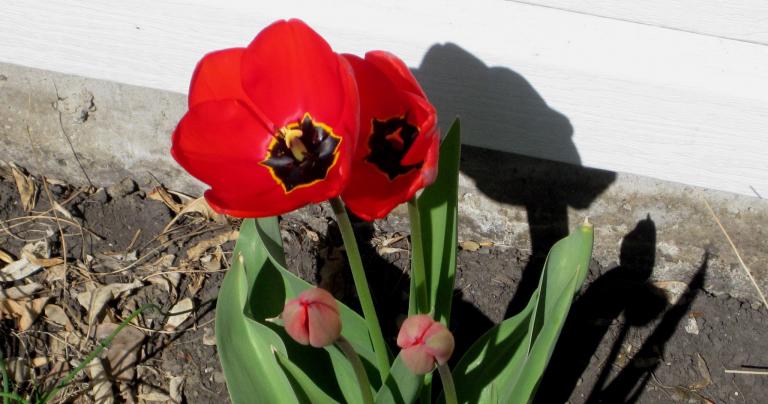
(c) 2018 Sam Wagar
In all cases, this is not something for nothing. The Gods demand that a person work and serve them wholeheartedly in their areas of interest in return for help. Making agreements with the Gods obliges one to uphold their end of the agreement. Be careful what you agree to and be careful that you know Whom you are serving – a War Goddess like the Morrigan is not a kindly Mother and She dislikes being treated like one, the God Dionysus does not like people who are inclined to temperate behaviour but demands passionate excess, and so on.
It’s rather like having a powerful friend who takes one on as a protégé. In other words, devoting yourself to the God does not automatically guarantee you Their wholehearted support – that has to be earned – but that devotion gets Their attention. And you have the option of refusing to be involved with a particular Goddess or God, although you will then be frustrated in the areas They rule.
I am assuming that you are beginning here with a desire to find and connect with a Matron and Patron, or with a sense that Someone is trying to get your attention. Well, to begin with, do the research – Who is this Goddess or God, why are They interested in hanging around with you (or why are you interested in getting Their attention) and how do they like to be worshipped? It is gloriously inappropriate and insulting to assume that you know everything that you need to know by “listening to your gut” or by some syncretic “all Goddesses are One” balderdash. So, know to Whom you are speaking. And talk with them appropriately. There is no need to grovel, but an attitude of respect is good.
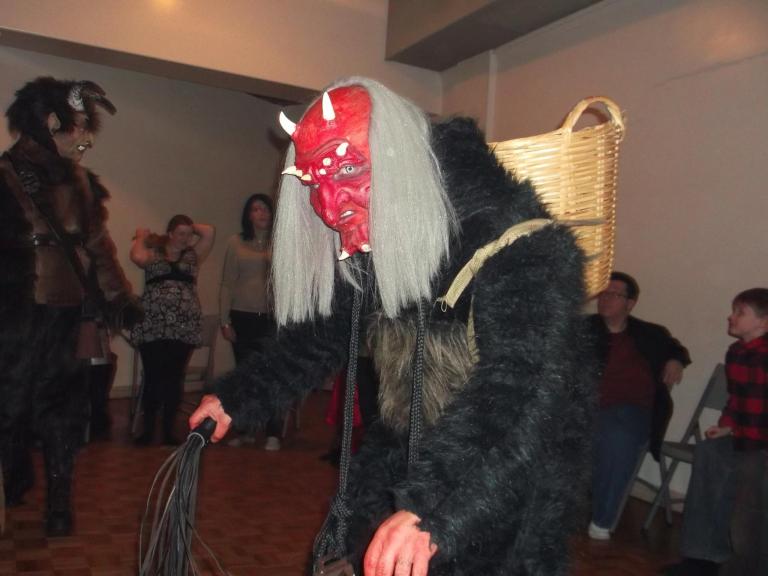
(c) 2018 Sam Wagar – a visit from some Krampusi to my Temple Yule.
If there is a Goddess or God that has already tapped you on the shoulder and you feel drawn to develop a relationship with Her begin by doing some research – find one of the great stories, the myths. Set aside a small amount of time every day to read this story and to imagine yourself as a part of it.
In the stories, for example, of Demeter and Persephone in the Homeric Hymn to Demeter, you might take the scene where Demeter (in the form of an old woman) is the nursemaid to the young Demophon and she dips him into the fire to make him immortal only to be interrupted by his horrified mother, Metanira, before all of his body has been hardened. Begin as seeing yourself as a person, perhaps a slave, watching the scene unfold – what did you see, smell, feel, taste, hear? Later put yourself into the different actors in the story – Demeter, Demophon, Metanira – what did they experience, see, hear, smell etc. What was the result? How does this story show the Goddess’ beauty and power? As part of the meditation and prayer, talk with the characters in the story – make it real to you.
Dwell on the images arising in this story and others, feel as deeply as you wish, engage all of your senses in your imagination. Build as many details as you can, paying attention to everything. The meaning inside the story will unfold as it becomes part of your experience of life. This deliberate repeated use of inner visual and sensory experience, interacting with the story and its characters, and deepening the amount of sensory detail creates a stronger set of skills for connecting to the Gods.

(c) 2018 Sam Wagar
Building the capacity for strong mental imagery is also central to trance journeying, guided meditation, pathworking, out of body experiences, and many shamanic practices. I suggest that people learning the skills take a minimum of twenty minutes a day for a minimum of a month to practice these skills and run through the exercise with their preferred stories of the Gods.
To move from the intensive training to making the relationship real involves both regular conversation and above all mindful service to the Gods as they work in the world. Ask, frequently, for help, and trust that your Matron and Patron are on your side as you strive to become stronger, better, more competent – it is not your accomplishment but your genuine effort and commitment that they appreciate and love in you. But doing nothing in service means nothing at all.

About Samuel Wagar
I've been doing this Witch thing for a long time (since 1982) but I'm still having fun. Now that I'm an old fart, my focus has switched from doing a lot of things to mentoring, teaching, and writing. I'm a chaplain at University of Alberta, a Doctor of Ministry candidate at St. Stephen's College, in charge of the Congregationalist Wiccan Assembly of Alberta's clergy training program, and the dean of the baby Edmonton Wiccan Seminary. You can read more about the author here.
Previous Post

August 7, 2018
Start with Mission
Next Post

August 14, 2018 More Temple Organizing Thoughts
Browse Our Archives
Select a Category Uncategorized
Select a Month September 2018 August 2018 July 2018 June 2018 May 2018 April 2018
Follow Us!
TAKE THE
Religious Wisdom Quiz
What metaphor is often used for the righteous in Psalms and Proverbs?
Select your answer to see how you score.
A river A mountain A sun A tree
Related posts from Translating Worlds



Temple Publicity and Public Information Tips
TRENDING AT PATHEOS Pagan

I was recently chatting with someone on Instagram. She asked me what...

While there are many people who share their results, the end of...

On July 23, I saw Christopher Nolan's The Odyssey which is Homer’s...

As I write this two big events have just finished up. One...

Restoring the Watershed of Divine Love
Perhaps cooperation is not something we manufacture through legislation, ideology, or moral...

Many UUs don’t pray because of bad experiences in a previous religion,...
view all Pagan blogs
Ad-Free & Subscriber Log-In Subscription Support
- About Us
- 2026 Calendar
- Videos
- Podcasts
- Library of World Religions
- Faith In Media Tracker
- Advertise With Us
- Write for Us
- Privacy Policy
- Terms of Service
- Do Not Sell My Data
- Contact Us
- Radiant Digital
- Manage Newsletter Subscriptions
- Unsubscribe From Notifications
- Sitemap
Copyright 2008-2026, Patheos. All rights reserved.
Subscription Support Ad-Free & Subscriber Log-In
Follow Patheos