
BuddhistCatholicContemplativeEvangelicalGeneral ChristianHinduJewishLatter-day SaintMuslimNew VisionsProgressive Christian
Beliefs
- Buddhist
- Catholic
- Contemplative
- Evangelical
- General Christian
- Hindu
- Jewish
- Latter-day Saint
- More Voices
- Muslim
- New Visions
- Pagan
- Progressive Christian
Topics
- Religion News
- Food and Religion
- Sports and Religion
- Religious Art
- Religious Music and Entertainment
- Religious Events
- History and Religion
- Style and Religion
- Politics and Religion
- Women in Religion
- Recreation Outdoors and Religion
- Business Finance and Religion
- Careers Workplace and Religion
- Education and Religion
- Family Parenting and Religion
- Health Fitness and Religion
- Home and Religion
- Relationships and Religion
- Technology and Religion
- Travel and Religion
Columnists
- Buddhist Columnists
- Business Finance and Religion Columnists
- Careers Workplace and Religion Columnists
- Catholic Columnists
- Contemplative Columnists
- Education and Religion Columnists
- Evangelists Columnists
- Family Parenting and Religion Columnists
- General Christian Columnists
- Health Fitness and Religion Columnists
- Hindu Columnists
- History and Religion Columnists
- Home and Religion Columnists
- Jewish Columnists
- More Voices Columnists
- Latter Day Columnists
- Muslim Columnists
- New Visions Columnists
- Nonreligious Columnists
- Pagan Columnists
- Politics and Religion Columnists
- Progressive Columnists
- Recreation Outdoors and Religion Columnists
- Relationships and Religion Columnists
- Religion News Columnists
- Religious Art Columnists
- Religious Events Columnists
- Religious Music and Entertainment Columnists
- Sports and Religion Columnists
- Style and Religion Columnists
- Technology and Religion Columnists
- Travel and Religion Columnists
- Women in Religion Columnists
Resource Library
- 2026 Calendar
- Library of World Religions
- The 100 Most Holy Places on Earth
- Patheos Answers
- Podcasts
- Videos
- Faith Leaders Database
- Anglican Episcopalian
- Bahai
- Baptist
- Buddhism
- Christianity
- Confucianism
- Eastern Orthodoxy
- Hinduism
- Holiness and Pentecostal
- ISKCON
- Islam
- Judaism
- Lutheran
- Methodist
- The Church of Jesus Christ of Latter-day Saints
- New Age
- Paganism
- Presbytarian and Reformed
- Protestantism
- Religion Behind the Scenes
- Roman Catholic
- Scientology
- Shia Islam
- Sikhism
- Sufism
- Sunni Islam
- Taoism
- Zen
- See all religions
Research Tools
 Ad-Free & Subscriber Log-In Subscription Support
Ad-Free & Subscriber Log-In Subscription Support
Follow Patheos 

- Trending:
- Forgiveness
- |
- Marriage
- |
- Consciousness
- |
- Death Penalty
- |
- Election
- |
- Halloween
 Translating Worlds
- Home
- Pagan
- Temple Clergy Training Outline
Temple Clergy Training Outline
Last updated on: July 21, 2018 at 10:56 am by Samuel Wagar
Temple Clergy Training Outline 2018-07-21T10:56:12-07:00 Samuel Wagar
Patheos Explore the world's faith through different perspectives on religion and spirituality! Patheos has the views of the prevalent religions and spiritualities of the world.

(c) Sam Wagar 2018 Odin and Apollo priests, Isis Priestess for LGBTQ Pride 2017.
There is a difference between being a Priestess or Priest and being a clergy person in a temple. In the first case a person is in a relationship with the gods, in the second they are in service to a community. There is overlap, and a clergy person needs to be a Priest/ess first, but public groups need to train their clergy people in different skills. This training outline, which I developed for the Congregationalist Wiccan Association, is based around the Five Element symbolism and the expansion of a famous occult motto to suit it: “To Know, to Will, to Dare, to Keep Silent, and to Act in the World.”
First, a clergy candidate must meet the minimum requirements of the bylaws to be ordained. In my temple they must be an initiate (2nd degree or equivalent), have undergone a minimum of a year of training under the direct supervision of an ordained Minister and have passed the scrutiny of our Ordination Committee.
To Know: The person must be able to found and lead a group, and to train all of its members. That means they must be very knowledgeable about Paganism as they understand it. They must be able to create and demonstrate ritual that works and to explain why it works. This part focuses on public clergy skills – writing and leading larger group rituals, explaining and teaching, theology, rites of passage, knowledge of our constitution and bylaws.
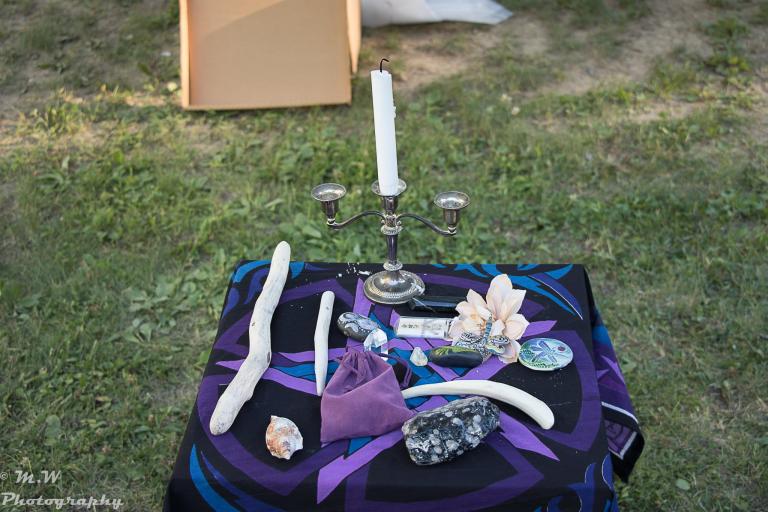
(c) Michelle Weran 2018 altar at retreat. (used with permission)
To Will: They must be able to be a public spokesperson for the temple in specific and Paganism in general. This part will focus on organizational skills, the ability to focus the will not just of oneself but of one’s congregation as well, toward the setting and realizing of joint goals.
To Dare: The person must be of good character – honest and sincere, with demonstrated good judgement and strong moral character, direct and trustworthy, possessing a creative intelligence, compassion for others, some counselling and teaching ability. Character is first because the Goddess is not a matter of information but of heart and emotions. It is our self that we offer to Her and in service to our community. And it is through our honest commitment to compassion, to mutual vulnerability that we can serve Her as clergy in the temple. This means the capacity to act as a role model for an ethical and deeply religious engagement with the world. The clergy person must assist others in drawing out their spiritual commitments. They must be able to take emotional risks and to be vulnerable. They must also be an Initiate.
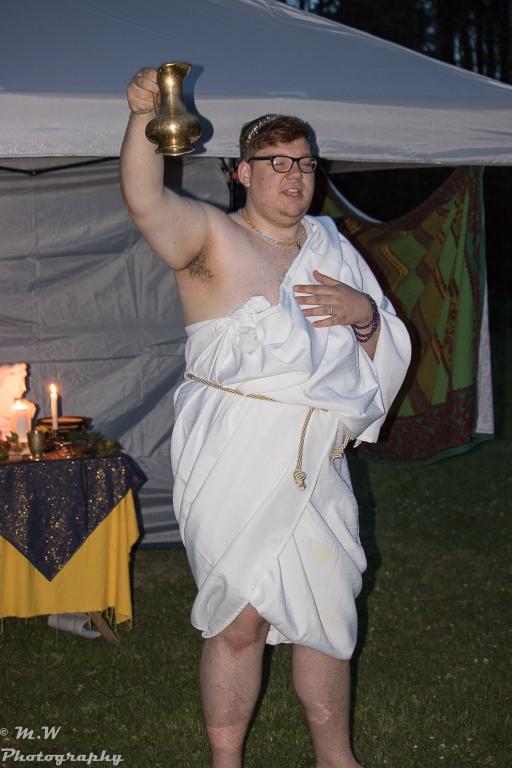
(c) Michelle Weran 2018 Priest of Apollo. (used with permission)
To Keep Silent: Priestly confidentiality, subject to the law, oath-keeping – the need to receive and keep silent confessions, to obey the code of Priestly confidentiality subject to the law. Clergy must assist others to find their way without imposing their will or taking advantage of their weaknesses (even, especially, “for their own good”). Clergy must reinforce and respect boundaries. This also refers to the qualities of personal integrity.
To Act in the World: This is where we focus on the skills of public ritual performance, public speaking in general, being interviewed by and speaking with the press, performing rites of passage, dealing with bureaucracies and public institutions, gaining and keeping a good knowledge of resources to refer people in distress to – hospitals, psychiatric institutions, halfway houses and shelters and so on, as well as religious institutions and resources.
Earth: It is vitally important that all clergy complete faeces coagulation 101. They must keep their personal lives generally in order. To begin with they must have a regular and sufficient source of income, a place to live and an adequate diet, no active addictions, and reasonably stable lifestyle. This does not mean that all clergy must live conventional mainstream lifestyles. However, if a person cannot get their own life in order they are manifestly not capable of helping others to do so. Everyone experiences periods of upheaval but someone in chronic crisis is not a “proper person, properly prepared”.
Air: A clergy person must be learning, reading and thinking. They must identify gaps in their knowledge and be working to plug the holes. Learning and teaching go together so clergy people should generally have students of their own.
Fire: A clergy person must have courage – the courage to state what they believe to be right and to live their life in accord with their beliefs. They must have emotional depth and commitment and perseverance to continue to pursue their goals. They must look within and bring the fire out – this is a key mentoring task.
Water: A clergy person must be emotionally complex, able to be vulnerable and strong, able to give of herself to assist others without being self-sacrificing. He must be creative, aware of art and beauty as great life-giving forces, and personally expressive.
Spirit: It is essential that a clergy person be deeply and passionately connected to the Gods, that she give her life to Their service, and that he frequently prays, does ritual and refreshes these connections and this commitment. She must engage in ecstatic and mystical practices, dive deep and retrieve some of this experience to share with the laity.
Frequent opportunities for the clergy to get together will be to the benefit of the church as a whole, for training both formally and informally, for ritual and fellowship, to continue and deepen our religious commitment.
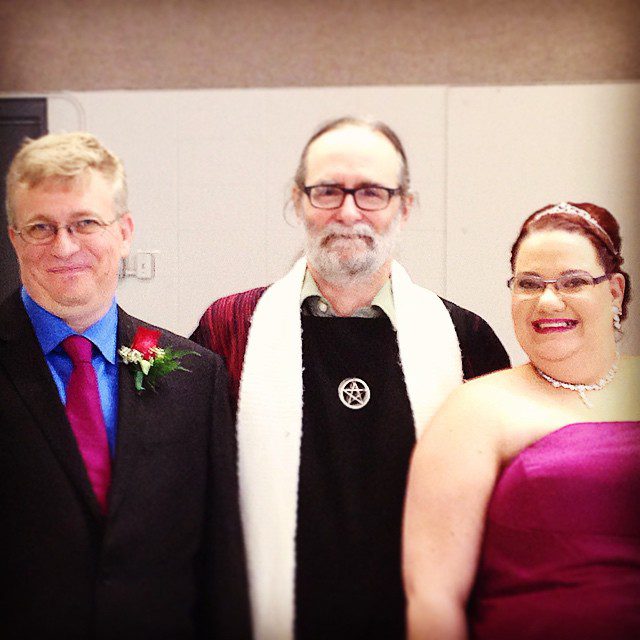
Priesting a vow renewal in 201(?)
Although training principally will happen through mentorship, there is also a reading list, roughly one book a month.
Readings for the first month: Janet Farrar and Stewart Farrar A Witch’s Bible (Custer WA: Phoenix Publishing)
Readings for the second month: Kennon L. Callahan Twelve Keys to an Effective Church (New York: HarperCollins Publishers, 1983)
Readings for the Third month: Kenneth C. Haugk Antagonists in the Church: How to Identify and Deal with Destructive Conflict (Minneapolis: Augsburg Fortress Publishing, 1988), and Anonymous Twelve Steps and Twelve Traditions (New York: Alcoholics Anonymous World Services, 1952).
Readings for the Fourth Month: Starhawk The Spiral Dance: A Rebirth of the Ancient Religion of the Great Mother (San Francisco: HarperCollins, 1979)
Readings for the Fifth Month: Ron Hutton The Triumph of the Moon: A History of Modern Pagan Witchcraft (Oxford: Oxford University Press, 1999). Helen A. Berger A Community of Witches: Contemporary Neo-Paganism and Witchcraft in the United States (Columbia, South Carolina: University of South Carolina Press, 1999).
Readings for the Sixth Month: Aliester Crowley Magick in Theory and Practice (1929 reprinted New York: Dover, 1976)
Readings for the Seventh Month: T.M. Luhrmann Persuasions of the Witch’s Craft: Ritual Magic in Contemporary England (Cambridge MA: Harvard University Press, 1998) (final section)
Readings for the Eighth Month: Walt Whitman Leaves of Grass (1855 reprinted New York: Penguin Classics, 1986). John Seed, Joanna Macy, Pat Fleming and Arne Naess Thinking Like A Mountain: Toward A Council of All Beings (Philadelphia PA: New Society Publishers, 1988).
Readings for the Ninth Month: John Michael Greer Inside A Magical Lodge: Group Ritual in the Western Tradition (St. Paul MN: Llewellyn, 1998) or Brandy Williams The Woman Magician (St. Paul MN: Llewellyn, 2011).
Readings for the Tenth Month: Grey Cat Deepening Witchcraft: Advancing Skills and Knowledge (Toronto: ECW Press, 2002).
Readings for the Eleventh Month: Judy Harrow Wicca Covens: How to Start and Organize your Own (Secaucus NJ: Citadel Press, 1999).
Readings for the Twelfth Month: Raven Kaldera and Tannin Schwartzstein Handfasting and Wedding Rituals: Welcoming Hera’s Blessing (St. Paul MN: Llewellyn, 2003).

About Samuel Wagar
I've been doing this Witch thing for a long time (since 1982) but I'm still having fun. Now that I'm an old fart, my focus has switched from doing a lot of things to mentoring, teaching, and writing. I'm a chaplain at University of Alberta, in charge of the Congregationalist Wiccan Assembly of Alberta's clergy training program, and the dean of the baby Edmonton Wiccan Seminary. You can read more about the author here.
Previous Post

July 16, 2018
Ritual for Others and Community, Ritual Tools
Next Post

July 24, 2018 Ritual Reading List
Browse Our Archives
Select a Category Uncategorized
Select a Month September 2018 August 2018 July 2018 June 2018 May 2018 April 2018
Follow Us!
TAKE THE
Religious Wisdom Quiz
What is the purpose for the Law?
Select your answer to see how you score.
To give hope To bring about adoption To save people To teach of sin
Related posts from Translating Worlds



Temple Publicity and Public Information Tips
TRENDING AT PATHEOS Pagan

I was recently chatting with someone on Instagram. She asked me what...

While there are many people who share their results, the end of...

On July 23, I saw Christopher Nolan's The Odyssey which is Homer’s...

As I write this two big events have just finished up. One...

Restoring the Watershed of Divine Love
Perhaps cooperation is not something we manufacture through legislation, ideology, or moral...

Many UUs don’t pray because of bad experiences in a previous religion,...
view all Pagan blogs
Ad-Free & Subscriber Log-In Subscription Support
- About Us
- 2026 Calendar
- Videos
- Podcasts
- Library of World Religions
- Faith In Media Tracker
- Advertise With Us
- Write for Us
- Privacy Policy
- Terms of Service
- Do Not Sell My Data
- Contact Us
- Radiant Digital
- Manage Newsletter Subscriptions
- Unsubscribe From Notifications
- Sitemap
Copyright 2008-2026, Patheos. All rights reserved.
Subscription Support Ad-Free & Subscriber Log-In
Follow Patheos