
BuddhistCatholicContemplativeEvangelicalGeneral ChristianHinduJewishLatter-day SaintMuslimNew VisionsProgressive Christian
Beliefs
- Buddhist
- Catholic
- Contemplative
- Evangelical
- General Christian
- Hindu
- Jewish
- Latter-day Saint
- More Voices
- Muslim
- New Visions
- Pagan
- Progressive Christian
Topics
- Religion News
- Food and Religion
- Sports and Religion
- Religious Art
- Religious Music and Entertainment
- Religious Events
- History and Religion
- Style and Religion
- Politics and Religion
- Women in Religion
- Recreation Outdoors and Religion
- Business Finance and Religion
- Careers Workplace and Religion
- Education and Religion
- Family Parenting and Religion
- Health Fitness and Religion
- Home and Religion
- Relationships and Religion
- Technology and Religion
- Travel and Religion
Columnists
- Buddhist Columnists
- Business Finance and Religion Columnists
- Careers Workplace and Religion Columnists
- Catholic Columnists
- Contemplative Columnists
- Education and Religion Columnists
- Evangelists Columnists
- Family Parenting and Religion Columnists
- General Christian Columnists
- Health Fitness and Religion Columnists
- Hindu Columnists
- History and Religion Columnists
- Home and Religion Columnists
- Jewish Columnists
- More Voices Columnists
- Latter Day Columnists
- Muslim Columnists
- New Visions Columnists
- Nonreligious Columnists
- Pagan Columnists
- Politics and Religion Columnists
- Progressive Columnists
- Recreation Outdoors and Religion Columnists
- Relationships and Religion Columnists
- Religion News Columnists
- Religious Art Columnists
- Religious Events Columnists
- Religious Music and Entertainment Columnists
- Sports and Religion Columnists
- Style and Religion Columnists
- Technology and Religion Columnists
- Travel and Religion Columnists
- Women in Religion Columnists
Resource Library
- 2026 Calendar
- Library of World Religions
- The 100 Most Holy Places on Earth
- Patheos Answers
- Podcasts
- Videos
- Faith Leaders Database
- Anglican Episcopalian
- Bahai
- Baptist
- Buddhism
- Christianity
- Confucianism
- Eastern Orthodoxy
- Hinduism
- Holiness and Pentecostal
- ISKCON
- Islam
- Judaism
- Lutheran
- Methodist
- The Church of Jesus Christ of Latter-day Saints
- New Age
- Paganism
- Presbytarian and Reformed
- Protestantism
- Religion Behind the Scenes
- Roman Catholic
- Scientology
- Shia Islam
- Sikhism
- Sufism
- Sunni Islam
- Taoism
- Zen
- See all religions
Research Tools
 Ad-Free & Subscriber Log-In Subscription Support
Ad-Free & Subscriber Log-In Subscription Support
Follow Patheos 

- Trending:
- Forgiveness
- |
- Marriage
- |
- Consciousness
- |
- Death Penalty
- |
- Election
- |
- Halloween
 Translating Worlds
- Home
- Pagan
- Ritual Reading List
Ritual Reading List
Last updated on: July 24, 2018 at 9:45 am by Samuel Wagar
Ritual Reading List 2018-07-24T09:45:37-07:00 Samuel Wagar
Patheos Explore the world's faith through different perspectives on religion and spirituality! Patheos has the views of the prevalent religions and spiritualities of the world.
Dear readers,
People do religion, they don’t principally think it, it is a kind of praxis, performative and experiential. Experiences of a minority of people – ecstatic trance, Mystery experiences – are the centre of the Wiccan religious movement. They potentially can deepen religion and provide significant insight into the realities behind appearances. An ongoing issue for all religious bodies and communities is translation of the ecstatic experiences of ‘spiritual athletes’ into ritual forms which express something of the fire and can provide opening and meaningful experiences for the uninitiated masses. This need for translation is particularly pressing for Wiccan Temple groups centred on laity.
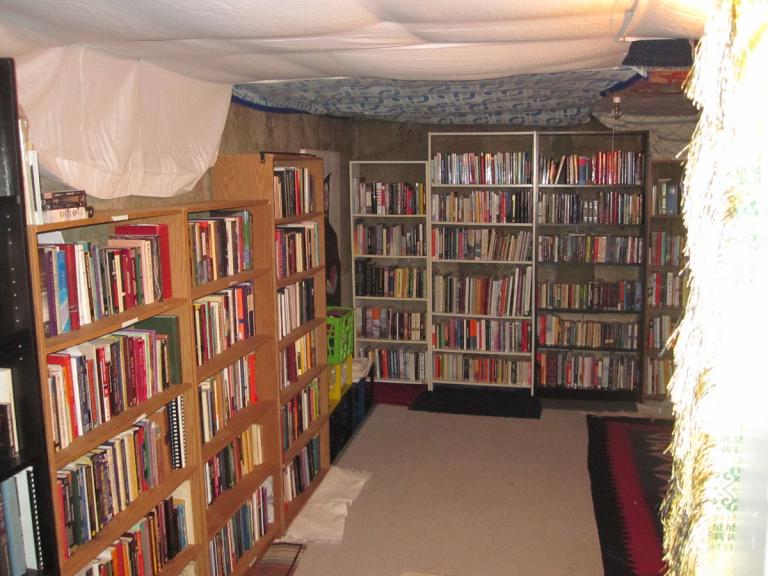
(c) 2018 Sam Wagar Some of the library before I moved (my aching back).
The best ritual books and approaches that I have found to ritual and ritual theory are briefly discussed below. There are no books of ritual scripts here – for scripts I recommend Janet and Stewart Farrar’s A Witch’s Bible or my own Creating Lore, Writing Ritual in the Wiccan vein.
Harvey Whitehouse’ Modes of Religiosity: A Cognitive Theory of Religious Transmission is tremendously useful. He looks at the biological bases for transmission and survival of religious ideas. He believes, and gives a well-developed and careful pile of evidence, that different types of memory are involved in Mystery, folk and churchy religious expression, each with strengths and weaknesses. There are two principal modes through which these insights are translated into experience and become normal for practitioners: Imagistic and Doctrinal.
In the Imagistic mode intense trance and mystical experiences are provided to a group of people, often as Initiation ceremonies – fear, noise, music, dancing, often hallucinogenic plants and ritual drama – with no, or minimal, explanation. People undergo emotionally wrenching experiences and are driven to tease out the meanings of them over years of reflection and of re-engagement in the ritual at progressively more advanced levels, never having a rational or formal explanation. One can always say when exactly one had the experience that embedded the idea in one’s brain and body.
In the Doctrinal mode less experiential ritual is used, with homilies or simple required sets of actions repeatedly delivering the message so that it is an accepted part of the landscape, an assumed truth. A person inculcated from childhood never need grapple with the truths of the faith, absorbed by osmosis, a normal way of thinking and being and foundation for life. Repetition and routinization in this mode “to activate implicit memory for ritual procedures and semantic memory for verbally codified teachings, including ritual exegesis.”
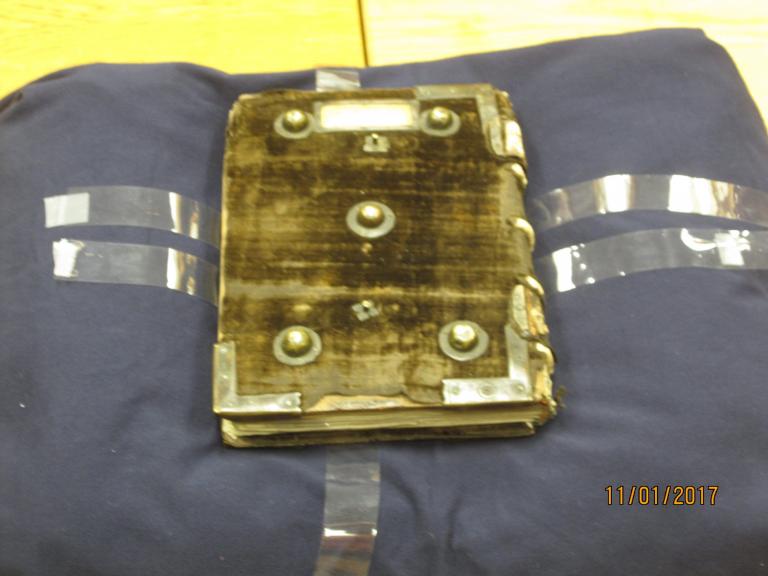
(c) 2018 Sam Wagar This unimpressive object is a truly evil book. It is an early Witch-hunter’s scholarly legal justification for the Witch- persecutions in Western Europe. It’s one of 5 handwritten copies that exist, and it’s in the University of Alberta’s rare books collection. Last November 1st a small group of scholars, and me, was allowed to see the book and learn something of its history and impact. https://omeka.library.ualberta.ca/exhibits/show/tinctor/imagining
Antonin Artaud’s The Theatre and Its Double brilliantly places theatre as ritual and as magic. This is a key text in theatre writing. He passionately expresses an approach that immerses the spectators and makes them participants. I would strongly urge any ritual composer to read Artaud.
Catherine Bell is probably the most prominent theoretician of ritual, brilliant and challenging. Ritual Theory, Ritual Practice (1992), Ritual: Perspectives and Dimensions (1997), and Teaching Ritual (2007), which she edited are all very valuable works. The first sets forward her practice-based theory of ritual, after careful and thorough critical analysis of other models of ritual. The second gives an overview of the development of ritual studies and the discipline of history of religions as well as in-depth looks at a range of different systems of ritual. She develops and extends her theoretical work from the previous book and makes it (somewhat) more accessible. Teaching Ritual (2007), is a collection of chapters from a wide assortment of teachers at the post-secondary level and a range of disciplines with some very fine and practical tips and ideas in just about each chapter. A very useful and provocative collection.
Michel Foucault’s interview “Of Other Spaces” trans. Jay Miskowiec Diacritics 16.1 (Spring, 1986), 22-27, and The History of Sexuality, An introduction, Volume 1 (1990). The first piece introduces the concept of heterotopia, which is exceptionally useful in looking at ‘other’ spaces – those temporarily or provisionally outside of the regular flow of society, what they are and how they function in relation to the whole of society. Such spaces as cemeteries, brothels, gay bath houses, are neither in nor out of society, which goes for ritual spaces as well. The second develops his enormously influential theory of power as relationship whose potential ritual explorations are legion.
Sabina Magliocco’s Witching Culture: Folklore and Neo-Paganism in America (2004). She looks at Witchcraft and neo-Paganism as a vernacular / folk religion, and has a great deal of illuminating things to say about our creation of ritual and of religious ideas out of experience.
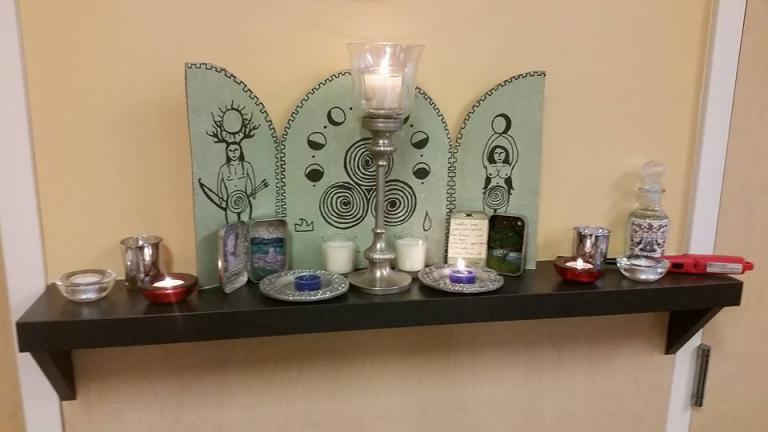
(c) 2018 Sam Wagar Sacred Oak Temple altar. Design by Keegan Quinton.
Jonathan Z. Smith’s collection of essays, Imagining Religion: From Babylon to Jonestown (1982).Smith reminds us that religion is a kind of human labour and that, like all other activities, it develops over time. His work provides several excellent examples of the birth and development of new religions. He also reminds us that religion is the source of much evil, as well as good – an effective corrective. A pragmatic and highly useful work.
Victor Turner’s collection The Ritual Process: Structure and Anti-Structure (1969) deals with both the aspects of religion that reinforce the social order and corrosive tendencies. His communitas and liminality notions are key concepts in religious studies, deservedly.
Courtney Bender, Wendy Cadge, Peggy Levitt, and David Smilde editors*. Religion on the Edge; De-Centring and Re-Centring the Sociology of Religion* (2013). This is a valuable collection which brings together several bright young scholars in sociology of religion challenging secularization and the assumption that American Protestant Christianity is the ‘norm’ of all religion.
Much of the content of this series of posts on ritual was adapted from my book Creating Lore, Writing Ritual available through Amazon, or from me directly.
Next week, I’m moving on to begin a series of posts on starting public temples.

About Samuel Wagar
I've been doing this Witch thing for a long time (since 1982) but I'm still having fun. Now that I'm an old fart, my focus has switched from doing a lot of things to mentoring, teaching, and writing. I'm a chaplain at University of Alberta, in charge of the Congregationalist Wiccan Assembly of Alberta's clergy training program, and the dean of the baby Edmonton Wiccan Seminary. You can read more about the author here.
Previous Post

July 18, 2018
Temple Clergy Training Outline
Next Post

July 25, 2018 Hope in the time of 'breaking of nations'
Browse Our Archives
Select a Category Uncategorized
Select a Month September 2018 August 2018 July 2018 June 2018 May 2018 April 2018
Follow Us!
TAKE THE
Religious Wisdom Quiz
Which Christian movement began with John Wesley in the 18th century?
Select your answer to see how you score.
Presbyterianism Calvinism Lutheranism Methodism
Related posts from Translating Worlds



Temple Publicity and Public Information Tips
TRENDING AT PATHEOS Pagan

I was recently chatting with someone on Instagram. She asked me what...

While there are many people who share their results, the end of...

On July 23, I saw Christopher Nolan's The Odyssey which is Homer’s...

As I write this two big events have just finished up. One...

Restoring the Watershed of Divine Love
Perhaps cooperation is not something we manufacture through legislation, ideology, or moral...

Many UUs don’t pray because of bad experiences in a previous religion,...
view all Pagan blogs
Ad-Free & Subscriber Log-In Subscription Support
- About Us
- 2026 Calendar
- Videos
- Podcasts
- Library of World Religions
- Faith In Media Tracker
- Advertise With Us
- Write for Us
- Privacy Policy
- Terms of Service
- Do Not Sell My Data
- Contact Us
- Radiant Digital
- Manage Newsletter Subscriptions
- Unsubscribe From Notifications
- Sitemap
Copyright 2008-2026, Patheos. All rights reserved.
Subscription Support Ad-Free & Subscriber Log-In
Follow Patheos