
BuddhistCatholicContemplativeEvangelicalGeneral ChristianHinduJewishLatter-day SaintMuslimNew VisionsProgressive Christian
Beliefs
- Buddhist
- Catholic
- Contemplative
- Evangelical
- General Christian
- Hindu
- Jewish
- Latter-day Saint
- More Voices
- Muslim
- New Visions
- Pagan
- Progressive Christian
Topics
- Religion News
- Food and Religion
- Sports and Religion
- Religious Art
- Religious Music and Entertainment
- Religious Events
- History and Religion
- Style and Religion
- Politics and Religion
- Women in Religion
- Recreation Outdoors and Religion
- Business Finance and Religion
- Careers Workplace and Religion
- Education and Religion
- Family Parenting and Religion
- Health Fitness and Religion
- Home and Religion
- Relationships and Religion
- Technology and Religion
- Travel and Religion
Columnists
- Buddhist Columnists
- Business Finance and Religion Columnists
- Careers Workplace and Religion Columnists
- Catholic Columnists
- Contemplative Columnists
- Education and Religion Columnists
- Evangelists Columnists
- Family Parenting and Religion Columnists
- General Christian Columnists
- Health Fitness and Religion Columnists
- Hindu Columnists
- History and Religion Columnists
- Home and Religion Columnists
- Jewish Columnists
- More Voices Columnists
- Latter Day Columnists
- Muslim Columnists
- New Visions Columnists
- Nonreligious Columnists
- Pagan Columnists
- Politics and Religion Columnists
- Progressive Columnists
- Recreation Outdoors and Religion Columnists
- Relationships and Religion Columnists
- Religion News Columnists
- Religious Art Columnists
- Religious Events Columnists
- Religious Music and Entertainment Columnists
- Sports and Religion Columnists
- Style and Religion Columnists
- Technology and Religion Columnists
- Travel and Religion Columnists
- Women in Religion Columnists
Resource Library
- 2026 Calendar
- Library of World Religions
- The 100 Most Holy Places on Earth
- Patheos Answers
- Podcasts
- Videos
- Faith Leaders Database
- Anglican Episcopalian
- Bahai
- Baptist
- Buddhism
- Christianity
- Confucianism
- Eastern Orthodoxy
- Hinduism
- Holiness and Pentecostal
- ISKCON
- Islam
- Judaism
- Lutheran
- Methodist
- The Church of Jesus Christ of Latter-day Saints
- New Age
- Paganism
- Presbytarian and Reformed
- Protestantism
- Religion Behind the Scenes
- Roman Catholic
- Scientology
- Shia Islam
- Sikhism
- Sufism
- Sunni Islam
- Taoism
- Zen
- See all religions
Research Tools
 Ad-Free & Subscriber Log-In Subscription Support
Ad-Free & Subscriber Log-In Subscription Support
Follow Patheos 

- Trending:
- Forgiveness
- |
- Marriage
- |
- Consciousness
- |
- Death Penalty
- |
- Election
- |
- Halloween
 Translating Worlds
- Home
- Pagan
- Ritual As Power
Ritual As Power
Last updated on: July 2, 2018 at 4:59 pm by Samuel Wagar
Ritual As Power 2018-07-02T16:59:55-07:00 Samuel Wagar
Patheos Explore the world's faith through different perspectives on religion and spirituality! Patheos has the views of the prevalent religions and spiritualities of the world.
Power is everywhere; not because it embraces everything, but because it comes from everywhere… power is not an institution, and not a structure; neither is it a certain strength we are endowed with; it is the name that one attributes to a complex strategical situation in a particular society. – Michel Foucault
Ritual has a complicated relationship to power, both individual and social power. On the one hand rituals are used to announce and confirm transfers of power – to swear in Prime Ministers and Presidents and to anoint and crown Queens and Kings as well as Popes. On the other ritual choices can subvert the established order – as for example when millions of dalits (Untouchables in the Hindu religion) all converted en mass to Buddhism under the leadership of Ambedkar in 1956, as an explicit rejection of the caste system of India and its oppression of the lower castes.
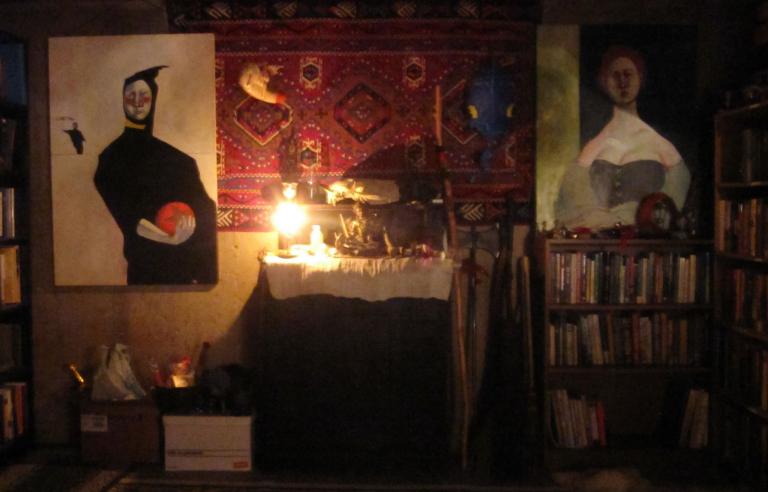
(c) 2018 Sam Wagar My home altar.
Even those rituals that ultimately confirm the established order of things frequently temporarily dissolve all power relationships and distinctions between people and state that “all are equal here”, requiring all ritual participants to eat the same food together, to wear the same clothing, and to all be subjected to the same discipline. A community of feeling, called by Victor Turner “communitas,” is created that connects all people below the level of social differences and roles. It is only through passing through this period of common humanity that people can be re-incorporated into the appropriate roles in society.
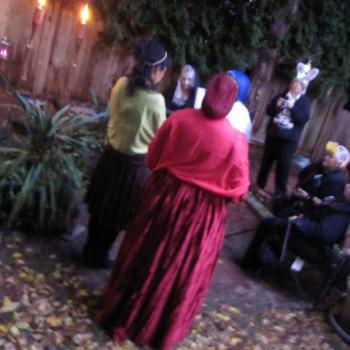
There are also the common rituals of carnival which include periods of license that include the inversion of the established order – women having authority over men, servants over their masters, the Feast of Fools in which the village fool is crowned King for a Day, and the wearing of bizarre costumes. Periods of wild partying and drunken excess, strictly limited in their time and place like Mardi Gras or 420 celebrations, would also be ritual occasions marking and confirming the established order by departing from it so extravagantly.
Frequently religious rituals, especially in the monotheistic religions which emphasize the “otherness” of the God, so much greater than human beings that any distinctions between people are insignificant in comparison with the absolute gulf which opens between humans and the God, are set up so the ritual leaders are, in ritual, purely the servants of the God without any personal authority and as much as possible no personal qualities at all. The ritual garb and uniforms are standardized for this purpose.
Ritual is power as it frames and reframes the power relationships in a society. It authorizes and symbolizes transfer of power in both democracy and autocracy. It grants university degrees, another kind of power and authority. It also is a kind of power when it attacks the established order by asserting a conflict of powers or authority. In the United States the silent prayerful walks of Black protesters against the Jim Crow laws were ritual theatre that asserted the primacy of the values of equality and human dignity over and against the legitimacy of the unjust racist laws. Their ritual power, in particular through the disciplined non-violent witness of hundreds of participants was very important in rallying and recreating a mass movement for social change which reached its finest moment thus far with the election of President Obama, a Black man, 50 years later. Another example of ritual political theatre, less successful, was the naked protests of the Sons of Freedom Doukhobour order when they were being forced to put their children into government schools in the 1950s and 1960s in BC.
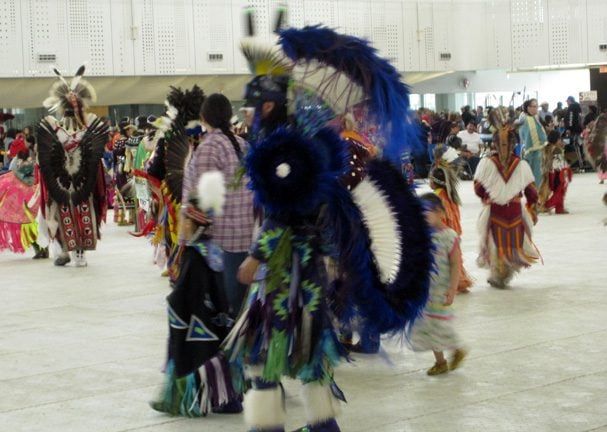
(c) 2018 Sam Wagar Dancers in the opening parade at Ben Calf Robe Powwow 2015.
Power relationships in ritual are explicit during their performance – some have leading roles and others do not, some write the rituals and others do not, and the issues that they deal with and the conclusions that they reach are selective. The use of ritual and symbolic action is often also a way to let off steam and prevent more effective political action (although it can work the other way as well – ritual openings can provide space for the larger issues that the ritual is intended to avoid to force themselves onto the agenda). Implicit in ritual, though, are limitations on power – so long as the ritual is needed, then power passes from the Gods or the people to the ruler and she is dependent on them for her authority, and the people have the right to question or revoke their ritual agreements.
Ritual often drains away tension from some part of a community by creating an “imaginary community” (after Benedict Anderson) – defining some people through ritual actions as being a part of the community and others as the enemy, or at least as “others”.
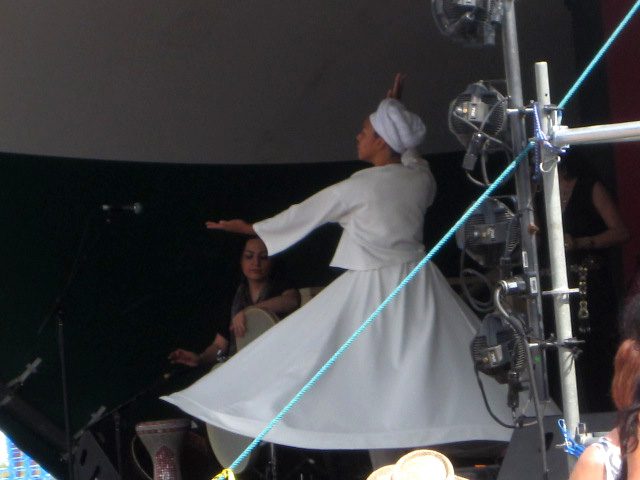
(c) 2018 Sam Wagar Sufi dancer Edmonton Folk Music Festival 2015.
Ritual which brings people together into a common sense of purpose and a common community makes the possibility of united action around the issues easier. It does not, however, determine what that action might be. Ritual aimed at creating power or unifying communities is not democratic – it is strongly determined by the intentions and direction of the ritual authors and leaders. Ritual Civil Rights marches led by Martin Luther King were no less orchestrated and controlled by the leadership than the Nuremberg Rallies of the Nazi Party – the intentions were different and the element of compulsion was not there in the first instance, but the form was set by the leadership, marshals and section leaders were trained in what to do and how to control the crowd, the ideology was strongly inculcated into the large minority of the participants and so on. The creation of lasting power through ritual is not random or unplanned, nor is it spontaneous and “organic”.
Next Week “Ritual as Problem-solving, as Art, as Magic, in the Creation of Community”

About Samuel Wagar
I've been doing this Witch thing for a long time (since 1982) but I'm still having fun. Now that I'm an old fart, my focus has switched from doing a lot of things to mentoring, teaching, and writing. I'm a chaplain at University of Alberta, in charge of the Congregationalist Wiccan Assembly of Alberta's clergy training program, and the dean of the baby Edmonton Wiccan Seminary. You can read more about the author here.
Previous Post
June 28, 2018
Festival Season Reconciliation
Next Post

July 4, 2018 Changing Complementarity Theology in Wicca
Browse Our Archives
Select a Category Uncategorized
Select a Month September 2018 August 2018 July 2018 June 2018 May 2018 April 2018
Follow Us!
TAKE THE
Religious Wisdom Quiz
Who had a coat of many colors?
Select your answer to see how you score.
Jacob Esau Benjamin Joseph
Related posts from Translating Worlds



Temple Publicity and Public Information Tips
TRENDING AT PATHEOS Pagan

I was recently chatting with someone on Instagram. She asked me what...

While there are many people who share their results, the end of...

On July 23, I saw Christopher Nolan's The Odyssey which is Homer’s...

As I write this two big events have just finished up. One...

Restoring the Watershed of Divine Love
Perhaps cooperation is not something we manufacture through legislation, ideology, or moral...

Many UUs don’t pray because of bad experiences in a previous religion,...
view all Pagan blogs
Ad-Free & Subscriber Log-In Subscription Support
- About Us
- 2026 Calendar
- Videos
- Podcasts
- Library of World Religions
- Faith In Media Tracker
- Advertise With Us
- Write for Us
- Privacy Policy
- Terms of Service
- Do Not Sell My Data
- Contact Us
- Radiant Digital
- Manage Newsletter Subscriptions
- Unsubscribe From Notifications
- Sitemap
Copyright 2008-2026, Patheos. All rights reserved.
Subscription Support Ad-Free & Subscriber Log-In
Follow Patheos