
BuddhistCatholicContemplativeEvangelicalGeneral ChristianHinduJewishLatter-day SaintMuslimNew VisionsProgressive Christian
Beliefs
- Buddhist
- Catholic
- Contemplative
- Evangelical
- General Christian
- Hindu
- Jewish
- Latter-day Saint
- More Voices
- Muslim
- New Visions
- Pagan
- Progressive Christian
Topics
- Religion News
- Food and Religion
- Sports and Religion
- Religious Art
- Religious Music and Entertainment
- Religious Events
- History and Religion
- Style and Religion
- Politics and Religion
- Women in Religion
- Recreation Outdoors and Religion
- Business Finance and Religion
- Careers Workplace and Religion
- Education and Religion
- Family Parenting and Religion
- Health Fitness and Religion
- Home and Religion
- Relationships and Religion
- Technology and Religion
- Travel and Religion
Columnists
- Buddhist Columnists
- Business Finance and Religion Columnists
- Careers Workplace and Religion Columnists
- Catholic Columnists
- Contemplative Columnists
- Education and Religion Columnists
- Evangelists Columnists
- Family Parenting and Religion Columnists
- General Christian Columnists
- Health Fitness and Religion Columnists
- Hindu Columnists
- History and Religion Columnists
- Home and Religion Columnists
- Jewish Columnists
- More Voices Columnists
- Latter Day Columnists
- Muslim Columnists
- New Visions Columnists
- Nonreligious Columnists
- Pagan Columnists
- Politics and Religion Columnists
- Progressive Columnists
- Recreation Outdoors and Religion Columnists
- Relationships and Religion Columnists
- Religion News Columnists
- Religious Art Columnists
- Religious Events Columnists
- Religious Music and Entertainment Columnists
- Sports and Religion Columnists
- Style and Religion Columnists
- Technology and Religion Columnists
- Travel and Religion Columnists
- Women in Religion Columnists
Resource Library
- 2026 Calendar
- Library of World Religions
- The 100 Most Holy Places on Earth
- Patheos Answers
- Podcasts
- Videos
- Faith Leaders Database
- Anglican Episcopalian
- Bahai
- Baptist
- Buddhism
- Christianity
- Confucianism
- Eastern Orthodoxy
- Hinduism
- Holiness and Pentecostal
- ISKCON
- Islam
- Judaism
- Lutheran
- Methodist
- The Church of Jesus Christ of Latter-day Saints
- New Age
- Paganism
- Presbytarian and Reformed
- Protestantism
- Religion Behind the Scenes
- Roman Catholic
- Scientology
- Shia Islam
- Sikhism
- Sufism
- Sunni Islam
- Taoism
- Zen
- See all religions
Research Tools
 Ad-Free & Subscriber Log-In Subscription Support
Ad-Free & Subscriber Log-In Subscription Support
Follow Patheos 

- Trending:
- Forgiveness
- |
- Marriage
- |
- Consciousness
- |
- Death Penalty
- |
- Election
- |
- Halloween
 Translating Worlds
- Home
- Pagan
- “What’s done in the dark will be brought to the light”
“What’s done in the dark will be brought to the light”
Last updated on: June 20, 2018 at 6:01 pm by Samuel Wagar
“What’s done in the dark will be brought to the light” 2018-06-20T18:01:03-07:00 Samuel Wagar
Patheos Explore the world's faith through different perspectives on religion and spirituality! Patheos has the views of the prevalent religions and spiritualities of the world.

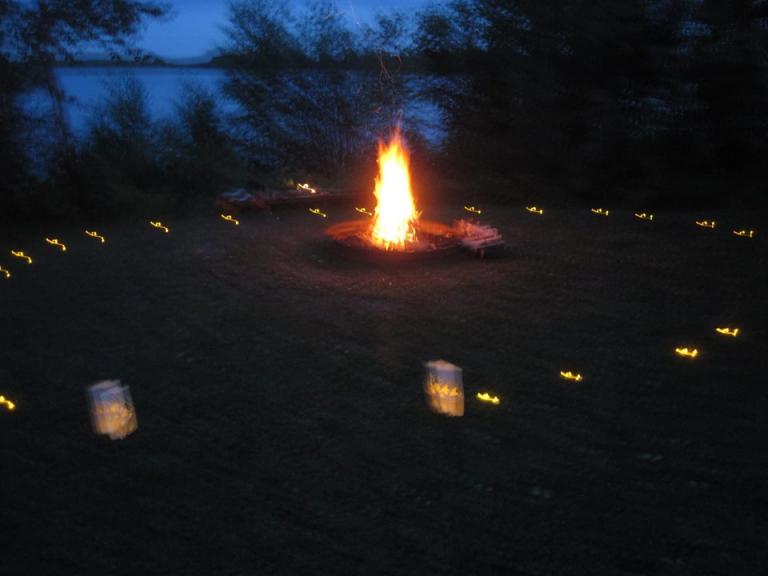
(c) 2018 Samuel Wagar MidSummer sunset 2015 from near Saskatoon
“Well you may throw your rock and hide your hand
Workin’ in the dark against your fellow man
But as sure as God made black and white
What’s done in the dark will be brought to the light” – John Cash “God’s Gonna Cut You Down”
I am moved this week to think about theological basics and foundations and how they fit into building and sustaining community and culture. My friend Dan Miller, an Asatru gothi, has beautifully summarized Natural Theology and embodied theology as; “That is wise which helps the health and wholeness of the chain of the generations”. We are links in the chain of generations that goes from our remote Ancestors through us forward to our remote descendants, a chain which necessarily includes the relationships that link out to other people that we are not biologically related to, and to the world of nature which feeds us and inspires us and provides the foundation to everything that we build as human beings.
At the core of this chain, the strongest link, is our immediate biological families. Our mothers, fathers, sisters and brothers and our own children. In a natural theology the goddesses and gods are real and expressed in and through our bodies and through the relationships centred on family.
The ethics of this theology is about human flourishing as fully human beings, so a key consideration is identifying human nature (and human IN nature). Natural theology depends, in details, on that understanding of what human nature is, and what the natural world is. These definitions are culture-bound, so dogmatism needs to be avoided and constant attention to what IS, not what SHOULD be.
From this theological perspective taking children away from their parents (as has been done repeatedly – through selling slave children away from their families, kidnapping Indigenous children and forcing them into residential schools, the Nazis separating children at Auschwitz and sending them off to the gas chambers, and the current actions of the American government on its southern border) is wrong. It directly attacks the central link in the chain of generations, the present biological family.
(c) 2018 Samuel Wagar
Do all human beings possess an inherent dignity AS human beings? There is the notion of the soul, a non-material essential ingredient which gives life to a person, where our humanity is found. Do all people have this thing? If they do, then treating persons as things is a violation of their humanity and an evil act. So, slavery, murder, and taking children away from their parents (except in the extreme case of the need to prevent abuse and direct harm to them) are evil acts.
If all humans do not possess the same dignity, then who does? In the past women were defined (and in some places still are) as lacking souls and therefore needing to be treated as property. In the same way racial minorities have been treated as things rather than as beings. Typically, the enemies of the powerful rulers of a society have been said to be less than fully human – working class people, religious minorities, the people of nations that the rulers wished to go to war against.
If only some people are human, as racists assert, then whatever action that the Ubermenschen undertake to promote the interests of the fully human minority is good. Taking children of imperfect “mud people” away from their parents has no more moral weight than taking calves away from cows, or puppies away from bitches (although a good animal breeder will try to wean the puppies first). So long as the chain of generations of that fully human minority is improved by these actions, the cruelty is simply irrelevant.
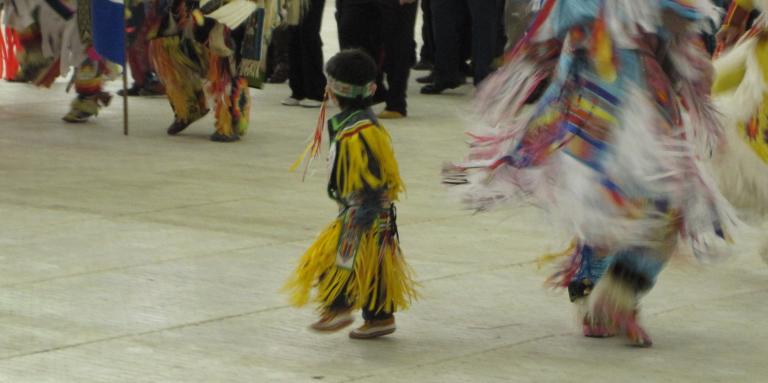
(c)2018 Samuel Wagar Kid dancing at powwow 2016.
This discussion above seems so abstract. I am so angry that I shake when I think of the two thousand or more children that have been separated from their parents at the US border in the last two months, because of a policy of the President. I cried when I heard the audio recording of that brave little girl reciting her aunt’s telephone number to guards to try to get herself out of prison there. I am sick when I think of the dehumanizing hatred and racism of those that defend this policy, and when I reflect on the similar actions of racism and inhumanity I mention above.
There are many goddesses and gods and some of them are not kind and loving. Some of them might endorse this racist cruelty (certainly there are some people that I have recently interacted with that have used religious justifications for vile and despicable actions). But I refuse to have anything to do with those deities. I refuse to join or work with any temple or any religious community that endorses the version of Jehovah that “taketh and dashes thy little ones against the stones” (KJV Ps 137:9) or sees the All-Father Odin as only the White people’s god: “where you recognize evil, speak out against it, and give no truces to your enemies” (Havamal 127).
How can we build lasting religious community, except by beginning with a solid foundation? We must begin by understanding ourselves in the chain of generations, in the present but growing from the past and extending to the future, not forever tied to this place and time. We must also begin with connection and relationship, with community. Community that includes difference, hospitality, kindness, the virtues. It is not the raw power of the oppressor that builds nourishing community, but the power of kindness and of love.
Previous Post
June 19, 2018
Ritual and Transformation
Next Post

June 25, 2018 Ritual of Life-Passages
Browse Our Archives
Select a Category Uncategorized
Select a Month September 2018 August 2018 July 2018 June 2018 May 2018 April 2018
Follow Us!
TAKE THE
Religious Wisdom Quiz
What city is considered holy by Christians, Jews, and Muslims alike?
Select your answer to see how you score.
Paris Rome Jerusalem Antioch
Related posts from Translating Worlds



Temple Publicity and Public Information Tips
TRENDING AT PATHEOS Pagan

I was recently chatting with someone on Instagram. She asked me what...

While there are many people who share their results, the end of...

On July 23, I saw Christopher Nolan's The Odyssey which is Homer’s...

As I write this two big events have just finished up. One...

Restoring the Watershed of Divine Love
Perhaps cooperation is not something we manufacture through legislation, ideology, or moral...

Many UUs don’t pray because of bad experiences in a previous religion,...
view all Pagan blogs
Ad-Free & Subscriber Log-In Subscription Support
- About Us
- 2026 Calendar
- Videos
- Podcasts
- Library of World Religions
- Faith In Media Tracker
- Advertise With Us
- Write for Us
- Privacy Policy
- Terms of Service
- Do Not Sell My Data
- Contact Us
- Radiant Digital
- Manage Newsletter Subscriptions
- Unsubscribe From Notifications
- Sitemap
Copyright 2008-2026, Patheos. All rights reserved.
Subscription Support Ad-Free & Subscriber Log-In
Follow Patheos