
BuddhistCatholicContemplativeEvangelicalGeneral ChristianHinduJewishLatter-day SaintMuslimNew VisionsProgressive Christian
Beliefs
- Buddhist
- Catholic
- Contemplative
- Evangelical
- General Christian
- Hindu
- Jewish
- Latter-day Saint
- More Voices
- Muslim
- New Visions
- Pagan
- Progressive Christian
Topics
- Religion News
- Food and Religion
- Sports and Religion
- Religious Art
- Religious Music and Entertainment
- Religious Events
- History and Religion
- Style and Religion
- Politics and Religion
- Women in Religion
- Recreation Outdoors and Religion
- Business Finance and Religion
- Careers Workplace and Religion
- Education and Religion
- Family Parenting and Religion
- Health Fitness and Religion
- Home and Religion
- Relationships and Religion
- Technology and Religion
- Travel and Religion
Columnists
- Buddhist Columnists
- Business Finance and Religion Columnists
- Careers Workplace and Religion Columnists
- Catholic Columnists
- Contemplative Columnists
- Education and Religion Columnists
- Evangelists Columnists
- Family Parenting and Religion Columnists
- General Christian Columnists
- Health Fitness and Religion Columnists
- Hindu Columnists
- History and Religion Columnists
- Home and Religion Columnists
- Jewish Columnists
- More Voices Columnists
- Latter Day Columnists
- Muslim Columnists
- New Visions Columnists
- Nonreligious Columnists
- Pagan Columnists
- Politics and Religion Columnists
- Progressive Columnists
- Recreation Outdoors and Religion Columnists
- Relationships and Religion Columnists
- Religion News Columnists
- Religious Art Columnists
- Religious Events Columnists
- Religious Music and Entertainment Columnists
- Sports and Religion Columnists
- Style and Religion Columnists
- Technology and Religion Columnists
- Travel and Religion Columnists
- Women in Religion Columnists
Resource Library
- 2026 Calendar
- Library of World Religions
- The 100 Most Holy Places on Earth
- Patheos Answers
- Podcasts
- Videos
- Faith Leaders Database
- Anglican Episcopalian
- Bahai
- Baptist
- Buddhism
- Christianity
- Confucianism
- Eastern Orthodoxy
- Hinduism
- Holiness and Pentecostal
- ISKCON
- Islam
- Judaism
- Lutheran
- Methodist
- The Church of Jesus Christ of Latter-day Saints
- New Age
- Paganism
- Presbytarian and Reformed
- Protestantism
- Religion Behind the Scenes
- Roman Catholic
- Scientology
- Shia Islam
- Sikhism
- Sufism
- Sunni Islam
- Taoism
- Zen
- See all religions
Research Tools
 Ad-Free & Subscriber Log-In Subscription Support
Ad-Free & Subscriber Log-In Subscription Support
Follow Patheos 

- Trending:
- Forgiveness
- |
- Marriage
- |
- Consciousness
- |
- Death Penalty
- |
- Election
- |
- Halloween
 Translating Worlds
- Home
- Pagan
- Ritual is a Way of Making Meaning
Ritual is a Way of Making Meaning
Last updated on: June 5, 2018 at 10:39 am by Samuel Wagar
Ritual is a Way of Making Meaning 2018-06-05T10:39:43-07:00 Samuel Wagar
Patheos Explore the world's faith through different perspectives on religion and spirituality! Patheos has the views of the prevalent religions and spiritualities of the world.
“It is not the experience of the sacred that makes us spiritual, but rather it is our response to it. We are transformed not by standing at the threshold, but by crossing it. The Immensity does not provide you with any answers. It only provides you with questions. The answers must be discovered within yourself, in and through the things you do. Therefore, if the person does not act in response to the Immensity, then he effectively closes himself off from the fullness of the experience. There are parts of the Immensity which are revealed only through positive response to it, that is through words and deeds. Some one who remains humble and passive in its presence will never see this …The reason is because the response to the spiritual experience is very much a part of the experience.” – Brendan Myers (The Other Side of Virtue)
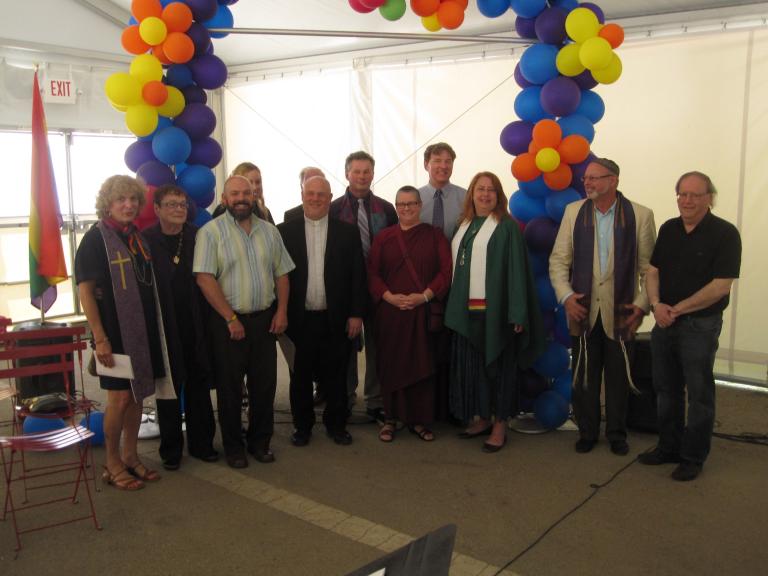
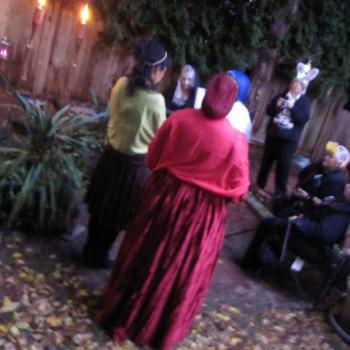
(c) 2018 Sam Wagar Participants in the 2014 LGBTQ Pride Interfaith ceremony in Edmonton.
Ritual is not only religious but religious ritual is what people first think of when they hear the word. I’m not interested in converting people to a religion by the back door. And I think that the same tools of ritual can be used in any religion or to mark signposts in life without religion at all. The universe is not centred on human beings and our needs. The great creative force that gave rise to the galaxies, that caused the Big Bang and established the fundamental laws of gravitation, electromagnetism, and all the rest of it, is not concerned about your love life in particular. The Universe is not hostile to humanity, just indifferent to us. So, there is no meaning inherent in the laws of the universe. Things come into existence, persist for greater or lesser periods of time, and then cease to exist or transform into other forms.
Ritual constructs meaning; it does not just recognize what is already there. Which is why training and selection and a little bit of talent are so important. The fact that we impose pattern onto a chaotic and complex mass of experiences and impressions doesn’t make our patterns less real or powerful. In fact, the making meaning that we do comes from our own needs and from genuine affinities and harmonies between facts and processes that we observe. Our stories and our imaginations are powerful forces in shaping our worlds. We can navigate through life more confidently, more powerfully, and with more joy, toward accomplishing our goals if we take ownership of our rituals and reshape them to fit us, instead of seeing them as handed down from on high.
We begin with the outcome we desire and with our intention. Ritual comes before religion; the experience comes before the explanation of it. After the shock of some experience, of beauty or awe, or fear, a natural impulse is to make some sense of it. The intellect makes sense of an experience or work of art, but it does not make meaning. We can understand what happened, and can find all of the here-and-now reasons for it, but still not have any idea of why it happened and what comes next for us as a result of the experience.
We find ourselves wanting to do something to remember and to relive powerful experiences, to keep some of the power but bring it under our control. We will dance or move or make up poems or songs, or travel to the place where the powerful thing happened to give a gift of flowers or food to the spirit of the place, or pray. All of these spontaneous actions and feelings that arise without us thinking about them are the basic impulses of ritual and the building blocks for it.
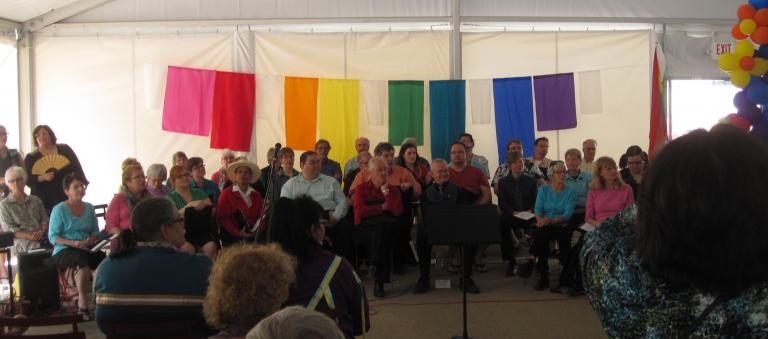
(c) 2018 Sam Wagar Choir at Interfaith Pride 2014
Ritual is about feeling and experience. The other things that come afterward must constantly return to those feelings to make meaning from them. The ritual practice, experiences and a pragmatic approach have to come before the theory and explanations. Beliefs do not come first because beliefs do not predict behaviours or produce experiences. Practice leads to practical results that can then spur on belief. This practice-based approach to ritual means that we can modify our rituals to make them more effective in getting what we want from them and consciously shape the experience and its energy to make meaning that is useful to us and to our communities.
Ritual in religion is the way to pass along complex theological ideas that have been developed out of personal revelations – the stories, truths and meanings at the centre of the religions. It doesn’t just celebrate the experiences of revelation but tries to make the revelations part of the personal understanding and experience of each worshipper.
Three very different kinds of ritual that work with different kinds of memories are used – there are the talk rituals that are led by a single person who uses a very familiar pattern of standing, kneeling and listening to a story, that stays the same and is repeated often, there are the exciting occasional rituals led by a team of people that involve a lot of singing, movement, theatre, music, colour and action, and underlying them, there are the daily observances or little ritual things that people are moved to do on their own and when the time seems right, which are simple and private.
Each of these types of ritual has strengths in making meaning and in helping people to remember it and pass it along. Ritual borrows back and forth among all three styles. There is a toolkit of symbols and actions that can be used by all three and I talk about how to get that together and provide examples throughout this discussion. Remember that the ritual comes first, then the explanation, performance then the meaning, at least the first time. The best way to deepen the meaning that you get from ritual is to start with the first little bit of feeling or insight and then repeat it and develop it, pruning away things that don’t work, adding things that do. Ritual is a practical matter – it is a kind of work on oneself and in life, a method for understanding – the ritual is not the experience that it is about and it sure isn’t the meaning that we are making through it. When we approach ritual as a tool, we are going to get more out of it.
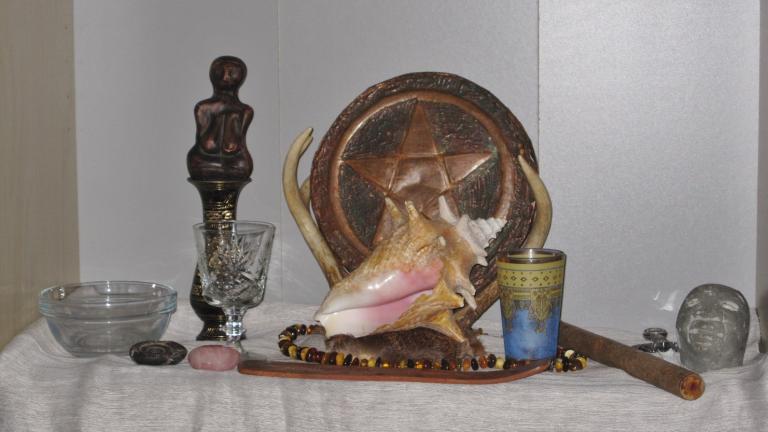
(c) Sam Wagar 2018 Chaplain’s office altar
To start with – just about any action can be done as a ritual action, just about any thing or experience can be a ritual tool. For personal ritual select those actions or symbols that make sense to you and give them as much meaning as you can, for group ritual select things that the members of your group agree are appropriate. Although the range of possibilities is very wide, give the choice of symbols some thought if this ritual is one that you are going to perform more than once or if it is one that deals with a very important part of your life. Choose ideas and symbols that fit together in a natural and harmonious way (either because of your personal history or because of a reasonable connection that they have with each other – symbols of birth naturally fit together, of strength, of the sun and so on, because they are directly about the same thing).
It is very useful to take a little time to think about what things you associate with particular emotions or experiences that you have had. What colour is hunger, or grief? What does a butterfly mean to you? And so on. This will build the toolkit of symbols that you can use to make ritual that is powerful and meaningful – the larger the toolkit and the more flexible that you are in your use of the parts of ritual and these tools, the better that you will be as a ritualist, and the more effective this part of your life will be for you and your community.
Next week “Ritual is a Kind of Doing”
Previous Post

May 30, 2018
An Experience of Ministry
Next Post
June 6, 2018 Getting Organized
Browse Our Archives
Select a Category Uncategorized
Select a Month September 2018 August 2018 July 2018 June 2018 May 2018 April 2018
Follow Us!
TAKE THE
Religious Wisdom Quiz
What Christian group follows the Nicene Creed?
Select your answer to see how you score.
Baptists Seventh-day Adventists Orthodox Jehovah’s Witnesses
Related posts from Translating Worlds



Temple Publicity and Public Information Tips
TRENDING AT PATHEOS Pagan

I was recently chatting with someone on Instagram. She asked me what...

While there are many people who share their results, the end of...

On July 23, I saw Christopher Nolan's The Odyssey which is Homer’s...

As I write this two big events have just finished up. One...

Restoring the Watershed of Divine Love
Perhaps cooperation is not something we manufacture through legislation, ideology, or moral...

Many UUs don’t pray because of bad experiences in a previous religion,...
view all Pagan blogs
Ad-Free & Subscriber Log-In Subscription Support
- About Us
- 2026 Calendar
- Videos
- Podcasts
- Library of World Religions
- Faith In Media Tracker
- Advertise With Us
- Write for Us
- Privacy Policy
- Terms of Service
- Do Not Sell My Data
- Contact Us
- Radiant Digital
- Manage Newsletter Subscriptions
- Unsubscribe From Notifications
- Sitemap
Copyright 2008-2026, Patheos. All rights reserved.
Subscription Support Ad-Free & Subscriber Log-In
Follow Patheos