
BuddhistCatholicContemplativeEvangelicalGeneral ChristianHinduJewishLatter-day SaintMuslimNew VisionsProgressive Christian
Beliefs
- Buddhist
- Catholic
- Contemplative
- Evangelical
- General Christian
- Hindu
- Jewish
- Latter-day Saint
- More Voices
- Muslim
- New Visions
- Pagan
- Progressive Christian
Topics
- Religion News
- Food and Religion
- Sports and Religion
- Religious Art
- Religious Music and Entertainment
- Religious Events
- History and Religion
- Style and Religion
- Politics and Religion
- Women in Religion
- Recreation Outdoors and Religion
- Business Finance and Religion
- Careers Workplace and Religion
- Education and Religion
- Family Parenting and Religion
- Health Fitness and Religion
- Home and Religion
- Relationships and Religion
- Technology and Religion
- Travel and Religion
Columnists
- Buddhist Columnists
- Business Finance and Religion Columnists
- Careers Workplace and Religion Columnists
- Catholic Columnists
- Contemplative Columnists
- Education and Religion Columnists
- Evangelists Columnists
- Family Parenting and Religion Columnists
- General Christian Columnists
- Health Fitness and Religion Columnists
- Hindu Columnists
- History and Religion Columnists
- Home and Religion Columnists
- Jewish Columnists
- More Voices Columnists
- Latter Day Columnists
- Muslim Columnists
- New Visions Columnists
- Nonreligious Columnists
- Pagan Columnists
- Politics and Religion Columnists
- Progressive Columnists
- Recreation Outdoors and Religion Columnists
- Relationships and Religion Columnists
- Religion News Columnists
- Religious Art Columnists
- Religious Events Columnists
- Religious Music and Entertainment Columnists
- Sports and Religion Columnists
- Style and Religion Columnists
- Technology and Religion Columnists
- Travel and Religion Columnists
- Women in Religion Columnists
Resource Library
- 2026 Calendar
- Library of World Religions
- The 100 Most Holy Places on Earth
- Patheos Answers
- Podcasts
- Videos
- Faith Leaders Database
- Anglican Episcopalian
- Bahai
- Baptist
- Buddhism
- Christianity
- Confucianism
- Eastern Orthodoxy
- Hinduism
- Holiness and Pentecostal
- ISKCON
- Islam
- Judaism
- Lutheran
- Methodist
- The Church of Jesus Christ of Latter-day Saints
- New Age
- Paganism
- Presbytarian and Reformed
- Protestantism
- Religion Behind the Scenes
- Roman Catholic
- Scientology
- Shia Islam
- Sikhism
- Sufism
- Sunni Islam
- Taoism
- Zen
- See all religions
Research Tools
 Ad-Free & Subscriber Log-In Subscription Support
Ad-Free & Subscriber Log-In Subscription Support
Follow Patheos 

- Trending:
- Forgiveness
- |
- Marriage
- |
- Consciousness
- |
- Death Penalty
- |
- Election
- |
- Halloween
 Translating Worlds
- Home
- Pagan
- Ritual is a Kind of Doing
Ritual is a Kind of Doing
Last updated on: June 11, 2018 at 9:55 pm by Samuel Wagar
Ritual is a Kind of Doing 2018-06-11T21:55:14-07:00 Samuel Wagar
Patheos Explore the world's faith through different perspectives on religion and spirituality! Patheos has the views of the prevalent religions and spiritualities of the world.
Morality, defined as an activity of the soul, is an ongoing process of entering into one’s destiny and nature with responsibility, that is, with a response in life to the demands uncovered in moral reflection. Gradually during a lifetime, we discover what life demands of us and step by step we deepen our values. Moralism, on the other hand, is some fixed notion about what one’s nature requires. Essentially, moralism is a defence against morality, the safeguarding of a single, safe idea about one’s life and resistance against the subtlety and complexity of that life. Moralism protects a person from the unfolding of complexity. – Thomas Moore
Ritual is only real when it is performed. And so if you’re just reading this and not planning to perform or participate in rituals, you’re wasting your time – you will never understand. Ritual is not only a literary form but a way of acting that cause effects in itself – for example as the ritual statement “I now pronounce you married” in a wedding ceremony makes a couple married. Meanings that we give to ritual performances reflect the cultural and religious predispositions of the people participating in the ritual, not anything inherent to it. The technical aspects of ritual performance are, however, usually taught as though they had meanings. This can give ritual performance greater power to start with but it limits the options available to the performer and the participants, which is why I am trying to avoid conflating the two things.
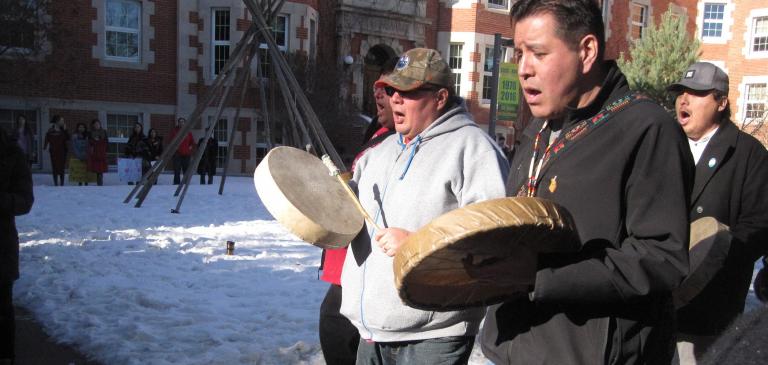
(c) 2018 Sam Wagar Drummers in the ceremony mourning Missing and Murdered Indigenous Women, University of Alberta 2017
It might take you a little longer to build up a head of steam if you are aware that it is the process of ritual doing that creates energy and meaning but you will, I am sure, come out of it as a stronger ritualist in a larger number of settings and dealing with more issues than if you trained in a single tradition only, or than if you only followed a cookbook.
We begin formal rituals in a special space set aside. This sanctuary space allows the focus and specific actions to do ritual and produce results that may or may not later be brought back into our lives as a whole. These rituals have a formal opening and closing of the boundaries of the ritual space, inviting people to come in (it’s not just completely open door during the ritual), outside ordinary time and include reflection outside of time, space and culture. It also is specifically a liminal space with participants in between states, and outside of their conventional social roles.
Ritual is practice, not theory, and not dogma. But consistent and coherent ritual experimentation and goal-directed ritual construction is limited if we don’t think about what we’re doing – we just do what we have always done, then, which limits our ability to address different problems and repeats the same problems. We are faced with a practical or technical set of questions – not a theological, moral, or ethical issue but much more concrete, not”what is right?” but “what works?”
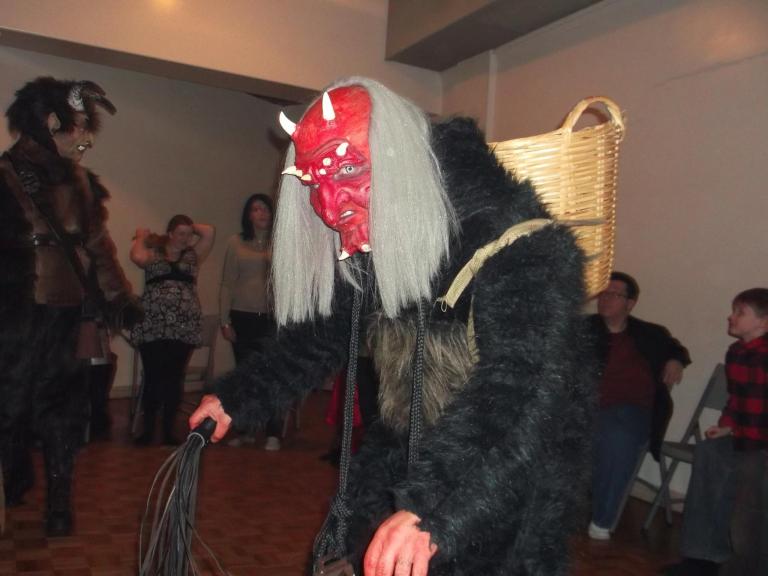
Photo by Jon Summers 2015, Krampusi at Yule ritual for Ravenwood (now Stony Creek) Temple in Edmonton.
Although some people feel that rituals were handed down from the divine ancestors or the Gods themselves and so all we can do is simply repeat what has been done forever before us, I disagree completely with this perspective. Rituals were written by people to deal with problems or express feelings around experiences they had or wanted to have. That means that other people can write other rituals. And, I definitely take the perspective that older rituals should serve as raw material for newer ones – as they always have. Our divine ancestors improvised using the materials at hand and adapted them to the task or story and so we must write rituals inspired by our personal connection. The conscious creation and adaptation of ritual, as a matter of course, creates fluid and very pragmatic use of it as a tool for spiritual and personal exploration that actively subverts dogmatism.
The effect is what is the most important but we can also have aesthetic judgements of the value of a particular piece of ritual. Although ritual is not simply artwork (in the ‘art for its own sake’ mode) it is important to pay attention to language, pacing, movement and gesture, and the theatrical tricks as well as explicit content of a piece of ritual. Ritual is not simply lecture and the tendency to just tell yourself, or tell others, what it is that you want the ritual to be about drains away the power of it. Ritual is to be performed and to be experienced and the meanings must come from the emotional reliving of the ritual, the impression and experience of it, from what is deep in it and not the surface aspects of it.
The actions in a ritual are often similar to actions that we undertake at other times in our lives. We light candles when it is dark; we sing because we like music, we share meals with friends. But we also perform actions that we ordinarily don’t or in unusual order – we don’t ordinarily walk all the way around a room to get from one side to the other, we move more rapidly ordinarily and speak less clearly, we are less focused and more day to day ordinarily. Our clothing may be different, our style of movement usually is, our choice of language.
Next Week “Ritual of Transformation”

About Samuel Wagar
I've been doing this Witch thing for a long time (since 1982) but I'm still having fun. Now that I'm an old fart, my focus has switched from doing a lot of things to mentoring, teaching, and writing. I'm a chaplain at University of Alberta, in charge of the Congregationalist Wiccan Assembly of Alberta's clergy training program, and the dean of the baby Edmonton Wiccan Seminary. You can read more about the author here.
Previous Post

June 6, 2018
Getting Organized
Next Post

June 13, 2018 Mission and Pride
Browse Our Archives
Select a Category Uncategorized
Select a Month September 2018 August 2018 July 2018 June 2018 May 2018 April 2018
Follow Us!
TAKE THE
Religious Wisdom Quiz
Which Psalm prophesies the coming of the Messiah being rejected?
Select your answer to see how you score.
Psalm 118 Psalm 1 Psalm 51 Psalm 137
Related posts from Translating Worlds



Temple Publicity and Public Information Tips
TRENDING AT PATHEOS Pagan

When we talk about Greek religion, we often begin with the dodekatheion—the...

I was recently chatting with someone on Instagram. She asked me what...

While there are many people who share their results, the end of...

On July 23, I saw Christopher Nolan's The Odyssey which is Homer’s...

As I write this two big events have just finished up. One...

Restoring the Watershed of Divine Love
Perhaps cooperation is not something we manufacture through legislation, ideology, or moral...
view all Pagan blogs
Ad-Free & Subscriber Log-In Subscription Support
- About Us
- 2026 Calendar
- Videos
- Podcasts
- Library of World Religions
- Faith In Media Tracker
- Advertise With Us
- Write for Us
- Privacy Policy
- Terms of Service
- Do Not Sell My Data
- Contact Us
- Radiant Digital
- Manage Newsletter Subscriptions
- Unsubscribe From Notifications
- Sitemap
Copyright 2008-2026, Patheos. All rights reserved.
Subscription Support Ad-Free & Subscriber Log-In
Follow Patheos