
BuddhistCatholicContemplativeEvangelicalGeneral ChristianHinduJewishLatter-day SaintMuslimNew VisionsProgressive Christian
Beliefs
- Buddhist
- Catholic
- Contemplative
- Evangelical
- General Christian
- Hindu
- Jewish
- Latter-day Saint
- More Voices
- Muslim
- New Visions
- Pagan
- Progressive Christian
Topics
- Religion News
- Food and Religion
- Sports and Religion
- Religious Art
- Religious Music and Entertainment
- Religious Events
- History and Religion
- Style and Religion
- Politics and Religion
- Women in Religion
- Recreation Outdoors and Religion
- Business Finance and Religion
- Careers Workplace and Religion
- Education and Religion
- Family Parenting and Religion
- Health Fitness and Religion
- Home and Religion
- Relationships and Religion
- Technology and Religion
- Travel and Religion
Columnists
- Buddhist Columnists
- Business Finance and Religion Columnists
- Careers Workplace and Religion Columnists
- Catholic Columnists
- Contemplative Columnists
- Education and Religion Columnists
- Evangelists Columnists
- Family Parenting and Religion Columnists
- General Christian Columnists
- Health Fitness and Religion Columnists
- Hindu Columnists
- History and Religion Columnists
- Home and Religion Columnists
- Jewish Columnists
- More Voices Columnists
- Latter Day Columnists
- Muslim Columnists
- New Visions Columnists
- Nonreligious Columnists
- Pagan Columnists
- Politics and Religion Columnists
- Progressive Columnists
- Recreation Outdoors and Religion Columnists
- Relationships and Religion Columnists
- Religion News Columnists
- Religious Art Columnists
- Religious Events Columnists
- Religious Music and Entertainment Columnists
- Sports and Religion Columnists
- Style and Religion Columnists
- Technology and Religion Columnists
- Travel and Religion Columnists
- Women in Religion Columnists
Resource Library
- 2026 Calendar
- Library of World Religions
- The 100 Most Holy Places on Earth
- Patheos Answers
- Podcasts
- Videos
- Faith Leaders Database
- Anglican Episcopalian
- Bahai
- Baptist
- Buddhism
- Christianity
- Confucianism
- Eastern Orthodoxy
- Hinduism
- Holiness and Pentecostal
- ISKCON
- Islam
- Judaism
- Lutheran
- Methodist
- The Church of Jesus Christ of Latter-day Saints
- New Age
- Paganism
- Presbytarian and Reformed
- Protestantism
- Religion Behind the Scenes
- Roman Catholic
- Scientology
- Shia Islam
- Sikhism
- Sufism
- Sunni Islam
- Taoism
- Zen
- See all religions
Research Tools
 Ad-Free & Subscriber Log-In Subscription Support
Ad-Free & Subscriber Log-In Subscription Support
Follow Patheos 

- Trending:
- Forgiveness
- |
- Marriage
- |
- Consciousness
- |
- Death Penalty
- |
- Election
- |
- Halloween
 Translating Worlds
- Home
- Pagan
- How to be a Wiccan Chaplain
How to be a Wiccan Chaplain
Last updated on: May 2, 2018 at 11:25 pm by Samuel Wagar
How to be a Wiccan Chaplain 2018-05-02T23:25:19-07:00 Samuel Wagar
Patheos Explore the world's faith through different perspectives on religion and spirituality! Patheos has the views of the prevalent religions and spiritualities of the world.
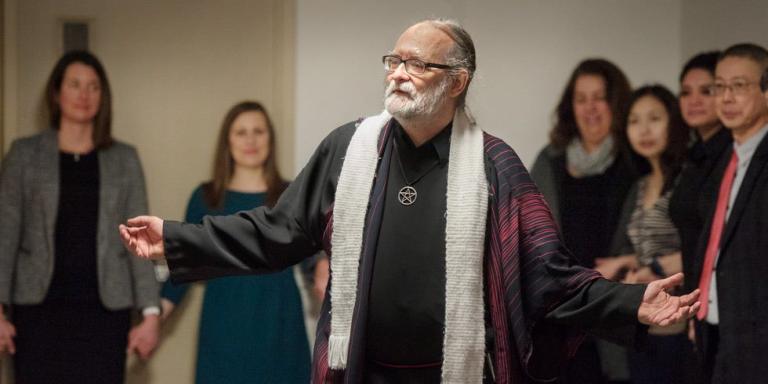
Photo by Richard Siemens, U of Alberta photographer, 2017. I was delivering a blessing, as one of the chaplains participating in the dedication ceremony for the Multifaith Prayer and Meditation Space at HUB. “In a circle no person is closer or further away from the centre. The divine is revealed in and through these relationships, and meaning is found all around the circle.”
Every week through the school year, on Tuesday, Wednesday and Thursday afternoons, I head up to University of Alberta campus. I am the Wiccan chaplain to the University and have also been elected Chair of the Interfaith Chaplains’ Association there. My hours during summer term are a little less regular.
Being a chaplain has been the principal form that my service as a public clergy person has taken over the past four years since I was appointed. People often ask me what I do as a chaplain, what it’s like being the Wiccan chaplain, and so on. So, I’ll try to talk about it here.
University of Alberta has an explicitly multi-faith chaplaincy, with members representing a range of faith traditions, although most are Christian clergy of one stripe or another. In addition to myself, the non-Christians include the Muslim, Unitarian, and Jewish chaplains. We serve the entire university population, although mainly working with students, from the understanding that life, including academic life, is a spiritual journey.
I am here to assist students, faculty, and staff in being spiritually grounded and connected through offering qualified spiritual guidance, as well as assisting in finding community groups, activities, and resources of various sorts for religious fellowship and growth. I’m here for people of any religion, or none, although I mostly talk with Wiccans and other Pagans. I work together with chaplains from other faith communities to sacralise the university, and to draw out the ethical and spiritual parts of the life of study, research, learning and teaching.
I am also here to educate and inform people of other faiths (or none), of the basic beliefs and practices of Wicca (as a small minority religious path cannot expect to be well-known or understood without reaching out to explain itself). And, finally, my work here involves developing our church’s interfaith outreach and expertise, to learn from other faith groups, and to develop alliances around issues of common concern.
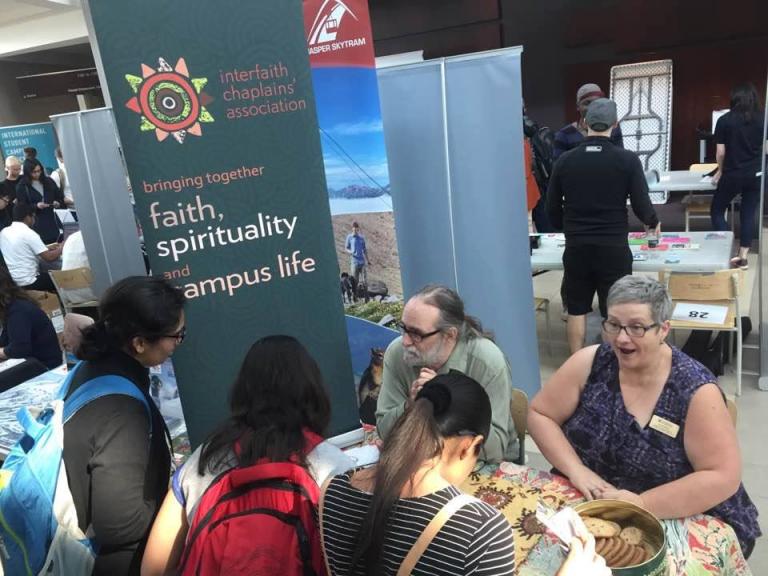
Photo by Richard Reimer. Staffing the chaplains’ table alongside Anne Barker, the Unitarian chaplain, at international students’ orientation September 2017.
How did I get here? This is where the Gods have called me to be. But in practical terms, all recognized chaplains must go through an application and interview process and be voted upon by the other chaplains. We all are Called to serve this particular community – the community centred on research, teaching and learning. We all have significant post-secondary experience (I had an MA and am currently working on a doctorate). We are all educated and trained in the practical work of spiritual leadership, care and guidance, according to the requirements of our faith communities – basically, we are ordained or the equivalent. We are appointed by, and accountable to, our faith communities through a local support committee.
We must all be willing to work collaboratively with the other chaplains, be recognized and supported as clergy and/or paid staff of a faith community that is registered with the provincial government and whose beliefs, faith statements and financial records are transparent and open to public scrutiny. We are also each reappointed annually.
So, my Temple applied to appoint me. I provided a letter of application, and a cv. And a group of chaplains interviewed me and two members of the Temple Board about my qualifications, experience, and Call. That small committee reported to the whole Association and they voted as a body and I received a majority of votes in favour. (We have turned down applicants, so it was not guaranteed that I would be accepted.)
Since I was appointed in 2014, I have participated in a series of interfaith dialogues, been part of the chaplains’ presence at Orientation, offered emergency support to refugees from the great fires that destroyed part of Fort MacMurray two years ago, been part of the annual memorial ceremony for alumni, and in other ways worked cooperatively with other chaplains. I was appointed as the scheduler for the new Multi-faith Prayer and Meditation Space for the past two years, which is where my office is located now. I am very involved in encouraging student religious groups and faith-based initiatives in this space, especially those that are multi-faith. I also connect with Pagan students, faculty and staff, and offer regular meetings for worship in collaboration with Pagan students and my home Temple.
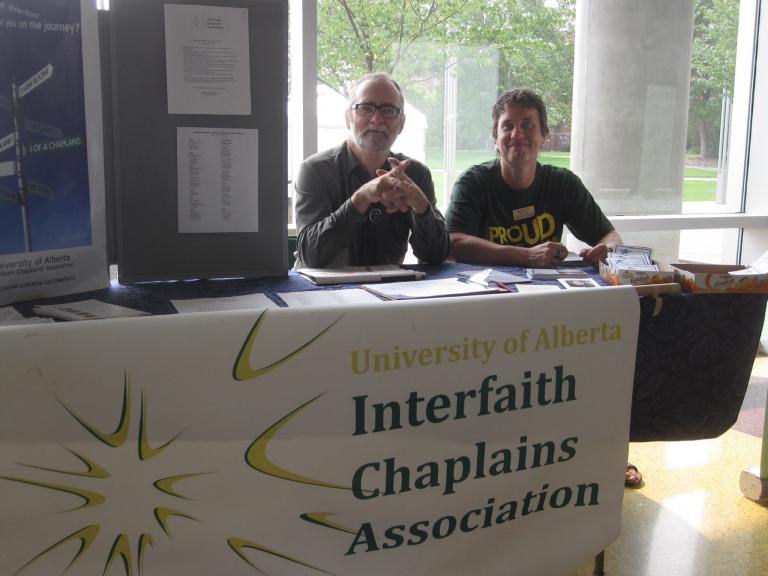
Photo by Richard Reimer. Staffing an information table together with Bryan Clarke, Presbyterian chaplain, 2016.
It’s difficult to find people to work with on an ongoing basis. This is true for my fellow chaplains from large religious traditions as well. Most students don’t know the chaplains exist, and so I’ve been doing things to make us visible. My most successful outreach has been weekly Tarot Tables in the Student Union Building – I book a space and spend Wednesday afternoons doing quick three-card readings for people and telling them about the Wiccan chaplaincy and the chaplains in general.
This service has been rich and meaningful. I have had the opportunity to help people get through crises, find groups to worship with, and have enjoyed teaching about my religion. I really enjoy those moments when I’m sitting at the Tarot Table and someone comes rushing up to me, delighted that there is another Wiccan on campus, and that I am a chaplain! (Happened four times last term!)
As Chair, I have liked working with the university brass to get things done, liaising with different groups around campus life issues – like the Food Bank around food insecurity and student poverty. I have also benefitted by Wicca still being a little unusual and so my chaplaincy has attracted a fair amount of publicity, which has rebounded to the benefit of the whole university and the chaplaincy.
If you are interested in this area of service, start with a search for the Call. You will not be getting paid, you will have some emotional and spiritual support from your fellow chaplains, but it will take years to build a presence on campus. So, this must be something that you are passionate about. Then check your skills and abilities – honestly, are you a good counselor, a kind person, a listener? Are you qualified – an Initiate, a recognized leader and public clergy person? And do you have community support – specifically from a legally recognized and formally organized religious body to which you are responsible? And it really helps to be able to be public and to be a student or instructor already connected to the school.

About Samuel Wagar
I've been doing this Witch thing for a long time (since 1982) but I'm still having fun. Now that I'm an old fart, my focus has switched from doing a lot of things to mentoring, teaching, and writing. I'm a chaplain at University of Alberta, in charge of the Congregationalist Wiccan Assembly of Alberta's clergy training program, and the dean of the baby Edmonton Wiccan Seminary. You can read more about the author here.
Previous Post
May 1, 2018
Building a Body of Lore
Next Post

May 7, 2018 What is part of the Lore ?
Browse Our Archives
Select a Category Uncategorized
Select a Month September 2018 August 2018 July 2018 June 2018 May 2018 April 2018
Follow Us!
TAKE THE
Religious Wisdom Quiz
Which festival was celebrated with great joy after completing the wall?
Select your answer to see how you score.
Feast of Dedication Pentecost Passover Feast of Tabernacles
Related posts from Translating Worlds



Temple Publicity and Public Information Tips
TRENDING AT PATHEOS Pagan

I was recently chatting with someone on Instagram. She asked me what...

While there are many people who share their results, the end of...

On July 23, I saw Christopher Nolan's The Odyssey which is Homer’s...

As I write this two big events have just finished up. One...

Restoring the Watershed of Divine Love
Perhaps cooperation is not something we manufacture through legislation, ideology, or moral...

Many UUs don’t pray because of bad experiences in a previous religion,...
view all Pagan blogs
Ad-Free & Subscriber Log-In Subscription Support
- About Us
- 2026 Calendar
- Videos
- Podcasts
- Library of World Religions
- Faith In Media Tracker
- Advertise With Us
- Write for Us
- Privacy Policy
- Terms of Service
- Do Not Sell My Data
- Contact Us
- Radiant Digital
- Manage Newsletter Subscriptions
- Unsubscribe From Notifications
- Sitemap
Copyright 2008-2026, Patheos. All rights reserved.
Subscription Support Ad-Free & Subscriber Log-In
Follow Patheos