
BuddhistCatholicContemplativeEvangelicalGeneral ChristianHinduJewishLatter-day SaintMuslimNew VisionsProgressive Christian
Beliefs
- Buddhist
- Catholic
- Contemplative
- Evangelical
- General Christian
- Hindu
- Jewish
- Latter-day Saint
- More Voices
- Muslim
- New Visions
- Pagan
- Progressive Christian
Topics
- Religion News
- Food and Religion
- Sports and Religion
- Religious Art
- Religious Music and Entertainment
- Religious Events
- History and Religion
- Style and Religion
- Politics and Religion
- Women in Religion
- Recreation Outdoors and Religion
- Business Finance and Religion
- Careers Workplace and Religion
- Education and Religion
- Family Parenting and Religion
- Health Fitness and Religion
- Home and Religion
- Relationships and Religion
- Technology and Religion
- Travel and Religion
Columnists
- Buddhist Columnists
- Business Finance and Religion Columnists
- Careers Workplace and Religion Columnists
- Catholic Columnists
- Contemplative Columnists
- Education and Religion Columnists
- Evangelists Columnists
- Family Parenting and Religion Columnists
- General Christian Columnists
- Health Fitness and Religion Columnists
- Hindu Columnists
- History and Religion Columnists
- Home and Religion Columnists
- Jewish Columnists
- More Voices Columnists
- Latter Day Columnists
- Muslim Columnists
- New Visions Columnists
- Nonreligious Columnists
- Pagan Columnists
- Politics and Religion Columnists
- Progressive Columnists
- Recreation Outdoors and Religion Columnists
- Relationships and Religion Columnists
- Religion News Columnists
- Religious Art Columnists
- Religious Events Columnists
- Religious Music and Entertainment Columnists
- Sports and Religion Columnists
- Style and Religion Columnists
- Technology and Religion Columnists
- Travel and Religion Columnists
- Women in Religion Columnists
Resource Library
- 2026 Calendar
- Library of World Religions
- The 100 Most Holy Places on Earth
- Patheos Answers
- Podcasts
- Videos
- Faith Leaders Database
- Anglican Episcopalian
- Bahai
- Baptist
- Buddhism
- Christianity
- Confucianism
- Eastern Orthodoxy
- Hinduism
- Holiness and Pentecostal
- ISKCON
- Islam
- Judaism
- Lutheran
- Methodist
- The Church of Jesus Christ of Latter-day Saints
- New Age
- Paganism
- Presbytarian and Reformed
- Protestantism
- Religion Behind the Scenes
- Roman Catholic
- Scientology
- Shia Islam
- Sikhism
- Sufism
- Sunni Islam
- Taoism
- Zen
- See all religions
Research Tools
 Ad-Free & Subscriber Log-In Subscription Support
Ad-Free & Subscriber Log-In Subscription Support
Follow Patheos 

- Trending:
- Forgiveness
- |
- Marriage
- |
- Consciousness
- |
- Death Penalty
- |
- Election
- |
- Halloween
 Translating Worlds
- Home
- Pagan
- Making A Temple To Last (and grow)
Making A Temple To Last (and grow)
Last updated on: May 23, 2018 at 10:05 pm by Samuel Wagar
Making A Temple To Last (and grow) 2018-05-23T22:05:16-07:00 Samuel Wagar
Patheos Explore the world's faith through different perspectives on religion and spirituality! Patheos has the views of the prevalent religions and spiritualities of the world.

(c) Samuel Wagar 2018
When I started along on the Wiccan path 36 years ago, there were few public Wiccan temples. They are still rare but starting to be more common. I was, at that point, very strongly in the no organization is good organization camp but over the years I’ve made a 180. I shifted when I realized that most people who are called to Wicca’s goddesses and gods and approach to the spirit in the world are not called to the demanding mystical path of clergy and coven. These people should be able to build community and to worship together, and to have clergy for counselling and to preside over religious rituals marking the great events of their lives.
That means building organizations, finding interested people and learning together about the religion, training and authorizing clergy to lead our temples. Plus, dealing with governments and with all the practical issues that a group of five or six friends meeting in my basement ritual room don’t have.
If we are going to build temples and organizations (I recognize that many Wiccans don’t want to, but I’m not talking to them), we need to do it well. The gods and the community should be served effectively and consistently and in a way that is sustainable. Luckily, we are not the first religion that got organized, and there is plenty of literature and many examples of how to do it effectively.
I’m not going to run through my library of church-planting and sociology of religion texts here, but mainly talk about one very influential sociologist, Rodney Stark, a sociologist of religion. He and his associates put forward theory of religion with formal testable hypotheses and propositions around facets of religious organization. Stark is interested in new religious movements such as Wicca and has written several works on the birth, growth, consolidation, and maturation of new religions and sectarian groups. Today I’ll draw from his 1996/2015 paper “Why Religious Movements Succeed or Fail; A Revised General Model”, which is the best single set of pointers I’ve ever found.

(c) Samuel Wagar 2018
First off – it is easier, inside a Christian culture, to attract people to a Christian religious body. They give up less of their previous religious ideas and learn fewer brand-new things. New religions grow overwhelmingly by conversion for the first few hundred years of their existence and so overcoming this cultural disadvantage must be a key for us. By emphasizing the pre-Christian elements in our culture (the Greek stories, the Celtic mythology) and our links to valuable new cultural movements (feminist, sexual liberation, ecological movements) we can draw upon other sources of cultural and spiritual capital.
NRMs need to be supernatural. Although magick and altered states of consciousness are not all that Wicca is about, we are also not separating the spiritual from daily life. We, when teaching and talking about the mystical parts of our religion, connect them firmly to the practical. Part of what people hunger for that Wicca provides is beauty, and mystery, and direct connection with the divine. Not shying away from the supernatural, but embracing it, makes our religious appeal stronger.
When we look at the world we see problems to be fixed – sexism, racism, ecological destruction, an unhealthy and unhappy life for so many people. We are obliged as religious people to do something about these things. This will inevitably mean that some people will be unhappy with our ideas, some people will be uncomfortable inside our temples. If we are open and welcoming to racists, we exclude people they hate, if we’re open and welcoming to homophobes then we exclude LGBTQ+ folk, and we must be critical of the society that has these flaws. There will always be a temptation to be less critical, different, and more tolerant to “get along and welcome everyone”, but that way lies irrelevance and the death of the organization.
Here’s where groups and individuals often go wrong. Religions must see the tension between their beliefs and mission and the larger society, and strive to express a different vision, not compromise to ‘get along’. Religions must expect things from members – service to the gods, behaviors, volunteer hours or money to support the mission of the group. If a religion is just like everyday life, and there are no obligations or responsibilities, or benefits connected with it, why bother? If anybody, regardless of their beliefs, or the way they behave toward others, regardless of their ethics or their connection to the gods, regardless of anything else, can be a member of a religion, then why bother? And in those amorphous ‘religions’ where anybody can be a member, who will do the work to keep them going, who will give their money and time, who will go out to bring their friends to check it out, so it can grow? Why, nobody will. Because there is nothing there.

Photo by Laura Sou 2015 used with permission of CWAA Stony Creek Temple
Temples must be routes toward growth, contact and development, which means that there must be things to learn, activities to engage in, expectations to fulfill, and obligations connected with membership.
Legitimate leadership is essential and religious leaders must be trained, informed and in tune with the beliefs and practices of the temples, and supported and authorized by the members. Strong leaders are supported by committed followers. There must also be a theology of leadership which connects the leaders’ authority to the divine, through the consent of the membership.
Two key tasks are both encouraging volunteers and finding things for them to do, because the outreach and recruitment and whatever good works that the temple does in the world can be led and inspired by the vision of the clergy and board of directors, but most of the work and inspiration must come from the members. Those groups that rely a great deal on professional paid staff are much less effective than volunteer-led groups. If you have a healthy temple then people will be excited to be part of it. They will want to help make it better by giving time, money, and other energy, by volunteering for events, and by bringing their family members and friends around to check it out.
The next couple of points should be obvious: There must be support to biological families and real roles for children. Children must have a place in the temple and there must be real tasks for them to do, religious education and support work appropriate to their age. Teens can participate in ritual, can help with the moon school, and can be thinking toward clergy training and other leadership roles. Children and young people must be encouraged to step up and volunteer as part of engaging and involving them.
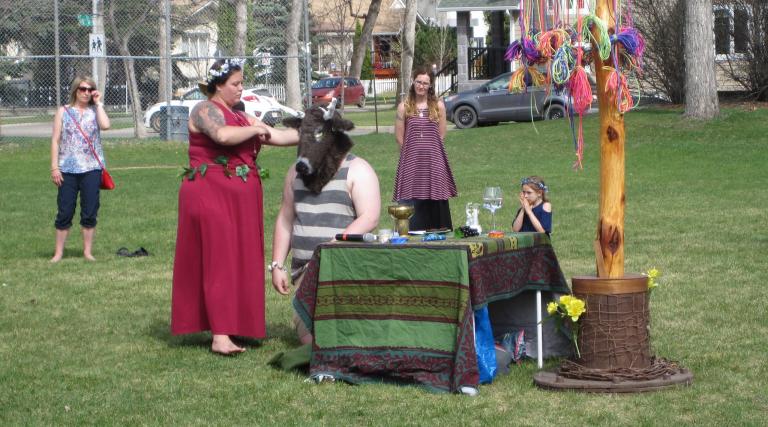
(c) 2018 Samuel Wagar – Beltaine Faire Edmonton, 2017.
Wicca, like other new religions, is a religion of converts. People generally do not change their religion, and when they do they rarely make big changes. To the extent than an area has a lot of people that are not very connected to a religion or who are looking around, or whose religion of origin is like Wicca – Hinduism or Indigenous spirituality or vodoun- it will be a more likely location for a successful Wiccan temple. An active presence in secular movements that have a lot in common with Wicca – LGBTQ+, feminist, ecological, Green / progressive – will be likely to bring interested people to visit because of the weaker presence of other religious options.
Finally, people are attracted to people more than they are to ideas. People go where their friends are. Building strong community both attracts and keeps people – the temples must be caring environments of spiritual and personal support. Attention must also be given to the constant problem of ‘free-riders’ who take but do not contribute anything. At the same time members must be encouraged to stay engaged with their families and their communities in tune with our values.
Growing the temple is not the reason to do things, but we want to grow to be large enough to be viable in the long term and to begin to accomplish some of our goals. It should always be possible for friends of members to get an invitation to a temple activity. It is important to have a public presence so that people who are looking for us can easily find us. Then our influence reaches out into the larger world to improve it.

About Samuel Wagar
I've been doing this Witch thing for a long time (since 1982) but I'm still having fun. Now that I'm an old fart, my focus has switched from doing a lot of things to mentoring, teaching, and writing. I'm a chaplain at University of Alberta, in charge of the Congregationalist Wiccan Assembly of Alberta's clergy training program, and the dean of the baby Edmonton Wiccan Seminary. You can read more about the author here.
Previous Post

May 21, 2018
Books, References, Sources for Lore
Next Post

May 28, 2018 Notes on Ritual Theory for the Wiccan Priest/ess
Browse Our Archives
Select a Category Uncategorized
Select a Month September 2018 August 2018 July 2018 June 2018 May 2018 April 2018
Follow Us!
TAKE THE
Religious Wisdom Quiz
What will happen to Satan at the end of time, according to Revelation 20:10?
Select your answer to see how you score.
He will repent and be forgiven He will be cast out of heaven again He will roam the earth forever He will be thrown into the lake of fire
Related posts from Translating Worlds



Temple Publicity and Public Information Tips
TRENDING AT PATHEOS Pagan

I was recently chatting with someone on Instagram. She asked me what...

While there are many people who share their results, the end of...

On July 23, I saw Christopher Nolan's The Odyssey which is Homer’s...

As I write this two big events have just finished up. One...

Restoring the Watershed of Divine Love
Perhaps cooperation is not something we manufacture through legislation, ideology, or moral...

Many UUs don’t pray because of bad experiences in a previous religion,...
view all Pagan blogs
Ad-Free & Subscriber Log-In Subscription Support
- About Us
- 2026 Calendar
- Videos
- Podcasts
- Library of World Religions
- Faith In Media Tracker
- Advertise With Us
- Write for Us
- Privacy Policy
- Terms of Service
- Do Not Sell My Data
- Contact Us
- Radiant Digital
- Manage Newsletter Subscriptions
- Unsubscribe From Notifications
- Sitemap
Copyright 2008-2026, Patheos. All rights reserved.
Subscription Support Ad-Free & Subscriber Log-In
Follow Patheos