
BuddhistCatholicContemplativeEvangelicalGeneral ChristianHinduJewishLatter-day SaintMuslimNew VisionsProgressive Christian
Beliefs
- Buddhist
- Catholic
- Contemplative
- Evangelical
- General Christian
- Hindu
- Jewish
- Latter-day Saint
- More Voices
- Muslim
- New Visions
- Pagan
- Progressive Christian
Topics
- Religion News
- Food and Religion
- Sports and Religion
- Religious Art
- Religious Music and Entertainment
- Religious Events
- History and Religion
- Style and Religion
- Politics and Religion
- Women in Religion
- Recreation Outdoors and Religion
- Business Finance and Religion
- Careers Workplace and Religion
- Education and Religion
- Family Parenting and Religion
- Health Fitness and Religion
- Home and Religion
- Relationships and Religion
- Technology and Religion
- Travel and Religion
Columnists
- Buddhist Columnists
- Business Finance and Religion Columnists
- Careers Workplace and Religion Columnists
- Catholic Columnists
- Contemplative Columnists
- Education and Religion Columnists
- Evangelists Columnists
- Family Parenting and Religion Columnists
- General Christian Columnists
- Health Fitness and Religion Columnists
- Hindu Columnists
- History and Religion Columnists
- Home and Religion Columnists
- Jewish Columnists
- More Voices Columnists
- Latter Day Columnists
- Muslim Columnists
- New Visions Columnists
- Nonreligious Columnists
- Pagan Columnists
- Politics and Religion Columnists
- Progressive Columnists
- Recreation Outdoors and Religion Columnists
- Relationships and Religion Columnists
- Religion News Columnists
- Religious Art Columnists
- Religious Events Columnists
- Religious Music and Entertainment Columnists
- Sports and Religion Columnists
- Style and Religion Columnists
- Technology and Religion Columnists
- Travel and Religion Columnists
- Women in Religion Columnists
Resource Library
- 2026 Calendar
- Library of World Religions
- The 100 Most Holy Places on Earth
- Patheos Answers
- Podcasts
- Videos
- Faith Leaders Database
- Anglican Episcopalian
- Bahai
- Baptist
- Buddhism
- Christianity
- Confucianism
- Eastern Orthodoxy
- Hinduism
- Holiness and Pentecostal
- ISKCON
- Islam
- Judaism
- Lutheran
- Methodist
- The Church of Jesus Christ of Latter-day Saints
- New Age
- Paganism
- Presbytarian and Reformed
- Protestantism
- Religion Behind the Scenes
- Roman Catholic
- Scientology
- Shia Islam
- Sikhism
- Sufism
- Sunni Islam
- Taoism
- Zen
- See all religions
Research Tools
 Ad-Free & Subscriber Log-In Subscription Support
Ad-Free & Subscriber Log-In Subscription Support
Follow Patheos 

- Trending:
- Forgiveness
- |
- Marriage
- |
- Consciousness
- |
- Death Penalty
- |
- Election
- |
- Halloween

- Home
- New Visions
- Relationships and Religion
- The Archetype of Revival: The Need and Danger of Spiritual Inflation
The Archetype of Revival: The Need and Danger of Spiritual Inflation
Last updated on: February 22, 2023 at 4:13 am by Dr. Mike Simmons
The Archetype of Revival: The Need and Danger of Spiritual Inflation 2023-02-22T04:13:14-08:00 Dr. Mike Simmons
Patheos Explore the world's faith through different perspectives on religion and spirituality! Patheos has the views of the prevalent religions and spiritualities of the world.
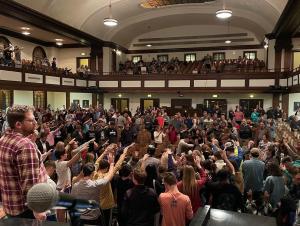
Photo by Daily Citizen, Bruce Hausknecht
“Most forms of Christian spirituality deny the shadow.” “[…] we tend to be so split with regard to our humanness that we advocate “angelism.” We wish we could forget about our bodies and sexuality and our aggressive urges and all the parts of us that are not nice.” (Robert Moore, Archetype of Initiation, 98)
For believers, revival can feel like the pinnacle of one’s spiritual journey, yet for skeptics such a spectacle is delusionary. In reality, it is neither, and perhaps a little of both. Humans have a tendency to fall asleep to their lives, so we need awakening experiences throughout. However, life is more than waking up, it is also about living, creating and action. Revival may pleasantly awaken us from our nightmares, but what can sober us from our illusions?
My Time at Asbury
“When people act ‘crazy’ by conventional standards they are often searching for some kind of extraordinary space that will allow them to leave an old phase of life behind and experience initiation into an entirely new phase. Age-old human existential issues bring with them a yearning to locate and enter a sacred ‘temple’ where the issues can be addressed.” (Robert Moore, 20)
In winter of 2010, I made the drive up I-75 from Cleveland, Tennessee to Wilmore, Kentucky on an admissions visit to Asbury Theological Seminary. As a senior at Lee University, I had a passion for God, for learning, and, at that time, an unconscious cavernous need for healing–a craze for some kind of extraordinary space, a temple where my issues could be addressed.
Asbury Seminary was that space for me. I can’t explain it. I can’t prove it. It’s a mystery that I experienced, which words don’t do justice. Asbury is where I first met my Sadness; on the left side of Estes Chapel I cried harder than ever before over all the loss lodged in my body. Sadness is a dear friend still today. Asbury is where I met Little Michael and became the parent I always needed. And Asbury is where I met OCD, General Anxiety, Depression, Lexapro, Abilify, Fluoxetine. However I label that time, it was a life-saving and transformational space.
Liminal Space
My 3 years at Asbury Seminary were liminal space. The word liminal comes from the Latin (limen), meaning threshold. A threshold is not a space itself, but a space between spaces. When you stand on a threshold, such as a door frame, you are neither in the room before, nor behind, and yet, you are in both. Though transformation requires liminal space, such space is transitional, and our goal should never be to stay indefinitely. When we stay, we get stuck in what’s called chronic liminality.
Chronic Liminality
Transformation is possible when we enter liminal space, but it is only realized when we exit on the other side, and integrate our transformative experience. Robert Moore calls this the Archetype of Initiation. Chronic liminality; however, occurs when we attempt to exist in liminal space indefinitely. There is always a temptation, and to some extent, an expectation within revivals, for liminal space to become normative, for the threshold to become the room.
Liminal space is obviously present at the Asbury revival, and it is real to those present. The question remains, will people be able to exit and integrate? Will they remember their “bodies and sexuality and their aggressive urges and all the parts that are not nice?” Will there come a countering inclusivity to the this exclusive moment? Or will chronic liminality set in and seek to normalize and homogenize everyone and everything involved?
The Archetype of Revival
Regardless of one’s religious affiliation, or stage of life, the archetype of revival is universal and necessary for human transformation. Revival, regardless of its form and construct, is always intense liminality meant to awaken us to divine energy within and around (read more in my essay, Why You’ve Outgrown Church). The archetype of revival is intoxicating and has a nearly inescapable pull because it inflates and dilates one aspect of our humanity while temporarily tranquilizing others. In a recent video, a student at the Asbury revival stands before the whole assembly and shouts, “Forget the guy! Forget the girl! Forget everything! He is worthy!” This young man described himself as a recent convert to Christianity. He experienced something quite real. Nevertheless, his experience is an inflation of unconscious elements flooding the conscious ego, and temporarily taking control.
When we find ourselves in the gravitational pull of revival, we imagine we’ve arrived in a place of wholeness, but in fact we’re simply in a temporary (and necessary) state of single-mindedness. Here, we experience a vivid, etherial connection with the universe, God, the cosmos, that is both energizing, and yet not actualized. It is real, but not whole.
The archetype of revival feels like a summit, a culmination of spirituality and mystical experience. However, it is simply an initial step in a person’s individuation or developmental journey. Liminal space is inherently trans-form-ational; we transcend (or transgress) the forms and constructs we’ve created, not in order to expel other elements, but to include the expanded element into our life. Revival may accentuate spirituality to the exclusion of sexuality, for example, but our spirituality and sexuality must ultimately meet and welcome one another. The opposite is true–we may experience a sexual awakening, but the point is not for sexuality to become the center and circumference of life. Instead, when sexuality inflates, it does so for a time in order to consciously integrate into our full human experience.
Engaging the Archetype of Revival
For many, the Asbury revival will stand as a transformational marker for the rest of their lives. That is simply a fact. For many, myself included, the temptation is to scoff at the spectacle, and think, “Why are people into this?” “They’re crazy.” etc. I invite you to allow your gaze to shift to your own craze. Allow yourself to engage the archetype of revival on your own terms, in ways that are congruent with your life. Here are a few questions to spark this transgressive inner work:
- What is waking up in you?
- When have you experienced a “revival”? What forms did you have to transgress to be revived?
- What needs and urges are surfacing in your life, your dreams, your interactions? How do you experience these needs and urges in your body?
- What do you need to leave in order to fully live?
- What divine or archetypal energy are you craving?
If Revival Triggers You
The concept of revival may trigger memories of abuse, coercion, group think, body-betrayal, etc (by others or by yourself). Take an opportunity to do some some inner work such as active imagination, shadow work, imaginative boundary setting, etc. Visit my What is Shadow Work? page to learn how you can engage this work in a one-on-one space.
General Christian
Previous Post

January 11, 2023
Why You've Outgrown Church
Next Post

May 21, 2023 Needing a New Christ Image
Recent Comments
Browse Our Archives
Select a Category Christianity psychology Shadow Work Social Justice Spirituality Uncategorized
Select a Month July 2025 June 2025 May 2025 January 2025 September 2024 August 2024 June 2024 February 2024 January 2024 December 2023 July 2023 May 2023 February 2023 January 2023 December 2022
TAKE THE
Religious Wisdom Quiz
What Christian group believes in the doctrine of transubstantiation?
Select your answer to see how you score.
Pentecostals Protestants Catholics Baptists
Related posts from Transgressive Spirituality

Get Your Inner Gold Back From Jesus

Your Shadow is Queer: Pride Offers Courageous Alignment

Fascism and the Collective Shadow
A Split God-image: The Cost of Dividing for...
TRENDING AT PATHEOS New Visions

Did Prayer Cure His Cancer? Or Was It...
At 4 AM one morning, Joshua W. Brown’s wife awoke to a...

8 Ways a Near-Death Experience Rewires the Soul
Does Consciousness Survive Physical Death? After 50 Years of Research, Dr. Raymond...

Holy Longing: What Our Restlessness Is Telling Us
“One can find so many pains when the rain is falling.” -John...

What this is NOT about. This blog is definitely not about...

Who said the Israelites were God’s chosen? That’s right, they did. Who...

The Spirit World Is the Real World: God...
A Monk’s Wisdom on Body and Spirit I sit with Brother Martin...
view all New Visions blogs
Ad-Free & Subscriber Log-In Subscription Support
- About Us
- 2026 Calendar
- Videos
- Podcasts
- Library of World Religions
- Faith In Media Tracker
- Advertise With Us
- Write for Us
- Privacy Policy
- Terms of Service
- Do Not Sell My Data
- Contact Us
- Radiant Digital
- Manage Newsletter Subscriptions
- Unsubscribe From Notifications
- Sitemap
Copyright 2008-2026, Patheos. All rights reserved.
Subscription Support Ad-Free & Subscriber Log-In
Follow Patheos