
BuddhistCatholicContemplativeEvangelicalGeneral ChristianHinduJewishLatter-day SaintMuslimNew VisionsProgressive Christian
Beliefs
- Buddhist
- Catholic
- Contemplative
- Evangelical
- General Christian
- Hindu
- Jewish
- Latter-day Saint
- More Voices
- Muslim
- New Visions
- Pagan
- Progressive Christian
Topics
- Religion News
- Food and Religion
- Sports and Religion
- Religious Art
- Religious Music and Entertainment
- Religious Events
- History and Religion
- Style and Religion
- Politics and Religion
- Women in Religion
- Recreation Outdoors and Religion
- Business Finance and Religion
- Careers Workplace and Religion
- Education and Religion
- Family Parenting and Religion
- Health Fitness and Religion
- Home and Religion
- Relationships and Religion
- Technology and Religion
- Travel and Religion
Columnists
- Buddhist Columnists
- Business Finance and Religion Columnists
- Careers Workplace and Religion Columnists
- Catholic Columnists
- Contemplative Columnists
- Education and Religion Columnists
- Evangelists Columnists
- Family Parenting and Religion Columnists
- General Christian Columnists
- Health Fitness and Religion Columnists
- Hindu Columnists
- History and Religion Columnists
- Home and Religion Columnists
- Jewish Columnists
- More Voices Columnists
- Latter Day Columnists
- Muslim Columnists
- New Visions Columnists
- Nonreligious Columnists
- Pagan Columnists
- Politics and Religion Columnists
- Progressive Columnists
- Recreation Outdoors and Religion Columnists
- Relationships and Religion Columnists
- Religion News Columnists
- Religious Art Columnists
- Religious Events Columnists
- Religious Music and Entertainment Columnists
- Sports and Religion Columnists
- Style and Religion Columnists
- Technology and Religion Columnists
- Travel and Religion Columnists
- Women in Religion Columnists
Resource Library
- 2026 Calendar
- Library of World Religions
- The 100 Most Holy Places on Earth
- Patheos Answers
- Podcasts
- Videos
- Faith Leaders Database
- Anglican Episcopalian
- Bahai
- Baptist
- Buddhism
- Christianity
- Confucianism
- Eastern Orthodoxy
- Hinduism
- Holiness and Pentecostal
- ISKCON
- Islam
- Judaism
- Lutheran
- Methodist
- The Church of Jesus Christ of Latter-day Saints
- New Age
- Paganism
- Presbytarian and Reformed
- Protestantism
- Religion Behind the Scenes
- Roman Catholic
- Scientology
- Shia Islam
- Sikhism
- Sufism
- Sunni Islam
- Taoism
- Zen
- See all religions
Research Tools
 Ad-Free & Subscriber Log-In Subscription Support
Ad-Free & Subscriber Log-In Subscription Support
Follow Patheos 

- Trending:
- Forgiveness
- |
- Marriage
- |
- Consciousness
- |
- Death Penalty
- |
- Election
- |
- Halloween
 Transcendentalish
- Home
- Evangelical
- Preparing for Advent: Reflections on Tanner’s “The Annunciation”
Preparing for Advent: Reflections on Tanner’s “The Annunciation”
Last updated on: November 27, 2019 at 3:15 pm by Mark Craymor
Preparing for Advent: Reflections on Tanner’s “The Annunciation” 2019-11-27T15:15:52+00:00 Mark Craymor
Patheos Explore the world's faith through different perspectives on religion and spirituality! Patheos has the views of the prevalent religions and spiritualities of the world.
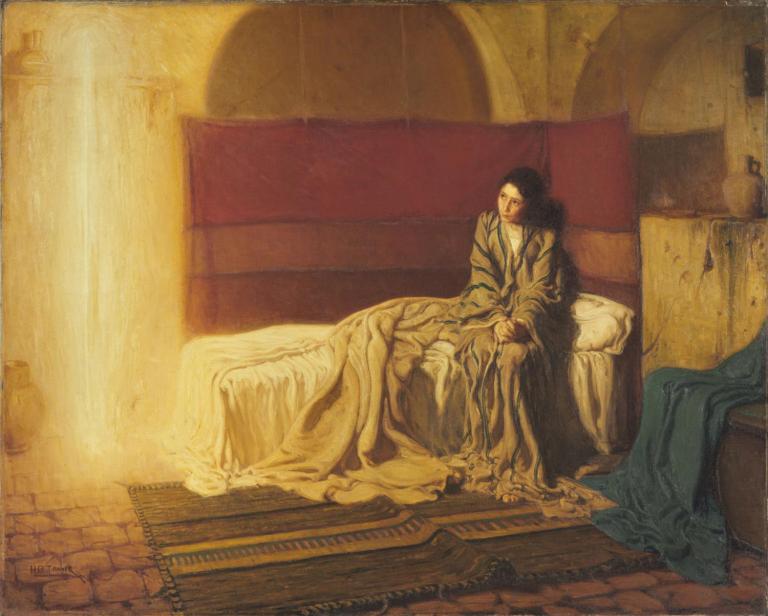
The Annunciation
Henry Ossawa Tanner’s “The Annunciation” is one of my favorite depictions of this pivotal biblical scene where the angel Gabriel announces to Mary that, though she is a virgin, the Holy Spirit will come upon her and she will bear the Son of God. We read about this incredible scene in Luke 1:26-38:
In the sixth month the angel Gabriel was sent from God to a city of Galilee named Nazareth, to a virgin betrothed to a man whose name was Joseph, of the house of David. And the virgin’s name was Mary. And he came to her and said, “Greetings, O favored one, the Lord is with you!” But she was greatly troubled at the saying, and tried to discern what sort of greeting this might be. And the angel said to her, “Do not be afraid, Mary, for you have found favor with God. And behold, you will conceive in your womb and bear a son, and you shall call his name Jesus. He will be great and will be called the Son of the Most High. And the Lord God will give to him the throne of his father David, and he will reign over the house of Jacob forever, and of his kingdom there will be no end.”
And Mary said to the angel, “How will this be, since I am a virgin?”
And the angel answered her, “The Holy Spirit will come upon you, and the power of the Most High will overshadow you; therefore, the child to be born will be called holy—the Son of God. And behold, your relative Elizabeth in her old age has also conceived a son, and this is the sixth month with her who was called barren. For nothing will be impossible with God.” And Mary said, “Behold, I am the servant of the Lord; let it be to me according to your word.” And the angel departed from her.
The main thing I want to say about this painting is how unconventional it is. Very often, artists imbue the annunciation scene with rich and royal colors and depictions of holy action like Mary piously praying or solemnly reading some sacred text. Take Francisco de Zurbarán’s version of the same scene as an example. This massive painting is also housed in the Permanent Collection of the Philadelphia Museum of Art. It is a rich experience reading and comparing both paintings.
Tanner’s composition is quite different. Completed just two years before the turn of the 19thcentury, it was inspired by visions of the people and places he witnessed during a trip to Northern Africa and the Middle East. After touring Egypt and what was then called Palestine, he saw the faces, the fabrics, the framing of dingy Palestinian interiors and painted the annunciation scene from what his eyes witnessed. We could say it is morerealistic, or at least, how it might have looked if one was a fly on that pockmarked wall. To be sure, Tanner creatively portrays the angel Gabriel as a shaft of light (do you know better what an angel looks like?). Nevertheless, we see Mary, the soon to be Mother of God, painted as she is: a young, poor, Jewish girl, alone in an unremarkable room, wearing unremarkable clothes.
Tanner paints the subject with exquisite attention to detail, but it is not overly stylized. He doesn’t entirely reject the “tradition”, but he eschews much of the typical language of Marian hagiography. Or, perhaps better put, he reclaims the holiness of a remarkably unremarkable scene that is transfigured by the angelic visitation and the promise of God’s advent.
Much more could be said about this marvelous painting. I want to focus on how an anonymous girl in a drab room is enlightened and transformed by the advent of God. There is a lesson for us in this as we step in Advent this year.
Reflections on Advent
This year, Advent begins on December 1. The season derives its name from the Latin adventusmeaning “a coming, approach, or arrival.” Because Advent ushers in Christmastide (beginning on Christmas eve and extending over 12 days), our tendency is to think Advent primarily refers to Jesus’ incarnation. However, if we focus exclusively on the birth of Jesus during Advent, we’re being a bit shortsighted.
During Advent we are invited to remember that God saturates the fullness of time, encompassing our past, our future, and our present. As we observe the season of Advent, we are invited to recall afresh the story of what God has done, what He has promised to do, and what he is doing even now. And so, we are invited to celebrate, to cry out, and to pay attention.
We celebrate the greatest advent in human history (to date, at least) as we remember the incarnation. We cry out for the second advent of Jesus Christ when he will come to set all things to rights. We pay attention to how Christ comes to us, enlightening the humdrum of our everyday and invites us to be Christ’s light to the world.
For whatever reason, I am drawn to focus on the present this time around. Tanner’s painting is a wonderful example of how, when God comes to us, he transforms the most mundane, the most drab, the most unremarkable space into holy ground. That is, God transforms our present reality if we, like Mary the Mother of God, say ““Behold, I am the servant of the Lord; let it be to me according to your word.” When we respond with “yes,” he transforms our present into a marvelous encounter with the Living God. I think this is probably another way of saying that Advent helps us to see that such an encounter, such a transfiguration is always and already available every moment. We simply need the Light of the World to see it.
We need Christ’s illumination and perhaps also a little courage. All of this reminds me of one of my favorite passages from Gilead. Marilynne Robinson writes:
It has seemed to me sometimes as though the Lord breathes on this poor gray ember of Creation and it turns to radiance – for a moment or a year or the span of a life. And then it sinks back into itself again, and to look at it no one would know it had anything to do with fire, or light…Wherever you turn your eyes the world can shine like transfiguration. You don’t have to bring a thing to it except a little willingness to see. Only, who could have the courage to see it?
Open your eyes. Take courage y’all. Also, here are some resources that will help you to see God’s coming to you in your day to day this Advent:
Recommended Resources
- Waiting on the Word by Malcolm Guite, an Anglican priest and poet. This is far and away my favorite Advent devotional. It includes a poem with commentary every day from Advent to Epiphany.
- Art of Advent by Jane Williams, the better half of Abp Rowan Williams. Best to buy on Kindle. This includes a painting to contemplate with commentary every day from Advent to Epiphany.
- Advent for Everyone by NT Wright. In this devotional, Bishop Tom leads you through the Gospel of Luke. Great resource by the greatest living Biblical scholar (IMHO).
- Biola Advent Project 2019 an online devotional with Scripture, art, and music. It’s always very well done. Sign up and they send a daily email.
- Advent Spotify Playlist 10-hours of diverse Advent music curated by a friend who blogs at artandtheology.org
“Come, Lord Jesus! The grace of the Lord Jesus be with all. Amen.” (Rev 22:20-21)
Previous Post

November 25, 2019
Should all Christians be vegetarians? Pt. 4: On meat
Next Post
February 21, 2020 Written Prayers: Gifts from Howard Thurman & John Stott
Browse Our Archives
Select a Category Art Current Events Film Music Poetry Review Science and Religion THE ANTLIZT Theology Uncategorized Video
Select a Month December 2021 November 2021 October 2021 September 2021 July 2021 January 2021 June 2020 May 2020 April 2020 March 2020 February 2020 November 2019 October 2019 July 2019 November 2018 August 2018 May 2018 April 2018 March 2018 February 2018 January 2018 December 2017 August 2017 December 2016 October 2016 September 2016 April 2016 September 2015 August 2015 April 2015 February 2015 January 2015 December 2014 November 2014 October 2014 September 2014 August 2014 July 2014 June 2014 May 2014 April 2014 March 2014 February 2014 January 2014
Follow Us!
TAKE THE
Religious Wisdom Quiz
How did Nehemiah show concern for the poor in Jerusalem's community?
Select your answer to see how you score.
He gave up rebuilding He expelled foreigners He canceled debts and returned land He doubled taxes
Related posts from Transcendentalish


The Religious Pull of Politics OR Why you...
Visionings ^4: An Interview with an Iconographer
Visionings ^3: Praying Through Icons
TRENDING AT PATHEOS Evangelical

How the author of the world's best hymn...
I've been working with John Newton for a while now. This makes...

Long before this Lectio Divina, Psalm 130 - the song - started...

What About the Trees? Another Living Parable
After I finished writing the last article about falling leaves as a...

Why Classical Education Is a Conversation, Not a...
Come and Read: Joy in Classical Education When I was a little...

Falling Leaves: A Living Parable on Letting Go
I’ve spent the vast majority of my life in the southeast corner...

Cornell University has received a great deal of negative publicity and intense...
view all Evangelical blogs
Ad-Free & Subscriber Log-In Subscription Support
- About Us
- 2026 Calendar
- Videos
- Podcasts
- Library of World Religions
- Faith In Media Tracker
- Advertise With Us
- Write for Us
- Privacy Policy
- Terms of Service
- Do Not Sell My Data
- Contact Us
- Radiant Digital
- Manage Newsletter Subscriptions
- Unsubscribe From Notifications
- Sitemap
Copyright 2008-2026, Patheos. All rights reserved.
Subscription Support Ad-Free & Subscriber Log-In
Follow Patheos