
BuddhistCatholicContemplativeEvangelicalGeneral ChristianHinduJewishLatter-day SaintMuslimNew VisionsProgressive Christian
Beliefs
- Buddhist
- Catholic
- Contemplative
- Evangelical
- General Christian
- Hindu
- Jewish
- Latter-day Saint
- More Voices
- Muslim
- New Visions
- Pagan
- Progressive Christian
Topics
- Religion News
- Food and Religion
- Sports and Religion
- Religious Art
- Religious Music and Entertainment
- Religious Events
- History and Religion
- Style and Religion
- Politics and Religion
- Women in Religion
- Recreation Outdoors and Religion
- Business Finance and Religion
- Careers Workplace and Religion
- Education and Religion
- Family Parenting and Religion
- Health Fitness and Religion
- Home and Religion
- Relationships and Religion
- Technology and Religion
- Travel and Religion
Columnists
- Buddhist Columnists
- Business Finance and Religion Columnists
- Careers Workplace and Religion Columnists
- Catholic Columnists
- Contemplative Columnists
- Education and Religion Columnists
- Evangelists Columnists
- Family Parenting and Religion Columnists
- General Christian Columnists
- Health Fitness and Religion Columnists
- Hindu Columnists
- History and Religion Columnists
- Home and Religion Columnists
- Jewish Columnists
- More Voices Columnists
- Latter Day Columnists
- Muslim Columnists
- New Visions Columnists
- Nonreligious Columnists
- Pagan Columnists
- Politics and Religion Columnists
- Progressive Columnists
- Recreation Outdoors and Religion Columnists
- Relationships and Religion Columnists
- Religion News Columnists
- Religious Art Columnists
- Religious Events Columnists
- Religious Music and Entertainment Columnists
- Sports and Religion Columnists
- Style and Religion Columnists
- Technology and Religion Columnists
- Travel and Religion Columnists
- Women in Religion Columnists
Resource Library
- 2026 Calendar
- Library of World Religions
- The 100 Most Holy Places on Earth
- Patheos Answers
- Podcasts
- Videos
- Faith Leaders Database
- Anglican Episcopalian
- Bahai
- Baptist
- Buddhism
- Christianity
- Confucianism
- Eastern Orthodoxy
- Hinduism
- Holiness and Pentecostal
- ISKCON
- Islam
- Judaism
- Lutheran
- Methodist
- The Church of Jesus Christ of Latter-day Saints
- New Age
- Paganism
- Presbytarian and Reformed
- Protestantism
- Religion Behind the Scenes
- Roman Catholic
- Scientology
- Shia Islam
- Sikhism
- Sufism
- Sunni Islam
- Taoism
- Zen
- See all religions
Research Tools
 Ad-Free & Subscriber Log-In Subscription Support
Ad-Free & Subscriber Log-In Subscription Support
Follow Patheos 

- Trending:
- Forgiveness
- |
- Marriage
- |
- Consciousness
- |
- Death Penalty
- |
- Election
- |
- Halloween
 Transcendentalish
- Home
- Evangelical
- On Bon Iver, Charles Taylor, and Locating Ourselves in the World, OR An Exercise In Intertextuality
On Bon Iver, Charles Taylor, and Locating Ourselves in the World, OR An Exercise In Intertextuality
Last updated on: October 29, 2019 at 1:24 am by Mark Craymor
On Bon Iver, Charles Taylor, and Locating Ourselves in the World, OR An Exercise In Intertextuality 2019-10-29T01:24:40+00:00 Mark Craymor
Patheos Explore the world's faith through different perspectives on religion and spirituality! Patheos has the views of the prevalent religions and spiritualities of the world.
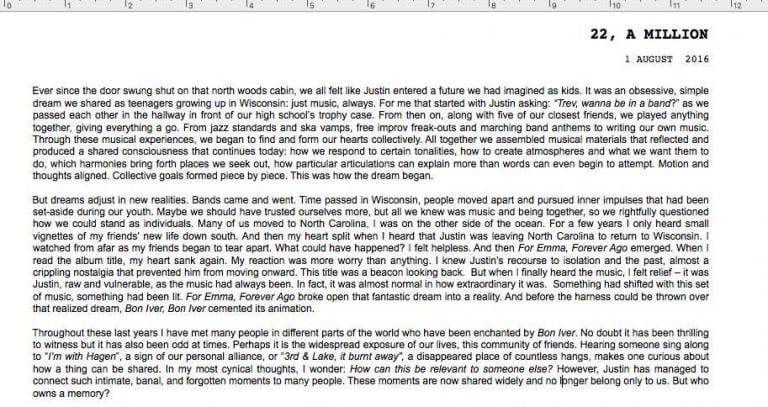
I had the opportunity to hear Bon Iver in concert a couple weeks back. 33, “GOD” was one of my favorite songs of the set and it is my favorite song from his previous record 22, A Million. It is one of the songs I have listened to the most the past three years – easily dozens of times. After hearing it live, I decided to revisit the song. I think it’s one of the songs that is most representative of our epoch. It’s almost as if its inspired by the zeitgeist.
In this post, I want to consider the meaning of this profound song. I think if we begin to understand what the song is all about, it will help us understand our cultural moment.
The key to the song is in its intertextuality. Intertextuality describes the relationship between texts whereby one text is read in light of another. In this case, we’ll mostly consider the songs Justin Vernon samples. There’s a lot going on with the song in terms of its interaction with other texts. I’ll review some of it here…but first here’s the song. I recommend listening to it in its entirety.
Layers of Intertextuality
Layer One: 33
Before getting into the song itself, I’ll first point out some details about its title and release. The song was released as a single on August 29, 2016 – 33 days before the album was released. It is 3:33 long. The title has “33” in it. Clearly, Justin Vernon wants us to see the 33 as significant. What do 33 and GOD have in common? The most obvious answer is this is a clear reference to the age that Jesus’ was crucified. This is the first instance of intertextuality.
Layer Two: Psalm 22
The second layer of intertextuality is the citation of Psalm 22:1. The song ends with words from this important psalm, perhaps best known from its citation in the gospels (3:09). It’s a bit hard to make it out because Vernon’s voice is so heavily distorted but the last words of the song are: “Why are you so far from saving me?” So, from the first introduction of the song to its final words, Vernon frames this song with the death of Jesus Christ. Whether this an embrace or repudiation is unclear, but this is the event out of which much (most?) of western art has emerged.
In addition to these references to the death of God, Vernon also samples from several songs. We’ll just look at three: “Morning” by Jim Ed Brown; “Iron Sky” by Paolo Nutini; and “Looking for All” by Lonnie Holley.
Layer 3: “Morning” by Jim Ed Brown from Morning (1971)
I know so well, that this is all there is
And when we leave this room it’s gone
My mind is clear as we walk down
The crooked little steps to the front doorA ray of sun that ricoches
From off a rooftop light our stumbling way
I touch your hand and feel your ring
And know this night is all we’ll ever have
The first song sampled is “Morning” by Jim Ed Brown. This song is about a man sleeping with another man’s wife. It intimates at a kind of orgasmic desire; the human longing for ecstasy and connection that simply cannot endure. There is a sense of eternal longing met with impermanence. The song embodies a sad ephemerality: a fleeting night, a fleeting light upon the walls. The desire for communion, for a kind of eternal bliss is sought inappropriately and, like the morning mist, is burned up by the sun, dissolving into the ether.
Layer 4: “Iron Sky” by Paolo Nutini from Caustic Love (2014)
We find god and religions too,
To paint us with salvation.
But no one,
No nobody,
Can give you the power,To rise over love,
And over hate,
Through this iron sky,
That’s fast becoming our minds.
Over fear and into freedom.
The second song sampled is “Iron Sky” by Paolo Nutini.The line that Vernon samples suggests transcendence has broken into immanence. God has been found. Or has He? If you continue to listen to “Iron Sky” you quickly realize the opposite is true. It’s almost the reverse of how we see Jesus using Psalm 22, which begins with despair and ends with hope. We may find gods and religion but they fail to make good on their promises. These are impotent to help us overcome. The song is a thoroughly late modern anthem embodying a kind of post/Enlightenment liberalism in a post/Christian world. It is secular, humanistic, skeptical and yet a hopeful anthem where freedom is the highest good achieved when we free our minds from hate and fear, from dictators and propaganda.
Locating Ourselves
As I imagine it, listening to the song is something like eavesdropping on Justin Vernon’s consciousness. We overhear a patchwork of random half-echoes of memories threaded through with snippets of songs. Is this song a kind of memory? If it is, it’s been so heavily slughorned that it is pushes and pulls at the same time. It is intimate and elusive by intention.
In the end, 33 “GOD” is not really a memory. It is a heavily produced song with a seemingly high degree of intentionality and meaning. Vernon is trying really hard to say something. We turn our attention to what 33 “GOD” means.
This track gives expression to Justin Vernon’s personal experience of the world and, in so doing, it expresses the tenor of our times. Interestingly, the song aligns in a remarkable way with what Charles Taylor unpacks in A Secular Age.
If the album “liner notes” are any indication, at least part of the genesis of this album was born out of the crisis of Vernon becoming famous for bearing his soul to listeners while they remain perfect strangers. The album is “part love letter, part final resting place of two decades of searching for self-understanding like a religion.” 33, “GOD” expresses intimacy and elusiveness, connection and confusion. It offers an obscured glimpse into a narrativing of memory fragments that are conversing antiphonally with the sampled songs. Vernon expresses a yearning for transcendence, connection, meaning, eternity in the midst of seemingly banal episodes of his life. It seems clear that the scratch isn’t itched. It is less clear if Vernon thinks this is even possible.
Through the lens of Vernon’s personal wrestling, the song proves insightful for understanding our own times, what Charles Taylor calls our secular age. The song, especially its inclusion of the Brown and Nutini samples, aptly expresses Charles Taylor’s notion of the Immanent Frame. The idea of the immanent frame is that humans in the late modern world understand themselves as living in a natural as opposed to a supernatural world. According to this implicit understanding of the world – this social imaginary – there is nothing beyond, there is no transcendence. We live in a world with an iron sky. Nevertheless, humans remain haunted by the ghosts of ultimate, transcendent meaning and purpose. We desire eternity but life is fleeting. We seek transcendence out but the hunt is thwarted. We lift our heads to the heavens butbang our heads on a low, hard ceiling.
Taylor explains this phenomenon as being “cross-pressured.” We are pulled one way by the gravity of transcendence and sucked back by the vacuum of immanence. Being frustrated by the inability to access the transcendent and the inadequacy of an immanent order leads to the Nova Effect. The Nova Effect describes the emergence of new options, secular alternatives, for making sense of the world and ourselves in it. Essentially, each person is left to determine her own way of being human. The individual establishes her own rule for the good.
Layer 6: “Looking for All” by Lonnie Holley from Just Before Music (2012)
I think we see something akin to this in Vernon’s sampling of Lonnie Holley’s “Looking For All.” Holley’s song is clear: meaning, truth are rendered from within the person. It is the perhaps role of the artist above all people to make this kind of meaning manifest. Maybe this is where Vernon ultimately lands. Maybe individual artistic expression is somehow the way in which all truth is rendered, the way in which a sense of transcendence is attained?
Perhaps. But this doesn’t seem to be the case. Or, at least, this is not the final word. The final word is indicative insofar as it is interrogative. At the end of the song, Vernon cries out with a question. He cites Christ who is citing Psalm 22: “Why are you so far from saving me?” So many layers. The song is left open. Psalm 22 opens up 33, “GOD” and the lid isn’t shut.
This is part of what makes the song so good. It is also why, if I had to identify a song that captures our times, 33, “GOD” would be at the top of the list. Existence, like the song, is not tied together into a neat bow. In the final analysis, if someone wanted to understand where we are, I would be hard-pressed to find a more suitable song than 33, “GOD” to capture the tensions between our desires and their frustrations we late moderns experience in our secular age.
Previous Post

July 18, 2019
The Tragedy of American Machiaevangelicals
Next Post

November 22, 2019 Should all Christians be vegetarians? Pt. 3: On death
Browse Our Archives
Select a Category Art Current Events Film Music Poetry Review Science and Religion THE ANTLIZT Theology Uncategorized Video
Select a Month December 2021 November 2021 October 2021 September 2021 July 2021 January 2021 June 2020 May 2020 April 2020 March 2020 February 2020 November 2019 October 2019 July 2019 November 2018 August 2018 May 2018 April 2018 March 2018 February 2018 January 2018 December 2017 August 2017 December 2016 October 2016 September 2016 April 2016 September 2015 August 2015 April 2015 February 2015 January 2015 December 2014 November 2014 October 2014 September 2014 August 2014 July 2014 June 2014 May 2014 April 2014 March 2014 February 2014 January 2014
Follow Us!
TAKE THE
Religious Wisdom Quiz
What was the first miracle performed by Elisha?
Select your answer to see how you score.
Parting the Jordan River Multiplying oil Healing Naaman’s leprosy Raising a boy from the dead
Related posts from Transcendentalish


Visionings ^4: An Interview with an Iconographer
Visionings ^3: Praying Through Icons
TRENDING AT PATHEOS Evangelical

How the author of the world's best hymn...
I've been working with John Newton for a while now. This makes...

Long before this Lectio Divina, Psalm 130 - the song - started...

What About the Trees? Another Living Parable
After I finished writing the last article about falling leaves as a...

Why Classical Education Is a Conversation, Not a...
Come and Read: Joy in Classical Education When I was a little...

Falling Leaves: A Living Parable on Letting Go
I’ve spent the vast majority of my life in the southeast corner...

Cornell University has received a great deal of negative publicity and intense...
view all Evangelical blogs
Ad-Free & Subscriber Log-In Subscription Support
- About Us
- 2026 Calendar
- Videos
- Podcasts
- Library of World Religions
- Faith In Media Tracker
- Advertise With Us
- Write for Us
- Privacy Policy
- Terms of Service
- Do Not Sell My Data
- Contact Us
- Radiant Digital
- Manage Newsletter Subscriptions
- Unsubscribe From Notifications
- Sitemap
Copyright 2008-2026, Patheos. All rights reserved.
Subscription Support Ad-Free & Subscriber Log-In
Follow Patheos