
BuddhistCatholicContemplativeEvangelicalGeneral ChristianHinduJewishLatter-day SaintMuslimNew VisionsProgressive Christian
Beliefs
- Buddhist
- Catholic
- Contemplative
- Evangelical
- General Christian
- Hindu
- Jewish
- Latter-day Saint
- More Voices
- Muslim
- New Visions
- Pagan
- Progressive Christian
Topics
- Religion News
- Food and Religion
- Sports and Religion
- Religious Art
- Religious Music and Entertainment
- Religious Events
- History and Religion
- Style and Religion
- Politics and Religion
- Women in Religion
- Recreation Outdoors and Religion
- Business Finance and Religion
- Careers Workplace and Religion
- Education and Religion
- Family Parenting and Religion
- Health Fitness and Religion
- Home and Religion
- Relationships and Religion
- Technology and Religion
- Travel and Religion
Columnists
- Buddhist Columnists
- Business Finance and Religion Columnists
- Careers Workplace and Religion Columnists
- Catholic Columnists
- Contemplative Columnists
- Education and Religion Columnists
- Evangelists Columnists
- Family Parenting and Religion Columnists
- General Christian Columnists
- Health Fitness and Religion Columnists
- Hindu Columnists
- History and Religion Columnists
- Home and Religion Columnists
- Jewish Columnists
- More Voices Columnists
- Latter Day Columnists
- Muslim Columnists
- New Visions Columnists
- Nonreligious Columnists
- Pagan Columnists
- Politics and Religion Columnists
- Progressive Columnists
- Recreation Outdoors and Religion Columnists
- Relationships and Religion Columnists
- Religion News Columnists
- Religious Art Columnists
- Religious Events Columnists
- Religious Music and Entertainment Columnists
- Sports and Religion Columnists
- Style and Religion Columnists
- Technology and Religion Columnists
- Travel and Religion Columnists
- Women in Religion Columnists
Resource Library
- 2026 Calendar
- Library of World Religions
- The 100 Most Holy Places on Earth
- Patheos Answers
- Podcasts
- Videos
- Faith Leaders Database
- Anglican Episcopalian
- Bahai
- Baptist
- Buddhism
- Christianity
- Confucianism
- Eastern Orthodoxy
- Hinduism
- Holiness and Pentecostal
- ISKCON
- Islam
- Judaism
- Lutheran
- Methodist
- The Church of Jesus Christ of Latter-day Saints
- New Age
- Paganism
- Presbytarian and Reformed
- Protestantism
- Religion Behind the Scenes
- Roman Catholic
- Scientology
- Shia Islam
- Sikhism
- Sufism
- Sunni Islam
- Taoism
- Zen
- See all religions
Research Tools
 Ad-Free & Subscriber Log-In Subscription Support
Follow Patheos 

- Trending:
- Advent
- |
- Forgiveness
- |
- Thanksgiving
- |
- Election
- |
- Seasonal Holidays
- |
- Marriage
 Transcendentalish
- Home
- Evangelical
- Cultivating Intellectual Humility: a Lesson from the Chartres Cathedral and C.S. Lewis
Cultivating Intellectual Humility: a Lesson from the Chartres Cathedral and C.S. Lewis
Last updated on: August 22, 2018 at 4:42 pm by Mark Craymor
Cultivating Intellectual Humility: a Lesson from the Chartres Cathedral and C.S. Lewis 2018-08-22T16:42:25+00:00 Mark Craymor
Patheos Explore the world's faith through different perspectives on religion and spirituality! Patheos has the views of the prevalent religions and spiritualities of the world.
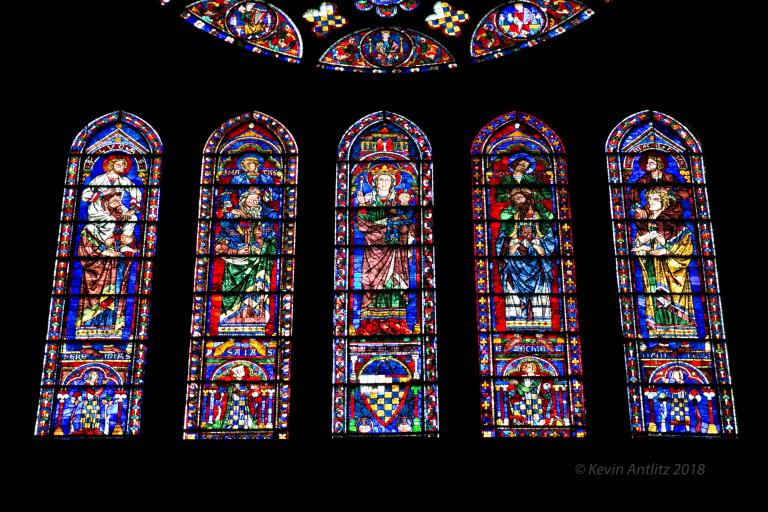
[Photo taken by author] In this series of lancets located below the south rose window of the Chartres Cathedral, the four evangelists are perched upon the shoulders of their forebears, the prophets. From left to right: the good doctor sits on Jeremiah, Matthew on Isaiah, John on Ezekiel, and Mark on Daniel. The story told by these windows is that the evangelists’ vision of Christ is dependent upon the Old Testament prophets. They saw what they did only because they sat on the shoulders of giants.
The first thing I should say is that this cathedral is a library. I want you to imagine the stone as the binding and the windows and sculptures as the pages and texts. Each is a book full of knowledge. In our brief time together, I want to help you begin to read them.
With something like these words (I paraphrase), Malcolm Miller, the world’s leading expert of the miraculous marvel of medieval stone, stained glass, and genius began my recent tour of the Chartres Cathedral. Completed in 1220, the Cathedral is in surprisingly excellent condition having survived 800 years of political and religious tumult relatively unscathed. Located about 60 miles southwest of Paris, the cathedral boasts the world’s largest collection of medieval stained glass. Around 150 of the original 13th century stained glass windows are wonderfully preserved, making Chartres the quintessential gothic cathedral. Each of the windows illuminates Biblical (and sometimes extra-biblical) stories told through the imaginary of medieval theology, cosmology, and symbolism.
Because most of the pilgrims who journeyed to this holy site over the centuries were illiterate, the master craftsmen who designed and constructed the cathedral effectively taught the Bible to the faithful. Their handiwork continues to share the light of the gospel through the stories carved in stone and painted in colored glass. The cathedral is a library.
Just as the position of sun lights up some windows while leaving others looking like sheets of opaque lead, some were absolutely brilliant and provided me with fresh insights into the Scriptures and Christian theology. I was pleasantly surprised at just how often rich and robust theology shone through the colored panes. Other stories told through the windows, however, were dark to my view and remained foreign or mysterious to me, a 21st century pilgrim.
The Good Samaritan and Adam and Eve Window is a fine example. Located along the south wall of the nave, this window allegorically “combines the parable of the Good Samaritan with the narrative of creation and fall of Adam and Eve, thereby illustrating a symbolic interpretation of Christ’s parable that was popular in the Middle Ages.” [1] This type of allegorical interpretation is not in vogue today but was not at all uncommon fare for medieval Christians. Stained glass windows combining these same two biblical stories are found in other medieval cathedrals like Bourges and Sens is evidence for this.
There were dozens of other examples; this is but one instance of a lesson taught in stone or glass that struck me as strange. I bring it up not to defend or refute allegorical interpretations of Scripture (a perennial debate in biblical hermeneutics), but to highlight a temptation I faced in the cathedral. As a modern, educated, post-Enlightenment theologian, there were a couple times when I found myself tempted to turn up my nose at ideas or beliefs medieval Christians held sacred. They were foreign to my modern theological and hermeneutical sensibilities. They didn’t correspond to my understanding of God, the Bible, or the world. After all, didn’t some of these strange ideas have an expiration date somewhere around the year 1500?
Allowing this kind of thinking to go unexamined and unchecked is to be guilty of a type of cultural arrogance, which can anesthetize us to the vision of truth seen by other ages. C.S. Lewis named this line of faulty thinking “chronological snobbery.” In Surprised by Joy, he defines chronological snobbery as “the uncritical acceptance of the intellectual climate common to our own age and the assumption that whatever has gone out of date is on that account discredited.” [2] This fallacy assumes that the progress of time necessarily corresponds to the progress of true ideas. It is the mistaken belief that new ideas are right and old ideas are wrong or as J.I. Packer has put it: “the newer is the truer, only what is recent is decent.” [3] One must not reject an idea simply because it is from a different time and has gone out of date. Rather, writes Lewis, “You must find out why it went out of date. Was it ever refuted (and if so by whom, where, and how conclusively) or did it merely die away as fashions do? If the latter, this tells us nothing about its truth or falsehood.” [4]
But it is not enough to merely be open to the luminaries whose ideas are so strange they seem lightyears away. Lewis argues that we ought to seek them out. In his Introduction to On the Incarnation by Athanasius, Lewis argues that the best way to combat chronological snobbery is to adopt the rule of reading one old book between every new one. He writes:
Every age has its own outlook. It is specially good at seeing certain truths and liable to make certain mistakes. We all, therefore, need the books that will correct the characteristic mistakes of our own period…the only palliative is to keep the clean sea breeze of the centuries blowing through our minds, and this can be done only by reading old books. Not, of course, that there is any magic about the past. People were no cleverer then than they are now; they made as many mistakes as we. But not the same mistakes…Two heads are better than one, not because either is infallible, but because they are unlikely to go wrong in the same direction. [5]
What this requires, then, is a kind of intellectual humility, a virtue in short supply in our culture.
This brings me back to the cathedral. In his biography of the cathedral called Universe of Stone, Phillip Ball writes that the structure of the Chartres Cathedral maps out the medieval conception of the universe. The relationships between God and humanity, heaven and earth, good and evil, life and death are encoded in a complex set of symbols and structures with varying degrees of accessibility to the modern pilgrim.
“This intelligible beauty that the builders of the cathedrals sought to convey was not an aesthetic but a moral reality. The medieval church was a representation – more precisely, an evocation – of the celestial Jerusalem,” writes Ball. [6] If the medieval picture of the universe is strange, it is because the cathedral is actually from another world. Minding Lewis, we ought not for this reason to discredit the vision. Instead, we must ask: what did they see that we do not?
St. Peter describes the church in language that evokes a medieval cathedral: “you yourselves like living stones, are being built up as a spiritual house” (1Pet 2:4). Christians from every age are being built up into a kind of spiritual cathedral. Each stone is dependent upon the other. In the same way that no section of the cathedral remains fully illuminated throughout the day, no single generation can claim to see the full spectrum of God’s light. Cultural blind spots remain inevitable. This is, of course, until heaven comes down to earth and God fully and finally dwells with us in the celestial city of the age to come. In that day, there will be no more blindness. All will be illuminated for “night will be no more. They will need no light of lamp or sun, for the Lord God will be their light” (Rev 22:5).
Until that day, let us read old books …and old cathedrals.
[1] Malcolm Miller, Chartres Cathedral (New York: Riverside Book Co., 2001), 64.
[2] C.S. Lewis, Surprised by Joy (New York: Harcourt, Inc., 1955), 207.
[3] J.I. Packer, Doing Theology in Today’s World (Grand Rapids: Zondervan, 1991), 21.
[4] Lewis, Surprised by Joy, 207-208.
[5] Lewis, Introduction to On the Incarnation, (Crestwood: St Vladimir’s Seminary Press, 1996), 4-5.
[6] Phillip Ball, Universe of Stone: a Biography of Chartres Cathedral (New York: Harper, 2008), 56.
Previous Post

May 16, 2018
THE ANTLIZT: May 16, 2018
Next Post

November 28, 2018 Advent Book Recommendation: Malcolm Guite's Waiting on the Word
Browse Our Archives
Select a Category Art Current Events Film Music Poetry Review Science and Religion THE ANTLIZT Theology Uncategorized Video
Select a Month December 2021 November 2021 October 2021 September 2021 July 2021 January 2021 June 2020 May 2020 April 2020 March 2020 February 2020 November 2019 October 2019 July 2019 November 2018 August 2018 May 2018 April 2018 March 2018 February 2018 January 2018 December 2017 August 2017 December 2016 October 2016 September 2016 April 2016 September 2015 August 2015 April 2015 February 2015 January 2015 December 2014 November 2014 October 2014 September 2014 August 2014 July 2014 June 2014 May 2014 April 2014 March 2014 February 2014 January 2014
Follow Us!
TAKE THE
Religious Wisdom Quiz
What nation took Israel into captivity in 722 BC?
Select your answer to see how you score.
Egypt Persia Assyria Babylon
Related posts from Transcendentalish


The Religious Pull of Politics OR Why you...
Visionings ^4: An Interview with an Iconographer
Visionings ^3: Praying Through Icons
TRENDING AT PATHEOS Evangelical

Making Stones Into Bread: Choosing the “Right” Work
I was on my online arts ministry Zoom meeting with the International...

Ukraine’s exhausted Christians face fifth winter of war
By Julian Lukins The full-scale war in Ukraine is taking “a serious...

Russell Brand's Conviction is not anti-Christian Persecution
How do we shed the reputation that the Church is OK with...

Have you ever caught yourself saying, “I’ll do it tomorrow,” or “Now...

Write Your Story: A Great Way to Find...
A few month’s back, my son was scrolling around Facebook and saw...

Throughout history, people have pursued pleasure, possessions, relationships, and success in an...
view all Evangelical blogs
Ad-Free & Subscriber Log-In Subscription Support
- About Us
- 2026 Calendar
- Videos
- Podcasts
- Library of World Religions
- Faith In Media Tracker
- Advertise With Us
- Write for Us
- Privacy Policy
- Terms of Service
- Do Not Sell My Data
- Contact Us
- Radiant Digital
- Manage Newsletter Subscriptions
- Unsubscribe From Notifications
- Sitemap
Copyright 2008-2026, Patheos, part of the Radiant Digital network of media brands. All rights reserved.
Subscription Support Ad-Free & Subscriber Log-In
Follow Patheos