
BuddhistCatholicContemplativeEvangelicalGeneral ChristianHinduJewishLatter-day SaintMuslimNew VisionsProgressive Christian
Beliefs
- Buddhist
- Catholic
- Contemplative
- Evangelical
- General Christian
- Hindu
- Jewish
- Latter-day Saint
- More Voices
- Muslim
- New Visions
- Pagan
- Progressive Christian
Topics
- Religion News
- Food and Religion
- Sports and Religion
- Religious Art
- Religious Music and Entertainment
- Religious Events
- History and Religion
- Style and Religion
- Politics and Religion
- Women in Religion
- Recreation Outdoors and Religion
- Business Finance and Religion
- Careers Workplace and Religion
- Education and Religion
- Family Parenting and Religion
- Health Fitness and Religion
- Home and Religion
- Relationships and Religion
- Technology and Religion
- Travel and Religion
Columnists
- Buddhist Columnists
- Business Finance and Religion Columnists
- Careers Workplace and Religion Columnists
- Catholic Columnists
- Contemplative Columnists
- Education and Religion Columnists
- Evangelists Columnists
- Family Parenting and Religion Columnists
- General Christian Columnists
- Health Fitness and Religion Columnists
- Hindu Columnists
- History and Religion Columnists
- Home and Religion Columnists
- Jewish Columnists
- More Voices Columnists
- Latter Day Columnists
- Muslim Columnists
- New Visions Columnists
- Nonreligious Columnists
- Pagan Columnists
- Politics and Religion Columnists
- Progressive Columnists
- Recreation Outdoors and Religion Columnists
- Relationships and Religion Columnists
- Religion News Columnists
- Religious Art Columnists
- Religious Events Columnists
- Religious Music and Entertainment Columnists
- Sports and Religion Columnists
- Style and Religion Columnists
- Technology and Religion Columnists
- Travel and Religion Columnists
- Women in Religion Columnists
Resource Library
- 2026 Calendar
- Library of World Religions
- The 100 Most Holy Places on Earth
- Patheos Answers
- Podcasts
- Videos
- Faith Leaders Database
- Anglican Episcopalian
- Bahai
- Baptist
- Buddhism
- Christianity
- Confucianism
- Eastern Orthodoxy
- Hinduism
- Holiness and Pentecostal
- ISKCON
- Islam
- Judaism
- Lutheran
- Methodist
- The Church of Jesus Christ of Latter-day Saints
- New Age
- Paganism
- Presbytarian and Reformed
- Protestantism
- Religion Behind the Scenes
- Roman Catholic
- Scientology
- Shia Islam
- Sikhism
- Sufism
- Sunni Islam
- Taoism
- Zen
- See all religions
Research Tools
 Ad-Free & Subscriber Log-In Subscription Support
Ad-Free & Subscriber Log-In Subscription Support
Follow Patheos 

- Trending:
- Forgiveness
- |
- Marriage
- |
- Consciousness
- |
- Death Penalty
- |
- Election
- |
- Halloween
 Transcendentalish
- Home
- Evangelical
- Should all Christians become vegetarians? Pt. 2: On creation
Should all Christians become vegetarians? Pt. 2: On creation
Last updated on: November 23, 2019 at 8:24 pm by Mark Craymor
Should all Christians become vegetarians? Pt. 2: On creation 2019-11-23T20:24:08+00:00 Mark Craymor
Patheos Explore the world's faith through different perspectives on religion and spirituality! Patheos has the views of the prevalent religions and spiritualities of the world.

This is Part 2 in a series of posts exploring the question “Should all Christians become vegetarians?”
In Part 1, I tried to lay the foundation for why this question is one that Christians, particularly American Christians, ought to take seriously.
I concluded the first part with the great quote from Alasdair MacIntyre: “I can only answer the question ‘What am I to do?’ if I can answer the prior question ‘Of what story or stories do I find myself a part?’” In Part 2, I will outline a biblical theology of creation in order to help locate ourselves in the biblical metanarrative. This will help us answer the foundational questions: “Who is God?”, “Why did God create the world?”, and “What are humans for?” As we do this, the answer to our central question “Should all Christians become vegetarians?” will come into sharper focus.
Framework Hypothesis
Genesis 1 is the best place to begin exploring who God is, why He created the world, and what humans are for. The point of the first chapter of Genesis is not to highlight how God created the world (and definitely not how long it took!). The primary point is the Genesis 1 is why God created the world.
One of the best ways to understand the meaning of Genesis 1 is through the interpretive lens of the Framework Hypothesis. This hermeneutic avoids an overly literalistic interpretation with a focus not so much on the chronological progression of the days but the logical connection between the days.
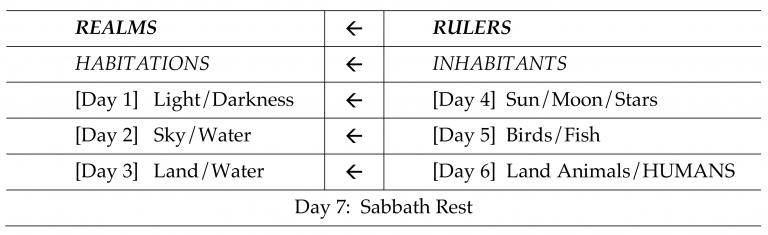
Looking at Genesis 1 through this framework really opens it up. Construed this way, Days 1-3 (first triad) correspond to Days 4-6 (second triad). At one level, Days 1-3 describe habitations and Days 4-6 outline the corresponding inhabitants. At a deeper level, Days 1-3 describe the realms and Days 4-6 outline the corresponding rulers. The interpretive key is first found in Day 4 and then again in Day 6.
On Day 4 God created the sun, moon, and stars. These are the inhabitants of the day and of the night (habitations). More specifically, we read God made the sun to rule the day and the moon to rule the night – “And God set them in the expanse of the heavens to give light on the earth, to rule over the day and over the night, and to separate the light from the darkness” (Gen 1:17-18).
We see a similar governing motif on Day 6, when God creates human beings. We read that God created human beings in the “image of God.” It’s tempting to import other ideas into the text here about what it means to be made in the image of God. For example, some argue that to be made in the image of God is an ontological description, referring to something about our essence that distinguishes us from other creatures (e.g., we have souls, we have reason, etc.). However, in the context of Genesis 1 and 2, the image language is clearly functional. It refers to the role humans are to play as rulers over the earth. Human beings are vice-regents who represent God in the world. As the image of God, humans are to represent God in the world, acting as if God would act.
As Norman Wirzba notes in The Paradise of God, image bearers “are called upon to bear witness and emulate the creator’s intention.” To this intention we now turn.
Cultural Mandate
I want to highlight two key passages in understanding the purpose for which human beings were created. Together, these comprise what theologians call the Cultural Mandate.
26 Then God said, “Let us make man in our image, after our likeness. And let them have dominion over the fish of the sea and over the birds of the heavens and over the livestock and over all the earth and over every creeping thing that creeps on the earth.” 27 So God created man in his own image, in the image of God he created him; male and female he created them. 28 And God blessed them. And God said to them, “Be fruitful and multiply and fill the earth and subdue it and have dominion over the fish of the sea and over the birds of the heavens and over every living thing that moves on the earth.” (Genesis 1:26-28)
15 The Lord God took the man and put him in the garden of Eden to work it and keep it. 16 And the Lord God commanded the man, saying, “You may surely eat of every tree of the garden, 17 but of the tree of the knowledge of good and evil you shall not eat, for in the day that you eat of it you shall surely die.” (Gen 2:15-17)
In these verses, we read that to be made in the image of God means to be entrusted with a particular function, namely exercising dominion over all that God created. Humans are to fill the earth and subdue it. Humans are “to work” the garden and “keep it.”
If we dig into the Hebrew words for these last two commands, we’ll find that this means humans are to serve the garden by helping it flourish and to protect the garden from being abused or desecrated. (I don’t have the space to talk about it here but these two verbs are the same verbs used to describe the work of Levitical priests in Israel’s temple [see Numbers 18:7]. This is in keeping with another insightful and complementary reading of Genesis 1-2 as God’s temple called the “Cosmic Temple View.”)
To bring it all together, here’s an excellent synopsis of the Cultural Mandate. Mike Metzger describes it this way in his essay “The Plus Four Solution”:
The Cultural Mandate describes the creational pattern intrinsic to the way reality works. The substance of the mandate is to be creative. The scope is all creation. The stewardship is promoting flourishing or maximizing latent potential. The Cultural Mandate explains what everyone is hard-wired to do everyday. It is the ‘human job description.’
I love the language used here. This is the human job description. As stewards of creation, our responsibility as human beings is to direct our creativity and ingenuity to cultivate the raw material of creation so that it comes to full bloom.
Three Key Points
I want to highlight a few things. The first thing I want to make note of is something that never ceases to surprise me. God’s intention for the primary means by which humans would serve, honor, and glorify God had nothing to do with the “spiritual” things we often associate with being a good Christian. It had everything to do with humans being obedient to God by fulfilling their task which was to be good farmers, tending to the plants and animals, cultivating and caring for creation responsibly. In a word, to obey the cultural mandate.
Second, I want to point out that this original human job description still applies. Obviously we’re not all farmers but the principles apply to all good work. Caring for creation is central to what it means to be human and consequently what it means to be a Christian. This is an emphasis we’ve clearly lost. When’s the last time you heard a sermon on the 21st century’s ecological crises and our responsibility to promote ecological justice?
Third, I’d like to highlight the fact that the one prohibition before the fall has to do with consumption. I find that to be very interesting, especially when considering our topic “Should all Christians be vegetarian?” The inner heart disposition could be described as pride, or rebellion, or distrust. The first sinful action was inappropriate consumption. Surely this raises interesting questions for us.
Next Steps
Surfacing the issue of consumption is a great place transition to Part 3. In this next part we’ll continue developing a biblical theology of creation with a focus on what the Scriptures have to say about death and eating meat before the fall, after the fall, and in the age to come.
Previous Post

February 21, 2018
THE ANTLIZT: February 21, 2018
Next Post
February 28, 2018 THE ANTLIZT: February 28, 2018
Browse Our Archives
Select a Category Art Current Events Film Music Poetry Review Science and Religion THE ANTLIZT Theology Uncategorized Video
Select a Month December 2021 November 2021 October 2021 September 2021 July 2021 January 2021 June 2020 May 2020 April 2020 March 2020 February 2020 November 2019 October 2019 July 2019 November 2018 August 2018 May 2018 April 2018 March 2018 February 2018 January 2018 December 2017 August 2017 December 2016 October 2016 September 2016 April 2016 September 2015 August 2015 April 2015 February 2015 January 2015 December 2014 November 2014 October 2014 September 2014 August 2014 July 2014 June 2014 May 2014 April 2014 March 2014 February 2014 January 2014
Follow Us!
TAKE THE
Religious Wisdom Quiz
Which book follows the Gospels in the New Testament?
Select your answer to see how you score.
Hebrews Acts Romans 1 Corinthians
Related posts from Transcendentalish

The Religious Pull of Politics OR Why you...
Visionings ^4: An Interview with an Iconographer
Visionings ^3: Praying Through Icons
TRENDING AT PATHEOS Evangelical

How the author of the world's best hymn...
I've been working with John Newton for a while now. This makes...

Long before this Lectio Divina, Psalm 130 - the song - started...

What About the Trees? Another Living Parable
After I finished writing the last article about falling leaves as a...

Why Classical Education Is a Conversation, Not a...
Come and Read: Joy in Classical Education When I was a little...

Falling Leaves: A Living Parable on Letting Go
I’ve spent the vast majority of my life in the southeast corner...

Cornell University has received a great deal of negative publicity and intense...
view all Evangelical blogs
Ad-Free & Subscriber Log-In Subscription Support
- About Us
- 2026 Calendar
- Videos
- Podcasts
- Library of World Religions
- Faith In Media Tracker
- Advertise With Us
- Write for Us
- Privacy Policy
- Terms of Service
- Do Not Sell My Data
- Contact Us
- Radiant Digital
- Manage Newsletter Subscriptions
- Unsubscribe From Notifications
- Sitemap
Copyright 2008-2026, Patheos. All rights reserved.
Subscription Support Ad-Free & Subscriber Log-In
Follow Patheos