
BuddhistCatholicContemplativeEvangelicalGeneral ChristianHinduJewishLatter-day SaintMuslimNew VisionsProgressive Christian
Beliefs
- Buddhist
- Catholic
- Contemplative
- Evangelical
- General Christian
- Hindu
- Jewish
- Latter-day Saint
- More Voices
- Muslim
- New Visions
- Pagan
- Progressive Christian
Topics
- Religion News
- Food and Religion
- Sports and Religion
- Religious Art
- Religious Music and Entertainment
- Religious Events
- History and Religion
- Style and Religion
- Politics and Religion
- Women in Religion
- Recreation Outdoors and Religion
- Business Finance and Religion
- Careers Workplace and Religion
- Education and Religion
- Family Parenting and Religion
- Health Fitness and Religion
- Home and Religion
- Relationships and Religion
- Technology and Religion
- Travel and Religion
Columnists
- Buddhist Columnists
- Business Finance and Religion Columnists
- Careers Workplace and Religion Columnists
- Catholic Columnists
- Contemplative Columnists
- Education and Religion Columnists
- Evangelists Columnists
- Family Parenting and Religion Columnists
- General Christian Columnists
- Health Fitness and Religion Columnists
- Hindu Columnists
- History and Religion Columnists
- Home and Religion Columnists
- Jewish Columnists
- More Voices Columnists
- Latter Day Columnists
- Muslim Columnists
- New Visions Columnists
- Nonreligious Columnists
- Pagan Columnists
- Politics and Religion Columnists
- Progressive Columnists
- Recreation Outdoors and Religion Columnists
- Relationships and Religion Columnists
- Religion News Columnists
- Religious Art Columnists
- Religious Events Columnists
- Religious Music and Entertainment Columnists
- Sports and Religion Columnists
- Style and Religion Columnists
- Technology and Religion Columnists
- Travel and Religion Columnists
- Women in Religion Columnists
Resource Library
- 2026 Calendar
- Library of World Religions
- The 100 Most Holy Places on Earth
- Patheos Answers
- Podcasts
- Videos
- Faith Leaders Database
- Anglican Episcopalian
- Bahai
- Baptist
- Buddhism
- Christianity
- Confucianism
- Eastern Orthodoxy
- Hinduism
- Holiness and Pentecostal
- ISKCON
- Islam
- Judaism
- Lutheran
- Methodist
- The Church of Jesus Christ of Latter-day Saints
- New Age
- Paganism
- Presbytarian and Reformed
- Protestantism
- Religion Behind the Scenes
- Roman Catholic
- Scientology
- Shia Islam
- Sikhism
- Sufism
- Sunni Islam
- Taoism
- Zen
- See all religions
Research Tools
 Ad-Free & Subscriber Log-In Subscription Support
Ad-Free & Subscriber Log-In Subscription Support
Follow Patheos 

- Trending:
- Forgiveness
- |
- Marriage
- |
- Consciousness
- |
- Death Penalty
- |
- Election
- |
- Halloween
 Grace Pending
- Home
- Catholic
- Tsarnaev: The Death Penalty (Somewhat) Revisited
Tsarnaev: The Death Penalty (Somewhat) Revisited
Last updated on: June 3, 2015 at 10:35 am by Tom Zampino
Tsarnaev: The Death Penalty (Somewhat) Revisited 2015-06-03T10:35:59-05:00 Tom Zampino
Patheos Explore the world's faith through different perspectives on religion and spirituality! Patheos has the views of the prevalent religions and spiritualities of the world.
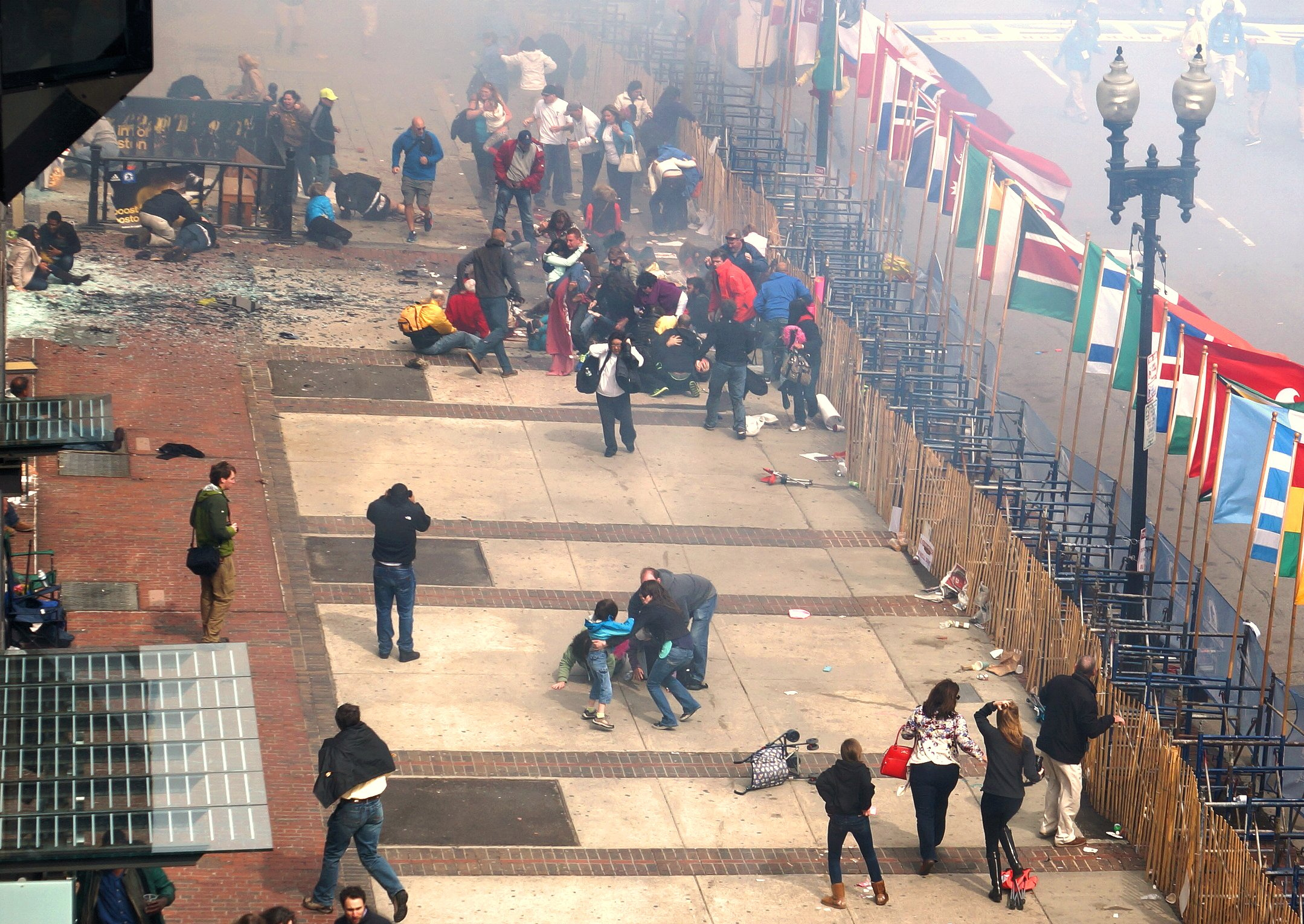
In light of the recent Boston Bomber verdicts and the now looming penalty phase, the death penalty once again takes center stage.
Here is what Boston’s four Bishops recently said about this case:
The defendant in this case has been neutralized and will never again have the ability to cause harm . . . [b]ecause of this, we, the Catholic Bishops of the Commonwealth of Massachusetts, believe that society can do better than the death penalty.
More:
The four bishops quoted a 2005 statement by the U.S. Bishops’ Conference on the death penalty that “no matter how heinous the crime, if society can protect itself without ending a human life, it should do so.”
As my recent blog post might have noted (reprinted in full below), this would seem to be consistent with the spirit of the Catechism, 2267.
Visceral feelings aside for the death penalty in this particular case, and they are strong – just look at that devastation and evil just seconds after the explosions – I struggle with the Bishops’ position here.
I guess that ultimately I’m not fully convinced that this radical Islamic terrorist – let’s not be afraid to call him what he is – has in fact been neutralized for good.
While I may not be convinced about what the sole moral answer is here – I certainly know how I feel.
But I suppose that my feelings are not the best barometer of what is or is not moral. I know that I, personally, would soon be in grave danger if I were guided by my emotions alone.
In the meantime, I’ll offer up a prayer for the jurors who now face a literal life and death decision. May they be guided by justice and mercy for all involved, but most especially the victims.
This was my post from several weeks back
Other than a required law school course in criminal procedure, I have had no training and have developed no special expertise in matters of criminal justice since becoming an attorney some 30 years ago. In fact, the closest that I’ve ever come to associating with any criminal element was when I ran for public office back in 1998 – but I digress.
So I speak here not as some kind of expert, but rather as a fellow citizen.
And I speak as someone who does not take lightly the teachings of the Catholic Church, with its deposit of knowledge and experience that has been actively debated, prayerfully considered, and faithfully transmitted for over 2,000 years.
I have never really given much thought to the imposition of the death penalty.
For as long as I can remember, I have more or less accepted its use both as a deterrent to others and as an expression of societal retribution imposed by the state acting on our behalf. I especially saw its efficacy for those prisoners already serving life sentences who somehow manage to murder prison guards. After all, they have nothing more to lose if no additional punishment can be meted out – all but surely endangering the lives of other prison guards and fellow inmates.
But as with many things, change often comes on the heels of revelation. And so it is here for me.
Where once I stood in silent acceptance, I today find myself in concerned and growing opposition.
At least in most cases.
Three factors have moved me.
But first, let’s start with the Church’s teaching on the death penalty, as set forth in the Catechism of the Catholic Church (CCC), while noting that a killing in self-defense has never been in question:
2267 Assuming that the guilty party’s identity and responsibility have been fully determined, the traditional teaching of the Church does not exclude recourse to the death penalty, if this is the only possible way of effectively defending human lives against the unjust aggressor.
If, however, non-lethal means are sufficient to defend and protect people’s safety from the aggressor, authority will limit itself to such means, as these are more in keeping with the concrete conditions of the common good and more in conformity with the dignity of the human person.
Today, in fact, as a consequence of the possibilities which the state has for effectively preventing crime, by rendering one who has committed an offense incapable of doing harm—without definitively taking away from him the possibility of redeeming himself—the cases in which the execution of the offender is an absolute necessity “are very rare, if not practically non-existent.”
Observe that while the Church does not explicitly bar the death penalty, it does seek to impose conditions which render its use practically non-existent:
- the defendant’s guilt must be fully determined;
- the death penalty must be the “only possible way” of defending other lives; and
- non-lethal means, if sufficient to defend and protect, are first necessary.
Taking one step back, the CCC is additionally clear that whatever punishment is imposed must be both proportionate to the crime, and corrective – and, I’d argue, that the Church sees its ultimate purpose as redemptive as well (as do I):
2266 [ ] Legitimate public authority has the right and the duty to inflict punishment proportionate to the gravity of the offense. Punishment has the primary aim of redressing the disorder introduced by the offense. When it is willingly accepted by the guilty party, it assumes the value of expiation. Punishment then, in addition to defending public order and protecting people’s safety, has a medicinal purpose: as far as possible, it must contribute to the correction of the guilty party.
Now, as for the death penalty itself, my basic opposition is grounded here:
First, as a proponent of limited government, I am instinctively and initially skeptical of most, if not all, governmental undertakings. The criminal justice system, although worthy of all due respect, is of course still a part and parcel of some governmental entity – comprising both very good and very bad actors who assert their authority and power in our name and stead.
As a lawyer, I have witnessed enough failure and “shortcutting” in the civil judicial system to recognize that it must surely also occur in the criminal justice system with all too much frequency. Erroneous convictions, and outright abuse of the process, is certainly not unheard of. One wrongful death penalty conviction is one too many. And, while still vigorously and hotly debated, there does exist an extensive body of research which at least points to a conclusion that the death penalty has often been imposed disproportionately – whether on the poor, or on minorities, or on anyone, for that matter, whose access to the effective assistance of counsel is limited. Writer S.E. Cupp has summarized conservative opposition to the death penalty with much more clarity than I have done here. It’s well worth your time.
Second, many recent, highly-publicized failures during its implementation have raised questions of the humanity, the dignity, and the morality of the death penalty. To be clear, no one should take a higher priority in our consciousness than the victim and his or her family. That is certainly consistent with Catholic teaching. But that does not and cannot absolve us of our responsibility to implement any punishment while being fully mindful of the dignity of all persons, even when imposed on our enemies – perhaps especially then. While my first emotional reaction may be, in some cases, for pain, hurt, revenge, and bodily destruction, allowing those emotions to overtake me would ultimately be destructive and deadly, for me and others. The death penalty, at least as implemented currently, all too often fails the test of morality, dignity and, yes, compassion.
Third and finally, I am all too aware of my own fallen nature. While I have never committed a physical act of murder, Christ reminds us, through John, that “everyone who hates his brother is a murderer” (1 John 3:15), and so I cannot say, if I am being honest, that I have never “murdered” in my heart – or even that I could never be capable of doing something more than feeling hate. Christ articulated this mental-hate-to-physical-murder connection for a reason – and we are well advised to take all of His words seriously, if we are to take any of them seriously at all. He is well aware of our nature, and well aware of how one innocuous step can inevitably lead to another – fatal – one.
Christ redeems us. He can change me. He has changed me. And he can change and redeem the least and most evil among us.
I stand in no better place before Him than they do.
In fact, He took up His cross to stand in their very place, even as He did so to stand in my very place.
Again, I speak with no authority or special insight. I can only reveal what lies heavy on my heart.
And so, my vocal opposition to the death penalty continues to grow.
For a thoughtful call to end all capital punishment, please read the following March 5, 2015 joint editorial by America Magazine, the National Catholic Register, The National Catholic Reporter, and Our Sunday Visitor, found here and let me know what you think, agree or disagree.
Peace
Photo Credit Here, via Wikimedia Commons: 1st Boston Marathon blast seen from 2nd floor and a half block away.jpg (Aaron Tang)

Previous Post

April 6, 2015
My Three Post-Lenten Questions
Next Post

April 12, 2015 Favor and Knowledge Still Test Our Faith: 10 Biblical Examples
Browse Our Archives
Select a Category Belief Changes Evil Faith Guest Post Jenner Laudato si Lawyers Life Prayer Priesthood Reviews Uncategorized
Select a Month April 2016 March 2016 February 2016 January 2016 December 2015 November 2015 October 2015 September 2015 August 2015 July 2015 June 2015 May 2015 April 2015 March 2015 February 2015 January 2015 December 2014 November 2014 October 2014 September 2014 August 2014
Follow Us!
TAKE THE
Religious Wisdom Quiz
What did God use to lead the Israelites by day?
Select your answer to see how you score.
A pillar of cloud An angel A trumpet A pillar of fire
Related posts from Grace Pending


Learning To Trust In The Day, Trusting To...

Thomas Merton And Bad Theology: Purposefully Pitting Ourselves,...

Elizabeth Scalia's Latest Book: "Little Sins Mean A...
TRENDING AT PATHEOS Catholic

Creation, Preservation, and Teleology in Catholic Theology
As I write this, it is very early Monday morning. Like millions...

The Parable Of The Sower And The Word...
One of Christ’s most famous parables is that of the sower who...

Rejecting Doom: Christian Hope And Human Action
Christianity is a religion of hope. We are to have hope and...

Why I Choose the Eucharist Over the Sermon
Choose the Eucharist, Not the Sermon What are we supposed to get...

5 Design Elements Found in Spiritually Rooted Homes
Putting Spirituality Into Home Decor Our homes are more than our living...

Credo: A Story of God Told with the...
About 10 years ago, I began to imagine a personal "Credo" that...
view all Catholic blogs
Ad-Free & Subscriber Log-In Subscription Support
- About Us
- 2026 Calendar
- Videos
- Podcasts
- Library of World Religions
- Faith In Media Tracker
- Advertise With Us
- Write for Us
- Privacy Policy
- Terms of Service
- Do Not Sell My Data
- Contact Us
- Radiant Digital
- Manage Newsletter Subscriptions
- Unsubscribe From Notifications
- Sitemap
Copyright 2008-2026, Patheos. All rights reserved.
Subscription Support Ad-Free & Subscriber Log-In
Follow Patheos