
BuddhistCatholicContemplativeEvangelicalGeneral ChristianHinduJewishLatter-day SaintMuslimNew VisionsProgressive Christian
Beliefs
- Buddhist
- Catholic
- Contemplative
- Evangelical
- General Christian
- Hindu
- Jewish
- Latter-day Saint
- More Voices
- Muslim
- New Visions
- Pagan
- Progressive Christian
Topics
- Religion News
- Food and Religion
- Sports and Religion
- Religious Art
- Religious Music and Entertainment
- Religious Events
- History and Religion
- Style and Religion
- Politics and Religion
- Women in Religion
- Recreation Outdoors and Religion
- Business Finance and Religion
- Careers Workplace and Religion
- Education and Religion
- Family Parenting and Religion
- Health Fitness and Religion
- Home and Religion
- Relationships and Religion
- Technology and Religion
- Travel and Religion
Columnists
- Buddhist Columnists
- Business Finance and Religion Columnists
- Careers Workplace and Religion Columnists
- Catholic Columnists
- Contemplative Columnists
- Education and Religion Columnists
- Evangelists Columnists
- Family Parenting and Religion Columnists
- General Christian Columnists
- Health Fitness and Religion Columnists
- Hindu Columnists
- History and Religion Columnists
- Home and Religion Columnists
- Jewish Columnists
- More Voices Columnists
- Latter Day Columnists
- Muslim Columnists
- New Visions Columnists
- Nonreligious Columnists
- Pagan Columnists
- Politics and Religion Columnists
- Progressive Columnists
- Recreation Outdoors and Religion Columnists
- Relationships and Religion Columnists
- Religion News Columnists
- Religious Art Columnists
- Religious Events Columnists
- Religious Music and Entertainment Columnists
- Sports and Religion Columnists
- Style and Religion Columnists
- Technology and Religion Columnists
- Travel and Religion Columnists
- Women in Religion Columnists
Resource Library
- 2026 Calendar
- Library of World Religions
- The 100 Most Holy Places on Earth
- Patheos Answers
- Podcasts
- Videos
- Faith Leaders Database
- Anglican Episcopalian
- Bahai
- Baptist
- Buddhism
- Christianity
- Confucianism
- Eastern Orthodoxy
- Hinduism
- Holiness and Pentecostal
- ISKCON
- Islam
- Judaism
- Lutheran
- Methodist
- The Church of Jesus Christ of Latter-day Saints
- New Age
- Paganism
- Presbytarian and Reformed
- Protestantism
- Religion Behind the Scenes
- Roman Catholic
- Scientology
- Shia Islam
- Sikhism
- Sufism
- Sunni Islam
- Taoism
- Zen
- See all religions
Research Tools
 Ad-Free & Subscriber Log-In Subscription Support
Ad-Free & Subscriber Log-In Subscription Support
Follow Patheos 

- Trending:
- Forgiveness
- |
- Marriage
- |
- Consciousness
- |
- Death Penalty
- |
- Election
- |
- Halloween
 Grace Pending
- Home
- Catholic
- Not Surprisingly, Francis Is Catholic
Not Surprisingly, Francis Is Catholic
Last updated on: June 11, 2015 at 9:26 pm by Tom Zampino
Not Surprisingly, Francis Is Catholic 2015-06-11T21:26:52-05:00 Tom Zampino
Patheos Explore the world's faith through different perspectives on religion and spirituality! Patheos has the views of the prevalent religions and spiritualities of the world.
I am, by disposition and training, what is generally referred to as a classic, free market economic conservative.
Having once run for public office – the New York State Assembly – my positions were more or less honed during an electoral battle against a far left entrenched incumbent. Although, truth be told, depending on the issue, I was variously described by my two opponents together as either a “dangerous right-winger” or an “out-of-touch liberal” during that race. I’ll just have to assume that most people would probably label me as either slightly right-of-center or as a squishy moderate.
At least politically.
But I was long ago persuaded that of all the economic systems that have ever been imposed, capitalism has been – by far – the most successful in lifting more people out of poverty and into economic freedom than any other.
One need only look at, in real time, the East Germany – West Germany, North Korea – South Korea, and pre-Castro – Castro “experiments” with an objective eye to be so convinced.
Coupled with a democratic political system, free markets – along with a system for the protection of private property rights and the judicial enforcement of contracts – tend to create an unbeatable environment of personal and economic liberty.
And, while others will no doubt vigorously object (and can certainly point to historical events to the contrary to advance their arguments), I believe that this political-economic combination also imposes substantial constraints which tend to, more often than not, curb destructive international ambitions.
In short, I find that democratic capitalism is the most moral, least oppressive, most innovative system ever devised by man. (Some of my thoughts in this regard were framed early on by Michael Novak’s book, The Spirit of Democratic Capitalism.)
That said, being a free market, economic conservative does not mean acquiescing to corporate control of the economy, or unregulated corporate and union monopolies, or an unfettered government-corporate nexus – often called crony capitalism.
On the contrary, those very things result in markets which are neither free nor conservative – economically or politically. They stifle free and open competition, and they can become forces of overwhelming greed, avarice, and destruction.
The Catholic Church has long held unambiguous views on the subject of economic liberty and private property, even as it has called for economic justice for the poor and working class.
The two positions are by no means incompatible or contradictory.
Rerum Novarum – The Encyclical of Pope Leo XIII on Capital and Labor, given at St. Peter’s in Rome in May, 1891 – provides much needed clarity and guidance.
It is not my intention here, in this short post, to review the encyclical in any great detail. Rather, I’ll set out just a couple of brief highlights that may prove helpful in framing the Francis discussion below.
Here the encyclical endorses the ownership of private property :
[P]rivate ownership is in accordance with the law of nature. Truly, that which is required for the preservation of life, and for life’s well-being, is produced in great abundance from the soil, but not until man has brought it into cultivation and expended upon it his solicitude and skill. Now, when man thus turns the activity of his mind and the strength of his body toward procuring the fruits of nature, by such act he makes his own that portion of nature’s field which he cultivates – that portion on which he leaves, as it were, the impress of his personality; and it cannot but be just that he should possess that portion as his very own, and have a right to hold it without any one being justified in violating that right.
Private property, it is observed, benefits the family:
That right to property, therefore, which has been proved to belong naturally to individual persons, must in like wise belong to a man in his capacity of head of a family; nay, that right is all the stronger in proportion as the human person receives a wider extension in the family group. It is a most sacred law of nature that a father should provide food and all necessaries for those whom he has begotten.
While the socialist ideal of compelled equality decidedly falls flat:
There naturally exist among mankind manifold differences of the most important kind; people differ in capacity, skill, health, strength; and unequal fortune is a necessary result of unequal condition. Such unequality is far from being disadvantageous either to individuals or to the community. Social and public life can only be maintained by means of various kinds of capacity for business and the playing of many parts; and each man, as a rule, chooses the part which suits his own peculiar domestic condition . . .
The great mistake made in regard to the matter now under consideration is to take up with the notion that class is naturally hostile to class, and that the wealthy and the working men are intended by nature to live in mutual conflict.
Yet, there is a necessary public role in alleviating economic pain and suffering:
We have said that the State must not absorb the individual or the family; both should be allowed free and untrammelled action so far as is consistent with the common good and the interest of others. Rulers should, nevertheless, anxiously safeguard the community and all its members; the community, because the conservation thereof is so emphatically the business of the supreme power, that the safety of the commonwealth is not only the first law, but it is a government’s whole reason of existence; and the members, because both philosophy and the Gospel concur in laying down that the object of the government of the State should be, not the advantage of the ruler, but the benefit of those over whom he is placed. As the power to rule comes from God, and is, as it were, a participation in His, the highest of all sovereignties, it should be exercised as the power of God is exercised – with a fatherly solicitude which not only guides the whole, but reaches also individuals . . .
Whenever the general interest or any particular class suffers, or is threatened with harm, which can in no other way be met or prevented, the public authority must step in to deal with it. (Emphasis added).
And finally this:
When work[ing] people have recourse to a strike and become voluntarily idle, it is frequently because the hours of labor are too long, or the work too hard, or because they consider their wages insufficient. The grave inconvenience of this not uncommon occurrence should be obviated by public remedial measures; for such paralysing of labor not only affects the masters and their work people alike, but is extremely injurious to trade and to the general interests of the public; moreover, on such occasions, violence and disorder are generally not far distant, and thus it frequently happens that the public peace is imperiled.
The laws should forestall and prevent such troubles from arising; they should lend their influence and authority to the removal in good time of the causes which lead to conflicts between employers and employed.
It is in this context, and other Church teachings, that I view Pope Francis’ recurring criticisms of orthodox market economics.
Where some see socialism lurking behind his words, we can find orthodox Church doctrine.
Pope Francis launched a fresh attack on economic injustice on Saturday, condemning the “throw-away culture” of globalization and calling for new ways of thinking about poverty, welfare, employment and society . . .
In a speech to the association of Italian cooperative movements, he pointed to the “dizzying rise in unemployment” and the problems that existing welfare systems had in meeting healthcare needs.
For those living “at the existential margins” the current social and political system “seems fatally destined to suffocate hope and increase risks and threats,” he said.
The Pope further declared:
“When money becomes an idol, it commands the choices of man. And thus it ruins man and condemns him. It makes him a slave,” he said
Idol worship of any kind inevitably leads to slavery. Money worship seems often to accelerate the process.
Catholic doctrine is clear: the ownership of private property benefits and supports families. It fosters work. It creates value. It is a force for good in the world.
But there can come a tipping point.
When economic power is left unchecked and concentrated in the hands of the few – whether it be in the hands of individuals, corporations, unions, or government – economic suffering necessarily follows.
We would be foolish to dismiss the role of the Church in reminding us of this very danger.
As a vigorous and open proponent of free markets, I find nothing in Francis’ declarations that would put him at odds with anything that has been taught by the Church, or with my own values.
In fact, it is nothing but consistent. So, no, Francis is not a socialist.
But more to the point:
Not surprisingly, Francis is Catholic.
Peace
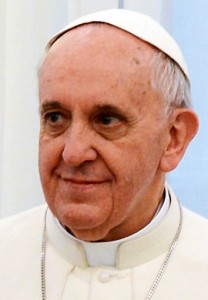
Photo Credit, Wikimedia Commons via: presidencia.gov.ar

Previous Post

February 21, 2015
One Observation On Lent: What Do We Worship?
Next Post
March 5, 2015 Three Reasons Why I No Longer Actively Support The Death Penalty
Browse Our Archives
Select a Category Belief Changes Evil Faith Guest Post Jenner Laudato si Lawyers Life Prayer Priesthood Reviews Uncategorized
Select a Month April 2016 March 2016 February 2016 January 2016 December 2015 November 2015 October 2015 September 2015 August 2015 July 2015 June 2015 May 2015 April 2015 March 2015 February 2015 January 2015 December 2014 November 2014 October 2014 September 2014 August 2014
Follow Us!
TAKE THE
Religious Wisdom Quiz
Who was sold into slavery by his brothers?
Select your answer to see how you score.
Joseph Judah Benjamin Dan
Related posts from Grace Pending


Learning To Trust In The Day, Trusting To...

Thomas Merton And Bad Theology: Purposefully Pitting Ourselves,...

Elizabeth Scalia's Latest Book: "Little Sins Mean A...
TRENDING AT PATHEOS Catholic

Rejecting Doom: Christian Hope And Human Action
Christianity is a religion of hope. We are to have hope and...

It’s What Comes From Within Which Matters
One of the most difficult things for us to understand is why...

Why I Choose the Eucharist Over the Sermon
Choose the Eucharist, Not the Sermon What are we supposed to get...

5 Design Elements Found in Spiritually Rooted Homes
Putting Spirituality Into Home Decor Our homes are more than our living...

Credo: A Story of God Told with the...
About 10 years ago, I began to imagine a personal "Credo" that...

The Anatomy of Divine Revelation in Catholic Thought
The claim that God has made Himself known to human beings is...
view all Catholic blogs
Ad-Free & Subscriber Log-In Subscription Support
- About Us
- 2026 Calendar
- Videos
- Podcasts
- Library of World Religions
- Faith In Media Tracker
- Advertise With Us
- Write for Us
- Privacy Policy
- Terms of Service
- Do Not Sell My Data
- Contact Us
- Radiant Digital
- Manage Newsletter Subscriptions
- Unsubscribe From Notifications
- Sitemap
Copyright 2008-2026, Patheos. All rights reserved.
Subscription Support Ad-Free & Subscriber Log-In
Follow Patheos