
BuddhistCatholicContemplativeEvangelicalGeneral ChristianHinduJewishLatter-day SaintMuslimNew VisionsProgressive Christian
Beliefs
- Buddhist
- Catholic
- Contemplative
- Evangelical
- General Christian
- Hindu
- Jewish
- Latter-day Saint
- More Voices
- Muslim
- New Visions
- Pagan
- Progressive Christian
Topics
- Religion News
- Food and Religion
- Sports and Religion
- Religious Art
- Religious Music and Entertainment
- Religious Events
- History and Religion
- Style and Religion
- Politics and Religion
- Women in Religion
- Recreation Outdoors and Religion
- Business Finance and Religion
- Careers Workplace and Religion
- Education and Religion
- Family Parenting and Religion
- Health Fitness and Religion
- Home and Religion
- Relationships and Religion
- Technology and Religion
- Travel and Religion
Columnists
- Buddhist Columnists
- Business Finance and Religion Columnists
- Careers Workplace and Religion Columnists
- Catholic Columnists
- Contemplative Columnists
- Education and Religion Columnists
- Evangelists Columnists
- Family Parenting and Religion Columnists
- General Christian Columnists
- Health Fitness and Religion Columnists
- Hindu Columnists
- History and Religion Columnists
- Home and Religion Columnists
- Jewish Columnists
- More Voices Columnists
- Latter Day Columnists
- Muslim Columnists
- New Visions Columnists
- Nonreligious Columnists
- Pagan Columnists
- Politics and Religion Columnists
- Progressive Columnists
- Recreation Outdoors and Religion Columnists
- Relationships and Religion Columnists
- Religion News Columnists
- Religious Art Columnists
- Religious Events Columnists
- Religious Music and Entertainment Columnists
- Sports and Religion Columnists
- Style and Religion Columnists
- Technology and Religion Columnists
- Travel and Religion Columnists
- Women in Religion Columnists
Resource Library
- 2026 Calendar
- Library of World Religions
- The 100 Most Holy Places on Earth
- Patheos Answers
- Podcasts
- Videos
- Faith Leaders Database
- Anglican Episcopalian
- Bahai
- Baptist
- Buddhism
- Christianity
- Confucianism
- Eastern Orthodoxy
- Hinduism
- Holiness and Pentecostal
- ISKCON
- Islam
- Judaism
- Lutheran
- Methodist
- The Church of Jesus Christ of Latter-day Saints
- New Age
- Paganism
- Presbytarian and Reformed
- Protestantism
- Religion Behind the Scenes
- Roman Catholic
- Scientology
- Shia Islam
- Sikhism
- Sufism
- Sunni Islam
- Taoism
- Zen
- See all religions
Research Tools
 Ad-Free & Subscriber Log-In Subscription Support
Ad-Free & Subscriber Log-In Subscription Support
Follow Patheos 

- Trending:
- Forgiveness
- |
- Marriage
- |
- Consciousness
- |
- Death Penalty
- |
- Election
- |
- Halloween
 Biblical Words and World
- Home
- Evangelical
- Musonius Rufus, Women’s Equality, and the New Testament
Musonius Rufus, Women’s Equality, and the New Testament
Last updated on: July 11, 2018 at 6:30 pm by Tom Hobson
Musonius Rufus, Women’s Equality, and the New Testament 2018-07-09T06:41:16-05:00 Tom Hobson
Patheos Explore the world's faith through different perspectives on religion and spirituality! Patheos has the views of the prevalent religions and spiritualities of the world.
My favorite pagan philosopher from the first century AD is a Stoic named Musonius Rufus. I like Musonius, both because his teachings are so much like those of the New Testament, and also because he is very liberated in his attitudes on the equality of men and women.
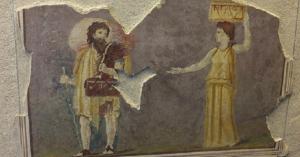
Musonius Rufus made the case for women’s equality in the New Testament world. Photo of a painting of the philosophers Crates and Hipparchia by Amphipolis. From the Museo Nazionale Romano. Attribution-ShareAlike 2.0 Generic (CC BY-SA 2.0) via Flickr.
Musonius believed that women are just as fit to study philosophy as men. He argues, “Women as well as men have received from the gods the gift of reason.” And why would it be good for men to study how to live a good life, but bad for women? When asked whether daughters should receive the same education as sons, Musonius answers, Why not? “Trainers of horses and dogs make no distinction in the training of the male and the female. For female dogs are taught to hunt just as the males are, and one can see no difference in the training of mares, if they are expected to do a horse’s work, and the training of stallions.”
Musonius questions whether there is any firm line between men’s work and women’s work. He is asked, “Come now, do you expect that men should learn spinning the same as women, and that women should take part in the gymnastic exercises the same as men?” His answer is, not necessarily. He concedes that most men are built stronger than most women. But he says, “Some men might more fittingly handle certain of the lighter tasks and what is generally considered women’s work, and again, women might do heavier tasks which seem more appropriate for men whenever conditions of strength, need, or circumstance warranted. For all human tasks…are a common obligation and are common for men and women, and none is necessarily appointed for either one exclusively.”
Musonius argues that courage is a virtue that a woman needs just as much as a man, “so that she will neither be swayed by hardships nor by fear. Otherwise, how will she be said to have self-control, if by threat or by force she can be constrained to yield to shame? Furthermore, it is necessary for woman to be able to repel attack, unless indeed they are willing to appear more cowardly than hens and other female birds, which fight with creatures much larger than themselves to defend their young.” He mentions the Amazons as proof that women can fight. “If, therefore, some of this courage is lacking in other women, it is due to lack of use and practice rather than because they were not endowed with it.”
Musonius states that a woman should be a good home economist, “a careful accountant of all that pertains to the welfare of her house, and capable of directing the household slaves.” A woman should also be chaste and self-controlled, “pure in respect of unlawful love, exercise restraint in other pleasures, not be a slave to desire, not be contentious, not lavish in expense, nor extravagant in dress…superior to uncontrolled emotion of every kind.” But Musonius tolerates no double standard. “No man with any self-control would think of having relations with a harlot or a free woman apart from marriage, no, not even with his maidservant.” He asks men, If you want the freedom to do it with your slave, what if your wife wants to do it with her slave?
Musonius talks about many of the same issues tackled in the New Testament. He talks about training oneself in virtue and toughing out hardships. He explores whether it’s OK for a philosopher to sue someone for personal injury. He considers how a philosopher should support himself, and whether or not marriage is a handicap to a philosopher. (Why should it be? Marriage is essential to life!) He addresses the question whether every child that is born should be raised, doing so more explicitly than the New Testament does.
Musonius answers the question, “Must one obey one’s parents under all circumstances?” Answer: “Do not let your father be an excuse to you for wrong-doing.” If a father doesn’t want his son to study philosophy, “the conduct of his son will win him over if his son is truly putting his philosophy into practice.” Sounds like Peter’s advice to wives (1 Peter 3:1)!
Musonius spends a few chapters talking about food, clothing, shelter, and furnishings. “Whatever is difficult to obtain or not convenient to use or not easy to protect is to be judged inferior.” Why seek the rare and expensive instead of the available and cheap? He states that luxury breeds sin and greed. He asks, “What good are courtyards surrounded by colonnades? Are they not the source of constant trouble, and do they not cost great sums of money from which many might have benefited by public and private charity?”
Musonius also gives his opinion on how long a man’s hair should be, opinions which may be useful to keep in mind as we read Paul’s line, “it is a shame for a man to have long hair” (1 Corinthians 11:14). Musonius thinks, “A man should cut the hair from the head for the same reason that we prune a vine – merely to remove what is useless.” But he insists that those who shave off their beards are womanish hermaphroditic creatures, not real men.
What would Musonius have thought of Jesus? We have no teachings from him on God, sin, or the life to come. Whether he ever encountered the Christian message, we cannot say. But he certainly had an ethic that was well in line with what Jesus’ followers were teaching.
Previous Post

July 9, 2018
Theology by the Polls: Ten Billion Flies Can't Be Wrong!
Next Post

July 15, 2018 Words I Never Heard in the Bible
Browse Our Archives
Select a Category Biblical ethic Biblical word studies Biblical world Creation Historical Jesus Uncategorized
Select a Month July 2018 June 2018 May 2018 April 2018 March 2018 February 2018 January 2018 December 2017 November 2017 October 2017 September 2017 August 2017 July 2017
Follow Us!
TAKE THE
Religious Wisdom Quiz
What city did God command Jonah to preach to?
Select your answer to see how you score.
Babylon Nineveh Tyre Jericho
Books by This Author Books by Tom Hobson
Related posts from Biblical Words and World




TRENDING AT PATHEOS Evangelical

How the author of the world's best hymn...
I've been working with John Newton for a while now. This makes...

Long before this Lectio Divina, Psalm 130 - the song - started...

What About the Trees? Another Living Parable
After I finished writing the last article about falling leaves as a...

Why Classical Education Is a Conversation, Not a...
Come and Read: Joy in Classical Education When I was a little...

Falling Leaves: A Living Parable on Letting Go
I’ve spent the vast majority of my life in the southeast corner...

Cornell University has received a great deal of negative publicity and intense...
view all Evangelical blogs
Ad-Free & Subscriber Log-In Subscription Support
- About Us
- 2026 Calendar
- Videos
- Podcasts
- Library of World Religions
- Faith In Media Tracker
- Advertise With Us
- Write for Us
- Privacy Policy
- Terms of Service
- Do Not Sell My Data
- Contact Us
- Radiant Digital
- Manage Newsletter Subscriptions
- Unsubscribe From Notifications
- Sitemap
Copyright 2008-2026, Patheos. All rights reserved.
Subscription Support Ad-Free & Subscriber Log-In
Follow Patheos