
BuddhistCatholicContemplativeEvangelicalGeneral ChristianHinduJewishLatter-day SaintMuslimNew VisionsProgressive Christian
Beliefs
- Buddhist
- Catholic
- Contemplative
- Evangelical
- General Christian
- Hindu
- Jewish
- Latter-day Saint
- More Voices
- Muslim
- New Visions
- Pagan
- Progressive Christian
Topics
- Religion News
- Food and Religion
- Sports and Religion
- Religious Art
- Religious Music and Entertainment
- Religious Events
- History and Religion
- Style and Religion
- Politics and Religion
- Women in Religion
- Recreation Outdoors and Religion
- Business Finance and Religion
- Careers Workplace and Religion
- Education and Religion
- Family Parenting and Religion
- Health Fitness and Religion
- Home and Religion
- Relationships and Religion
- Technology and Religion
- Travel and Religion
Columnists
- Buddhist Columnists
- Business Finance and Religion Columnists
- Careers Workplace and Religion Columnists
- Catholic Columnists
- Contemplative Columnists
- Education and Religion Columnists
- Evangelists Columnists
- Family Parenting and Religion Columnists
- General Christian Columnists
- Health Fitness and Religion Columnists
- Hindu Columnists
- History and Religion Columnists
- Home and Religion Columnists
- Jewish Columnists
- More Voices Columnists
- Latter Day Columnists
- Muslim Columnists
- New Visions Columnists
- Nonreligious Columnists
- Pagan Columnists
- Politics and Religion Columnists
- Progressive Columnists
- Recreation Outdoors and Religion Columnists
- Relationships and Religion Columnists
- Religion News Columnists
- Religious Art Columnists
- Religious Events Columnists
- Religious Music and Entertainment Columnists
- Sports and Religion Columnists
- Style and Religion Columnists
- Technology and Religion Columnists
- Travel and Religion Columnists
- Women in Religion Columnists
Resource Library
- 2026 Calendar
- Library of World Religions
- The 100 Most Holy Places on Earth
- Patheos Answers
- Podcasts
- Videos
- Faith Leaders Database
- Anglican Episcopalian
- Bahai
- Baptist
- Buddhism
- Christianity
- Confucianism
- Eastern Orthodoxy
- Hinduism
- Holiness and Pentecostal
- ISKCON
- Islam
- Judaism
- Lutheran
- Methodist
- The Church of Jesus Christ of Latter-day Saints
- New Age
- Paganism
- Presbytarian and Reformed
- Protestantism
- Religion Behind the Scenes
- Roman Catholic
- Scientology
- Shia Islam
- Sikhism
- Sufism
- Sunni Islam
- Taoism
- Zen
- See all religions
Research Tools
 Ad-Free & Subscriber Log-In Subscription Support
Ad-Free & Subscriber Log-In Subscription Support
Follow Patheos 

- Trending:
- Forgiveness
- |
- Marriage
- |
- Consciousness
- |
- Death Penalty
- |
- Election
- |
- Halloween
 Biblical Words and World
- Home
- Evangelical
- R-Rated Prophets
R-Rated Prophets
Last updated on: June 7, 2018 at 5:30 am by Tom Hobson
R-Rated Prophets 2018-06-06T12:24:34-05:00 Tom Hobson
Patheos Explore the world's faith through different perspectives on religion and spirituality! Patheos has the views of the prevalent religions and spiritualities of the world.
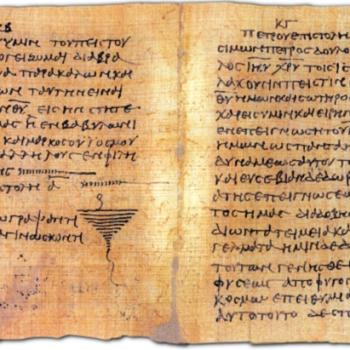
Ezekiel was literally an R-rated prophet. St. Jerome writes to Bishop Paulinus in Epistle 53:8 that Jews in 400 AD would not let men read parts of Ezekiel until they were 30 years old, particularly the opening vision of the chariots. Similarly, the Mishnah (200 AD) states that Ezekiel 1 is restricted to be read privately, and can only be discussed one-on-one by experts (Hagigah 2:1). The Mishnah also states that both chapters 1 and 16 of Ezekiel must not be read out loud to an audience (Megillah 4:10).
Why the restrictions, you ask? The chapters about the chariot visions were withheld simply because they sounded bizarre even to ancient ears; to us, they sound like UFO’s. The vision of the new Temple (Ezekiel 40-48) contains details that were hard to reconcile with the Law of Moses. But the most obvious reason to restrict the reading of Ezekiel is the very “adult” sexual rhetoric he uses. Although I will try my best to handle the subject with care, ultimately the uncensored Ezekiel is not for the squeamish. As Professor Stuart told us at seminary, some of Ezekiel is not the kind of stuff you’d use in a children’s sermon.

This Missouri county highway sign warns us about the shocking road ahead: here come the R-rated prophets! Photo: Catherine Hobson.
Such material is concentrated in chapters 16 and 23, where Judah is portrayed as a nymphomaniac, insatiable in her desire for lovers outside of her commitment to the one true God. In Ezekiel 16:25, where God says to the nation, “You offered yourself to all passers-by,” the Hebrew says literally, “You spread your legs.” In 16:31, where we are told that the nation builds herself an idol shrine or platform, the Latin version says she builds herself a lupanar (= Greek version’s porneion = English “brothel”).
Ezekiel 16:26 uses the Hebrew expression “great of flesh” as a euphemism for a man’s “package” (to use an English language euphemism). In the same passage, Ezekiel 16:17 speaks of male images of metal “with which you played the harlot.” (Only recently in our age of technological advances would a meaning other than idolatry come to mind.)
Ezekiel 23:20 is about as R-rated a verse as you can get: “You ta‘ugabah (“sexually desired,” a rare word) your concubines, whose flesh (see previous paragraph) is like the flesh of donkeys, and whose (literally “what-comes-out”) is like that of horses.” How graphic can the prophet get? By the way, here is the only place in the Hebrew Bible (or anywhere?) where the Hebrew word for “concubine” is used for males instead of women. Here the word appears to mean “paramours” or “boy toys.”
Ezekiel, Jeremiah, and Hosea are the only authors in our canonical Bible where the Greek version uses the word erastai, a word that comes from the noun erōs (“erotic” desire), which means “lovers” in an exclusively sexual sense.
Not to be outdone, Jeremiah likens Judah to a lust-filled she-camel, “in her heat sniffing the wind. Who can restrain her lust? No one who seeks her need wear themselves; in her month they will find her.” (Jeremiah 2:23-24) God asks Judah in Jeremiah 3:2, “Where have you not been —-ed?” (I suggest a verb that rhymes with “rude.”) The verb used here (shiggēl) was considered obscene by later copyists, who directed readers in their footnotes to read the verb “laid” instead.
By comparison, Hosea’s real-life soap opera, where God commands him to marry a harlot and buy her back again from sex-slavery, sounds downright tame. The term erastai is used five times in Hosea 2, but the rampant illicit sex practices in the Baal worship that Hosea condemns make the term entirely appropriate.
Why did God speak in such shocking terms? The question presumes (correctly, I would say) that God actually inspired these words, and that we should not blame the prophets themselves for them. Perhaps God found it necessary to use such images and language to get the attention of an unshockable people.
But God does not speak this way all the time. Referring to the wild ways of the surrounding Gentile world, Paul writes, “It is shameful even to speak of the things they do in secret.” (Ephesians 5:12) When I taught Latin at a classical Christian college, I would steer my students away from reading the comic poet Martial, because his material was definitely R-rated, if not worse. Paul knows the Roman world around him is far beyond R-rated.
In the cases of both Paul and the Hebrew prophets, audience was everything. Paul’s Greco-Roman audience needed no details on the depravity around them; they needed to flush it out of their lips, ears, and minds. By contrast, the audience of the Hebrew prophets could not see their own depravity, until it was portrayed for them in shockingly graphic form.
The R-rated portions of the prophets are few, but even without them, the Bible is not a children’s book. Yet the Bible is not pornographic. It is frank, but it is not designed to feed the twisted parts of our natures. It is written to convince us, in sometimes graphic detail, of how much we need a Savior.
Previous Post

June 4, 2018
False Versus Unfulfilled Prophecy
Next Post

June 11, 2018 Gambling Is Not a Biblical Issue
Browse Our Archives
Select a Category Biblical ethic Biblical word studies Biblical world Creation Historical Jesus Uncategorized
Select a Month July 2018 June 2018 May 2018 April 2018 March 2018 February 2018 January 2018 December 2017 November 2017 October 2017 September 2017 August 2017 July 2017
Follow Us!
TAKE THE
Religious Wisdom Quiz
Which parable tells of a shrewd manager who is commended for his cleverness?
Select your answer to see how you score.
The Unjust Steward The Lost Sheep The Wise Virgins The Good Samaritan
Books by This Author Books by Tom Hobson
Related posts from Biblical Words and World

Musonius Rufus, Women's Equality, and the New Testament


TRENDING AT PATHEOS Evangelical

How the author of the world's best hymn...
I've been working with John Newton for a while now. This makes...

Long before this Lectio Divina, Psalm 130 - the song - started...

What About the Trees? Another Living Parable
After I finished writing the last article about falling leaves as a...

Why Classical Education Is a Conversation, Not a...
Come and Read: Joy in Classical Education When I was a little...

Falling Leaves: A Living Parable on Letting Go
I’ve spent the vast majority of my life in the southeast corner...

Cornell University has received a great deal of negative publicity and intense...
view all Evangelical blogs
Ad-Free & Subscriber Log-In Subscription Support
- About Us
- 2026 Calendar
- Videos
- Podcasts
- Library of World Religions
- Faith In Media Tracker
- Advertise With Us
- Write for Us
- Privacy Policy
- Terms of Service
- Do Not Sell My Data
- Contact Us
- Radiant Digital
- Manage Newsletter Subscriptions
- Unsubscribe From Notifications
- Sitemap
Copyright 2008-2026, Patheos. All rights reserved.
Subscription Support Ad-Free & Subscriber Log-In
Follow Patheos