
BuddhistCatholicContemplativeEvangelicalGeneral ChristianHinduJewishLatter-day SaintMuslimNew VisionsProgressive Christian
Beliefs
- Buddhist
- Catholic
- Contemplative
- Evangelical
- General Christian
- Hindu
- Jewish
- Latter-day Saint
- More Voices
- Muslim
- New Visions
- Pagan
- Progressive Christian
Topics
- Religion News
- Food and Religion
- Sports and Religion
- Religious Art
- Religious Music and Entertainment
- Religious Events
- History and Religion
- Style and Religion
- Politics and Religion
- Women in Religion
- Recreation Outdoors and Religion
- Business Finance and Religion
- Careers Workplace and Religion
- Education and Religion
- Family Parenting and Religion
- Health Fitness and Religion
- Home and Religion
- Relationships and Religion
- Technology and Religion
- Travel and Religion
Columnists
- Buddhist Columnists
- Business Finance and Religion Columnists
- Careers Workplace and Religion Columnists
- Catholic Columnists
- Contemplative Columnists
- Education and Religion Columnists
- Evangelists Columnists
- Family Parenting and Religion Columnists
- General Christian Columnists
- Health Fitness and Religion Columnists
- Hindu Columnists
- History and Religion Columnists
- Home and Religion Columnists
- Jewish Columnists
- More Voices Columnists
- Latter Day Columnists
- Muslim Columnists
- New Visions Columnists
- Nonreligious Columnists
- Pagan Columnists
- Politics and Religion Columnists
- Progressive Columnists
- Recreation Outdoors and Religion Columnists
- Relationships and Religion Columnists
- Religion News Columnists
- Religious Art Columnists
- Religious Events Columnists
- Religious Music and Entertainment Columnists
- Sports and Religion Columnists
- Style and Religion Columnists
- Technology and Religion Columnists
- Travel and Religion Columnists
- Women in Religion Columnists
Resource Library
- 2026 Calendar
- Library of World Religions
- The 100 Most Holy Places on Earth
- Patheos Answers
- Podcasts
- Videos
- Faith Leaders Database
- Anglican Episcopalian
- Bahai
- Baptist
- Buddhism
- Christianity
- Confucianism
- Eastern Orthodoxy
- Hinduism
- Holiness and Pentecostal
- ISKCON
- Islam
- Judaism
- Lutheran
- Methodist
- The Church of Jesus Christ of Latter-day Saints
- New Age
- Paganism
- Presbytarian and Reformed
- Protestantism
- Religion Behind the Scenes
- Roman Catholic
- Scientology
- Shia Islam
- Sikhism
- Sufism
- Sunni Islam
- Taoism
- Zen
- See all religions
Research Tools
 Ad-Free & Subscriber Log-In Subscription Support
Ad-Free & Subscriber Log-In Subscription Support
Follow Patheos 

- Trending:
- Forgiveness
- |
- Marriage
- |
- Consciousness
- |
- Death Penalty
- |
- Election
- |
- Halloween
 Biblical Words and World
- Home
- Evangelical
- Back to the Second Century: Echoes of Modern Heresy
Back to the Second Century: Echoes of Modern Heresy
Last updated on: July 4, 2018 at 3:49 pm by Tom Hobson
Back to the Second Century: Echoes of Modern Heresy 2018-07-04T15:49:46-05:00 Tom Hobson
Patheos Explore the world's faith through different perspectives on religion and spirituality! Patheos has the views of the prevalent religions and spiritualities of the world.
Today’s church is now re-living the second century AD, a period when the church was shot through with heresy so badly that it threatened to take over the church entirely. That period may prove instructive to us as a model as we seek to find our way forward in an age where today’s church is similarly shot through with heresies amazingly like those of the second and third centuries.
Bart Ehrman (Lost Christianities) and Dan Brown (The Da Vinci Code) would argue that the opposite took place. They would argue (following Walter Bauer’s Orthodoxy and Heresy) that the church started out with views that we today would consider heresy. They would argue that it was we, a small, embattled orthodox minority, who managed to muscle our way into power and stomp the tar out of our opposition.
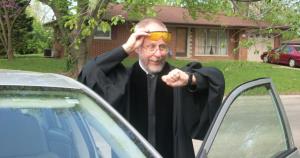
Pastor Hobson heads back to the second century AD to see what happened to produce today’s heresy! Photo: Catherine Hobson.
But the facts prove otherwise. Believers who lived in the period 70-100 AD, the ones who were in the best position to know what Jesus and the apostles really said and did, certified the four Gospels of our canon as being superior to the Gospel of the Hebrews, the Gospel of the Egyptians, and all the latecomers that began to appear in the late second century (Thomas, Judas, Mary, and Philip, among others). And as we read orthodox works of the second century (Clement, the epistles of Ignatius, the Shepherd of Hermas, and the works of Justin Martyr, Melito, Athenagoras, and Irenaeus), we can plainly see that the orthodox faith was no splinter group that engineered a hostile takeover of the Christian scene.
Around 100 AD, Cerinthus gets his two minutes of fame for teaching that “Jesus was not born of a virgin, for that is impossible, but was the son of Joseph and Mary by a generation like that of all other men.” (Irenaeus, Against Heresies 1.26.1) Sounds familiar! Cerinthus also believed that Christ came into the earthly Jesus, then left him at the end of his life. Eusebius reports that when the apostle John saw Cerinthus entering the public bath, he cried, “Let us flee, lest the bath fall in, while Cerinthus the enemy of the truth is here!” (Eusebius, Ecclesiastical History 3.28.6, also reported by Irenaeus in Against Heresies 3.3.4) We know John as the apostle of love, and yet we see that John loves the truth more than he fears to hurt anyone’s feelings.
One second century heresy that seems more prevalent in today’s church is the heresy of Marcion, for which I must refer you to a more complete treatment in Randy Otto’s excellent article in the Sept/Oct 1998 edition of Theology Matters (http://www.theologymatters.com/SEPOCT98.PDF). In 140 AD, Marcion introduced his god of sweetness and light to replace the vengeful, evil Creator of the material world. As Tertullian derisively describes Marcion’s theology, a “better god has been discovered, one who is neither offended nor angry nor inflicts punishment, who has no fire warming up in hell, and no outer darkness wherein there is shuddering and gnashing of teeth: he is merely kind. Of course he forbids you to sin – but only in writing…Fool: you call him lord, but deny he is to be feared.” (Against Marcion 1.27.1)
Because he despised the material creation, Marcion opted for an asceticism that regarded even marriage as being lechery. But Tertullian rightly asks, “So then, you who decline to fear your god because he is good, what keeps you from bubbling over into all manner of vice…?” (Against Marcion 1.27.5)
Marcion is famous for jettisoning the entire Old Testament, plus three Gospels and the rest of the New Testament except for a mutilated (Irenaeus calls it “circumcised”) Gospel of Luke and ten mutilated letters of Paul. Likewise, today’s progressives wish to dispense with the evil god of the Old Testament and proclaim a god who is all love and no wrath. Even evangelicals like Andy Stanley have echoed Marcion by claiming that we need to “unhitch” ourselves from the Old Testament.
Irenaeus tells us that that when Marcion begged Polycarp, “Recognize us,” Polycarp replied, “I do recognize you, you firstborn of Satan.” (Against Heresies 3.3.4)
The followers of Carpocrates (mid-second century AD) sound eerily like today’s progressives in their argument for why they held all their women in common sexually. Clement of Alexandria (Stromateis 3.29.1) quotes them as follows:
“So you must hear the words ‘You shall not lust’ as a joke of the Lawgiver, to which he added the even more ludicrous words ‘for your neighbor’s property.’ The very one who endows human beings with desire to sustain the processes of birth gives orders that it is to be suppressed, though he suppresses it in no other living creature! The words ‘for your neighbor’s wife’ are even more ridiculous since he is forcing public property to become private property.”
So here we have both the ridicule of the concept of a God who teaches sexual restraint, plus the assertion that we are created to be promiscuous – both very “progressive” ideas that are infiltrating our own churches today.
Adding to what Clement says about them, Irenaeus states that the Carpocratians declare good and evil to be matters of opinion (another “progressive” teaching). They teach that human souls must “try out every possible way of living and acting,” including acts that no one else living in the same cities would dream of doing (Against Heresies 1.25.4). He writes,
“These people have been sent by Satan to the pagans in order to slander the divine name of the church, so that when men hear them spoken of in various ways and imagine we are all like them, they may turn their ears away from the preaching of the truth or, viewing their conduct they may blaspheme all of us, even though we communicate with them in nothing, neither doctrine nor morals nor daily life. But these people, who live in debauchery and profess impious doctrines, abuse the Name as a veil to cover their wickedness.” (Against Heresies 1.25.3)
We know how this works, all too well: the orthodox get tarred with the same brush as the “progressives,” when we fail to root the latter out of our midst.
Next time, we’ll take a look at how Gnosticism resembled today’s progressivism, and how no one in the second century was in a position to exercise meaningful church discipline – just like today.
Previous Post
May 17, 2018
What's the Difference Between Spirit and Soul?
Next Post
May 24, 2018 Back to the Second Century: Gnostics Then and Now
Browse Our Archives
Select a Category Biblical ethic Biblical word studies Biblical world Creation Historical Jesus Uncategorized
Select a Month July 2018 June 2018 May 2018 April 2018 March 2018 February 2018 January 2018 December 2017 November 2017 October 2017 September 2017 August 2017 July 2017
Follow Us!
TAKE THE
Religious Wisdom Quiz
Who became king after David and built the first Temple in Jerusalem?
Select your answer to see how you score.
Rehoboam Adonijah Solomon Absalom
Books by This Author Books by Tom Hobson
Related posts from Biblical Words and World

Musonius Rufus, Women's Equality, and the New Testament



TRENDING AT PATHEOS Evangelical

How the author of the world's best hymn...
I've been working with John Newton for a while now. This makes...

Long before this Lectio Divina, Psalm 130 - the song - started...

What About the Trees? Another Living Parable
After I finished writing the last article about falling leaves as a...

Why Classical Education Is a Conversation, Not a...
Come and Read: Joy in Classical Education When I was a little...

Falling Leaves: A Living Parable on Letting Go
I’ve spent the vast majority of my life in the southeast corner...

Cornell University has received a great deal of negative publicity and intense...
view all Evangelical blogs
Ad-Free & Subscriber Log-In Subscription Support
- About Us
- 2026 Calendar
- Videos
- Podcasts
- Library of World Religions
- Faith In Media Tracker
- Advertise With Us
- Write for Us
- Privacy Policy
- Terms of Service
- Do Not Sell My Data
- Contact Us
- Radiant Digital
- Manage Newsletter Subscriptions
- Unsubscribe From Notifications
- Sitemap
Copyright 2008-2026, Patheos. All rights reserved.
Subscription Support Ad-Free & Subscriber Log-In
Follow Patheos