
BuddhistCatholicContemplativeEvangelicalGeneral ChristianHinduJewishLatter-day SaintMuslimNew VisionsProgressive Christian
Beliefs
- Buddhist
- Catholic
- Contemplative
- Evangelical
- General Christian
- Hindu
- Jewish
- Latter-day Saint
- More Voices
- Muslim
- New Visions
- Pagan
- Progressive Christian
Topics
- Religion News
- Food and Religion
- Sports and Religion
- Religious Art
- Religious Music and Entertainment
- Religious Events
- History and Religion
- Style and Religion
- Politics and Religion
- Women in Religion
- Recreation Outdoors and Religion
- Business Finance and Religion
- Careers Workplace and Religion
- Education and Religion
- Family Parenting and Religion
- Health Fitness and Religion
- Home and Religion
- Relationships and Religion
- Technology and Religion
- Travel and Religion
Columnists
- Buddhist Columnists
- Business Finance and Religion Columnists
- Careers Workplace and Religion Columnists
- Catholic Columnists
- Contemplative Columnists
- Education and Religion Columnists
- Evangelists Columnists
- Family Parenting and Religion Columnists
- General Christian Columnists
- Health Fitness and Religion Columnists
- Hindu Columnists
- History and Religion Columnists
- Home and Religion Columnists
- Jewish Columnists
- More Voices Columnists
- Latter Day Columnists
- Muslim Columnists
- New Visions Columnists
- Nonreligious Columnists
- Pagan Columnists
- Politics and Religion Columnists
- Progressive Columnists
- Recreation Outdoors and Religion Columnists
- Relationships and Religion Columnists
- Religion News Columnists
- Religious Art Columnists
- Religious Events Columnists
- Religious Music and Entertainment Columnists
- Sports and Religion Columnists
- Style and Religion Columnists
- Technology and Religion Columnists
- Travel and Religion Columnists
- Women in Religion Columnists
Resource Library
- 2026 Calendar
- Library of World Religions
- The 100 Most Holy Places on Earth
- Patheos Answers
- Podcasts
- Videos
- Faith Leaders Database
- Anglican Episcopalian
- Bahai
- Baptist
- Buddhism
- Christianity
- Confucianism
- Eastern Orthodoxy
- Hinduism
- Holiness and Pentecostal
- ISKCON
- Islam
- Judaism
- Lutheran
- Methodist
- The Church of Jesus Christ of Latter-day Saints
- New Age
- Paganism
- Presbytarian and Reformed
- Protestantism
- Religion Behind the Scenes
- Roman Catholic
- Scientology
- Shia Islam
- Sikhism
- Sufism
- Sunni Islam
- Taoism
- Zen
- See all religions
Research Tools
 Ad-Free & Subscriber Log-In Subscription Support
Ad-Free & Subscriber Log-In Subscription Support
Follow Patheos 

- Trending:
- Forgiveness
- |
- Marriage
- |
- Consciousness
- |
- Death Penalty
- |
- Election
- |
- Halloween
 Biblical Words and World
- Home
- Evangelical
- Who Do the Polls Say That I Am?
Who Do the Polls Say That I Am?
Last updated on: July 4, 2018 at 3:43 pm by Tom Hobson
Who Do the Polls Say That I Am? 2018-07-04T15:43:09-05:00 Tom Hobson
Patheos Explore the world's faith through different perspectives on religion and spirituality! Patheos has the views of the prevalent religions and spiritualities of the world.
Polls cannot measure truth. Polls cannot measure reality outside the human mind; they can only measure faulty human opinion. Truth is never determined by what we think. It is dangerous to make decisions based entirely on polls or focus groups. A majority of public opinion can easily be wrong.
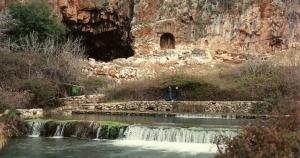
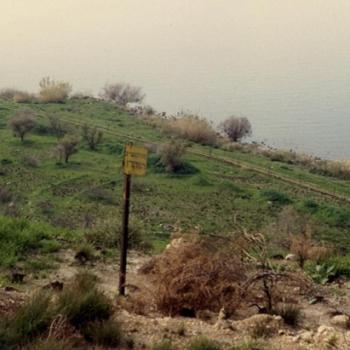
Caesarea Philippi, where Jesus asks his followers, “Who do people say that I am?” Photo: Tom Hobson.
In Matthew 16:13-20, Jesus takes a sample poll to see what public opinion is saying about him. Jesus takes this poll while he is on retreat with his followers in the woods up north near the Lebanese border, at a place called Caesarea Philippi, at the source of the Jordan River, at the foot of snow-capped Mount Hermon. Here the ancient Canaanites had built a shrine called Baal-Gad, “The Lord of Fortune.” (Joshua 11:17, 12:7, 13:5) Hundreds of years later, the Greeks built a temple here to Pan, the god of nature. And recently, Herod’s brother Philip had built a temple here for the worship of Augustus Caesar, and had named the nearby town after Caesar (“Caesarea of Philip”).
Here in the woods at the source of the Jordan, surrounded by pagan shrines, Jesus asks, “Who do people say that I am?” The answers he gets prove how wrong polls can be. Almost every answer they give is wrong. Out of all those surveyed in this poll, only one guy gets anywhere near the right answer. Simon Peter answers, “You are the Messiah, the Son of the living God.”
Jesus says, “Simon son of Jonah! You lucky guy! You have stumbled into the truth! You didn’t figure this out from the polls. You didn’t get it from any human brain. You got it straight from God. You have just unearthed the rock on which I will build my Knesset (my assembly / church). That’s why I’m going to call you Peter – Rocky! I’m going to make you the chief rabbi in charge of the teaching I am passing on to the group. I’m going to give you the keys to my Kingdom, the authority to make binding decisions based on my teachings after I’m gone.”
Here at Caesarea Philippi, surrounded by the shrines of other gods (the Baal of Fortune, the Greek god of nature, the temple of Caesar), Jesus lays his identity on the line. He claims to be both the Jewish Messiah, and the Son of the living God. Jesus claims to stand taller than any competing claim on the market.
Peter’s answer to the ultimate poll question becomes the rock on which we stand. Like the Jordan River that flows downhill from here, the question “Who is Jesus Christ?” is a watershed dividing line. Where our faith goes is determined by the answer we give here.
Jesus is not one Lord among many. He is not merely Lord “for me.” Nobel prize winning physicist John Polkinghorne says, “Either Jesus is God’s Lord and Christ or he is not, and it matters supremely to know which is the right judgment.”
“Who do people say that I am?” remains a question that cannot be answered by the polls. It doesn’t matter what one billion nominal Christians think – we could all be wrong. It doesn’t matter what 800 million Muslims think. To quote the Quran, “Those who say the Lord of mercy has begotten a son preach a monstrous falsehood.” (Sura 19:88) No human opinion poll can decide this fundamental disagreement.
The Hindus say that Jesus is one of many gods, and that we are all a part of God. The Buddhists and most Jews accept him as a great teacher. Atheists would peg him as either deluded or dishonest. Who Jesus is, does not depend on the polls.
Jesus makes some uncompromising claims, in a time and place where the name of the game was compromise. There was plenty of room to accommodate anyone’s god, as long as nobody claimed that theirs was Lord of all. The Romans tolerated the Jews for their belief as long as the Jews were willing to tolerate everyone else. Jesus’ claims put him at odds with his world. He makes it hard, even dangerous to follow him.
Jesus’ claims may be an embarrassment to us today. We live in an age where we are surrounded by neighbors who bow down at different altars. We find it hard to believe that so many good people could be wrong, or that their different beliefs could make that much difference. We cringe at the thought of being arrogant, intolerant, or bigoted. We cave in to post-modern peer pressure, which reduces faith to opinion.
We live in a day where we are tempted to believe that polls determine truth. We hear people say, “Nobody today believes in hell.” All the numbers can tell us is what’s in people’s minds. They cannot tell us what God thinks. The Himalayas do not cease to exist, simply because no one believes they do. Wishing can’t change reality.
The same is true for all the great issues that divide us: abortion, capital punishment, homosexuality, living together, evolution, and war. We don’t decide any of these issues. We cannot invent the truth. The best we can do is to discover the truth. And that all depends ultimately on whom we trust as our most reliable source of information.
Is Jesus one of many lords? Or is he Lord of all, whether anyone chooses to bow to him or not? The answer can never be decided by the polls. It can never be determined by faulty, fickle human opinion. Lucian the skeptic said that ten philosophers can make ten different guesses on how many beans are in a jar, and they can all be wrong. Therefore, it never matters which way the winds of human opinion are blowing, nor does it matter when they may change or where they may blow next.
We need not be arrogant as we affirm that Jesus is Lord of all. If someone believes the world is flat, we don’t need to call them stupid or treat them like dirt. But neither must we agree with them or humor them in order to love and respect them. We can respect someone, without accepting their beliefs as equally true. Saying that someone is wrong does not make us hateful.
Nor do we need to fear that our faith is just an accident of where we were born. The principles of space flight are just as true, whether you were born in Texas or Indonesia. So what if you are more likely to learn them if you were born in Texas? Where you were born doesn’t change the laws of physics. Neither does where you were born change the truth about God.
Standing in the woods in the shadow of Mount Hermon at the source of the river Jordan, surrounded by the gods of competing faiths, Jesus asks us the ultimate poll question: “Who do you say that I am?” It doesn’t matter what the majority of public opinion thinks. It doesn’t matter what anyone else thinks. Jesus’ question is a watershed dividing line. Where our faith goes, and our eternal destiny, is determined by the answer we give here.
Previous Post
April 26, 2018
Jesus as World Champion Exorcist, Part Two
Next Post
May 3, 2018 What Does Jesus Say About Homosexual Behavior?
Browse Our Archives
Select a Category Biblical ethic Biblical word studies Biblical world Creation Historical Jesus Uncategorized
Select a Month July 2018 June 2018 May 2018 April 2018 March 2018 February 2018 January 2018 December 2017 November 2017 October 2017 September 2017 August 2017 July 2017
Follow Us!
TAKE THE
Religious Wisdom Quiz
How much was Judas paid to betray Jesus?
Select your answer to see how you score.
10 pieces of silver 20 pieces of silver 12 pieces of silver 30 pieces of silver
Books by This Author Books by Tom Hobson
Related posts from Biblical Words and World

Theology by the Polls: Ten Billion Flies Can't...
How Much Did Paul Get from Jesus?

Jesus' Ascension: What Difference Does It Make?
Jesus as World Champion Exorcist, Part Two
TRENDING AT PATHEOS Evangelical

How the author of the world's best hymn...
I've been working with John Newton for a while now. This makes...

Long before this Lectio Divina, Psalm 130 - the song - started...

What About the Trees? Another Living Parable
After I finished writing the last article about falling leaves as a...

Why Classical Education Is a Conversation, Not a...
Come and Read: Joy in Classical Education When I was a little...

Falling Leaves: A Living Parable on Letting Go
I’ve spent the vast majority of my life in the southeast corner...

Cornell University has received a great deal of negative publicity and intense...
view all Evangelical blogs
Ad-Free & Subscriber Log-In Subscription Support
- About Us
- 2026 Calendar
- Videos
- Podcasts
- Library of World Religions
- Faith In Media Tracker
- Advertise With Us
- Write for Us
- Privacy Policy
- Terms of Service
- Do Not Sell My Data
- Contact Us
- Radiant Digital
- Manage Newsletter Subscriptions
- Unsubscribe From Notifications
- Sitemap
Copyright 2008-2026, Patheos. All rights reserved.
Subscription Support Ad-Free & Subscriber Log-In
Follow Patheos