
BuddhistCatholicContemplativeEvangelicalGeneral ChristianHinduJewishLatter-day SaintMuslimNew VisionsProgressive Christian
Beliefs
- Buddhist
- Catholic
- Contemplative
- Evangelical
- General Christian
- Hindu
- Jewish
- Latter-day Saint
- More Voices
- Muslim
- New Visions
- Pagan
- Progressive Christian
Topics
- Religion News
- Food and Religion
- Sports and Religion
- Religious Art
- Religious Music and Entertainment
- Religious Events
- History and Religion
- Style and Religion
- Politics and Religion
- Women in Religion
- Recreation Outdoors and Religion
- Business Finance and Religion
- Careers Workplace and Religion
- Education and Religion
- Family Parenting and Religion
- Health Fitness and Religion
- Home and Religion
- Relationships and Religion
- Technology and Religion
- Travel and Religion
Columnists
- Buddhist Columnists
- Business Finance and Religion Columnists
- Careers Workplace and Religion Columnists
- Catholic Columnists
- Contemplative Columnists
- Education and Religion Columnists
- Evangelists Columnists
- Family Parenting and Religion Columnists
- General Christian Columnists
- Health Fitness and Religion Columnists
- Hindu Columnists
- History and Religion Columnists
- Home and Religion Columnists
- Jewish Columnists
- More Voices Columnists
- Latter Day Columnists
- Muslim Columnists
- New Visions Columnists
- Nonreligious Columnists
- Pagan Columnists
- Politics and Religion Columnists
- Progressive Columnists
- Recreation Outdoors and Religion Columnists
- Relationships and Religion Columnists
- Religion News Columnists
- Religious Art Columnists
- Religious Events Columnists
- Religious Music and Entertainment Columnists
- Sports and Religion Columnists
- Style and Religion Columnists
- Technology and Religion Columnists
- Travel and Religion Columnists
- Women in Religion Columnists
Resource Library
- 2026 Calendar
- Library of World Religions
- The 100 Most Holy Places on Earth
- Patheos Answers
- Podcasts
- Videos
- Faith Leaders Database
- Anglican Episcopalian
- Bahai
- Baptist
- Buddhism
- Christianity
- Confucianism
- Eastern Orthodoxy
- Hinduism
- Holiness and Pentecostal
- ISKCON
- Islam
- Judaism
- Lutheran
- Methodist
- The Church of Jesus Christ of Latter-day Saints
- New Age
- Paganism
- Presbytarian and Reformed
- Protestantism
- Religion Behind the Scenes
- Roman Catholic
- Scientology
- Shia Islam
- Sikhism
- Sufism
- Sunni Islam
- Taoism
- Zen
- See all religions
Research Tools
 Ad-Free & Subscriber Log-In Subscription Support
Ad-Free & Subscriber Log-In Subscription Support
Follow Patheos 

- Trending:
- Forgiveness
- |
- Marriage
- |
- Consciousness
- |
- Death Penalty
- |
- Election
- |
- Halloween
 Biblical Words and World
- Home
- Evangelical
- Cynics: Simple Lifestyle Freaks of the New Testament World
Cynics: Simple Lifestyle Freaks of the New Testament World
Last updated on: April 19, 2018 at 5:30 am by Tom Hobson
Cynics: Simple Lifestyle Freaks of the New Testament World 2018-04-18T19:46:11-05:00 Tom Hobson
Patheos Explore the world's faith through different perspectives on religion and spirituality! Patheos has the views of the prevalent religions and spiritualities of the world.
One of the most bizarre groups from the first century AD was the Cynics. The Cynics were wandering social critics who lived a radical simple lifestyle. They answered to Zeus alone, and nobody else. The Cynics were so non-conformist that they often defied the rules of decency. Some would even relieve nature in full public view, which earned them the name Cynic (meaning “dog-like”).
Epictetus described the classic Cynic as a man who lives under the open sky, a free man, naked, houseless, sleeping on the ground with only one rough cloak to cover him. (Discourses 3.22.45-47) A true Cynic must live on barley, watercress, and cold water, and must never indulge in meat, wine, hot baths, or any other luxury. Yet Cynics ought to keep themselves clean and fresh looking (3.22.86-89).
The Cynic must be pure and viceless, and must labor for the sake of the human race, reproving and guarding them from error. When flogged like a donkey, “he must love those who flog him.” (3.22.54) The Cynic yields his body to attackers, we are told, but nobody takes away his will. (3.22.100, 105) The parallel to Jesus’ teaching to love one’s enemies is obvious. The Cynic cares not about Caesar, or proconsuls, or anyone except Zeus, the one who sent him and whom he serves. (3.22.56)
Because the Cynic must live like a soldier ready for battle, the Cynic should not be tied down by duties such as marriage or procreation. Diogenes says (Pseudo-Diogenes 47.1), “One should not wed nor raise children, since our race is weak, and marriage and children burden human weaknesses with troubles.” (Compare Jesus’ and Paul’s enthusiasm for celibacy in Matthew 19:10-12 and 1 Corinthians 7:8, 32-34.)
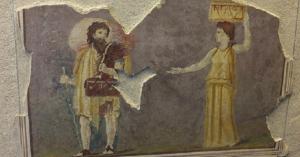
Crates and Hipparchia, a famous Cynic couple. Photo by Amphipolis. From the Museo Nazionale Romano. Attribution-ShareAlike 2.0 Generic (CC BY-SA 2.0) via Flickr.
One famous Cynic named Crates did take a wife, Hipparchia, but we are told that he did so out of love, and she was another Crates, exactly like him. They lived together homeless on the streets of Athens. Yet when Hipparchia bears a child, the news takes Crates completely by surprise while he is out of town. He writes to her in Epistle 33, “I hear that you have given birth. You would not have given birth so easily unless, while pregnant, you had continued to toil like the athletes do… Thanks be to God and to you… Take care of this little puppy of ours. Let his bath water be cold, his clothes be a cloak, his food be milk, yet not to excess. Rock him in a cradle made from a tortoise shell, for this, they say, protects against childhood diseases.” Epictetus (3.22.75) thought that children could not be raised like Cynics from birth; better to abandon them to die than kill them with such a tough lifestyle.
Cynics were misunderstood. Diogenes was asked, “Are you Diogenes, who does not believe there are gods?” He answered, “And how can this be, when I think that you stink to the gods?” Diogenes claims to have said to Alexander the Great, “Poverty does not consist in not having money…, but poverty consists in desiring everything.” (Pseudo-Diogenes 33.3)
Cynics were sometimes the ancient equivalent of the traveling hellfire preacher on the street corner. Heraclitus the Cynic has a long harangue against the people of Ephesus. He complains that they poison friends and rob temples. “Should I laugh when I see…a woman attacks her child with drugs…or a young woman losing her virginity by force during nighttime festivals, or a hooker who is not yet a wife but who already has all the misfortunes of a wife, or a single young man who through licentiousness is the lover of an entire city…or men at banquets who increase the size [of their manhood] with their fingers? …In peacetime you make war with words; during war you govern with iron. You snatch away justice with swords. The deserts are crowded because injustice is done.” (Heraclitus 7.4-5, 9)
In his book Cynics, Paul and the Pauline Churches, F. Gerald Downing documents how Paul’s lifestyle and experience both parallels and contrasts with that of the Cynics. Paul was able to fit the Cynic picture of an ill-clad, wandering preacher, constantly getting run out of town. Downing points out that some Cynics bring trouble upon themselves by provoking the crowds with abuses, but others don’t. He quotes Epictetus, who says, “If you want to be crucified, just wait. The cross will come.” (Discourses 2.2.20)
Like the Cynics, Paul was able to list all sorts of hardships he had endured: hunger and thirst, homelessness, cold, nakedness, working night and day, rejection, being jeered at, whipped, and treated like everyone else’s dirt (1 Corinthians 4:9-13; 2 Corinthians 6:3–10, 11:23-27). But unlike Paul, many Cynics chose to suffer in such ways, rather than waiting for it to be inflicted on them.
Unlike the Cynics, who categorically rejected wealth, when Paul tells the Philippians that he has learned in all states to be content (Philippians 4:11–12), he is adopting a Stoic rather than Cynic approach to wealth; the Cynics were more consistently austere. Crates the Cynic echoes Paul when he says “one should live quietly” (see 1 Thessalonians 4:11) and “although we possess nothing, we have everything” (Pseudo-Crates 7.1; compare 2 Corinthians 6:10).
In his pastoral approach, Paul conducts himself like the kind of Cynic who is hard on himself but gentle on others (1 Thessalonians 1:7–8 – see Abraham Malherbe’s article “Gentle as a Nurse: The Cynic Background to I Thess ii” at https://myrrh.library.moore.edu.au/handle/10248/10374). Other Cynics were harsh with everybody: Diogenes opens his letter to the “so-called Greeks”, not with chairein (“Greetings”), but with “a plague on you!”(Pseudo-Diogenes 28.1) Like the Cynic, Paul refuses flattery (1 Thessalonians 1:5). And like the Cynic, but unlike the Stoic or any of the other philosophical schools, Paul offers himself as a model (Philippians. 4:9). Rarely do we find anyone but Cynics offering themselves as credible examples who practice what they preach.
One more parallel between Paul and Cynicism: Downing writes that Cynic tradition would give to Socrates, and to Cynics such as Diogenes, heavenly judicial authority over humans after death. Heraclitus, for example, declares that when he dies, “I shall prosecute the Ephesians. I shall be a citizen, not among men, but among the gods.” (Pseudo-Heraclitus 5.2) Likewise, Heraclitus writes to Hermodorus, “The Ephesians will pay homage to you after you are dead, when your laws govern men.” (Pseudo-Heraclitus 8.1) Paul can make an even higher claim: “At the name of Jesus, every knee shall bow.” (Philippians 2:10) Indeed, to the Corinthian Christians, Paul writes that even they shall judge angels (1 Corinthians 6:3).
But there is one huge difference in Paul, says Downing: no Cynic ever “proclaimed a crucified Galilean Jew as the focus of his challenge to all inherited custom and law.” Neither did any Cynic proclaim a resurrected Master who was the one true God in human flesh. Jesus was and is the embodiment of everything good about the Cynics, with a Gospel that they could never deliver.
Previous Post

April 16, 2018
Seneca: As Christian as a Pagan Stoic Could Get
Next Post

April 23, 2018 Jesus: World Champion Exorcist
Browse Our Archives
Select a Category Biblical ethic Biblical word studies Biblical world Creation Historical Jesus Uncategorized
Select a Month July 2018 June 2018 May 2018 April 2018 March 2018 February 2018 January 2018 December 2017 November 2017 October 2017 September 2017 August 2017 July 2017
Follow Us!
TAKE THE
Religious Wisdom Quiz
What does Proverbs 23:4-5 warn against pursuing too much?
Select your answer to see how you score.
Power Status Knowledge Wealth
Books by This Author Books by Tom Hobson
Related posts from Biblical Words and World

Musonius Rufus, Women's Equality, and the New Testament



TRENDING AT PATHEOS Evangelical

How the author of the world's best hymn...
I've been working with John Newton for a while now. This makes...

Long before this Lectio Divina, Psalm 130 - the song - started...

What About the Trees? Another Living Parable
After I finished writing the last article about falling leaves as a...

Why Classical Education Is a Conversation, Not a...
Come and Read: Joy in Classical Education When I was a little...

Falling Leaves: A Living Parable on Letting Go
I’ve spent the vast majority of my life in the southeast corner...

Cornell University has received a great deal of negative publicity and intense...
view all Evangelical blogs
Ad-Free & Subscriber Log-In Subscription Support
- About Us
- 2026 Calendar
- Videos
- Podcasts
- Library of World Religions
- Faith In Media Tracker
- Advertise With Us
- Write for Us
- Privacy Policy
- Terms of Service
- Do Not Sell My Data
- Contact Us
- Radiant Digital
- Manage Newsletter Subscriptions
- Unsubscribe From Notifications
- Sitemap
Copyright 2008-2026, Patheos. All rights reserved.
Subscription Support Ad-Free & Subscriber Log-In
Follow Patheos